Witch Week Readalong: Something Wicked This Way Comes

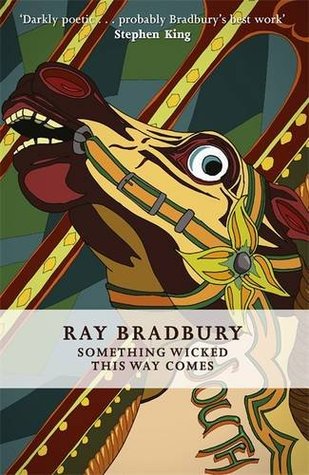
witch-week-2016 I read this Ray Bradbury novel for a readalong as part of Witch Week, hosted by Lory at The Emerald City Book Review, but I’m sure I would have read it eventually anyway. It’s a book I’ve been interested in reading for a while – mainly, I have to confess, because I liked the title. It comes from a line spoken by one of the witches in Shakespeare’s Macbeth: “By the pricking of my thumbs, Something wicked this way comes”. I didn’t really have any idea what the novel itself was about, so the Witch Week readalong seemed a good opportunity to find out!

Published in 1962, Something Wicked This Way Comes tells the story of two teenage boys, Will Halloway and Jim Nightshade, who live in Green Town, Illinois. Not only are Will and Jim neighbours and best friends, they share another special bond: they were born just a few minutes apart, Will one minute before Halloween and Jim one minute after. They are inseparable, but they also have very different personalities – Will is the more sensible and cautious of the two, whereas Jim is more reckless and daring. The boys are thirteen years old as the novel opens one day in October when they have an encounter with a mysterious lightning rod salesman who warns that a storm is approaching.

something-wicked-this-way-comes That same night, a carnival – Cooger & Dark’s Pandemonium Shadow Show – is heading towards Green Town. Will and Jim watch it arrive at three o’clock in the morning, excited that a carnival has come so late in the year. Their excitement quickly starts to fade, however, as strange things begin to happen in connection with the carnival and its sinister owners. When they spot Mr Cooger riding on a carousel while the music plays backwards, they realise they are witnessing something which shouldn’t have been possible, something which tells them that this is no ordinary carnival – and that their lives could be in danger.

I didn’t know what to expect from this novel, as it’s the first I’ve read by Ray Bradbury, but I’m pleased to say that I enjoyed it. The writing style is unusual and took a while to get used to, but I found the use of language very intriguing. The streets are ‘footstepped’, for example, the rain ‘chuckles’ and ‘nuzzles’ at the windows, the people of the town ‘breathe back and forth’ to the carnival and laughter ‘walks on panther feet’. I’m not sure if I particularly liked the writing – the choice of words and the structure of the sentences are often so unconventional that I found it quite distracting – but it’s certainly one of the things I’ll remember most about this book.

I’ll also remember the philosophical musings of Charles Halloway, Will’s father:

So in sum, what are we? We are the creatures that know and know too much. That leaves us with such a burden again we have a choice, to laugh or cry. No other animal does either. We do, depending on the season and the need.

And the many wonderful descriptions of the library, where he works:

When rivers flooded, when fire fell from the sky, what a fine place the library was, the many rooms, the books. With luck, no one found you. How could they! – when you were off to Tanganyika in ’98, Cairo in 1812, Florence in 1492!?

Some of the readalong participants have discussed the fact that the two main characters (in the first half of the book, at least) are teenage boys and how the age we are when we first read the book could affect our ability to relate to the boys and their lives. Although I did still enjoy it anyway, I do wonder whether I might have had a different impression of it if I’d read it when I was younger. Later in the book, Charles Halloway begins to play a bigger part in the story, providing an adult perspective and bringing his experience, knowledge and wisdom to the fight against the evil forces of the carnival.

Good versus evil is obviously one of the major themes of the novel. A feeling of malice and danger hangs over the carnival from the moment it arrives and the people connected with it are both strange and sinister – particularly the blind Dust Witch who hovers over the boys’ houses in a hot air balloon in one of the creepiest scenes in the book. There are other themes too, though, such as life and death, age and the passing of time, the ties of friendship and the power of happiness and of love. Something Wicked This Way Comes is a fascinating read and one which left me with a lot to think about.

Children of Earth and Sky by Guy Gavriel Kay

children-of-earth-and-sky I love Guy Gavriel Kay’s books, so I really don’t know why it is that I’ve read so few of them! I’ve had Under Heaven waiting on my Kindle since finishing The Last Light of the Sun more than a year ago, but for some reason there always seems to be something else that needs to be read first. When I noticed his latest novel, Children of Earth and Sky, in the library I decided to forget Under Heaven for now and read this one first, while I was in the mood for it.

Guy Gavriel Kay’s books are a wonderful and unique blend of fantasy and historical fiction. Children of Earth and Sky is set in the same world as several of his other novels, including The Lions of Al-Rassan – a world with two moons, one blue and one white, in which the three main religious groups are the sun-worshipping Jaddites, the Asharites who pray to the stars and the Kindath who worship the moons (corresponding to Christians, Muslims and Jews respectively). The action in this book takes place mainly in thinly disguised versions of Venice, Dubrovnik and Constantinople – which Kay renames Seressa, Dubrava and Asharias – in what is clearly supposed to be the Renaissance period.

The plot is quite a complex one, with multiple storylines which meet and intersect from time to time, so rather than attempting to describe it in any detail, I’m just going to mention a few of the characters we meet.

First, there’s Pero Villani, a young artist from Seressa, who has been sent on a mission to the Osmanli (Ottoman) court at Asharias with a commission to paint a portrait of the Grand Khalif, Gurçu the Destroyer. However, Seressa’s Council of Twelve have another task in mind for Pero to carry out at Asharias, one which could put his life in danger. The Council are also keen to place a spy in the rival republic of Dubrava and enlist the services of Leonora Valeri, a woman with a troubled past who welcomes the chance to escape from Seressa.

The ship on which Pero and Leonora embark on the first stage of their journey is owned by the family of Marin Djivo. As the younger son of a Dubrava merchant, Marin has a lot of experience of the world of trade and shipping, but this particular voyage is about to change his life. Sailing from Seressa to Dubrava, his ship is boarded by pirates from the walled town of Senjan, and among them is the archer Danica Gradek, a young woman who is desperate to prove herself as a warrior and avenge her family against the Osmanli. Finally, there’s Damaz, who was captured as a child and trained to fight in the Osmanli army.

The lives of these five characters become closely entwined as their paths cross, then part, then cross again, and the actions of one may have consequences – sometimes unintentional – which affect the lives of one or all of the others. Now that I’ve read several of Kay’s novels, I can see that this seems to be a recurring theme in his work.

I have been to both Venice and Dubrovnik – and would highly recommend visiting them if you haven’t already – and even though Kay’s versions have different names, the descriptions of both locations are still clearly recognisable. If you have a good knowledge of the history of Renaissance Europe, you should be able to draw historical parallels, as well as geographical, between this fantasy world and the real one – but remember that it is a fantasy world (even though the magical elements are small and understated), which gives Kay the freedom to take the story in any way he wishes without sticking rigidly to historical fact.

I found a lot to love about this book; my only disappointments were the ending and the lack of emotional engagement I felt with the characters. When I think of the thought-provoking epilogue that ended Tigana, or the dramatic conclusion of The Lions of Al-Rassan, that’s what was missing from Children of Earth and Sky. The novel’s various storylines were wrapped up too neatly and too completely at the end of the book and didn’t make much of an emotional impact on me, which was a shame after spending so long getting to know this set of characters.

This is not one of my favourite Kay novels so far, but I did enjoy it and am looking forward to reading the rest of his work, probably beginning with Under Heaven!

The Hawley Book of the Dead by Chrysler Szarlan

the-hawley-book-of-the-dead The first line of The Hawley Book of the Dead is a very intriguing one: “on the day I killed my husband, the scent of lilacs startled me awake.” Immediately there are questions. Who is speaking? Why did she kill her husband? And what does the scent of lilacs have to do with anything?

I didn’t have long to wait for the first two questions, at least, to be answered. The narrator is Reve (short for Revelation) Dyer and she didn’t intend to kill her husband. She and Jeremy were happily married with three children and had worked together for years as part of a successful Las Vegas magic act known as the Amazing Maskelynes. Jeremy’s death was the result of a stunt that went wrong when someone replaced the blanks in Reve’s pistol – a stage prop – with real bullets, something which must have been done deliberately. Now Reve has been left devastated and afraid – even more so when she becomes convinced that the murderer is a man who has been on her trail since her student days, a man she knows only as ‘the Fetch’.

Deciding it’s time to start a new life as far away as possible, Reve and her three young daughters, Grace, Fai and Caleigh, move to their family’s neglected old estate in Massachusetts. Hawley Five Corners was once a thriving little town, but was abandoned long ago amid stories of unexplained disappearances and a haunted wood. It seems the perfect place to hide from the Fetch, but almost as soon as she and the girls move into an empty farmhouse in the deserted town, strange things begin to happen. When she finds a mysterious red and gold book which has been in her family for years, passed down through the generations, Reve discovers that the only way she can keep her daughters safe is to try to understand the secrets the book contains.

The Hawley Book of the Dead is the third book I’ve read for the R.I.P. XI event. It proved to be an ideal book to read at this time of year when the weather is beginning to change and the nights are starting to get longer (the characters even celebrate Halloween halfway through the novel). I’ve seen comparisons with The Night Circus, The Lost Book of Salem and A Discovery of Witches and while I can see some similarities with all of those, I thought there were plenty of original ideas here too.

I liked the way magic was handled in the novel. It’s important to the plot but doesn’t dominate the story to the exclusion of everything else. A few chapters in, we learn that the female members of the Dyer family (going back for centuries) possess magical powers of one sort or another – for example, Reve’s gift is the ability to vanish into thin air, while Caleigh’s is a fascinating one involving string games. At first I didn’t really understand the purpose of their magic but as the history of the Dyers and Hawley Five Corners was gradually revealed, it all began to make more sense. I was particularly intrigued by the Irish mythology and folklore – especially the tales of the Tuatha de Danann – which were woven into the story of Reve’s ancestors.

However, the magic was the most interesting thing about the characters. Although I liked Reve and her daughters and enjoyed the occasional scenes involving Reve’s grandmother, Nan, and her mysterious friend, Falcon Eddy, I didn’t find any of the characters very strong or memorable. I also thought the inclusion of Reve’s old boyfriend, Jolon, as a love interest was unnecessary, especially as she was still supposed to be grieving for Jeremy. These were my only disappointments with the book; otherwise, I loved the author’s descriptive writing, the entertaining story and the atmospheric setting.

The Hawley Book of the Dead was published in 2014 and according to the About the Author note at the end of the book it was intended to be the first in a quartet. I can’t find any recent news about a second novel, but I hope there’s still going to be one as I would like to know what happens next!

The Last Enchantment by Mary Stewart

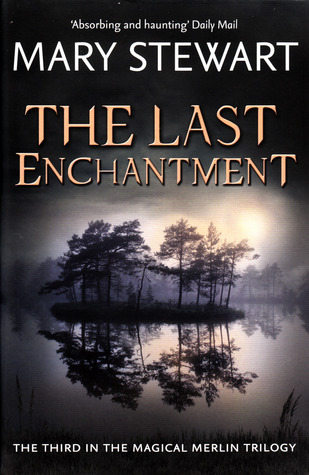
The Last Enchantment The Last Enchantment is the final part of Mary Stewart’s Merlin trilogy, which began with The Crystal Cave and The Hollow Hills. I have been reading it this week for Lory’s Witch Week, a celebration of fiction based on fairy tales, folklore, myths and legends, but I’m sure I would have picked it up soon anyway as I loved the first two books and was looking forward to reading the conclusion of Merlin’s story.

The Last Enchantment picks up the story where The Hollow Hills ended, with Arthur beginning his reign as High King of Britain after pulling the sword Caliburn (Excalibur) from its stone. Almost immediately, Arthur must begin a series of battles against the Saxons before he can achieve peace and security throughout his kingdom. But Arthur is not the main focus of the novel; like the previous two books, this one is narrated by Merlin…and Merlin is facing a battle of his own. Arthur’s half-sister, the witch Morgause, has given birth to a son, and Merlin has foreseen that this child, Mordred, could pose a threat to the King.

In the first half of the novel, Merlin tells us of his journey north in search of Mordred, as well as several other events, such as the building of Camelot and Arthur’s marriage to Guinevere, which will be familiar even to readers who, like me, only have a basic knowledge of the Arthurian legends. In the second half of the book, there is a growing sense of sadness and poignancy as Merlin ages, his magical powers begin to fade and Arthur, while still valuing his friendship, no longer relies on him as he used to. Merlin takes on an apprentice, Nimuë, whom he hopes will eventually take his place as the King’s enchanter, but he soon discovers that his new assistant has some surprises in store for him.

Maybe because I found this such a sad story, I didn’t love it quite as much as The Crystal Cave and The Hollow Hills, but I do think all three are wonderful books. I was slightly disappointed with the portrayal of the female characters (I think I mentioned that in my review of the previous novel too). Arthur’s sisters, Morgan and Morgause, are both evil witches, while Guinevere is pushed into the background and never really comes to life at all. Then there’s Nimuë, whose storyline I really disliked and found quite painful to read at times. Merlin’s relationship with Arthur, though, is one of the highlights of the book and I found myself looking forward to all of their scenes together.

Before reading this trilogy my knowledge of Arthurian myth was limited to T.H. White’s The Sword in the Stone and one or two television adaptations which I can now barely remember watching; I think this was an advantage, because it meant I was kept in suspense, only vaguely aware of the outline of the story and the role each character would play. I was surprised that there was no Lancelot (his part in the story is taken by Arthur’s friend, Bedwyr, instead), I had no idea that Arthur was thought to have had more than one wife called Guinevere and I knew nothing of the involvement of Nimuë in the later stages of Merlin’s story. Mary Stewart discusses all of these things and more in her author’s note at the end of the book, explaining how she chose to interpret various sources and to decide what to include in her version of the legend.

I was sorry to reach the end of Merlin’s story, but I can definitely see myself wanting to re-read all three of these books in the future – and, of course, I would also like to read Mary Stewart’s other two Arthurian novels, The Wicked Day (the story of Mordred) and The Prince and the Pilgrim. I think it’s fascinating that there are so many different variations of these legends and now that I’ve read this version, I’m interested in reading interpretations by other authors. If you can recommend any good ones, please let me know!

The Hollow Hills by Mary Stewart

Hollow Hills I didn’t really intend to read The Hollow Hills last weekend. I have books on my library pile, review copies to catch up with, and books to read for various other projects, but something made me yearn for Mary Stewart and I picked up the second of her Arthurian novels on Saturday morning. I was immediately pulled into the story and had finished the book by Monday.

The Hollow Hills is part of a series of five books set in Arthurian Britain, although the first three are usually described as the Merlin Trilogy. The first book, The Crystal Cave, introduces us to Merlin and his world; The Hollow Hills continues the story, beginning just before the birth of Arthur. As the illegitimate son of Uther Pendragon and Ygraine of Cornwall, the young Arthur is sent into hiding, not only as protection against Uther’s enemies but also to keep him conveniently out of the way until another legitimate heir is born. But Merlin, with his gift of prophecy and visions, knows that it will be Arthur who will one day raise the legendary sword Caliburn from its resting place and become King.

Like The Crystal Cave, the story is narrated by Merlin himself and as Arthur is only a baby throughout much of the novel (and still only fourteen at the end) this book is more about Merlin than it is about Arthur. While Arthur is growing up in safety, ignorant of his true parentage, Merlin is having adventures of his own as he travels throughout Europe, takes on new identities, and explores the legends behind the great sword Caliburn (which until now I have always known as Excalibur). I loved the book from beginning to end and was never bored, but there is always the sense that the whole novel is building towards the moment when Arthur will learn who he really is and be ready to reclaim his heritage.

The plot means that Merlin and Arthur are kept apart for most of the novel, but I enjoyed the scenes that they do have together. I like the way Mary Stewart portrays both characters and the development of the bond between the two of them. It’s disappointing, though, that there are no strong female characters in this book: Ygraine only appears briefly and while Morgause (in this version Arthur’s half-sister) does have an important role in the story, she is hardly portrayed very flatteringly. Apart from that, I loved everything else about this book, and of course, it’s very well written with lots of beautiful, vivid descriptions. It’s Mary Stewart, after all!

While I don’t have a lot of knowledge of the Arthurian legends, I do know the basic details, so some parts of the story felt familiar to me – but even where I thought I knew what was going to happen, this didn’t lessen the enjoyment of the book for me. There is not just one version of the legend, of course, but lots of them which all differ slightly, and in her notes at the end of the book, Stewart explains some of the choices she has made. Some readers may be disappointed that there is so little actual ‘magic’ in this novel, but that’s one of the things I like about it; most of what happens has a rational explanation and there’s only a touch of the supernatural.

I think of the two books in this series that I’ve read so far, I did prefer The Crystal Cave, but only slightly, and I’m now looking forward to reading the next one, The Last Enchantment.

Uprooted by Naomi Novik

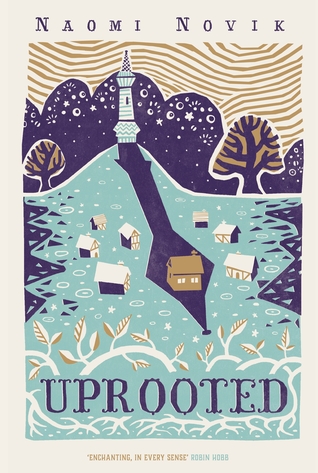
Uprooted Naomi Novik is best known for her Temeraire series set during an alternate version of the Napoleonic Wars in which dragons are used in aerial combat. After reading the first Temeraire book in March I was delighted when I unexpectedly received a review copy of Novik’s new novel. While Uprooted is not a Temeraire story, it does have a Dragon…but not of the winged, fire-breathing variety. The Dragon in Uprooted is a wizard – the most powerful wizard in the kingdom. Which kingdom? Well, we aren’t really told, but it does resemble Poland in the 16th century.

Our narrator, Agnieszka, lives in Dvernik, a village on the edge of a dark and sinister forest known only as the Wood. The villagers rely on the Dragon to defend them from the horrors that lurk in the Wood, but his protection comes at a price: every ten years the Dragon selects a seventeen-year-old girl from the village and takes her away to live with him in his tower. Nobody knows what happens to the girls during their time with the Dragon, but when they return ten years later they have changed and are unwilling to go back to their old lives in the village.

The year Agnieszka turns seventeen is a Dragon-year and she waits anxiously with the other girls her age while he makes his choice. Everyone thinks it will be the beautiful Kasia, Agnieszka’s best friend, but the Dragon has other ideas and it is Agnieszka herself who ends up in his tower. At first she has no idea what the Dragon wants from her and spends most of her time trying to avoid him, but it’s not long before she discovers why she was chosen. As Agnieszka learns more about the wizard and his magic, the evil forces within the Wood continue to grow stronger and soon she and the Dragon must work together to save the kingdom.

Uprooted is a wonderfully imaginative fantasy novel. When I first began to read, I thought it felt like a fairy tale retelling – there were definitely some elements of Beauty and the Beast as well as some references to Eastern European folklore – but very soon it started to develop into something original and different. There was a lot to love about the book and although it wasn’t as flawlessly brilliant as it seemed to be at first, I would highly recommend it both to fantasy fans and to those like me who only dip into fantasy occasionally.

I found the ways in which magic is used in the novel particularly interesting, as there are so many different types performed by the Dragon and various other characters. These range from the Dragon’s meticulous, almost scientific methods to the more natural, instinctive magic found in the old spellbooks of the great witch, Jaga. Agnieszka learns a lot about magic while living in the Dragon’s tower; it was fascinating and I was slightly disappointed when the scope of the story broadened and the action moved first to court and then to other parts of the kingdom.

The relationship between Agnieszka and the Dragon is well written, particularly in the first half of the book, but a lot of time is also spent on exploring the strong female friendship between Agnieska and her best friend, Kasia. There’s also a romantic thread to the story but this does not form a big part of the plot, which could be either a good thing or a bad thing depending on how you feel about romance. Personally I would have liked this aspect of the novel to have been developed in a little bit more depth as it seemed to be neglected halfway through as a very long and drawn out magical battle took centre stage instead.

The most memorable thing about Uprooted, though, was the role played by the Wood. When people talk about books, they often say that the setting felt almost like a character. With this book, it wouldn’t be an exaggeration to say that the setting really is a character. The Wood is portrayed as not just a collection of trees, but as a strong evil presence – an intelligent living entity with thoughts, feelings and desires. I found it genuinely creepy and menacing and the fact that it isn’t human makes it an unforgettable fantasy villain.

I’m not sure whether Naomi Novik is going to write more books set in this world. There is the potential for more, but the way Uprooted ended suggests that it will remain a standalone. Either way I’m happy – and I still have the rest of the Temeraire series to read!

Thanks to Pan Macmillan for providing a copy of this book for review.

The Last Light of the Sun by Guy Gavriel Kay

The Last Light of the Sun I’m hoping to read Guy Gavriel Kay’s Under Heaven soon for the Once Upon A Time challenge, but first I need to tell you about another of his novels which I read a few weeks ago: The Last Light of the Sun.

This is the third book I’ve read by Kay and like the other two (Tigana and The Lions of Al-Rassan) it is set in a fantasy world that closely resembles a real historical one. A blue moon and a white moon shine in the sky, faeries wait to claim the souls of the dead, and ancient magical forces lurk in the forest, yet the world portrayed in The Last Light of the Sun can easily be identified as Northern Europe in the time of the Vikings, the Anglo-Saxons and the Celts.

In this re-imagined land, the Vikings have been renamed the Erlings, the Anglo-Saxons have become the Anglycn and the Celts have been transformed into the Cyngael. While the Erlings are sea-raiders who inhabit the islands in the far north, the Anglycn live in what is surely the country we now know as England, and the Cyngael live to the west, presumably in Wales. These lands of the Cyngael, on the western edge of the known world, are the last to see the light of the setting sun – and also form the final outpost of the new religion of Jad, the sun god.

Throughout the novel, we follow the adventures of three groups of characters from each of the three cultures I’ve described above. First, we meet Bern Thorkellson, a young Erling who has lost his lands and his freedom as a result of his father being exiled for murder. Desperate to escape and build a new life for himself, Bern joins a raiding party heading for the Anglycn shores. Meanwhile, in the Cyngael lands, two young princes called Alun and Dai happen to be spending the night at the home of a rival Cyngael warrior, Brynn ap Hywll, when it is attacked by another group of Erling raiders. Finally we get to know the family of the Anglcyn king, Aeldred, who has been trying to unite his people against the threat of the Erlings.

To describe the plot in any more detail would be difficult as it does become quite complex as the lives of each of these characters become entwined with all of the others. The author doesn’t really ‘take sides’ or favour one of the three cultures over the other two – perspectives and points of view are balanced fairly between the three and there are good people and bad within each group. Feuds and rivalries are formed, but so are friendships and loyalties as Erling, Anglcyn and Cyngael find that they need to adapt to a changing world.

One thing Kay does in this book, which I’m not sure I really like, is to occasionally leave his main characters behind for a while to explore the life of a completely new character who enters the novel for a few pages and then disappears, never to be mentioned again – as Kay himself describes it: “At the margins of any tale there are lives that come into it only for a moment. Or, put another way, there are those who run quickly through a story and then out, along their paths.” I can understand the reasons for this – to show us what is going on away from the central plot and the central characters – but I did find it slightly distracting.

This is a beautifully written novel, though, and as well as being an entertaining story, it’s also very thought-provoking in places. I particularly liked these two quotes:

“It happens this way. Small things, accidents of timing and congruence: and then all that flows in our lives from such moments owes its unfolding course, for good or ill, to them. We walk (or stumble) along paths laid down by people and events of which we remain forever ignorant. The road someone else never took, or travelled too late, or too soon, means an encounter, a piece of information, a memorable night, or death, or life.”

“A hard truth: that courage can be without meaning or impact, need not be rewarded, or even known. The world has not been made in that way. Perhaps, however, within the self there might come a resonance, the awareness of having done something difficult, of having done…something.”

I’ve loved all three of the Guy Gavriel Kay novels I’ve read so far and am looking forward to reading his others, beginning with Under Heaven. Have you read any of his books, and if so do you have a favourite?