Assassin’s Apprentice by Robin Hobb

Assassin's Apprentice Yet again I have book blogging to thank for helping me to discover an author who I think is going to become a favourite. Not being a big reader of fantasy, I would probably never have thought of reading Robin Hobb until I noticed how enthusiastic bloggers such as Leander and Alex were about her work. Assassin’s Apprentice, the first book of The Farseer Trilogy seemed the logical place to start, and what a great book it turned out to be!

Assassin’s Apprentice is set in the Kingdom of the Six Duchies, a fictional world that in some ways resembles Europe during the medieval period. Our narrator is Fitz, the illegitimate son of Prince Chivalry, the heir to the throne. Fitz is only six years old when he comes to court for the first time, having been handed over by his maternal grandfather. Chivalry himself considers the arrival of his bastard son such a disgrace that he retires from court and removes himself from the line of succession before he and Fitz even have a chance to meet. As the years go by, Fitz tries to settle into his new life at Buckkeep, the home of the royal family (the Farseers), but he finds that while there are some people who show concern for his welfare – his uncle, Prince Verity, for example, and Chivalry’s loyal stableman, Burrich, who cares for him during his early years – there are others who have no intention of making him feel welcome, such as Prince Regal, the younger half-brother of Chivalry and Verity (in Fitz’s world, the nobility have names that reflect their personal qualities).

While Fitz struggles to find a place for himself at Buckkeep, his grandfather, King Shrewd, decides to gain the boy’s loyalty and assure himself that Fitz will be working for the royal house rather than against it. And so Fitz begins to receive private lessons from the mysterious assassin, Chade, who will train him in the art of killing for the king. The adventures Fitz has over the years that follow are best left for readers to discover for themselves, so I won’t say any more about the plot here, except to say that I thought it was wonderful!

The world Robin Hobb describes in Assassin’s Apprentice is not greatly different from our own – or as our own world used to be a few hundred years ago. That is, there are no elves, wizards, goblins or other magical beings of the sort you find in other fantasy novels. However, there are a small number of magical abilities which some of our characters possess: the Wit – a special affinity between humans and animals; the Skill – the power to communicate telepathically with other people; and Forging – the act of removing a person’s emotions and humanity, named for the village of Forge where this first occurred. The first two are abilities which Fitz himself uses or attempts to use, without fully understanding either of them; the third is a method employed by the Red Ship Raiders who spend most of the novel attacking the coasts of the Six Duchies. All the other things we need to know about this world – history, geography, traditions – are described in brief passages at the beginning of each chapter so that we can learn gradually without having too much information thrown at us all at once.

I’ve discussed the plot and the setting, so what about the characters? Well, they are excellent as well. Fitz is one of the most endearing and engaging narrators I’ve come across for a long time. It would be difficult not to have sympathy for the lonely little boy he is at the beginning of the book, but I continued to love him as he grew into an awkward, insecure teenager. The other characters range from the ‘good’ (Burrich and Verity) to the ‘bad’ (Galen the Skillmaster and Prince Regal) to those, like King Shrewd, whose motives are more difficult to interpret. I was also intrigued by the Fool, who appears from time to time and gives Fitz advice in the form of cryptic riddles. I can see from the titles of some of Robin Hobb’s other books that the Fool must have a bigger part to play than was obvious from this first novel, so I’ll look forward to meeting him again.

Knowing that there are another two books in The Farseer Trilogy and having enjoyed this one so much, I will naturally be starting the second one as soon as possible!

Smiler’s Fair by Rebecca Levene

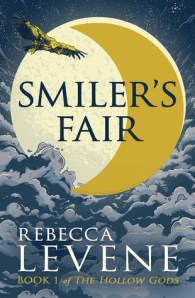
Smiler's Fair I don’t read a lot of fantasy, but something drew me to this book – probably a combination of the striking cover and unusual title – and I’m glad it did. Smiler’s Fair is the first of a new fantasy series, The Hollow Gods, and I enjoyed it enough to be in no doubt that I’ll be reading the next one whenever it appears. It’s always difficult to know how much information on the plot to give away when writing a review, especially with fantasy as I think one of the most enjoyable things about reading a fantasy novel is discovering the world the author has created and the surprises it contains. I would hate to spoil any of those surprises for future readers, so I can promise you that I’ve included very little here that can’t already be found on the back cover of the book itself.

The story begins with the birth of a baby…not just any baby, but the heir of Yron the Moon God, reborn to human parents. His father, King Nayan, has heard a prophecy that this child will grow up to kill his father, so he tries to have the boy destroyed at birth. His attempt fails, however, and the baby escapes with the help of his mother and her maid. We will have to wait to find out what exactly happens to the child, because the story now jumps forward several years and we get our first glimpse of Smiler’s Fair.

Despite its name, the fair is not quite as wonderful as it sounds. Forced to keep moving from place to place – because something terrible will happen should it stay in one spot for too long – Smiler’s Fair adapts itself to each new location, reassembling and rearranging its labyrinth of market stalls, taverns and gambling dens. You may be able to find your heart’s desire there (the fair can offer “every food, every spice, every pleasure and every vice”) but it will come at a high price.

Smiler’s Fair provides a starting point for storylines involving five very different characters. First there’s Nethmi, a young woman who pays a visit to the fair on her way to Winter’s Hammer where she will become the wife of Lord Thilak. On arriving in her new husband’s fort she finds that married life is not going to be easy and is driven to commit an act that will change everything. Next, there’s Dae Hyo, the last surviving member of his tribe. Following the slaughter of the rest of the Dae, he has been left alone to find a way of avenging his people and is turning increasingly to alcohol for support.

Our third character is Eric, a teenage boy who works in a brothel in Smiler’s Fair. When Eric finds himself falling in love he must decide whether to stay with the fair or to leave and seize his chance of happiness. Next there’s Marvan, a rather unpleasant person who enjoys provoking fights so that he can have the fun of killing his victims. And finally, there’s Krish, a young goatherd from a remote mountain village who makes a discovery that changes his life.

At first, each character seems to be having adventures of his or her own which are separate from all of the others but eventually connections between the storylines begin to emerge and we see how each one is linked in some way with the central plot surrounding the re-birth of Yron the Moon God. Nethmi, Dae Hyo, Eric, Marvan and Krish all have entirely different personalities and backgrounds and so can offer very different perspectives on life in and around Smiler’s Fair. All five of these characters are flawed and they all do things at times that are shocking, cruel or unexpected, which makes them interesting, if not very likeable. The secondary characters are equally interesting – these include Sang Ki, the illegitimate son of Nethmi’s new husband; Olufemi, the mage of Mirror Town; and my personal favourite, Rii, a giant talking bat.

The world Rebecca Levene describes in this book is, in some ways, not entirely different from our own and there are echoes of cultures, religions and civilisations that feel familiar. But the world of Smiler’s Fair differs from the real world in some very imaginative and unusual ways. I was surprised to find that the fair itself plays a relatively minor role in the story; much of the action actually takes place in other locations. However, the fair is at the dark centre of what I quickly discovered was a very dark novel. If you’re going to read Smiler’s Fair you need to be prepared for violence, murder, prostitution, alcoholism and other serious themes. This is not a light and whimsical fantasy novel, but the exact opposite.

This did feel very much like the first book in a series, with a lot of time spent introducing the characters, setting the scene and explaining some of the history of this imaginary world. The ending is not completely satisfying because so much is left unresolved in preparation for the rest of the series, but I can almost guarantee that if you finish this book you’ll want to read the next one to find out how the story is going to continue.

Thanks to Bookbridgr for my copy of Smiler’s Fair

Shadow of Night by Deborah Harkness

Shadow of Night This is the second book in the All Souls Trilogy by Deborah Harkness. I read the first, A Discovery of Witches, earlier this year and the third, The Book of Life, has just been published, which is what made me decide to pick up the middle book last week.

Shadow of Night follows witch Diana Bishop and vampire Matthew Clairmont as they travel back in time to the year 1590 with two goals in mind. The first is to hunt down Ashmole 782, an elusive manuscript which they hope will provide important information on the origins of their species – witches, vampires and daemons (known collectively as ‘creatures’). The second is to find another witch who can help Diana to understand and control her magical powers. Another benefit of leaving the present day behind is that Matthew and Diana will be able to escape the clutches of the other witches, vampires and daemons who have also been trying to get their hands on Ashmole 782.

Arriving in Elizabethan England, Diana discovers that Matthew is one of a group of writers, artists and scientists known as the School of Night, whose other members include Sir Walter Raleigh and Christopher (Kit) Marlowe. Reunited with his old friends again, Matthew also resumes one of his other occupations – spying for Elizabeth I. Meanwhile, Diana’s mission to find a witch willing to train her in the use of magic proves more difficult than expected in a time when public fear and suspicion of witches is increasing. Discovering that life in the past is no less complicated than it was in the present, Diana’s and Matthew’s adventures take them first into the heart of Elizabethan London, then to Matthew’s family estate at Sept-Tours in France and to the court of Rudolf II in Prague.

This book should have been perfect for me as I usually enjoy both historical fiction and time travel, but I think I actually preferred A Discovery of Witches. There were some parts of this book that I loved, but for such a long novel (nearly 600 pages) I found the pace very slow and uneven. It seemed that most of the book’s major developments all took place in the final 50-100 pages.

There are a lot of characters to keep track of in Shadow of Night and the character list at the back of the book was very useful. Diana and Matthew meet a huge number of real historical figures as they travel between London, Sept-Tours and Prague, but while some of these were very intriguing, such as the Rabbi Judah Loew who created the Golem of Prague, many of them had little or no relevance to the story. I couldn’t help thinking that they had been included just for the sake of it; I would rather have had fewer characters so that we could spend more time getting to know each one. I also really disliked the portrayal of Kit Marlowe in the book. I’m sure the real Marlowe would have been a fascinating character to write about in his own right; making him a daemon (a very spiteful, petulant daemon) added nothing to the story.

Matthew began to stretch my belief to its limits. Not only does he belong to the School of Night, he is also a member of at least one other secret organisation and an order of chivalry, a spy for Elizabeth I and a close personal friend of numerous famous historical figures from all over Europe. You may think that as I’m happy to accept that he’s a vampire I should be able to accept the rest of it too, but it all felt too convenient and just not believable in the context of the story. I do like Diana, partly because as she’s the narrator the reader naturally feels closer to her, but I would still like to see her take the lead more often when it comes to decision-making.

The time travel aspect of the book didn’t quite make sense to me either – it seemed that as Matthew was returning to an earlier period in his own life, he simply replaced his previous self for a while, but I’m not sure what was supposed to have happened to the 16th century Matthew in the meantime or what would happen when he came back. Time travel is always confusing, though, so I tried not to think about it too much! I did like the way each section of the book ended with a chapter set in the present day, showing how Matthew and Diana’s actions in the past affect the future. This also gave us a chance to briefly catch up with characters from the previous book such as Diana’s aunts, Sarah and Emily, and Matthew’s mother, Ysabeau.

Although I didn’t find this book as enjoyable as A Discovery of Witches, I think it maybe suffered from being the middle book in a trilogy. I will still be reading The Book of Life and hoping I don’t have any of the problems I had with this one!

Thanks to Headline for providing a copy of this book for review.

These Mortals by Margaret Irwin

These Mortals I wasn’t familiar with Margaret Irwin until a few months ago when Jane wrote about one of her other books, Still She Wished for Company. It sounded intriguing, so when I had the opportunity to read this one, which has been released this month as an ebook by Bloomsbury Reader, I decided to investigate.

These Mortals is a fantasy novel originally published in 1925, taking its title from Shakespeare’s A Midsummer Night’s Dream (“Lord, what fools these mortals be”). But it was another of his plays – The Tempest – that I was reminded of when I began to read, because like Miranda in The Tempest, the heroine in this book is the daughter of a powerful magician. Her name is Melusine and she has grown up isolated from human society, living with her father, the Enchanter Aldebaran, in his palace by the sea.

Although Melusine loves her three best friends, the Cat, the Raven and the Snake, she longs to meet other human beings like herself. One day she makes a magic ship from a shell, a rose petal and a silver pin and uses it to sail across a moonbeam to the human world beyond. Arriving in the kingdom of the Emperor Eminondas, Melusine begins to learn the ways of mortals and discovers what it means to fall in love.

This book is written in the style of a fairy tale, complete with princes and princesses, shipwrecked kings and woodcutters’ daughters, poets, magicians and talking animals. It’s all very dreamlike and it feels timeless. There are elements of other classic myths and legends too, particularly the legend of the water fairy, Melusina, who married a mortal man, Count Raymond of Poitou.

The only problem with this fairy tale atmosphere is that I felt there was a distance between the reader and the characters; they didn’t feel like real people and apart from Melusine herself, they didn’t come to life at all. I found it difficult at first to distinguish between the various members of the Emperor’s court (Princess Blanchelys, Lady Valeria, Sir Oliver and Sir Diarmid) and to remember who was in love with who. I was much more interested in Melusine’s personal story. I particularly enjoyed the scenes where she uses her magical powers – and I found myself looking forward to any appearances of the Cat, the Raven and the Snake!

There’s also some humour in the story, as there are so many aspects of human life of which Melusine has no knowledge or understanding.

“Tell me,” she said, “of that game I have heard you speak of to others, an ancient solitary game that is played with clubs by half-naked savages in the northern hills. There seems so much to tell of that game that it must surely be more exciting than any tale of love or perilous adventure.”

“Ah, there’s nothing like a good game of golf,” he said.

I suspect this was probably not the best Margaret Irwin book for me to have started with, but it was an unusual and entertaining novel and I still enjoyed it. It’s a very short book, but long enough for the story that is being told. Now I’m interested in trying some of the historical novels the author is more famous for.

Thanks to Bloomsbury for providing a review copy via NetGalley

A Discovery of Witches by Deborah Harkness

A Discovery of Witches

“It begins with absence and desire. It begins with blood and fear. It begins with a discovery of witches.”

A Discovery of Witches is the first in Deborah Harkness’s All Souls Trilogy. I’ve come to this book years after everybody else, as usual, but it seems I’ve picked a good time to read it as the third book is due out this summer. I did actually receive a review copy of the second one, Shadow of Night, a while ago but as I prefer to start at the beginning of a series I couldn’t read it until I got round to reading this one first. I haven’t been actively looking for a copy of A Discovery of Witches as I really wasn’t sure it was something I would like, but when I noticed it was available through NetGalley I decided it was time to give it a try.

Our narrator, Diana Bishop, is an American academic who has come to England to research the history of alchemy in Oxford’s Bodleian Library. She is also a witch. Not the kind who wears a black hat and flies on a broomstick, but a young woman who is able to live and work alongside humans while possessing magical powers which even she doesn’t fully understand. When Diana discovers an old alchemical manuscript known as Ashmole 782 in the library, it draws the unwelcome attention of several other beings – not just witches, but also vampires and daemons. It seems that the manuscript is bewitched and contains hidden information these other creatures desperately want.

Among the crowds of otherworldly creatures descending on Oxford in search of the manuscript is scientist Matthew Clairmont, who happens to be a vampire. Together, Matthew and Diana attempt to unravel the secrets of Ashmole 782 and in the process they begin to fall in love. But relationships between witches and vampires are strictly forbidden and the Congregation – a council made up of three representatives from each group of creatures – will do anything to put an end to their romance.

This book was a nice surprise, because I enjoyed it much more than I’d expected to! If you’ve been following my blog for a while, you will know that I don’t normally read books about vampires and witches, but I think it was precisely the fact that I don’t normally read books about vampires and witches that explains why I found this one so much fun to read. It was something different for me and the complaint some readers have, that it’s too much like Twilight for adults, meant nothing to me as I haven’t actually read Twilight (am I the only person who hasn’t?) so I’m not really familiar with what might be seen as vampire romance cliches. There were echoes of lots of other books, though. The way the story began with the discovery of a manuscript in the library was reminiscent of The Historian by Elizabeth Kostova (one of the few vampire books I have read) and the backstory involving Diana’s parents reminded me of the Harry Potter books.

There were lots of things to enjoy about A Discovery of Witches. I loved the combination of romance, history, adventure and fantasy. I liked the idea of creatures (the collective term for witches, vampires and daemons) co-existing with humans and doing the normal, everyday things that humans do – studying in libraries, drinking tea, checking their emails, even going to yoga classes. I loved the descriptions of the various locations Diana and Matthew visit, beginning in Oxford before moving on to a remote castle in the French countryside and then finally a haunted house with a mind of its own and several resident ghosts. And I enjoyed all the little scientific and historical details that are dropped into the story – information on evolution, genetics and the history of alchemy.

The book was not without a few flaws, though. I thought the pace was uneven – after a great start there was a long period where not much happened and while I wasn’t exactly bored, I did wonder when the plot was going to move forward again. Somewhere in the middle of the novel I started to feel impatient with Diana as she seemed so content to have Matthew protect her and make all the decisions in their relationship, which was disappointing after she’d appeared to be such a strong character at the beginning. I found it frustrating that she was so reluctant to use her magic, although I did eventually understand the reasons why she couldn’t or wouldn’t.

It also seemed that the sole purpose of the final few chapters of the book was to set things up for the sequel. This was not a big problem for me, as I already have a copy of the second book and could have started it immediately if I’d wanted to, but I’m sure it must have been annoying for people who read the book when it was first published and wanted to know how the story would be resolved!

I don’t think I’ll be rushing to fill my shelves with vampire books now, but I did enjoy this one and will certainly be continuing with Shadow of Night soon.

Thanks to Headline for providing a review copy via NetGalley

Rediscovering Elric of Melniboné

This is a tale of tragedy, this tale of Melniboné, the Dragon Isle. This is a tale of monstrous emotions and high ambitions. This is a tale of sorceries and treacheries and worthy ideals, of agonies and fearful pleasures, of bitter love and sweet hatred. This is the tale of Elric of Melniboné. Much of it Elric himself was to remember only in his nightmares.

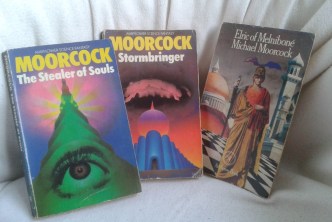
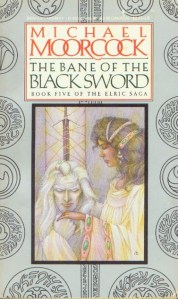
Elric I have my father to thank for introducing me, as a teenager, to Elric of Melniboné. I would almost certainly never have thought about reading these books otherwise and probably wouldn’t have even heard of them, as I’ve never had a lot of interest in reading fantasy, especially of the ‘swords and sorcery’ type. Michael Moorcock’s Elric books (and to a lesser extent, his Corum series) are among the small number of fantasy novels I’ve actually read and enjoyed. I hadn’t thought about them for years but when I was tidying my shelves one day a couple of weeks ago I came across my old copies (or rather, my dad’s old copies, some of which I’ve pictured above) and decided it might be fun to re-read them.

I only meant to re-read the first one but couldn’t resist reading most of the series again. This is not such an impressive feat as it sounds – there are six core books in the series, if you don’t count the sequels published later, and most of them are less than 200 pages long. Because they are so short (and some of them are collections of short stories rather than full-length novels) the pace is quick – there’s always something happening and the plot moves forward with every page. There seems to be some debate over the correct reading order for the series but as a general guide, Elric of Melniboné should be read first, followed by The Sailor on the Seas of Fate, The Weird of the White Wolf, The Sleeping Sorceress, The Bane of the Black Sword and finally, Stormbringer. Some of the individual stories in these books are also collected together in different orders in other volumes such as The Stealer of Souls.

The series follows the story of Elric of Melniboné, the four hundred and twenty-eighth Emperor to sit upon the Ruby Throne. Melniboné, or the Dragon Isle, is an island nation of sorcerers who once ruled the world but have seen their power gradually diminished as their human neighbours from the Young Kingdoms grow stronger and the gods of Law and Chaos battle for supremacy over the world. Some of the Melniboneans, including Elric’s ambitious cousin Yrykoon, believe Elric is not strong enough to rule as Emperor and to restore Melniboné to its former glory – because Elric is an albino, born with a deficiency of the blood which forces him to rely on magic potions to maintain his strength and prevent him from becoming weak and lethargic. When Yrykoon attempts to kill him and take both the throne and Elric’s lover, Cymoril, for himself, Elric enters into a bargain with Arioch, the Lord of Chaos. Arioch will come to his assistance whenever possible, but in return Elric will be bound to the enchanted black sword, Stormbringer, which steals the souls of its victims and often seems to have a mind of its own.

Elric of Melnibone and Other Stories Although Elric is the character around whom the whole series revolves, his actions are not always very heroic and in fact, he is much more of an anti-hero than a hero. He is not evil, but not ‘good’ either and it is often unclear whether he is fighting on the side of Chaos or of Law. I think the reason I found Elric so appealing when I was younger was because, not having read a lot of adult fiction at that time, I’d rarely encountered a fictional character with so much darkness and complexity and who didn’t always do what the reader wanted or expected him to do. From what I’ve read, Moorcock was trying to create an antithesis to other more traditional fantasy heroes such as Conan the Barbarian and so, rather than succeeding through physical power, Elric is brooding and melancholy, relying on sorcery rather than strength. Other characters come and go throughout the series – enemies such as Jagreen Lern, the Theocrat of Pan Tang, and the sorcerer, Theleb K’aarna, and friends including Rackhir the Red Archer, Dyvim Slorm, the Dragon Master, and my favourite, Moonglum of Elwher.

I’ll admit that you probably couldn’t describe these books as great literature, but they are not badly written and are very entertaining – and for such short books, the level of world building is very impressive. Moorcock’s style is not overly descriptive, but he manages to paint vivid images in only a few words: gold-plated battle-barges negotiating the rocks and grottos of the Melnibonean sea-maze; the underwater kingdom of Straasha and his water elementals; the dragons slumbering in their caves below the Dreaming City of Imrryr. Reading these books again, as an adult, I found that the quality of the writing seems to vary quite a lot from book to book, possibly because their chronological order is not the same as the order in which they were written and published. Elric of Melniboné and Stormbringer, in my opinion deserve to be considered classics of the fantasy genre, but some of the stories in between are much less satisfying.

The Bane of the Black Sword The Elric series is part of a much larger cycle of books known as The Eternal Champion, the idea being that Elric is just one incarnation of a hero who has existed in many different times and on different planes. There are other books and series featuring other incarnations of the Eternal Champion and at times their stories cross or intersect – for example, in the second Elric book, The Sailor on the Seas of Fate, Elric briefly meets three of his other selves, Corum, Erekose and Hawkmoon. I have read a few of the books featuring these other characters, but the only ones I enjoyed were the Corum books – a more straightforward fantasy series than Elric, but with a less interesting protagonist.

If I’ve convinced anyone to give Michael Moorcock a try (and I know these are entirely different from the books I usually write about on this blog) Elric of Melniboné, in my opinion, is the best place to start!

The Enchantress of Florence by Salman Rushdie

A More Diverse Universe I’ve never read anything by Salman Rushdie before and have always felt slightly intimidated by him, but when I was looking for something to read for the A More Diverse Universe blog tour (hosted by Aarti of Booklust) I came across this title on Aarti’s list of suggestions and thought it sounded intriguing.

The Enchantress of Florence is a very imaginative mixture of history and fantasy, with a plot that is almost impossible to describe – though I’ll do my best! The story begins in 16th century India when a mysterious yellow-haired stranger calling himself the Mogor dell’Amore arrives by bullock-cart at the court of the Emperor Akbar in Sikri. Claiming to be related to Akbar, he begins to tell the Emperor the story of the lost Mughal princess, Qara Köz, or Lady Black Eyes, who is captured and after a series of adventures ends up in Florence where she falls in love with the soldier Antonino Argalia. Qara Köz is the enchantress of the title, believed to have powers of sorcery, as well as great beauty, and the entire city of Florence becomes captivated by her presence. In a separate, but connected, storyline we also learn of Argalia’s childhood, growing up in Florence with his friends Ago Vespucci and Il Machia (Niccolò Machiavelli). Will Akbar believe the stories he is told and what effect will they have on the Emperor and his court?

The Enchantress of Florence There are lots of themes and ideas in The Enchantress of Florence and I’m sure I didn’t fully understand all of them. However, one of the main themes, to me, seems to be the power and the magic of storytelling. The novel is made up of lots of separate interlocking stories, not just the three main ones I’ve mentioned above. One character will begin to tell a story and then a character within that story will begin to tell another story and so on, until you almost begin to forget who the original storyteller was and who the listeners are. These stories may or may not be true and all of them are rich in magical realism – we meet the emperor’s favourite wife Jodha, for example, who is imaginary but also seems to have a life of her own; a slave girl who has become a ‘Memory Palace’ (or a device to aid the memory); and an artist hiding inside one of his own paintings.

The fantasy elements and the abundance of princesses, emperors, giants and witches gives the book a fairy tale feel (I was reminded of The Arabian Nights) and there are beautiful, lavish descriptions of both Mughal India and Renaissance Florence, two settings which are very different but also surprisingly alike. I did enjoy this book, especially the sections set in India, and I thought it was beautifully written, but I did find it very complicated and difficult to follow and I think I would probably have needed to read it twice to be able to really appreciate it. People often talk about books having multiple layers, and that’s usually a good thing, but this one has so many layers I was a bit overwhelmed!

I won’t be immediately rushing out to buy the rest of Salman Rushdie’s books but I’m glad I chose to read this one – it was a challenge, but worth the effort, I think.