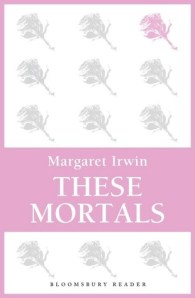
These Mortals by Margaret Irwin

These Mortals I wasn’t familiar with Margaret Irwin until a few months ago when Jane wrote about one of her other books, Still She Wished for Company. It sounded intriguing, so when I had the opportunity to read this one, which has been released this month as an ebook by Bloomsbury Reader, I decided to investigate.

These Mortals is a fantasy novel originally published in 1925, taking its title from Shakespeare’s A Midsummer Night’s Dream (“Lord, what fools these mortals be”). But it was another of his plays – The Tempest – that I was reminded of when I began to read, because like Miranda in The Tempest, the heroine in this book is the daughter of a powerful magician. Her name is Melusine and she has grown up isolated from human society, living with her father, the Enchanter Aldebaran, in his palace by the sea.

Although Melusine loves her three best friends, the Cat, the Raven and the Snake, she longs to meet other human beings like herself. One day she makes a magic ship from a shell, a rose petal and a silver pin and uses it to sail across a moonbeam to the human world beyond. Arriving in the kingdom of the Emperor Eminondas, Melusine begins to learn the ways of mortals and discovers what it means to fall in love.

This book is written in the style of a fairy tale, complete with princes and princesses, shipwrecked kings and woodcutters’ daughters, poets, magicians and talking animals. It’s all very dreamlike and it feels timeless. There are elements of other classic myths and legends too, particularly the legend of the water fairy, Melusina, who married a mortal man, Count Raymond of Poitou.

The only problem with this fairy tale atmosphere is that I felt there was a distance between the reader and the characters; they didn’t feel like real people and apart from Melusine herself, they didn’t come to life at all. I found it difficult at first to distinguish between the various members of the Emperor’s court (Princess Blanchelys, Lady Valeria, Sir Oliver and Sir Diarmid) and to remember who was in love with who. I was much more interested in Melusine’s personal story. I particularly enjoyed the scenes where she uses her magical powers – and I found myself looking forward to any appearances of the Cat, the Raven and the Snake!

There’s also some humour in the story, as there are so many aspects of human life of which Melusine has no knowledge or understanding.

“Tell me,” she said, “of that game I have heard you speak of to others, an ancient solitary game that is played with clubs by half-naked savages in the northern hills. There seems so much to tell of that game that it must surely be more exciting than any tale of love or perilous adventure.”

“Ah, there’s nothing like a good game of golf,” he said.

I suspect this was probably not the best Margaret Irwin book for me to have started with, but it was an unusual and entertaining novel and I still enjoyed it. It’s a very short book, but long enough for the story that is being told. Now I’m interested in trying some of the historical novels the author is more famous for.

Thanks to Bloomsbury for providing a review copy via NetGalley

A Discovery of Witches by Deborah Harkness

A Discovery of Witches

“It begins with absence and desire. It begins with blood and fear. It begins with a discovery of witches.”

A Discovery of Witches is the first in Deborah Harkness’s All Souls Trilogy. I’ve come to this book years after everybody else, as usual, but it seems I’ve picked a good time to read it as the third book is due out this summer. I did actually receive a review copy of the second one, Shadow of Night, a while ago but as I prefer to start at the beginning of a series I couldn’t read it until I got round to reading this one first. I haven’t been actively looking for a copy of A Discovery of Witches as I really wasn’t sure it was something I would like, but when I noticed it was available through NetGalley I decided it was time to give it a try.

Our narrator, Diana Bishop, is an American academic who has come to England to research the history of alchemy in Oxford’s Bodleian Library. She is also a witch. Not the kind who wears a black hat and flies on a broomstick, but a young woman who is able to live and work alongside humans while possessing magical powers which even she doesn’t fully understand. When Diana discovers an old alchemical manuscript known as Ashmole 782 in the library, it draws the unwelcome attention of several other beings – not just witches, but also vampires and daemons. It seems that the manuscript is bewitched and contains hidden information these other creatures desperately want.

Among the crowds of otherworldly creatures descending on Oxford in search of the manuscript is scientist Matthew Clairmont, who happens to be a vampire. Together, Matthew and Diana attempt to unravel the secrets of Ashmole 782 and in the process they begin to fall in love. But relationships between witches and vampires are strictly forbidden and the Congregation – a council made up of three representatives from each group of creatures – will do anything to put an end to their romance.

This book was a nice surprise, because I enjoyed it much more than I’d expected to! If you’ve been following my blog for a while, you will know that I don’t normally read books about vampires and witches, but I think it was precisely the fact that I don’t normally read books about vampires and witches that explains why I found this one so much fun to read. It was something different for me and the complaint some readers have, that it’s too much like Twilight for adults, meant nothing to me as I haven’t actually read Twilight (am I the only person who hasn’t?) so I’m not really familiar with what might be seen as vampire romance cliches. There were echoes of lots of other books, though. The way the story began with the discovery of a manuscript in the library was reminiscent of The Historian by Elizabeth Kostova (one of the few vampire books I have read) and the backstory involving Diana’s parents reminded me of the Harry Potter books.

There were lots of things to enjoy about A Discovery of Witches. I loved the combination of romance, history, adventure and fantasy. I liked the idea of creatures (the collective term for witches, vampires and daemons) co-existing with humans and doing the normal, everyday things that humans do – studying in libraries, drinking tea, checking their emails, even going to yoga classes. I loved the descriptions of the various locations Diana and Matthew visit, beginning in Oxford before moving on to a remote castle in the French countryside and then finally a haunted house with a mind of its own and several resident ghosts. And I enjoyed all the little scientific and historical details that are dropped into the story – information on evolution, genetics and the history of alchemy.

The book was not without a few flaws, though. I thought the pace was uneven – after a great start there was a long period where not much happened and while I wasn’t exactly bored, I did wonder when the plot was going to move forward again. Somewhere in the middle of the novel I started to feel impatient with Diana as she seemed so content to have Matthew protect her and make all the decisions in their relationship, which was disappointing after she’d appeared to be such a strong character at the beginning. I found it frustrating that she was so reluctant to use her magic, although I did eventually understand the reasons why she couldn’t or wouldn’t.

It also seemed that the sole purpose of the final few chapters of the book was to set things up for the sequel. This was not a big problem for me, as I already have a copy of the second book and could have started it immediately if I’d wanted to, but I’m sure it must have been annoying for people who read the book when it was first published and wanted to know how the story would be resolved!

I don’t think I’ll be rushing to fill my shelves with vampire books now, but I did enjoy this one and will certainly be continuing with Shadow of Night soon.

Thanks to Headline for providing a review copy via NetGalley

Rediscovering Elric of Melniboné

This is a tale of tragedy, this tale of Melniboné, the Dragon Isle. This is a tale of monstrous emotions and high ambitions. This is a tale of sorceries and treacheries and worthy ideals, of agonies and fearful pleasures, of bitter love and sweet hatred. This is the tale of Elric of Melniboné. Much of it Elric himself was to remember only in his nightmares.

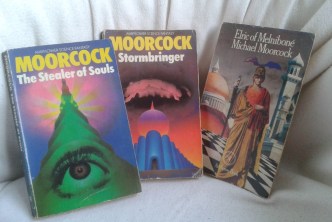
Elric I have my father to thank for introducing me, as a teenager, to Elric of Melniboné. I would almost certainly never have thought about reading these books otherwise and probably wouldn’t have even heard of them, as I’ve never had a lot of interest in reading fantasy, especially of the ‘swords and sorcery’ type. Michael Moorcock’s Elric books (and to a lesser extent, his Corum series) are among the small number of fantasy novels I’ve actually read and enjoyed. I hadn’t thought about them for years but when I was tidying my shelves one day a couple of weeks ago I came across my old copies (or rather, my dad’s old copies, some of which I’ve pictured above) and decided it might be fun to re-read them.

I only meant to re-read the first one but couldn’t resist reading most of the series again. This is not such an impressive feat as it sounds – there are six core books in the series, if you don’t count the sequels published later, and most of them are less than 200 pages long. Because they are so short (and some of them are collections of short stories rather than full-length novels) the pace is quick – there’s always something happening and the plot moves forward with every page. There seems to be some debate over the correct reading order for the series but as a general guide, Elric of Melniboné should be read first, followed by The Sailor on the Seas of Fate, The Weird of the White Wolf, The Sleeping Sorceress, The Bane of the Black Sword and finally, Stormbringer. Some of the individual stories in these books are also collected together in different orders in other volumes such as The Stealer of Souls.

The series follows the story of Elric of Melniboné, the four hundred and twenty-eighth Emperor to sit upon the Ruby Throne. Melniboné, or the Dragon Isle, is an island nation of sorcerers who once ruled the world but have seen their power gradually diminished as their human neighbours from the Young Kingdoms grow stronger and the gods of Law and Chaos battle for supremacy over the world. Some of the Melniboneans, including Elric’s ambitious cousin Yrykoon, believe Elric is not strong enough to rule as Emperor and to restore Melniboné to its former glory – because Elric is an albino, born with a deficiency of the blood which forces him to rely on magic potions to maintain his strength and prevent him from becoming weak and lethargic. When Yrykoon attempts to kill him and take both the throne and Elric’s lover, Cymoril, for himself, Elric enters into a bargain with Arioch, the Lord of Chaos. Arioch will come to his assistance whenever possible, but in return Elric will be bound to the enchanted black sword, Stormbringer, which steals the souls of its victims and often seems to have a mind of its own.

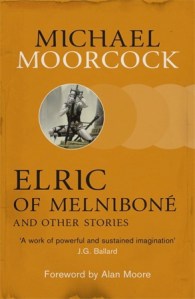
Elric of Melnibone and Other Stories Although Elric is the character around whom the whole series revolves, his actions are not always very heroic and in fact, he is much more of an anti-hero than a hero. He is not evil, but not ‘good’ either and it is often unclear whether he is fighting on the side of Chaos or of Law. I think the reason I found Elric so appealing when I was younger was because, not having read a lot of adult fiction at that time, I’d rarely encountered a fictional character with so much darkness and complexity and who didn’t always do what the reader wanted or expected him to do. From what I’ve read, Moorcock was trying to create an antithesis to other more traditional fantasy heroes such as Conan the Barbarian and so, rather than succeeding through physical power, Elric is brooding and melancholy, relying on sorcery rather than strength. Other characters come and go throughout the series – enemies such as Jagreen Lern, the Theocrat of Pan Tang, and the sorcerer, Theleb K’aarna, and friends including Rackhir the Red Archer, Dyvim Slorm, the Dragon Master, and my favourite, Moonglum of Elwher.

I’ll admit that you probably couldn’t describe these books as great literature, but they are not badly written and are very entertaining – and for such short books, the level of world building is very impressive. Moorcock’s style is not overly descriptive, but he manages to paint vivid images in only a few words: gold-plated battle-barges negotiating the rocks and grottos of the Melnibonean sea-maze; the underwater kingdom of Straasha and his water elementals; the dragons slumbering in their caves below the Dreaming City of Imrryr. Reading these books again, as an adult, I found that the quality of the writing seems to vary quite a lot from book to book, possibly because their chronological order is not the same as the order in which they were written and published. Elric of Melniboné and Stormbringer, in my opinion deserve to be considered classics of the fantasy genre, but some of the stories in between are much less satisfying.

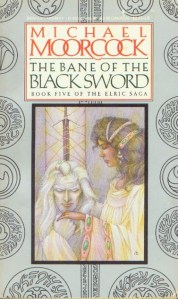
The Bane of the Black Sword The Elric series is part of a much larger cycle of books known as The Eternal Champion, the idea being that Elric is just one incarnation of a hero who has existed in many different times and on different planes. There are other books and series featuring other incarnations of the Eternal Champion and at times their stories cross or intersect – for example, in the second Elric book, The Sailor on the Seas of Fate, Elric briefly meets three of his other selves, Corum, Erekose and Hawkmoon. I have read a few of the books featuring these other characters, but the only ones I enjoyed were the Corum books – a more straightforward fantasy series than Elric, but with a less interesting protagonist.

If I’ve convinced anyone to give Michael Moorcock a try (and I know these are entirely different from the books I usually write about on this blog) Elric of Melniboné, in my opinion, is the best place to start!

The Enchantress of Florence by Salman Rushdie

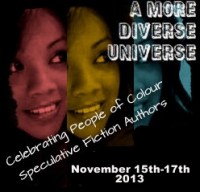
A More Diverse Universe I’ve never read anything by Salman Rushdie before and have always felt slightly intimidated by him, but when I was looking for something to read for the A More Diverse Universe blog tour (hosted by Aarti of Booklust) I came across this title on Aarti’s list of suggestions and thought it sounded intriguing.

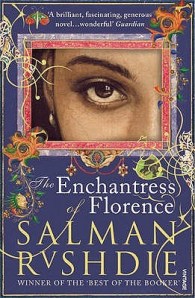
The Enchantress of Florence is a very imaginative mixture of history and fantasy, with a plot that is almost impossible to describe – though I’ll do my best! The story begins in 16th century India when a mysterious yellow-haired stranger calling himself the Mogor dell’Amore arrives by bullock-cart at the court of the Emperor Akbar in Sikri. Claiming to be related to Akbar, he begins to tell the Emperor the story of the lost Mughal princess, Qara Köz, or Lady Black Eyes, who is captured and after a series of adventures ends up in Florence where she falls in love with the soldier Antonino Argalia. Qara Köz is the enchantress of the title, believed to have powers of sorcery, as well as great beauty, and the entire city of Florence becomes captivated by her presence. In a separate, but connected, storyline we also learn of Argalia’s childhood, growing up in Florence with his friends Ago Vespucci and Il Machia (Niccolò Machiavelli). Will Akbar believe the stories he is told and what effect will they have on the Emperor and his court?

The Enchantress of Florence There are lots of themes and ideas in The Enchantress of Florence and I’m sure I didn’t fully understand all of them. However, one of the main themes, to me, seems to be the power and the magic of storytelling. The novel is made up of lots of separate interlocking stories, not just the three main ones I’ve mentioned above. One character will begin to tell a story and then a character within that story will begin to tell another story and so on, until you almost begin to forget who the original storyteller was and who the listeners are. These stories may or may not be true and all of them are rich in magical realism – we meet the emperor’s favourite wife Jodha, for example, who is imaginary but also seems to have a life of her own; a slave girl who has become a ‘Memory Palace’ (or a device to aid the memory); and an artist hiding inside one of his own paintings.

The fantasy elements and the abundance of princesses, emperors, giants and witches gives the book a fairy tale feel (I was reminded of The Arabian Nights) and there are beautiful, lavish descriptions of both Mughal India and Renaissance Florence, two settings which are very different but also surprisingly alike. I did enjoy this book, especially the sections set in India, and I thought it was beautifully written, but I did find it very complicated and difficult to follow and I think I would probably have needed to read it twice to be able to really appreciate it. People often talk about books having multiple layers, and that’s usually a good thing, but this one has so many layers I was a bit overwhelmed!

I won’t be immediately rushing out to buy the rest of Salman Rushdie’s books but I’m glad I chose to read this one – it was a challenge, but worth the effort, I think.

The Golem and the Djinni by Helene Wecker

The Golem and the Djinni Meet Chava. She’s a golem, a woman made of clay, created by a Rabbi in Poland and brought to life on a ship sailing to America. When her master dies during the voyage, the Golem, only a few days old, finds herself alone in a strange and unfamiliar land.

Ahmad is a djinni, a magical being made of flame, born in the Syrian desert in the seventh century and trapped inside a copper flask by a wizard. Now, many centuries later, the Djinni is released from the flask by a New York tinsmith, but discovers that he is bound to human form by an iron band around his wrist.

As the Golem and the Djinni try to adapt to their new surroundings and struggle to find a place for themselves in New York society, the two are eventually drawn together and their separate storylines begin to merge together in some unexpected ways.

The Golem and the Djinni have many things in common, the most obvious being that they are two non-human creatures trying to survive in the human world. They share a vulnerability and a childlike wonder at the people and things around them, which is what makes them both such endearing characters. But coming from such different cultures, they soon discover that they also have very different natures. Chava, as a golem, is designed to serve a master and satisfy the desires of others, while Ahmad has been imprisoned against his wishes and is desperate to regain his independence. The question of free will is something that comes up in their conversations often. Are the Golem and the Djinni responsible for their own actions or do their natures make them behave in a certain way? How much free will does either of them actually have? And what are the things that make a person human?

I found the relationship between the Golem and the Djinni very moving to read about and I think the reason for that was because it was not written as a typical ‘love at first sight’ romance. At first their relationship is based on curiosity and a longing to be able to discuss things with another outsider. A friendship gradually starts to form but it’s not until they find themselves threatened by a mutual enemy that the Golem and the Djinni realise how much they care about each other. I really liked the fact that the author took her time to introduce us to the characters and allowed their story to develop slowly so that the pace never felt too rushed.

Another thing I loved was the choice of setting – New York in 1899. As the Golem and the Djinni are mythical creatures they could probably have been placed into any setting and their story would still have been interesting, but choosing this specific time and place was particularly fascinating because of the insights we are given into the various immigrant communities of turn of the century New York. Through the Golem we get to know some of the city’s Jewish population and through the Djinni we meet the inhabitants of ‘Little Syria’, as well as learning about the Djinni’s previous life among the Bedouin desert tribes. There are lots of great characters in each of these communities: the old Rabbi who befriends Chava and the tinsmith who befriends Ahmad, the ice cream seller who suffers from a strange affliction that prevents him from looking people in the eye, and the beautiful young girl who receives some late night visits from the Djinni.

As a first novel, The Golem and the Djinni was a very ambitious one but everything worked perfectly. There were so many things about this book that impressed me – the beautiful writing, the clever plot, the blending of fantasy with historical fiction, and most of all, the wonderful characterisation of both Chava and Ahmad. In four months’ time when I make my list of favourite books of the year The Golem and the Djinni is one title that I’m sure will be on that list!

(Now, can anyone tell me why the spelling Djinni is used in the UK edition and Jinni in the American one?)

The Lions of Al-Rassan by Guy Gavriel Kay

The Lions of Al-Rassan Guy Gavriel Kay is only a recent discovery for me, but after reading Tigana in June I knew I wanted to read more of his work. Leander of The Idle Woman mentioned that she had been wanting to re-read The Lions of Al-Rassan, one of her favourite books, so we decided it would be interesting to read it at the same time and exchange our thoughts on it.

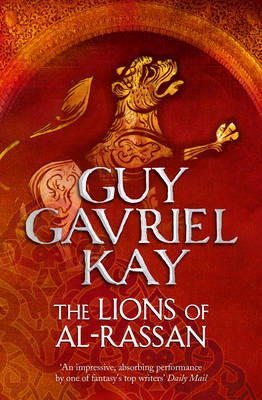
I should start by saying that although Kay is known as a fantasy author, this book has few, if any, elements that I would describe as ‘fantasy’ and is much closer to historical fiction. The story is set in a fictitious world very similar to medieval Spain. In the north, we have the sun-worshipping Jaddites – brave warriors and horsemen. The Jaddite lands have become divided and weakened over the years due to rivalries between their three kings but they still hope to one day ride south and reconquer the rest of the peninsula. In the south is Al-Rassan, the land of the Asharites, who worship the stars and who value poetry, music and beauty. After the death of their last Khalif, Al-Rassan has also become divided and is not as strong as it once was. Caught between the two are the wandering Kindath people, who pray to the two moons that shine in the sky, one blue and one white. Even with my very limited (almost non-existent) knowledge of Spanish history I could immediately see that the Jaddites represented Christians, the Asharites Muslims and the Kindath Jews.

As tension builds between the Jaddites and the Asharites and war begins to look inevitable, there are big consequences for the novel’s three central characters. One of these is Rodrigo Belmonte, Captain to a Jaddite king and one of the Jaddites’ greatest soldiers. When Rodrigo is exiled by his king he and his company find themselves in the Asharite city of Ragosa. Here he meets another great man, Ammar ibn Khairan, an Asharite who is also in exile, and the two form an instant connection. Our third protagonist is a woman, Jehane bet Ishak, a Kindath physician who joins Rodrigo’s company and becomes close to both men. With the peninsula heading rapidly towards conflict, will the bonds between Rodrigo, Ammar and Jehane be able to survive?

Now that I’ve read two of Guy Gavriel Kay’s novels, it’s hard to say which I liked best because both were such great books. I think I found Tigana more fun to read (simply because I read fantasy so rarely these days and it was something a bit different for me to read a book with magic and wizards) but I found the writing in The Lions of Al-Rassan more powerful and the characters more fully developed. Ammar, Rodrigo and Jehane are all characters that I could love and admire, and considering their very different backgrounds and cultures, it’s quite an achievement that Kay could make it possible to identify with and care about all three of them.

Although this novel is set in a fictional land, the parallels with a real period of history made me feel that I was gaining a better understanding of medieval Spain. But as well as the history, there’s also a lot of drama and excitement throughout the novel: among other things, there are battles, assassination attempts (both successful and unsuccessful), and a masked Carnival. What I really loved about this book, though, was the portrayal of the three main characters and the relationships between them. It’s not as simple as Jehane being in love with both men (or them being in love with her) and having to choose between them; although there is a romantic aspect, the relationships are much deeper and more complex than that and encompass not just love but also friendship, loyalty and trust.

There’s a growing sense of sadness too as you start to approach the end of the book and wonder whether all three of Ammar, Jehane and Rodrigo will survive the coming conflict and how they will cope if they find themselves on opposite sides. The final chapter was one of the most tense and emotional I’ve read for some time, though I thought it would have been even more effective without the epilogue that followed (I was pleased to see that Leander felt the same as I was wondering whether I was the only person who would rather not have had the loose ends tied up).

I’m excited about the prospect of working my way through the rest of Kay’s books, but I’m sure I’ll want to re-read this one at some point too – preferably after I’ve had a chance to read up on Spanish history! If you would like to see what Leander thought of The Lions of Al-Rassan, you can read her post here.

Tigana by Guy Gavriel Kay

Tigana by Guy Gavriel Kay Tigana is a fantasy novel set in the Peninsular of the Palm, a world loosely based on Renaissance Italy. Divided into nine rival provinces, the Palm is an easy target for two invading tyrants, one from the east and one from the west. Four of the Palm’s nine provinces have fallen to Alberico of Barbadior and four to Brandin of Ygrath, both powerful sorcerers, with only one province still to be conquered.

During the battle for one of these provinces, Prince Valentin of Tigana killed Brandin’s son, Stevan, which brought down Brandin’s wrath upon the entire province and its people. Brandin destroyed Tigana’s cities, its culture and its identity, then to complete his revenge he wiped all memory of Tigana and even its name from the minds of everyone in the peninsular, with the exception of those who were born in the province before the invasion. Eighteen years later, at the time when our story is set, a group of Tiganese exiles (including Prince Valentin’s only surviving son) set out to free the Palm of the two tyrants and restore Tigana’s name to the world.

This is the first book by Guy Gavriel Kay I’ve read, although I’ve been aware of his books for years and am now annoyed with myself for waiting so long to actually read one! I loved Tigana – not unreservedly, but enough to make it one of my books of the year so far.

I’ll admit to being very confused at first, as Kay doesn’t make things easy for the reader and throws us straight into a strange, unfamiliar world. Making a few notes of names and places helped, but really all that was needed was some patience. By the time I was halfway through the book, a world with one blue moon and one white, where people worship a Triad of Gods called Eanna, Adaon and Morian, and where wizards can be recognised by their two missing fingers, seemed almost as real as our own! I very rarely read fantasy anymore (not for any particular reason; I did used to enjoy it and am not sure why or when I stopped) but I actually thought that the overall feel of the book and the effort needed to understand the history, folklore and politics of the Palm were not a lot different from reading historical fiction. I could soon see the parallels with Renaissance Italy and the way its feuding city states left it vulnerable to threats from outside.

One of the things I liked about this book is that, with the possible exception of Alberico, none of the characters are portrayed as entirely good or entirely bad. The best example of this is probably Brandin of Ygrath, who at first appears to be one of the villains of the book because of what he has done to Tigana. It’s only later in the novel that we start to get closer to Brandin and see him from the point of view of the woman who loves him. This is Dianora, who is herself from Tigana and has spent several years in Brandin’s saishan (harem) on the island of Chiara, intending to kill him and lift his curse from Tigana. However, when she finds herself falling in love with him, she begins to wonder whether she’ll be able to carry her plan through to its end. I didn’t particularly like Dianora or agree with all of her choices, but I thought the scenes describing her internal conflict were very well written.

I don’t think the problem I had with Dianora was necessarily with the character herself, by the way, but more with the fact that her introduction into the novel came at a point where I had just begun to really understand the plot and to get to know Devin, Alessan, Catriana and the other characters; at that stage I didn’t want to be taken away from them and have to spend two chapters meeting a new character with a long backstory. I did become more interested in Dianora later in the book, but her sections were never my favourites and I was always glad to get back to the other characters’ storylines.

Another example of the boundaries between right and wrong becoming blurred involves the binding of a wizard. I don’t want to go into too many details as part of the fun of reading this book, being someone who doesn’t read much fantasy, was in learning about the various types of magic used in the Palm. However, the wizard binding episode raised some interesting questions. Can it ever be right to enslave a man against his will? Is the freedom of one person as important as the freedom of an entire nation?

As for the ending of the book, I both liked it and disliked it. I couldn’t quite believe in one of the romantic pairings at the end, as there had been so little hint of it throughout the book. There were other things that were left unresolved (or rather, they weren’t resolved in the way I wanted them to be) but I could accept that not everybody could have a happy ending. The revelation about one of the characters (again, I don’t want to say too much here and spoil the story for future readers) was heartbreaking! And the very last line of the epilogue is one of those final sentences that leaves you with something to continuing thinking about and trying to interpret even after you close the book and put it back on the shelf. I’ve got The Lions of Al-Rassan to read next and am excited to think that I might potentially have a new name to add to my list of favourite authors!