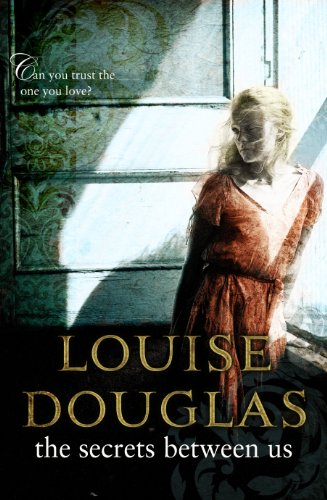
The Secrets Between Us by Louise Douglas

Suffering from the trauma of a stillborn baby and the end of her relationship with her boyfriend, Sarah agrees to accompany her sister and brother-in-law to Sicily for a holiday. Here she meets Alexander and his six-year-old son, Jamie, who are having problems of their own: Alexander’s wife, Genevieve, has left him and disappeared without trace. When Alex offers Sarah a job as housekeeper at his home in England, she agrees. Despite her family’s concerns, Sarah thinks it’s the right decision: she’s attracted to Alex, adores his little boy, and is desperate to make a fresh start and move on with her life.

But after joining Alex and Jamie at Avalon, their home in the village of Burrington Stoke in Somerset, Sarah begins to wonder exactly what happened to Genevieve. The missing woman’s family are convinced Alex knows more about the disappearance than he’s admitting to, but Sarah knows that can’t be true…or can it?

The Secrets Between Us was my final choice for the Transworld Book Group. Louise Douglas is not an author I’ve ever read before, so I didn’t know what to expect from this book, but I was immediately drawn to it when I saw that it had been compared to Rebecca by Daphne du Maurier, one of my favourite books. And there are definitely some similarities. Genevieve, like Rebecca, is described as beautiful, popular, talented and loved by everyone who knew her – and although she’s not there physically, she’s still a very strong presence and always at the heart of the story. The two books also share a gothic atmosphere and a sense of uneasiness and foreboding.

But this is also an excellent book in its own right. The author expertly keeps us guessing right to the end by adding some unexpected plot twists and ensuring that we can never be quite certain whether Alexander can be trusted or not. It’s also possible that Sarah, as the narrator, may not always be completely reliable. Some very strange and spooky things happen at Avalon and we are made to wonder whether they have supernatural causes or whether Sarah’s emotional state is making her see things that aren’t really there.

I did find it hard to believe that Sarah would agree to move in with a man she’d only met on a couple of brief occasions in Sicily, but at least this meant we were thrown into the action almost immediately, with only a short build-up. And Sarah is a narrator who is easy to like and to have sympathy for. I could really feel her fear and confusion as more and more facts about Genevieve were revealed, and her sense of growing isolation as the people of Burrington Stoke turned against her, believing that she and Alexander were trying to cover up the truth about Genevieve’s disappearance.

The Secrets Between Us is an excellent psychological thriller, with just the right amount of tension and suspense. Although Louise Douglas’ previous novels sound very different to this one, I really liked her writing and would be happy to try her other books at some point too.

I received a copy of this book from Transworld for review.

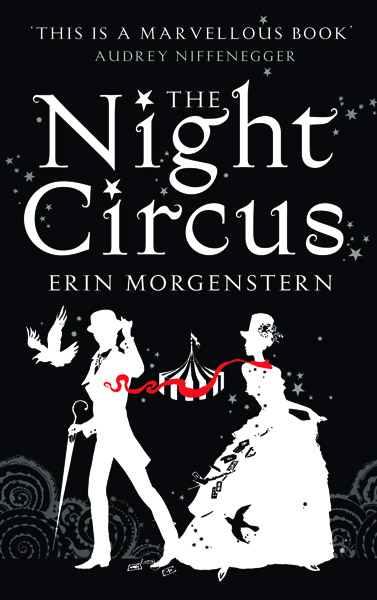
The Night Circus by Erin Morgenstern

I don’t usually pay much attention to hype, but I found I couldn’t ignore The Night Circus any longer. Judging by the number of glowing reviews this book has attracted, it has lived up to the hype for most people, but for me, although I did like it – loved it at times – I wasn’t quite as swept away by it as I had hoped to be. I’ll start by telling you what I loved about it and will then try to explain why not everything worked for me.

The Night Circus tells the story of Celia and Marco, two young magicians who have been selected by their mentors to take part in a very special contest. The rules of the competition are shrouded in mystery and even the two illusionists themselves aren’t sure what they have to do to win. And the venue for this magical battle? Le Cirque des Rêves, or the Circus of Dreams, one of the strongest, most vivid fictional worlds I’ve ever come across in a novel.

“The circus arrives without warning”, as we are told in the opening line of the novel. As it moves from town to town, it appears overnight and is “simply there, when yesterday it was not”. It really sounds amazing, more like a theme park than a traditional circus, and all the descriptions made me feel sorry that it doesn’t really exist! I know I’m not the only person who will have read this book wishing that they could visit the circus too and spend the night wandering from tent to tent, marvelling at all the spectacular attractions and performances. The setting is complemented with an authentic circus atmosphere complete with the smells of bonfire smoke and caramel, the taste of mulled cider, and a special black and white colour scheme. So much thought has gone into making the setting come to life, right down to the tiniest detail. What a great imagination Erin Morgenstern must have!

As it grows in popularity, the circus attracts a large group of followers who form a kind of fan club, calling themselves ‘rêveurs’. As we read the book we are encouraged to become rêveurs ourselves via a number of special chapters written in the second person, designed to make the reader feel they are actually there, inside the circus. I thought this aspect of the book was very effective and possibly the best use of second person narrative I’ve seen.

For me though, this book was all about the tone, the atmosphere and the descriptions of the circus, and there wasn’t much else beyond that. Outside the world of the circus there was no sense of time or place: the book is set in the late 19th and early 20th centuries, but it didn’t feel that way to me and I didn’t really notice anything to set the book in its time period. Maybe it was kept deliberately timeless – I don’t know, but I thought this was slightly disappointing as I do love a Victorian/turn of the century setting. The story develops slowly (sometimes too slowly for me), keeping the reader wondering about the true nature of the contest and what the outcome will be, but when I reached the end of the book I still wasn’t completely sure exactly what the point of the contest had been. Too many of my questions were left unanswered.

The biggest problem I had with this book, though, was the characters. When I think about my favourite books, the ones that I really loved and have kept on my shelves to read over and over again, they are the ones with strong characters, characters I can form an emotional connection with, who I can care about and understand. And that’s why, although I did like The Night Circus, I couldn’t love it. I didn’t think there was enough depth to the characters and even Celia and Marco never felt like real, fully developed people to me. Rather than being able to get inside their heads I felt I was watching them from a distance, though maybe the fact that most of the book was written in the third person present tense contributed to this. I did still enjoy this book and loved that wonderful circus setting, but if only the characters had been stronger it might have been one of my books of the year.

The Loving Spirit by Daphne du Maurier

If you’ve been following my blog for a while you’ll know that Daphne du Maurier is one of my favourite authors, so when I saw that Simon of Savidge Reads and Polly of Novel Insights were hosting a Discovering Daphne event throughout October I knew I’d have to read at least one du Maurier book this month. There are still plenty of her books that I haven’t read yet, but I decided I wanted to go back to the start of her career and read her first novel from 1931, The Loving Spirit.

The Loving Spirit is a family saga spanning four generations of the Coombe family. It begins in 1830 with the story of Janet Coombe, a passionate young woman who is forced to abandon her dreams of going to sea when she marries and settles down to start a family with her husband, a boat builder. We then move forward through the decades, ending one hundred years later in the 1930s. Along the way we meet Janet’s son, Joseph, her grandson, Christopher, and finally her great-granddaughter, Jennifer. The book is divided into four parts, one devoted to each of the main characters, but I won’t go into any plot details here as each story has its own set of dramas and surprises which I’ll leave you to discover for yourself.

Although this is a family story and doesn’t have the gothic feel of some of du Maurier’s other books, there are hints of the supernatural in the way the stories of the four Coombes are connected, particularly Janet’s and Joseph’s. The link between the four sections of the novel is the ‘loving spirit’ of Janet Coombe which seems to be watching over each successive generation. And this is probably a good place to mention the Emily Brontë poem, Self-Interrogation, which inspired the title of this novel:

“Alas! The countless links are strong
That bind us to our clay;
The loving spirit lingers long,
And would not pass away!”

Du Maurier had a real talent for giving her novels atmosphere and a strong sense of place, and this book is no exception. The Coombe family live in Plyn, a fictional shipbuilding town on the coast of Cornwall, and you can expect some beautiful, vivid descriptions of the Cornish coastline, the sea and Plyn itself. I’m really not a fan of books about boats and sailing, but luckily the actual seafaring action and terminology is kept to a minimum here. Instead, the focus is on the passion Janet, Joseph and other members of the Coombe family feel for the sea – and the ways in which sailing and the shipping industry become an intrinsic part of their lives.

There are some interesting supporting characters too, including one of my favourites, Jennifer’s grandmother. Du Maurier’s wonderful sense of humour comes through here in some of the dialogue in which the grandmother, who is starting to lose her hearing, constantly misinterprets what Jennifer is saying. For this reason, and also because Jennifer was the character who felt the most real to me, this final section of the novel was probably my favourite.

The Loving Spirit is not one of the better du Maurier novels I’ve read, but as a debut novel published when she was only twenty-four years old I did still find it quite impressive. It’s interesting to be able to compare it with her later novels and see how her writing developed throughout her career.

The Secret Lives of Baba Segi’s Wives by Lola Shoneyin

Baba Segi is a Nigerian businessman with four wives: Iya Segi, Iya Tope, Iya Femi and Bolanle (each named after their first born child, apart from Bolanle who has not had children). Bolanle is Baba Segi’s newest wife and the only one who is a university graduate. Baba Segi is very proud that a woman with a degree has chosen to join his household, but he is growing concerned about the fact that she has not yet conceived a child – after all, he has already had seven children with his other wives, so what is the problem with Bolanle?

This novel by Lola Shoneyin shows us what it is like to be part of a polygamous marriage and how Baba Segi’s wives feel about it. There are chapters narrated by all four wives and also Baba Segi himself, giving us a range of different perspectives and insights. These alternating narratives allow us to explore the complex relationships between the four women and their husband. As the title suggests, the wives all have secrets in their pasts and not everything is quite as it seems on the surface.

The position of each wife within the family, as well as her personal background, seems to determine the way she reacts to the arrival of Bolanle. The first and third wives, Iya Segi and Iya Femi, are very cruel and hostile towards her, but through their own narratives we gradually learn more about them and why they behave the way they do. They are suspicious of her education; they are jealous because with each new wife the amount of time they can spend with Baba Segi is decreased – and of course, with each new addition to the family, there’s a greater chance of their secrets being discovered.

I found it confusing that we weren’t always told who was narrating each chapter. If the characters had all been given distinct voices of their own I would have had no difficulty working out who was speaking, but they just weren’t distinctive enough for me – I thought Iya Segi and Iya Femi in particular sounded very similar. Sometimes I was halfway through a chapter before it became obvious who the narrator was. I can see why the author decided to write from different perspectives, but something as simple as stating the narrator’s name at the start of each chapter would have avoided any confusion.

Although it deals with some serious subjects, The Secret Lives of Baba Segi’s Wives is written in a very light, humorous style and I’m sure this book would be enjoyed by a wide range of readers. And yet, while I did find it an interesting and entertaining read, I think I would prefer to read a more serious novel on this topic. This was a good book rather than a great one, I think – or maybe I was just in the wrong mood for it.

The Birth of Love by Joanna Kavenna

The Birth of Love is a book about childbirth and motherhood. Before I go any further I should point out that I am not a mother myself and was uncertain as to whether or not I should read this book. But after seeing some positive reviews by other readers, not all of them mothers, I decided to give it a try.

The novel consists of four separate storylines, one set in the past, two in the present day, and one in the future, covering a wide range of different aspects of pregnancy and childbirth. At first there doesn’t appear to be much of a connection between the four, but eventually the links become clear.

We begin in 19th century Vienna, where Ignaz Semmelweis has been forced into an asylum. He is convinced that, as a doctor, he is responsible for the murder of hundreds of mothers and is tortured by nightmares and visions of blood and death. In 2009, we meet Michael Stone, an author who has written a book about Semmelweis. And also in 2009, Brigid Hayes is pregnant with her second child and planning a home birth. The final thread of the story takes place in the year 2153 and is in the form of an interview with a prisoner known only as Prisoner 730004. A woman has given birth, something which is no longer allowed, and her friends have been arrested and questioned.

This all sounded very interesting, so I’m sorry to have to say that this book wasn’t really a success with me at all! I found it very difficult to connect with any of the characters, though I suspect that if I had given birth myself I would have felt more empathy with Brigid. But I don’t think that was the only problem. I expected to at least be interested in the historical sections but I struggled with those too. I didn’t want to give up on the book though, because I wanted to find out how the four stories were related and how the author would bring them all together at the end.

I did enjoy the futuristic storyline at first, with its vision of a dystopian future where strict birth control regulations have been introduced to deal with overpopulation, where even the use of words like “mother” and “child” have been banned. If that could be considered a believable picture of the world 150 years into the future, then it’s very frightening to think about. After a while, though, I started to get bored with the interview format and repetitive questions and answers, which was disappointing because these parts of the book could potentially have been my favourites.

On a more positive note, I did like Joanna Kavenna’s writing and I was impressed by the way she created a different style and atmosphere for each section of the book, appropriate to the time period in which it was set. I would be happy to try other books by Kavenna, but this one just wasn’t right for me.

The Swimmer by Roma Tearne

The Swimmer is a beautifully written novel by Roma Tearne set in the small English town of Orford in Suffolk. It’s the story of Ria, a forty-three-year-old poet, and Ben, a young refugee from Sri Lanka.

Ria is a single woman who lives alone in Eel House, a cottage which once belonged to her uncle. She’s quite happy to be there on her own; if she needs company there’s Eric, an older man from the neighbouring farm, and her brother and his family visit occasionally too – although these visits aren’t entirely welcome. Sometimes, though, life can be lonely for Ria. After a few failed relationships in the past she’s almost given up hope of finding someone to love…until she discovers Ben swimming in the river behind her house.

Ben, a Tamil refugee, left Sri Lanka to escape from the violence there. His asylum application has not yet been processed and so he’s living and working in Britain as an illegal immigrant. Although he’s eighteen years younger than Ria and from an entirely different background, the two begin to fall in love.

I really liked the first section of this book and enjoyed watching Ria and Ben’s relationship slowly develop. I thought the rest of the novel would continue in the same way, but then something happened which I wasn’t prepared for. The plot started to go in another direction, there was a new narrator to get used to, and I felt as if I was reading a completely different book to the one I had been expecting. This wasn’t necessarily a bad thing, though; the second part of the book was interesting, moving and relevant and the narrator was a more passionate person than Ria.

The third, and shortest, section of the book also switches narrator and again took me by surprise. Although I found the third narrator difficult to like, I thought seeing things from this person’s point of view helped to pull the story together and set up a perfect ending to the book.

I was impressed by Roma Tearne’s wonderfully descriptive writing and the way she portrayed the hot summer days in Orford and the Suffolk landscape with its marshlands and rivers. I particularly liked the references to the eels in the rivers which migrate from the Sargasso Sea (‘swimmers’, like Ben). But at times there was too much description, too much detail, which made the story move at a very slow pace.

I was pleased to find that I enjoyed this book because before I started it I wasn’t sure if it would be for me. I can imagine that if you’ve read a lot of other novels about immigration and refugees you might find this book unoriginal and contrived, but I haven’t read much fiction on this subject so The Swimmer did leave me with a few things to think about.

The Obscure Logic of the Heart by Priya Basil

The Obscure Logic of the Heart is the story of Anil Mayur and Lina Merali who meet as students and fall in love. The problem is, Anil’s family are Sikhs and Lina’s are Muslims. It seems that almost everyone disapproves of their relationship: Anil’s parents are prepared to support their son but make it clear they’re not happy, Lina’s parents refuse to even consider allowing her to marry a non-Muslim, and Anil’s best friend Merc also has his own reasons for trying to split them up. And when Lina, who is beginning a career in the UN, starts to suspect that Anil’s father may be involved in illegal arms trading, she faces a battle not just with her parents but with her conscience too.

Interspersed with the main storyline are letters written by a woman to a man during the 1960s. At first this was confusing and I had no idea who or what I was reading about. Eventually, though, everything became clear and when I went back to re-read the letters again they made much more sense.

It took me a while to really get into this book, but as the author threw more and more obstacles into the way of Lina and Anil’s love, I became desperate to see how things would work out for them and whether they could overcome all their differences. Lina’s indecisiveness irritated me at times, but I could understand the difficulties and conflicting emotions she faced in trying to please both Anil and her parents. I thought Priya Basil did an excellent job of showing us the situation from a number of different perspectives so that at various points of the book we could sympathise in turn with Lina, Anil and both sets of parents. I particularly liked the parts told from the viewpoint of Shareef and Iman Merali, which helped me see why they were so reluctant to approve of their daughter’s relationship with Anil.

The variety of settings in which Priya Basil sets her story is another interesting aspect of the book. Anil’s family live in Nairobi, the capital of Kenya, Lina’s family are from Birmingham in England, and there are other chapters set in London, New York and various parts of Sudan. I also found Lina’s work for the UN fascinating to read about. It gave the author a chance to incorporate lots of different political and human rights issues into the novel, including the illegal arms trade, the corruption of governments, guns and violence, poverty in Africa, and how people viewed Islam following the 9/11 attacks. There’s such a lot going on in this book; it’s much more than just a simple love story.

This is my second book for the Transworld Book Group reading challenge. It’s also the first book I’ve read by Priya Basil and I’m pleased to be able to say that I enjoyed my first experience of her work.