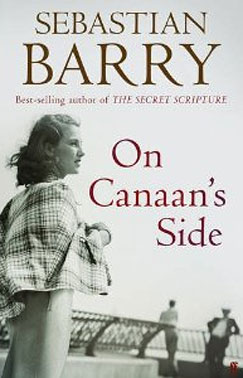
On Canaan’s Side by Sebastian Barry

“Bill is gone. What is the sound of an eighty-nine-year-old heart breaking? It might not be much more than silence, and certainly a small slight sound.”

When this year’s Man Booker Prize longlist was announced at the end of July, one of the titles that I was most looking forward to reading was this one, On Canaan’s Side. I read The Secret Scripture last year and fell in love with Sebastian Barry’s beautiful, poetic writing style. There are some similarities between The Secret Scripture and On Canaan’s Side, the most obvious one being the idea of an old woman looking back on her life, but the stories are different enough to make this book a good read too.

On Canaan’s Side is narrated by Lilly, a retired cook. At the beginning of the book she is eighty-nine years old and has just lost her beloved grandson, Bill, who has committed suicide after returning from fighting in the Gulf War. As Lilly mourns for her grandson, she begins to remember all the things that have happened in her life and over the next seventeen days she shares her memories with us.

Canaan, in the Bible, is the ‘promised land’ and the title On Canaan’s Side represents the idea that many Irish people had that America was a place where they would be safe and happy. Lilly’s story begins during her childhood in Ireland as the daughter of the superintendent of the Dublin police. She is forced to run away to America when both she and her boyfriend, Tadg Bere, find themselves the target of an IRA death sentence. However, Lilly soon discovers that even there, on ‘Canaan’s Side’, she and Tadg are still in danger. The following decades are filled with tragedy and sorrow. Lilly’s story is unbearably sad and yet her voice never becomes self-pitying; she stays a strong and resilient character until the day when her ‘eighty-nine year-old heart’ finally breaks.

At first I thought I wasn’t going to enjoy this book because the first chapter was very ‘stream-of-consciousness’ and it seemed as if it was going to be one of those novels where nothing really happens. But when I got further into the book and the story began to take shape I didn’t want to stop reading. I mentioned at the start of this post how beautifully written The Secret Scripture was and I thought Sebastian Barry’s writing was possibly even more beautiful in this book. I usually prefer books with more plot but the way Barry uses language and imagery is so stunning and mesmerising, the slow pace of the story didn’t bother me.

And it’s really not true that nothing happens: there’s murder, rape and suicide, for a start. Other themes include war (both World Wars, Vietnam and the Gulf War) and how it’s possible to survive a war physically but not mentally; identity and how sometimes we can live with people for years without really knowing who they are; important events in Irish and American history; racial tensions; love and loss.

I loved this book and although it was slow to begin with, I was soon swept away by the quality of Barry’s writing and the atmosphere his words convey. I haven’t read his previous books Annie Dunne and A Long, Long Way but as they are about Lilly’s sister and brother I really should read them soon.

Princes in the Land by Joanna Cannan

This is one Persephone book I had never heard anything about, so I picked it up and started reading without having any idea what to expect. I didn’t know who Joanna Cannan was until I read the biographical information on the cover and saw that she was the mother of Christine, Josephine and Diana Pullein-Thompson, three authors who were famous for their horse and pony stories. I remember reading some of the Pullein-Thompsons’ books as a child, so this made me more curious about reading Princes in the Land.

This novel has very little plot but like most Persephone books it raises a lot of interesting issues including marriage, parent/child relationships and class differences. The book itself is well-written and I liked the setting and the time period, but unfortunately this is the first Persephone I’ve read that I didn’t enjoy much at all.

Princes in the Land, published in 1938, is the story of Patricia Crispin and her experiences of being a wife and mother. We first meet Patricia as a child, shortly after her father has been killed in the Boer War. Patricia and her sister Angela are being taken by their mother to live with their grandfather, Lord Waveney, at his mansion in the countryside. While Angela is the quieter and better behaved of the two girls, Lord Waveney takes a special liking to the red-haired, freckled Patricia, who is more courageous and shares his love of horses.

Several years pass and Patricia marries Hugh Lindsay, a student from a poor background, much to the disgust of her mother who wanted Patricia to marry someone of her own class. Patricia and Hugh have three children, August, Giles and Nicola – and as they grow older they begin to disappoint Patricia as much as she had disappointed her own mother.

The biggest problem I had with this book was the characters. I don’t always need to like the characters to be able to enjoy a book, but in this case I think it would have made a big difference if there had been just one person I had been able to identify with and care about. Patricia and her mother both seemed to be complete snobs. Patricia’s attitude towards her daughter-in-law, Gwen, is particularly nasty and based purely on the fact that she thinks Gwen’s family are ‘common’. I don’t mind reading about snobbish characters if they are written with a touch of humour or satire, as in Jane Austen novels for example, but that wasn’t the case here. Patricia seems to think her attitude is perfectly acceptable and I felt that we, as the readers, were expected to agree with her.

The portrayals of marriage and parenthood were very cynical. The sad thing is that I really liked Patricia when she was a child at the very beginning of the book but as the years went by she changed into a person even she herself didn’t appear to be comfortable with. It’s tragic that despite devoting her life to her children, they barely seemed to know or understand each other at all. None of them really did anything bad and were children who Patricia could have been proud of, but because they failed to meet her expectations she ended up feeling disappointed in them and dissatisfied with her own life.

I’m sure a lot of people would enjoy reading Princes in the Land much more than I did, so please don’t let me put you off reading it. It was an interesting book, worthy of being a Persephone title and I can’t fault the writing either, but the amount of snobbery and class-obsession was just too much for me.

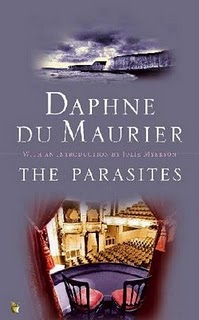
The Parasites by Daphne du Maurier

After reading the first few chapters of Daphne du Maurier’s The Parasites I had a feeling I wasn’t going to enjoy this book. I was finding the story very difficult to get into and I didn’t like any of the characters. But because Du Maurier is one of my favourite authors I decided I didn’t want to give up on the book just yet…and guess what? I ended up loving it! I should have known Daphne wouldn’t let me down.

The Parasites is a study into the lives of the Delaney family: Mama, a famous dancer, and Pappy, a successful singer, and their three children, Maria, Niall and Celia. The story begins one day in the 1940s when Niall and Celia, now adults, are spending the weekend at the home of Maria and her husband, Charles. It’s Charles, losing his temper with them, who refers to the three siblings as ‘parasites’…

“You always have been and you always will be. Nothing can change you. You are doubly, triply parasitic; first, because you’ve traded ever since childhood on that seed of talent you had the luck to inherit from your fantastic forebears; secondly, because you’ve none of you done a stroke of ordinary honest work in your lives, but batten upon us, the fool public who allow you to exist; and thirdly, because you prey upon each other, the three of you, living in a world of fantasy which you have created for yourselves and which bears no relation to anything in heaven or on earth.”

He then leaves the house in a rage, and Maria, Niall and Celia are left alone to wonder what his words meant and if it’s true that they really are ‘parasites’. Through a series of flashbacks and memories, the Delaneys spend the rest of the novel looking back at their childhoods and the things that turned them into the adults they are today.

One of the striking things about this book was the lack of one distinct narrator. Sometimes the three siblings seem to be narrating together, all speaking with one single voice, which was very unusual. It’s difficult to explain, but if you read the book you’ll see what I mean! As I read, I couldn’t help thinking that Maria, Niall and Celia must represent three different sides to Daphne du Maurier’s own personality; she writes so convincingly about all three characters and really gets inside their heads. And of course, her own father was the actor Gerald du Maurier and her mother the actress Muriel Beaumont, so she would have known what it was like to be the child of famous parents and could bring some of her personal experiences into this novel.

Maria, who becomes a famous actress, and Niall, who finds success as a songwriter, are stepbrother and stepsister and have a very strong bond. In her introduction to the book, Julie Myerson compares Maria and Niall with Cathy and Heathcliff from Wuthering Heights. I don’t think this would have occurred to me, but after it was pointed out I could definitely see the parallels.

Celia is half-sister to the other two, sharing a mother with Niall and a father with Maria. Although she also has a strong bond with them both, Celia often feels left behind. Despite her own talent for drawing and writing, she puts other people before herself and stays at home while her brother and sister go off to pursue their dreams. Of the three main characters in the book Celia was the only one who I liked and understood; some of the chapters where she takes a central role are very moving. I really disliked both Maria and Niall, who seemed to me to be very selfish characters who only ever thought about themselves. I found it difficult to feel any sympathy for either of them.

The Parasites may sound like a very serious novel, but there’s actually a good balance of drama and comedy. Some of the scenes are quite funny – in one of my favourite chapters, the Delaney family visit Charles and his parents at their country estate for the first time after Maria’s wedding and completely embarrass themselves! It was nice to see du Maurier’s sense of humour really shining through in this novel.

There are other du Maurier books that I’ve enjoyed more than this one, but after a slow start The Parasites turned out to be much better than I expected. It reminded me a lot of I’ll Never Be Young Again, one of her earlier novels, which was also very character-driven and personal. If you prefer her gothic, suspense-filled novels you may be disappointed, but if you want to try a different type of du Maurier book then hopefully you’ll enjoy this one as much as I did.

When God Was a Rabbit by Sarah Winman

When God was a Rabbit is the story of Eleanor Maud Portman (known as Elly) and is divided into two parts. In the first part, Elly tells us about her childhood growing up in England in the 1970s and introduces us to some of the important people in her life, including her older brother, Joe, her best friend, Jenny Penny – and a pet rabbit called God. We then jump forward fifteen years and rejoin Elly as an adult in the 1990s. Over the years the family experience more than their fair share of dramas and disasters, though there are some good times too. I don’t want to go into too much detail about what happens to them, but the Portmans’ lives are affected by murder, illness, kidnapping, child abuse and terrorism, to name just a few of the tragic events covered in the book.

I enjoyed When God was a Rabbit but I did think it had a few flaws. I often complain that books are too slow for me but if anything, the pace of this one was too fast. I felt that some of the things that happened to Elly and her family deserved to be explored in more depth, but instead the story moved quickly on to a new topic and a new tragedy – it was hard to believe that so many things could possibly happen to one family. I can appreciate that this is fiction and doesn’t have to be realistic, but I was still overwhelmed by the sheer amount of issues the book touches on.

I’m younger than Elly but a lot of the things from her childhood felt familiar to me too. I think for people of a certain age (especially those born around the time Elly was, in 1968) this is a book that could be enjoyed almost as much for the nostalgia and the memories as for the plot. Elly’s personal story is set against a backdrop of historical events including the Queen’s Silver Jubilee in 1977, John Lennon’s death in 1980 and the 9/11 tragedy in 2001. These events and others all affected Elly, either directly or indirectly, and again this is where I felt Sarah Winman was trying to pack too much into one novel.

I don’t want to sound too negative though, because I really was impressed by When God was a Rabbit. I loved the first half of the book and although the second half didn’t have the same feel of magic and innocence, I still found it compelling. I wanted to read on and find out what had happened in the intervening years and how the story would end for Elly, Joe, Jenny Penny and the others. Despite the whimsical title and cover, this book deals with some heavy themes and beneath the charm and humour there’s also a lot of sadness and poignancy. I often had tears in my eyes while I was reading but there were an equal number of scenes that made me smile (especially the school nativity play!). And although I had mixed feelings about this book, I thought the good points outweighed the bad. I would advise you to try it for yourself and see what you think!

The Flight of the Falcon by Daphne du Maurier

Having read most of Daphne du Maurier’s more popular books I’m now slowly working through her lesser known novels (though I’m saving Frenchman’s Creek for last as I’m expecting to love that one and want to have something to look forward to). Published in the 1960s, The Flight of the Falcon was one of her final novels and although I didn’t think it was one of her best, I did still enjoy it. If you’re new to du Maurier I would recommend reading some of her other books first, but this one is definitely worth reading too.

Our narrator, Armino Fabbio, works for Sunshine Tours and at the beginning of the book he is showing a group of British and American tourists the sights of Rome. By chance he becomes indirectly involved in the murder of an elderly peasant woman, who he believes he recognises as his childhood nurse, Marta. Deciding to visit Ruffano, the town of his birth, in an attempt to find out what had happened to Marta, Armino begins to uncover some shocking family secrets.

After Armino’s arrival in Ruffano (which is based on the real Italian city of Urbino), the story begins to revolve around the city’s university and the rivalry between the Arts students and the Commerce & Economics students. The battle between these two groups reaches its climax during the preparations for a festival re-enacting the final moments of the city’s fifteenth-century ruler, the evil Duke Claudio – also known as The Falcon.

As I think I’ve said every time I’ve written about a du Maurier book, one of the things I love most about her writing is the atmosphere she creates. In The Flight of the Falcon she succeeds in making Ruffano, with its medieval streets, historic churches and ducal palace, seem beautiful and picturesque but claustrophobic and forbidding at the same time. Whether she’s writing about Cornwall, Italy, France or any other part of the world, her settings always feel vivid and real.

Not everything about this book worked for me, though. I found I didn’t really care about the university politics and rival student groups, which formed such a big part of the plot. I was much more interested in Armino’s personal story. Armino himself is not the strongest of characters, but I was fascinated by his relationship with his elder brother, Aldo. And I hadn’t realised how many of du Maurier’s novels have male narrators! My Cousin Rachel, The Scapegoat, The House on the Strand, I’ll Never Be Young Again and now this one. Are there any others?

In October, Simon from Savidge Reads and Polly of Novel Insights are hosting a ‘Discovering Daphne’ season, so if you still haven’t read any of Daphne’s books that could be a good time to start.

Possession by A.S. Byatt

Possession is a literary mystery which follows two academics, Roland Michell and Maud Bailey, who are studying the lives of two fictional Victorian poets, Randolph Henry Ash and Christabel LaMotte respectively. When they discover new evidence that suggests the two poets knew each other and may even have been lovers, Roland and Maud begin working together to uncover the truth. Woven into the story are letters, poems, fairy tales and journal entries, all of which feel like authentic Victorian documents. The significance of these is not always immediately obvious but as Maud and Roland continue to find new clues regarding Ash and LaMotte, things slowly begin to make sense.

Possession is one of those books I feel I should have read long before now but never have, partly because I was afraid it might be too clever and intellectual for me. Now that I’ve finally read it I’m glad I got over my fear of it and decided to give it a try, because it wasn’t quite as difficult to read as I thought it would be and in fact was a very rewarding and enjoyable read. I did find it hard to get into at first and almost gave up a few times throughout the first 200 pages, but somewhere in the middle of the book I found myself becoming completely absorbed in the story and didn’t want to put it down.

I’m not a lover of poetry and was tempted to skip some of the longer poems, but although I did try to read them all I know I didn’t pick up on all the little references and metaphors they contained. I would need to read the whole book again to pick up on everything I missed the first time, but I found it such a challenge to read once I don’t think I’ll want to read it again, at least not in the near future.

I enjoyed following Maud and Roland on their physical journey, first around the North Yorkshire coast and then to Brittany, retracing the steps of Ash and LaMotte. This book made me wish I was also on the trail of an important literary mystery – I think it would be fascinating. It’s intriguing to think that an important part of someone’s life can become lost in the mists of time, and when rediscovered can completely change the way we think about them and their work.

As the book progressed, I had a better understanding of what the title ‘possession’ could mean and the various ways in which it could be interpreted. There’s the obvious interpretation of two people in love, but there’s also an intellectual possession – the possession of information, secrets and ideas. Then there are the physical possessions of the letters and writings, and the dispute over who should actually ‘possess’ them. There’s possession in a spiritual, ghostly sense. And the way we become possessed with the desire for knowledge and the wish to ‘possess’ our subject.

There are so many layers to this book that I would need to write a post twice as long as this one to be able to mention everything. There’s feminist symbolism, natural history, legends and mythology, the Victorian fascination with seances and spiritualists. And in addition to all this, Byatt creates an entire history for both Randolph Henry Ash and Christabel LaMotte, to the extent where they feel as if they could really have existed, as if they were real Victorian poets. I can’t imagine how much work must go into writing a novel like this; it’s very, very impressive and I can understand why it won the Booker Prize in 1990.

The House by the Sea by Santa Montefiore

The House by the Sea is the first book I’ve read by Santa Montefiore. The novel consists of two alternating stories, one set in present day England and the other in Italy several decades earlier. The Italian storyline begins in 1966 with Floriana, a ten-year-old girl who lives with her drunken father in a small village in Tuscany. Looking over the crumbling wall of a beautiful villa by the sea, Floriana comes face to face with seventeen-year-old Dante, whose parents own the house. Floriana dreams of one day marrying Dante and escaping from her lonely, miserable life but unfortunately things don’t go exactly as she planned.

In 2009 we meet Marina, a woman in her fifties who runs a hotel on the Devon coast. The hotel is in financial difficulties and in an attempt to save her struggling business, Marina advertises for an ‘artist-in-residence’ to spend the summer at the hotel teaching guests to paint. And so Rafa Santoro, an artist from Argentina, arrives in Devon and proves to be a big success – particularly with Marina’s stepdaughter, Clementine. But as Clementine begins to fall in love with Rafa, she starts to suspect that he may be hiding something.

What is Rafa’s secret? And what is the link between Floriana’s story and Marina’s? At first I had no idea; I couldn’t understand how the two could be connected. Eventually, though, the answers to these questions started to become clear – and there were a few other interesting sub-plots which also kept me guessing. I found myself completely engaged with both threads of the book. We spend quite a lot of time in each period before switching back to the other one, long enough to really get to know the characters and become absorbed in their lives. All of the characters were interesting to read about, even Clementine, who spent most of the book being completely annoying and irritating.

I thought Montefiore did a wonderful job of bringing two such different locations to life. The Devon chapters, with descriptions of cream teas, fishing trips and the office where Clementine works, have a very ‘English’ feel, while the Tuscan sections conjure up the sights and sounds of Italy. I loved both, though the Italian one felt particularly vivid and magical.

I really enjoyed this book and would be happy to read more books by Santa Montefiore, definitely. With mystery, romance, beautiful settings and well-developed characters, The House by the Sea proved to be a perfect summer read!

I received a copy of this book for review from Simon & Schuster