The Secret Scripture by Sebastian Barry

It’s 2011, the start of a new reading year, but I still have a few reviews to post of books that I read in December 2010.  This is the first, and I’ll be posting another two later in the week before I start to discuss my 2011 reading.

The Secret Scripture tells the story of Roseanne McNulty, who has spent most of her adult life in Roscommon Regional Mental Hospital. She’s now almost one hundred years old and has decided to devote her final days to recording her life story in a secret journal. Meanwhile, the hospital is about to be closed down and Dr Grene has begun the slow process of reassessing his patients to see if they can return to the community. There’s something about Roseanne that intrigues him and he becomes determined to find out why she is there and how she came to be admitted to a mental institution.

The story is told in the form of two alternating narratives: the first is Roseanne’s Testimony of Herself in which she relates anecdotes and memories from her childhood in Sligo, Ireland, building up a picture of the events that led to her admission to the mental hospital. Roseanne is a captivating narrator with a strong, memorable voice and her story is absolutely heartbreaking; it seemed her whole life was just one tragedy after another. The second narrative is from Dr Grene’s Commonplace Book, the doctor’s account of his investigations into Roseanne’s past, as well as the details of his own troubled marriage and strained relationships. Although Dr Grene’s voice was not as strong as Roseanne’s, I still found his sections of the story interesting.

I don’t want to say too much about the plot because I think this is one of those books that will have more impact if you go into it knowing as little as possible. What I do want to tell you about is Sebastian Barry’s writing style. His style is quite unusual, very poetic in places, and it took me a few chapters to get used to it. But as the book went on, I became more and more impressed by the quality of the writing. There are so many great lines, such as when Dr Grene describes his relationship with his wife:

Now we are two foreign countries and we simply have our embassies in the same house. Relations are friendly but strictly diplomatic.

Or when Roseanne describes how her mother’s beauty has faded:

She was like a painting with its varnish darkening, obscuring the beauty of the work.

It really was beautifully written and the plot started to take second place to the gorgeous prose.

The author assumes you have some previous knowledge of 20th century Irish history. There are a lot of references to the Free State, the Irregulars, the IRA, Eamonn de Valera, the Royal Irish Constabulary and the Irish civil war, for example. I only have a basic knowledge of Irish history and although I could still follow what was happening, I think I might have got more out of the novel if I’d had a deeper understanding of the historical and political context. I also knew nothing at all about the bombing of Belfast during World War II, described here by one of the characters:

I ran like a demon along the ways, screaming I do not doubt, and saying wild prayers for the people of Belfast, and soon there were hundreds in the streets, all doing the same as me, people in their nightdresses and people naked as babes, running and screaming, and at the edge of the city we just kept going, and the waves of planes had come in behind us, all the while without mercy letting go the bombs, and an hour later or maybe more, I cannot say, I was perched on the edge of a huge dark mountain, and looked back, and Belfast was a huge lake of fire, burning, burning, the flames leaping like red creatures, tigers and such, high high into the sky…

This is just one example of Barry’s vivid imagery; I could have included a lot more.

The only thing that disappointed me about this book was a plot development towards the end that just felt too contrived and unrealistic. If it wasn’t for that one negative point, The Secret Scripture would definitely have been one of my favourite books of 2010.

Highly recommended

Drive-By Saviours by Chris Benjamin

Drive-By Saviours, the debut novel by Canadian author Chris Benjamin, tells the story of two men from very different backgrounds who meet one day on the subway in Toronto and form a friendship that changes both of their lives forever. One of these men is Bumi, an illegal immigrant from Indonesia, on the run from his troubled past. The other is Mark, a Canadian social worker who is growing increasingly disillusioned with his job. As they get to know each other, Mark learns that Bumi is suffering from OCD (obsessive compulsive disorder) and decides to try to help him get the treatment he needs – and at the same time discovers that this new friendship could have important consequences for his own future.

The novel moves back and forth between Indonesia and Canada, with alternating chapters being told from first Bumi’s perspective, then Mark’s. Bumi’s chapters are in chronological order, whereas Mark’s are in the form of flashbacks and anecdotes. This might sound like a confusing structure, but the author handles the transitions very well and the story flows nicely.

This wasn’t a bad book by any means, but overall it didn’t quite work for me. Although I enjoyed the first half of the book, there were a few occasions during the second half where I started to lose interest in the story. And while I thought Bumi was a fascinating and sympathetic character, I felt less engaged with the chapters narrated by Mark. Maybe I just wasn’t the right reader for this book as most other reviews seem to be very positive.

However, there were some things I really liked about this book. First of all, I enjoyed the chapters set in Indonesia which described Bumi’s childhood on a small fishing island and the difficulties he experienced when he was sent to school in the city of Makassar as part of a government experiment. I know very little about Indonesia so it was nice to have the opportunity to learn something about the history, politics and culture of the country. I also found the portrayal of Bumi’s OCD very interesting to read about. The author spent a lot of time describing how Bumi’s obsessions originated and spiralled out of control, what the symptoms were, and how people reacted to his behaviour in a community where most people were uneducated and had a limited understanding of mental illness.

A lot of other interesting issues are touched on, including families being separated by immigration, the effects of tourism and progress on an island community, and life in Indonesia under President Suharto’s regime. But at the centre of the novel is the idea that two people who have grown up thousands of miles apart can discover a number of parallels in their lives and form a bond that transcends their cultural and personal differences.

I received a review copy of this book through LibraryThing Early Reviewers

The Uncommon Reader by Alan Bennett

The Queen has never had much time for reading but when she discovers a mobile library parked behind Buckingham Palace and decides to borrow a book, a whole new world is suddenly opened to her. With the help of her new friend Norman she reads one book after another and discovers that she has a real passion for literature. Unfortunately, not everyone shares her enthusiasm – and some people are prepared to do whatever it takes to stop Her Majesty from reading.

I have a feeling I’m one of the last people in the world to read this book (as usual) but I’m so glad I finally got round to it. Alan Bennett is one of my sister’s favourite writers and as we have such different reading tastes I never thought I would like him too. I’ve never been more pleased to have been proved wrong! This is a lovely, light-hearted, whimsical story that still contains a lot of witty observations, profound insights and wisdom.

In The Uncommon Reader, Bennett takes a humorous look at what it’s like to be the Queen and the pressure she’s under to conform to other people’s expectations. She is portrayed as an endearing character discovering the joys of reading for the first time and who just wants to be left alone with her books! It was interesting to watch the Queen progress as a reader, from being initially overwhelmed by the number of books available and relying on Norman to choose titles for her, to being able to make her own choices and develop her own tastes. Eventually, her reading begins to change the way she approaches her public duties and the way she views herself and the world around her.

There are some very funny moments, such as when the Queen perfects the art of waving from the royal carriage while holding a book in her other hand below the level of the window, and when one of her books is exploded because security think it’s a bomb.

Being a bookworm myself, I loved Bennett’s insights into the philosophy of reading and on almost every page there were quotes that every book lover will be able to identify with. I’ll leave you with a few of them…

‘I think of literature’, she wrote, ‘as a vast country to the far borders of which I am journeying but cannot possibly reach. And I have started too late. I will never catch up.’

‘Can there be any greater pleasure’, she confided in her neighbour, the Canadian minister for overseas trade, ‘than to come across an author one enjoys and then to find they have written not just one book or two, but at least a dozen?’

‘Books are wonderful, aren’t they?’ she said to the vice-chancellor, who concurred.
‘At the risk of sounding like a piece of steak,’ she said, ‘they tenderise one.’

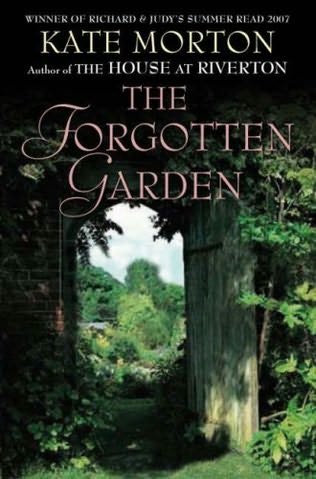
The Forgotten Garden by Kate Morton

Kate Morton’s latest book, The Distant Hours, is getting a lot of attention at the moment but I thought that before I decided whether to buy it I should really read the previous two books of hers that have been sitting on my shelf unread for a long time. I’m so glad I finally decided to pick up The Forgotten Garden because, although it wasn’t perfect, I loved it overall.

In 1913, just before the beginning of World War I, a port master finds a little girl with a suitcase sitting alone on the docks at Maryborough, Australia. With no sign of the child’s parents and no clue to her identity, he takes the girl home with him, where he and his wife name her Nell and raise her as their own daughter. But what was Nell doing in Australia? Who were her real parents? And what is her connection with the mysterious Eliza Makepeace, writer of fairy tales?

When Nell dies in 2005, she leaves everything to her granddaughter, Cassandra – including a cottage in Cornwall, England. When Cassandra travels to Cornwall to investigate, she begins to uncover some secrets about her grandmother’s identity and attempts to solve the mystery of Cliff Cottage.

At first I thought I was going to have a problem with Kate Morton’s writing style. She has quite a flowery, descriptive style which you’ll either love or hate. For example:

Was it always this way? Did those with passage booked on death’s silent ship always scan the dock for faces of the long-departed?

As the book went on though, the writing bothered me less, because I was becoming so absorbed in the story. It had a wonderful atmosphere and was very reminiscent of The Secret Garden in places (the manor house, the invalid cousin, the walled garden – and Frances Hodgson Burnett even makes a brief appearance!) It also felt a bit like a Daphne du Maurier book in places (particularly the Cornwall scenes) and the Swindell family whom Eliza lives with in turn-of-the-century London could have come straight from a Dickens novel. Some of Eliza’s fairy tales are even included in the book which I thought was a nice touch although I wasn’t too impressed with the stories themselves.

The biggest problem I had with this book was the constant jumping around in time and place. One chapter would be set in London in 1900, the next in Brisbane in 2005 and the next in Cornwall in 1975, which disrupted the flow of the story and made it difficult to follow. We also switch narrator with every chapter, which made me even more confused, particularly as there was almost nothing to differentiate between the voices of Cassandra, Nell and Eliza. It was too easy to forget who I was reading about. Eliza’s storyline was by far the most interesting of the three though and I think it would probably have worked on its own as a straight historical fiction novel.

The solution to the mystery was made very obvious to the reader from early on in the book, so when it was finally revealed it came as an anti-climax. This didn’t really spoil the story for me but it was slightly frustrating to watch Cassandra trying to solve the mystery and knowing that she was getting it completely wrong. I would have appreciated it if some of the clues could have been kept from the reader until nearer the end.

Other than those few points, I loved this book, which was great because I really hadn’t expected to. For such a long and complex book it was surprisingly quick to read.

Those of you who have read all of Kate Morton’s books, how does this one compare to The House at Riverton or The Distant Hours?

Review: The Night Watch by Sarah Waters

The Night Watch follows the lives of four very different people during and after World War II. There’s Kay, who drove an ambulance during the war, but now, in 1947, there’s something missing from her life and she wanders the streets of London on her own, a lost and lonely figure. There’s Helen, who is feeling insecure in her relationship with the sophisticated Julia. Then there’s Viv, having problems of her own with her boyfriend Reggie, an ex-soldier. And finally, we meet Viv’s brother Duncan, who was in prison during the war and is still haunted by events in his past.

The story quickly becomes so complex and involved that it would be difficult to tell you any more about the plot without spoiling it. What I can tell you about though, is the structure of the book, which was very unusual. The story begins by introducing us to the characters in 1947, after the war has ended, then moves back in time to 1944, and then in the final section goes back further still to 1941. I both liked this structure and disliked it.

I liked it because of the way it led to some surprising revelations about the characters and their histories. I disliked it because so many storylines were left unresolved. I wanted to know what happened; I wanted to know whether Kay, Helen, Viv and Duncan would find happiness. I think this is probably the first Sarah Waters book I’ve read where I really loved and cared about the characters – they all felt so real and believable. But while the book answered some of the questions about the characters’ pasts, I was left with a lot of unanswered questions about their futures.

In comparison to Sarah Waters’ other books, this one feels much more subdued and quiet, with an overall mood of sadness. Apart from relating some of the obvious horrors of war which affected society as a whole, there are some heartbreaking moments in the personal stories of all four main characters (the story that affected me the most was probably Viv’s). I also found it interesting to read about the various jobs that were available to women during the war. With so many of the men away fighting, this was a time when it was deemed acceptable for women to do jobs that would previously have been done by the men. Kay, as I mentioned, was an ambulance driver, and there were other women also doing the same work. Helen and Viv were employed in more conventional office jobs, but were still contributing to the war effort with Helen providing support for people who had lost their homes or were in financial difficulties, and Viv working as a typist for the Ministry of Food.

As I’ve come to expect from Sarah Waters’ books, The Night Watch is both well written and well researched. She manages to incorporate an incredible amount of detail into the book, but the detail never overwhelms the story. I would recommend this to anyone who enjoys reading about life during World War II and the effects of the war on the lives of ordinary people. But if you loved Fingersmith and are looking for more of the same, I should warn you that this book is about as different from Fingersmith as you could imagine!

Recommended.

Review: The Victorian Chaise-longue by Marghanita Laski

Of all the books in the Persephone catalogue this is the one I’ve been looking forward to reading the most. Maybe it was the word ‘Victorian’ that appealed to me (I’m slightly obsessed with the Victorian period) or maybe it’s just that it has sounded so fascinating in every review I’ve read. I’ve seen this book described as a horror story – ‘a little jewel of horror’. For me, though, it wasn’t so much frightening as unsettling and creepy.

Melanie Langdon is a young mother recovering from tuberculosis in bed at her home in 1950s London. When the doctor tells her she can move to another room for a change of scenery, Melanie decides to lie on the chaise-longue in the drawing room, an ugly item of Victorian furniture she had purchased in an antique shop.

Melanie lies on the chaise-longue and falls asleep – but when she awakens, something has changed. She’s still lying on the same chaise-longue, she still has TB, but it’s now the year 1864, she’s being cared for her by her hostile sister Adelaide, and her name is no longer Melanie – it’s Milly. Is Melanie dreaming? Remembering a previous life? Has she really travelled back in time and become somebody else?

Who is Milly Baines? came the gradual inquiry, and at last she looked, as she had not dared to before, at what was immediately around her, examined, tested, interpreted the feeling of this body of Milly Baines in which was imprisoned the brain of Melanie Langdon.

I have to admit I’m not sure that I fully understood what was supposed to be happening in this book. After thinking about it though, maybe that was the point – the reader isn’t supposed to understand because Melanie herself doesn’t understand. The book conveys a sense of confusion, panic and disorientation and I could really feel Melanie’s helplessness as she lay on the chaise-longue, trapped in Milly’s body, desperately trying to work out who she was and how she could escape.

What makes Melanie’s story so disturbing and nightmarish is that although she has apparently been transported back in time, she has kept all of her twentieth-century ideas and sensibilities. As Milly, she finds herself a victim of the repression of Victorian society and there’s nothing she can do to change her situation.

At only 99 pages, this book can easily be read in an hour, but there’s so much packed into those 99 pages that the story will stay in your mind for a lot longer than that.

Recommended

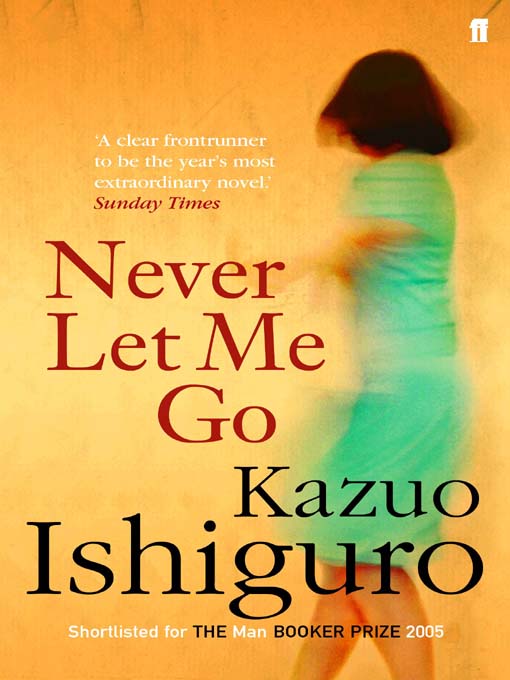
Review: Never Let Me Go by Kazuo Ishiguro

There seems to have been a big resurgence of interest in this book recently, coinciding with the release of the film (in the US now and the UK in January – I’m not sure of the release dates in other countries). I’ve seen a few other reviews this week, and I’m going to add one more.

This was a difficult review to write, because it’s almost impossible to discuss this book without spoiling it. When I started reading it I had no idea what it was about, so I think it probably made more of an impact on me than it would have if I’d known what to expect. I’m sure you could still enjoy it if you did know though, because there’s so much more to this book than the ‘mystery’ – and you may be able to work out what’s happening quite early in the book anyway, particularly if you read a lot of dystopian fiction.

The story is narrated by thirty-one year old Kathy, who is working as a carer, but I can’t tell you who she is caring for or why. In a series of memories and flashbacks, Kathy remembers her childhood at Hailsham School. Right from the beginning it’s obvious to the reader that Hailsham is not your average English boarding school – there’s something very unusual about both the school and its students…

Kathy’s narrative has an interesting structure. She’ll start to tell us something, then go off on a tangent and talk about something else for a few pages, then return to the original story she was telling – and she does this throughout the entire book, which means the plot moves forward very slowly. The whole truth about Hailsham and the fate of the students is revealed very gradually over the course of the novel. And yet, despite the slow pace, I never got bored or lost interest.

After finishing this book I know that I liked it, but I’m not sure how much. This is one of those times when I’m glad I stopped using star ratings on my blog! I found it difficult to care about the three main characters (especially Kathy’s ‘best friend’ Ruth, who I really disliked) or to feel emotionally involved in their story, apart from the final couple of chapters which were very moving. For me the attraction of this book is the range of fascinating questions and issues it raises. I would have liked the book to have explored some of these issues in more detail, but on the other hand I appreciate being left to think about them for myself. And I know I’m going to be thinking about them for a long time.

Recommended