Review: The Scapegoat by Daphne du Maurier

What would you do if you came face to face with yourself? That’s what happens to John, an Englishman on holiday in France, when he meets his exact double – a Frenchman called Jean de Gue.  John agrees to go for a drink with Jean but falls into a drunken stupor and wakes up in a hotel room to find that Jean has disappeared, taking John’s clothes and identity documents with him!

When Jean’s chauffeur arrives at the hotel, John is unable to convince him of what has happened – and ends up accompanying the chauffeur to Jean de Gue’s chateau, where the Frenchman’s unsuspecting family assume that he really is Jean de Gue.  Naturally, they expect him to continue running the family glass-making business and arranging shooting parties – things that John has absolutely no experience in.  Before long, it starts to become obvious that Jean is using John as a scapegoat; Jean’s family and business are both in a mess and he wants someone else to have to deal with them.

Throughout the book, I was forced to revise my opinions once or twice about what was really going on. If everything in the book is supposed to be taken literally, then we need to suspend belief at times: could two men really be so identical that even their mother, wife and daughter can’t tell the difference? There is also another way to interpret the story, one which goes deeper into the psychology of identity – I won’t say any more about that here, but if you have read the book this theory may have occurred to you too.

As usual, du Maurier’s writing is wonderfully atmospheric. She has a way of making you feel as though you’re actually there in the hotel room in Le Mans, the grounds of Jean de Gue’s estate in the French countryside and Bela’s antique shop in the town of Villars.

When John first arrives at the de Gue chateau, every member of the household is a stranger to him but we (and John) are given enough clues to gradually figure out who each person is and what their relationship is to Jean de Gue.  From the neglected pregnant wife and the hostile elder sister to the resentful younger brother and the religious ten-year-old daughter, every character is well-drawn and memorable.

Another thing I love about Daphne du Maurier’s writing is her ability to always keep the reader guessing right to the final page (and sometimes afterwards too).  This was a fascinating and unusual story, one of my favourite du Maurier books so far.

Highly recommended

Pages: 320/Publisher: Virago Press (Virago Modern Classics)/Year: 2004 (originally published 1957)/Source: Library book

Review: I’ll Never Be Young Again by Daphne du Maurier

I’ll Never Be Young Again was Daphne du Maurier’s second novel, written when she was only twenty three years old. It’s different from the other books of hers that I’ve read so far. It doesn’t have the suspense or the gothic feel of some of her other works – this is more of a psychological, character-driven book. It’s the story of Richard, a young man who has grown up in the shadow of his famous father, and his struggle to find his own identity. I’m not really a fan of ‘coming-of-age’ novels, but I’m glad I chose to read this one. It certainly seems to be one of her least well known novels –  and I was concerned that this might mean it wasn’t very good. Well, I can tell you that it is good and I enjoyed it a lot more than I was expecting to.

The book opens with Richard – or Dick as he prefers to call himself – standing on a bridge, preparing to jump. Immediately the reader is intrigued, wondering what has happened to drive him to suicide.  At the last minute Dick feels a hand on his shoulder – this is Jake, a complete stranger who saves his life and becomes his closest friend. The first half of the book follows the adventures of Dick and Jake as they leave England and sail to Scandinavia together in search of a new life. The second half is the story of Dick’s relationship with Hesta, a girl he meets in Paris.

The whole book is written in the first person from Dick’s perspective, which is significant as it was apparently the first time Daphne du Maurier wrote from a man’s point of view – and I thought she captured the male voice perfectly. The only problem I had was that I just didn’t like Dick very much. I found his immaturity and whining very irritating – although I understood that the point of the book was to follow his development from an insecure, selfish youth into a sensible, mature adult. Eventually he does begin to grow up and want different things out of life, but this comes too late in the book for me to be able to warm to him. However, the book is so well-written I could still enjoy it even with such an unsympathetic narrator. Her writing is absolutely beautiful and quite dreamlike, as she lets us get right inside Dick’s head and share his thoughts and emotions. There are also some vivid descriptions of the mountains and fjords of Norway and the other places that the characters visit, particularly Paris with its cafés and boulevards.

This would probably not be the best Daphne du Maurier book for a newcomer to begin with, but it’s a good choice for someone who wants to venture away from Rebecca and read one of her less popular novels. A word of warning, though – if you’re going to read the Virago Modern Classics edition, leave the introduction until last as it gives away the entire plot, including the ending (this is good advice with any book – I’ve learned from experience never to read the introduction first).

This is my first book for the Daphne du Maurier Challenge hosted by Chris at Book-a-rama. I wasn’t planning to take part in this challenge until I discovered my local library had almost all of her books. I’m looking forward to reading some more of her work during the next year, as there are still a lot of her books I haven’t read yet. This book also counts towards the 1930s challenge as it was a contemporary novel published in 1932 and set in 1930s Europe – and also the Typically British challenge.

Pages: 304/Publisher: Virago Press (Virago Modern Classics 515)/Year: 2005 (originally published 1932)/Source: Library book

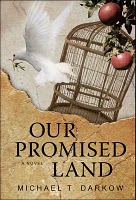
Review and Giveaway: Our Promised Land by Michael T. Darkow

Our Promised Land by Michael T. Darkow is a book about the Israeli-Palestinian conflict over the Holy Land. Keep reading for your chance to win a copy.

My review:

Our Promised Land follows the lives of two families, each on different sides of the Israeli-Palestinian conflict. The story begins during World War II when we see Ellie Liebowisc, who is a Jew, being herded onto a train with his mother and a group of other Jews from their town, having been told that they were going to be ‘resettled’ (‘resettlement’ being a euphemism for the concentration camp and gas chamber). However, Ellie is one of the lucky ones who survives the war and makes his way to the newly created Israel, determined that his people shouldn’t have suffered for nothing.

Next we are introduced to Yasif, a Palestinian boy whose family and neighbours are growing increasingly unhappy about the arrival of the Jews. Yasif is given the chance to go and study in America, but even there he can’t escape from what is going on – and a mysterious voice refuses to let him forget…

Before I started to read this book I thought I might have difficulty understanding it, as the Palestinian-Israeli situation is a subject I know very little about. However, I felt I came away from the book with a better knowledge of the origins of the conflict and why the people involved feel the way they do.

One of the things I really liked about the book was that it is told from both the Israeli and the Palestinian viewpoint, so that the reader is able to see things from two different perspectives. Whilst I was reading Ellie’s sections of the book I felt saddened and angered by the treatment the Jews had received and I could understand his feelings. The opening scenes when he and his mother arrived at the concentration camp were very moving and stayed in my mind even after finishing the book. On the other hand, during Yasif’s part of the story I could sympathise with the Palestinians. This was a good approach for a neutral reader like myself who has no personal involvement in the conflict. The only characters I didn’t sympathise with were those who unfortunately thought the way to solve things was through violence and terrorism.

The book has an unusual structure being told in a series of vignettes, or snapshots of particular moments, moods and ideas. This means it’s sometimes necessary for the story to jump forward in time quite abruptly, but overall I think it was an effective structure. The author also provides a time line at the front of the book to help clarify the historical background.

I would recommend this book to readers who want to learn more about the Israeli-Palestinian conflict.

Publisher: Synergy Books/Year: 2010/Pages: 192/Source: I received a review copy of this book from the author.

Giveaway (Open worldwide)

Would you like the chance to win a copy of Our Promised Land? Michael T. Darkow is kindly offering 5 copies of the book to readers of this blog.

To enter, all you need to do is leave a comment on this post, including a valid email address. Only one entry per person please.

This is an international giveaway and will end on Thursday April 29th.  Good luck!

Review: Watership Down by Richard Adams

I first read Watership Down when I was about 10 years old. It immediately became my favourite book and I re-read it many times. However, it’s been a long time since my last re-read and I wondered if I would still love it as much as I used to.

I know some people may consider a book about talking rabbits to be silly and childish, but Watership Down is not really a ‘children’s book’. It’s one of those books that can be enjoyed on different levels by people of all ages. In fact, the writing style and vocabulary used in this book is of a higher standard than many ‘adult’ books. It’s also not just ‘a book about rabbits’ – it’s a book about friendship, leadership, freedom, adventure, happiness, sadness and so much more.

Hazel and his brother Fiver are two young rabbits living in the peaceful Sandleford Warren. When Fiver has a premonition that the warren is going to be destroyed, he convinces Hazel and several of their friends to embark on an epic journey to find a new home. During their search for Fiver’s ‘safe, high place’, they encounter a number of problems and dangers including humans, predators and even other rabbits. The biggest obstacle of all, however, comes with the realization that as the group consists solely of male rabbits, they urgently need to find some females – this leads to a daring attempt to rescue some does from the overcrowded enemy warren of Efrafa…

Hazel and his friends are not cute little bunnies. They are intelligent, resourceful animals capable of solving almost any problem that is thrown at them. When faced with having to cross a river, for example, they observe that a plank of wood is floating on the surface of the water and they figure out how to use it as a raft. The rabbits are given such human thoughts and emotions that you can easily forget they’re actually not human! However, from a physical and behavioural point of view, they always behave like real wild rabbits. Richard Adams used R. M. Lockley’s The Private Life of the Rabbit as his reference.

Each rabbit has their own individual personality – Hazel is the leader, Fiver the sensitive prophet, Bigwig the fighter, Blackberry the brains, Dandelion the storyteller, Bluebell the clown, and so on. This allows every reader to identify with at least one rabbit and to choose a favourite (mine was always Bigwig, who at the beginning of the book was overbearing and aggressive but learned some important lessons during the journey to Watership Down and ended as one of the most highly respected rabbits in the warren).

One of the things I love about this book is the way Richard Adams has created an entire rabbit world. This includes:

  • A rabbit language, known as Lapine. Even before I began my re-read of the book, I could still remember that hrududu is the Lapine word for car, that a lendri is a badger, and Elil means enemies.
  • A rabbit religion. Rabbits are taught that Frith created the world and is represented by the sun. Inle is the word for moon, and the Black Rabbit of Inle is a grim reaper-type character who appears when a rabbit is about to die. The rabbits often talk about “ni-Frith” – noon – and “fu Inle” – after moonrise.
  • Rabbit folklore. The rabbits love to listen to stories about their hero, the legendary El-ahrairah, ‘the Prince with a Thousand Enemies’.

I think the author’s wonderfully detailed descriptions of the English countryside also deserve a special mention. As almost all of the places he writes about – the farms, hills, valleys and meadows – are places that really exist, it would be possible to follow the rabbits’ journey on a map or even to visit them yourself.

So, did I still enjoy this book as much as I did when I was 10? Yes, of course I did. No matter how many other books I read, Watership Down will always hold a special place in my heart.  I’ll leave you with a favourite quote from the book:

“‘Animals don’t behave like men,’ he said. ‘If they have to fight, they fight; and if they have to kill they kill. But they don’t sit down and set their wits to work to devise ways of spoiling other creatures’ lives and hurting them. They have dignity and animality.'”

Review: Lean on Pete by Willy Vlautin

I received a review copy of this book from LibraryThing Early Reviewers. Willy Vlautin is the lead singer and songwriter with the band Richmond Fontaine and Lean on Pete is his third novel. I’ve seen a lot of other reviewers comparing him to John Steinbeck, though I haven’t read enough of Steinbeck’s work to know whether that’s an accurate comparison.

Charley Thompson is a lonely fifteen year-old boy who lives with his irresponsible single father. The book begins with their arrival in Portland, Oregon, where Charley’s father has been offered a new job in a warehouse. Charley is desperate to get a job of his own so that he can earn enough money to put food on the table but the only work he can find is at the Portland Meadows race track with a disreputable horse trainer called Del. Portland Meadows has seen better days and is now home to hundreds of old, tired horses and second-rate jockeys who can’t get work anywhere else. It is here that Charley meets Lean On Pete, the racehorse who becomes his only friend and companion.

Willy Vlautin uses very simple prose with no flowery descriptions and no big words. As the story is told in the first person from the point of view of fifteen year-old Charley, this writing style is very effective – he uses the kind of language that Charley would realistically use. Despite his miserable home life, Charley comes across as quite a sensible, likeable person, and I really wanted to see him survive and be happy. I did get a bit bored with constantly being told exactly what he had to eat for every meal (usually cheeseburgers, if you’re interested), though I suppose for a teenage boy fending for himself with no money, it was probably quite important!

Almost all of the other characters we meet are drug addicts, alcoholics, or living in poverty, painting a portrait of a side of society we don’t often read about. Most of these people show Charley some kindness, but aren’t really in a position to be able to help him – Charley and Pete are completely alone in the world and there’s a constant atmosphere of sadness and loneliness that hangs over the entire book.

Lean on Pete was a big step away from the type of book I usually read, but I didn’t regret the couple of days it took me to read it.

Genre: General Fiction/Pages: 288/Publisher: Faber & Faber/Year: 2010/Source: Received from LibraryThing Early Reviewers

Review: Spring Bear by Betsy Connor Bowen

I received this novella from the First Reads program at Goodreads. Spring Bear is the story of a girl called Evvie Mallow who lives in the small town of Soper’s Mills, Maine. Evvie’s father suffered bad head injuries in an accident which left him unable to speak or take care of himself, and her mother has become involved with another man – Lester Darrow, a surly, aggressive man who traps bears in the woods.

Evvie dreams of going to California and escaping from the poverty and misery of her home, but when she discovers that she’s pregnant it seems that her chance of a better life has disappeared.

This self-published book is Betsy Connor Bowen’s debut novel. She has achieved what she set out to do, which is to successfully convey the atmosphere of a small town in Maine. I’ve never been to Maine, and the way of life described in the book was very different from my own – in some ways, a simpler way of life but not without its own set of problems and challenges.

Although I could sympathise with Evvie’s sad, lonely existence, I didn’t really feel any connection to any of the other characters – I would have liked to have been able to get to know them in more depth. Maybe if it had been a longer novel, there would have been more opportunity for character development, but for a quick, short read this book was quite enjoyable.

Genre: General Fiction/Pages: 96/Publisher: Lonefeather Productions/Year: 2009/Source: Won from Goodreads

Review: The End of the Alphabet by CS Richardson

When Ambrose Zephyr is diagnosed with an unidentified terminal illness and given only a month to live, he decides to make the most of his final days. Accompanied by his wife Zappora Ashkenazi (also known as Zipper) he sets off on a journey round the world, visiting each city on his list in alphabetical order. Will they make it to the end of the alphabet before time runs out for Ambrose?

At 128 pages, this is more of a novella than a novel and could easily be read in one sitting. I think the book might have lost its impact had it been any longer; I felt that the shortness of the book and the shortness of the individual chapters reflected the speed at which Ambrose’s remaining days were slipping away from him.

I loved the alphabetical theme which runs throughout the book from the characters’ initials (AZ and ZA) to the chapter titles (each stage of their journey is headed with the corresponding letter of the alphabet). Each place they visit brings back memories and evokes strong emotions for both Ambrose and Zipper. Richardson has given his characters a surprising amount of depth for such a short book; it was interesting to see how they each coped with the news of Ambrose’s illness in their own different ways.

Although there is quite a lot of dialogue in the book, the author has decided not to use quotation marks which made following the conversations unnecessarily confusing. I also sometimes found it hard to tell whether certain scenes were happening in the present or in a flashback. However, other readers will probably love his writing style.

Despite the tragic subject matter, I thought it was a warm, charming story and although I probably would never have chosen to read it if I hadn’t won a copy in a competition, it’s an impressive debut novel by CS Richardson.

Genre: General fiction/Pages: 128/Publisher: Portobello Books/Year: 2009/Source: won in a contest