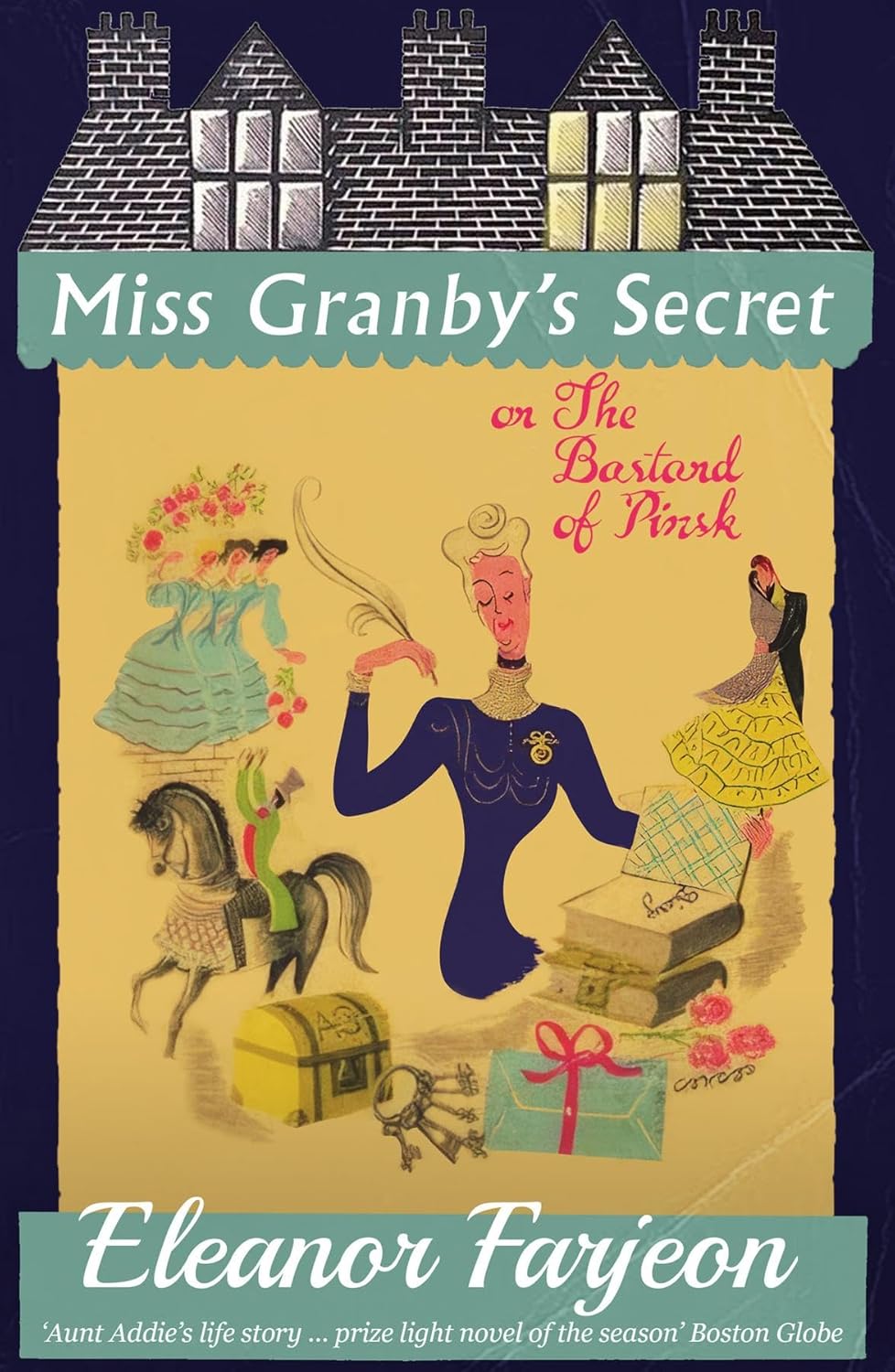
Miss Granby’s Secret: or The Bastard of Pinsk by Eleanor Farjeon

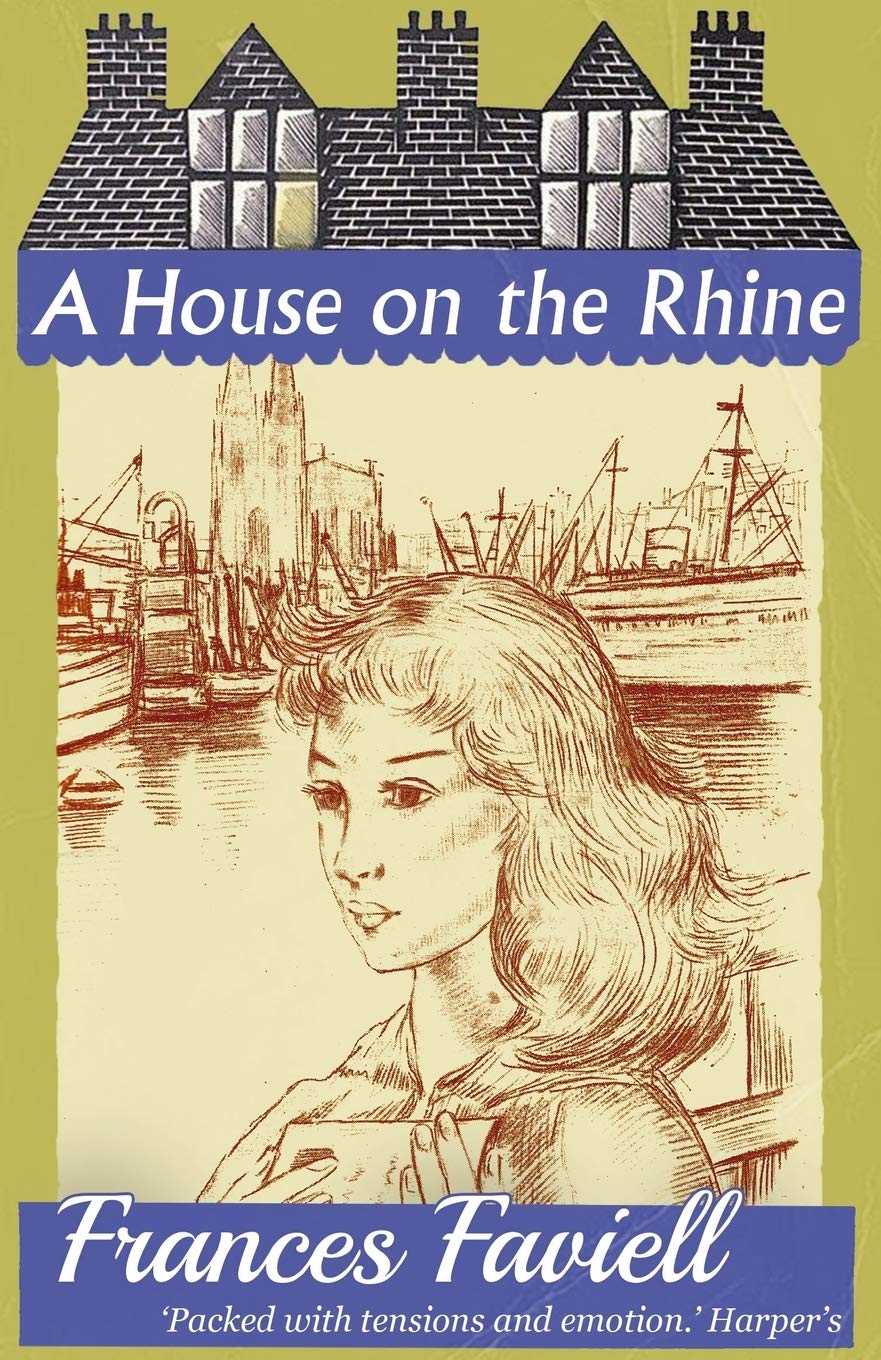
Like many readers who have previously enjoyed books published by Dean Street Press, I was pleased to hear recently that they were continuing with their Furrowed Middlebrow imprint, after a period when the future had looked uncertain. Miss Granby’s Secret: or The Bastard of Pinsk is the first new book since that announcement was made. First published in 1941, it was written by Eleanor Farjeon and this edition also includes an introduction by Elizabeth Crawford.

The novel opens with the death of Miss Adelaide Granby in 1912. Miss Granby had been a prolific and very successful author, publishing forty-nine romance novels and gaining a large readership, but to her great-niece Pamela, she was always just Aunt Addie. Pamela, who considers herself a ‘modern woman’, has long suspected that Addie, who never married, didn’t understand the facts of life – in fact, Addie always insisted that she didn’t want to know, as it would affect the innocence of her writing. When a large, elaborate wreath is delivered to the funeral, then, accompanied by a romantic poem and a card inscribed “from Stanislaw”, Pamela is intrigued by the idea that Addie must once have had a love interest after all.

Pamela has inherited Aunt Addie’s house and her collection of papers, which includes letters, diaries and the unpublished manuscript of her first novel, written when she was just sixteen. This novel is entitled The Bastard of Pinsk (it seems from Addie’s notes that she believes a bastard is “a very noble Hero of Royal Blood”). As Pamela reads the documents she looks for clues to the identity of Stanislaw and wonders if it will be possible to track him down.

The text of The Bastard of Pinsk is included in its entirety, forming a story-within-a-story. Incorporating lots of tropes of the Romantic or Gothic novel, it’s both ridiculous and quite amusing, mainly because Adelaide Granby clearly doesn’t understand the words she’s using or what they imply. Although it was fun for a while, I started to get impatient to go back to the main story, but I’m sure for other readers it will be their favourite part of the book! I can see why the full story was included, though, as some of the things the young Addie writes about have parallels with her own life.

I enjoyed Pamela’s parts of the book and seeing the mystery of Addie’s relationship with Stanislaw unfold and overall I found it a lovely, entertaining read. A good choice for the revival of this imprint!

Thanks to the publisher for providing a copy of this book for review.

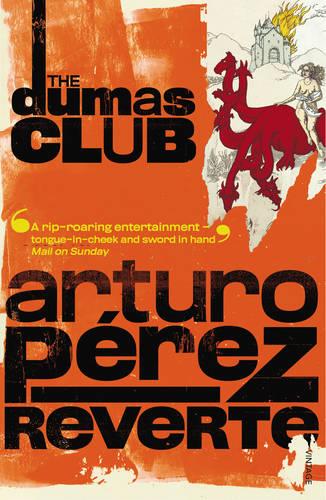
The Dumas Club by Arturo Pérez-Reverte

Translated by Sonia Soto

For Spanish and Portuguese Lit Month, hosted by Stu of Winstonsdad’s Blog, I decided to read a book that sounded perfect for me. A bibliomystery set in the world of antiquarian booksellers, paying tribute to Alexandre Dumas, whose novels I love. What could go wrong?

The Dumas Club (or The Club Dumas – it has appeared under both titles) was originally published in Spanish in 1993 and translated into English three years later by Sonia Soto. You may have watched the 1999 film adaptation The Ninth Gate, starring Johnny Depp; I don’t think I’ve seen it, but apparently it’s very different from the book and completely removes the Dumas connection, which seems strange but maybe they thought there was too much going on and couldn’t include everything.

Lucas Corso is a ‘book detective’ who hunts down rare or valuable books on behalf of his clients. Corso has found that unscrupulous dealers and collectors are prepared to pay large sums of money for the books and don’t really care whether the methods he has used to get hold of them are particularly legal or ethical. In The Dumas Club, we follow Corso as he travels across Europe on two separate missions. The first concerns an early draft of a chapter from Alexandre Dumas’ The Three Musketeers. The chapter, titled Anjou Wine, appears to be written at least partly in Dumas’ own handwriting and Corso’s job is to prove its authenticity.

His second task is more complex and involves a very different kind of book: The Book of the Nine Doors of the Kingdom of Shadows, published by Aristide Torchia in 1666. This rare and sinister book is thought to contain the key to summoning the Devil and Torchia was burned at the stake shortly after its publication. Only one copy is thought to have survived. Corso’s client, Varo Borja, owns a copy of the book which he believes may be a forgery and he wants Corso to examine two other copies, one in Portugal and one in France, to determine which is genuine and which are fakes.

Setting out on his journey, Corso begins to encounter some mysterious strangers who remind him of characters from books. For example, he is pursued by a man with a scar who resembles Rochefort, the ‘Man from Meung’, from The Three Musketeers and he also crosses paths with a young woman who introduces herself as Irene Adler after the character from the Sherlock Holmes stories. Corso is unsure whether these people are interested in The Anjou Wine, The Nine Doors or both, so he must try to keep the manuscripts out of their hands until he has solved the two mysteries.

The Dumas Club is an unusual novel and there were lots of things I liked about it. As a Dumas fan, I enjoyed all the references to The Three Musketeers and other titles; it’s not really essential to be familiar with Dumas, but you’ll definitely get more out of the book if you are. Pérez-Reverte includes a lot of unnecessary information, though, such as a full bibliography of all Dumas’ works inserted into the middle of a chapter. This info-dumping continues throughout the book, as well as lots of long digressions into printing and binding techniques and discussions of first editions, illustrations and rare collections. Some of it is quite fascinating and I think people who love books as physical objects more than for the words they contain will find it particularly interesting, but it doesn’t make for a very quick or easy read.

Although I enjoyed following the Anjou Wine thread of the story, Corso’s second mission revolving around The Nine Doors and the occult was of less interest to me and reminded me too much of The Da Vinci Code. It didn’t help that I didn’t like Lucas Corso at all and found most of the other characters equally unpleasant. Still, the ending is clever and we are given answers to both of the mysteries, so I think my feelings about this book are probably slightly more positive than negative. Another of Pérez-Reverte’s novels was recommended to me a few years ago – Captain Alatriste – and wonder if I would get on better with that one.

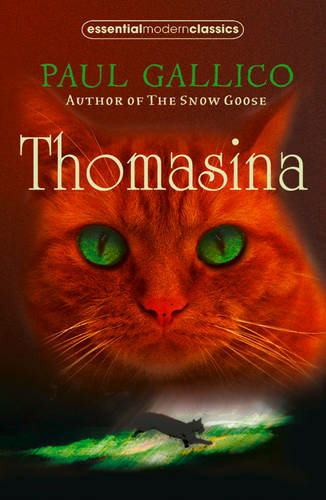
Thomasina by Paul Gallico – #ReadingtheMeow2024

When I saw that Mallika of Literary Potpourri was hosting her second Reading the Meow event this week – a celebration of cats in books – I knew exactly what I wanted to read. The Disney film The Three Lives of Thomasina was a favourite of mine as a child, but it never occurred to me to read the book on which it was based until I noticed that Lory of Entering the Enchanted Castle had read it for last year’s Reading the Meow so onto the list it went!

Published in 1957, Paul Gallico’s Thomasina is set in the fictional Scottish town of Inveranoch. Having lost his wife a few years earlier, veterinarian Andrew MacDhui has moved to the town from Glasgow and opened a surgery there, where he treats the pets of the townspeople, as well as looking after the health of the livestock on the surrounding farms. When the novel begins, MacDhui has only been living in Inveranoch for eighteen months and has already gained a reputation as a cold, bitter man who is good at his job but not mentally suited for it:

The gossips allowed that Andrew MacDhui was an honest, forthright and fair-dealing man, but, and this was the opinion of the strictly religiously inclined, a queer one to be dealing with God’s dumb creatures, since he appeared to have no love for animals, very little for man, and neither the inclination nor the time for God.

Since his wife’s death it seems that MacDhui has given what little love he still possesses to his seven-year-old daughter, Mary Ruadh, who is devoted to her ginger cat, Thomasina. When Thomasina becomes ill with a suspected meningeal infection, Mary takes her next door to her father’s surgery and begs him to save her pet’s life. Not pleased at being interrupted at his work and distracted by a difficult operation on a blind man’s dog, MacDhui tells her that Thomasina can’t be cured and orders his assistant to put the cat to sleep. Heartbroken, Mary vows never to speak to her father again and seems to really mean what she says. As the days go by and Mary’s silence continues, a desperate MacDhui pays a visit to Lori, a young woman who lives alone in the forest and is said to be a witch. Can Lori help repair the relationship between father and daughter or has too much damage been done?

Although I was already familiar with the plot, I found that this novel had far more depth than the Disney version and also a stronger religious element. There’s a lot of focus on MacDhui’s internal struggles as he tries to confront the loss of faith that has been with him since his wife died and on the efforts of Lori and the minister, Angus Peddie, to restore his belief in God and the power of love. Lori, a gentle, compassionate woman who tries to heal injured wild animals that others see as worthless, is a lovely character and reminded me a lot of Froniga in The White Witch by Elizabeth Goudge. However, I didn’t find the book overly sentimental because it’s balanced by the darker themes of loss and grief, as well as animal cruelty and its consequences for those who perpetrate it.

I’m sure younger readers will enjoy the chapters written from Thomasina’s own perspective, where she gives amusing descriptions of life in the MacDhui household, but I never really felt that I was reading a ‘children’s book’ and I think there’s enough here for readers of all ages to enjoy. Finally, without wanting to spoil too much, if you think Thomasina’s fate sounds too sad, I can assure you that her story is a happier one than you might expect.

This is book 3/20 of my 20 Books of Summer 2024.

Earth by John Boyne

Earth is the second in John Boyne’s new quartet of novellas named after the four elements. I enjoyed the first book, Water, so I was looking forward to this one and it didn’t disappoint. Although the two books (and presumably Fire and Air as well) are loosely linked, they are completely separate stories and you don’t need to read them in order. If you have already read Water, you may remember Evan Keogh, the teenage boy we last saw leaving his home on a small Irish island in search of a new life in England. Earth is Evan’s story.

Evan has had a talent for football from an early age, but his true passion is for painting and on his arrival in London he hopes to pursue a career as an artist. After a series of rejections he is forced to accept that he’s unlikely to achieve his dream and with his money running out he reluctantly decides that he will have to use his football skills after all. The book begins with Evan, now twenty-two and a famous footballer, preparing to stand trial for sexual assault. Robbie, his friend and teammate, is accused of rape and Evan has been charged as an accessory for filming the incident on his phone.

For such a short book (under 200 pages), Boyne manages to create a multi-layered story covering a range of important – and often uncomfortable – topics. Much of Evan’s story is told in flashbacks as he remembers his childhood, his strained relationship with his father and his growing awareness of his sexuality (Evan is gay, which can make life difficult both in his small Irish community and in the world of professional football). When he arrives in London he is taken advantage of by an older man who pushes him into work as a male escort, which has disastrous results for Evan. This is what leads to Evan’s decision to become a footballer, despite his dislike of the sport – and again I thought it was interesting to see how Boyne explores the idea of someone achieving huge success in a profession that they don’t enjoy and don’t respect, as well as the various ways in which young men cope with suddenly attaining a level of fame that they’re not really prepared for.

The trial is also a main focus of the book and I found it increasingly frustrating and infuriating to see how the victim was treated in court. I hoped Evan would do the right thing and not just try to protect his friend, but Boyne keeps us doubting him throughout the novel and I’m not going to tell you whether I got the outcome I wanted. Obviously there have been many real life cases of women making allegations of sexual assault against famous people and the courtroom scenes are all the more disturbing because you can easily imagine them happening.

Like ‘water’ in the previous book, Boyne works the element of earth into the story in several different ways, from the soil of Evan’s island home to the ground beneath his feet that is so important to his sport. Of the two, I think I preferred Water but both are powerful books and I’m now looking forward to Fire, coming in November of this year.

Thanks to Doubleday for providing a copy of this book for review via NetGalley.

Water Baby by Chioma Okereke

One of the things I love about reading is that it can take you to places you’ve never visited in real life and are never likely to. Chioma Okereke’s new novel, Water Baby, is set somewhere I knew absolutely nothing about: Makoko, a community built on and around a lagoon in the Nigerian city of Lagos. Although it may sound idyllic, that’s sadly not the case. Makoko, as Okereke describes it, is a place where most of the inhabitants are living in poverty, where the lagoon is dirty and polluted and drug use is a widespread problem. It has become known as Africa’s ‘biggest floating slum’.

The heroine of Okereke’s story is nineteen-year-old Yemoja, nicknamed Baby by her father. Since leaving school, Baby has been earning her living by rowing passengers across the water in her canoe, Charlie-Boy, named after her beloved younger brother, but she and her friends dream of one day experiencing a different way of life. However, with her father trying to push her into marriage with Samson, a neighbour who repairs boats, and with a large family of younger cousins to help care for, the possibility of leaving Makoko seems remote.

Things finally begin to change for Baby when she hears about a newly launched project using drones to create maps of Makoko, increasing the profile and visibility of their settlement. Young women from the community, known as ‘Dream Girls’, are being trained to pilot the drones and Baby is desperate to get involved, despite her father’s distrust of the project. When someone takes a photograph of her on the lagoon, mistaking her for a Dream Girl, the image soon goes viral on social media and Baby finds she has become a celebrity overnight. The opportunity arises for her to represent Makoko at a conference in Switzerland, but will this be the start of a new life for Baby or will she decide that her future lies at home after all?

I thought this book was fascinating, mainly because of the setting and the insights it gave me into a lifestyle so completely different from my own. Okereke describes Makoko so vividly I could already picture what it looked like even before searching for photos to see it for myself. The lives of the people of Makoko are already difficult – making your home on a lagoon means facing problems with sanitation, electricity supplies and running water, not to mention access to education and medical care – but they are also in an unusually vulnerable position regarding climate change:

There used to be more vessels on the horizon, but year on year that’s changing. From the shrinking lagoon size and lesser quantities of fish to water levels rising alongside the rubbish enveloping us. From manmade disasters to unthinkable diseases. Life is always throwing something at us, but we hold our ground.

I liked Baby, but some of the other characters were less well developed; in particular I felt that I never fully got to know her love interest, Prince. I did find Baby’s relationship with her little brother Charlie Boy very moving, though, for reasons that I can’t really explain here without spoiling the story! Although Baby and her friends are fictional characters, the Code for Africa mapping project and the Dream Girls are real and I found it interesting to read more about them after finishing the book.

Thanks to Quercus for providing a copy of this book for review via NetGalley.

Rosabelle Shaw by D.E. Stevenson – #1937Club

My third and final book for 1937 Club, hosted by Stuck in a Book and Kaggsy’s Bookish Ramblings, is Rosabelle Shaw (also published as The Story of Rosabelle Shaw) an early novel by D.E. Stevenson. Wikipedia describes Stevenson as an author of ‘light romantic novels’, but I have read several of her books and although some of them fit that description, others (such as her dystopian novel, The Empty World) do not. This is another that is not a typical Stevenson novel and I found it suprisingly dark.

The novel begins in 1890s Edinburgh with Fanny Dinwiddie, a pretty, lively young woman, who catches the eye of John Shaw, a farmer visiting the city on business. For John, it’s love at first sight and it’s not long before he is heading back to Shaws, his farm near the Scottish coast, with Fanny as his wife. It takes Fanny a while to adjust to her new home – she has left behind her father and beloved sister, Alison, and she misses the social life of Edinburgh – but eventually she begins to settle in and make friends and soon a daughter, Rosabelle, is born. At this point, I was expecting a gentle, domestic novel about the life of a farmer’s wife on a Scottish farm…but I was wrong.

When Rosabelle is three years old, a ship is lured onto the rocks near Shaws farm during a storm. John thinks he knows who is responsible for causing the wreck and is filled with guilt for not doing more to stop it, but is able to make amends by rescuing and informally adopting the only survivor of the disaster, a small child with whom Fanny immediately forms a bond. Nobody knows the little boy’s name or the identities of his real parents, so John and Fanny raise him with their own children and name him Jay. From the moment Jay enters their lives, tensions begin to form in the Shaw household. Unlike Rosabelle and her real brother and sister, Jay is a deceitful, jealous and manipulative child determined to get his own way. John struggles to like the boy, while for Fanny he can do no wrong, causing the first real disagreements of their married life.

Moving forward several years, we meet the Shaw children again as young adults. Rosabelle has begun to look at Jay in a different light, captivated by his good looks and charisma, and begins to fall in love, much to the dismay of her neighbour Tom, who was hoping to marry Rosabelle himself. But there could still be a chance for Tom after all, because Jay is about to bring shame on the Shaw family and betray their kindness and generosity, breaking the hearts of both Rosabelle and Fanny.

I found Rosabelle Shaw quite enjoyable, but it seems to have had mainly negative reviews, maybe because the melodramatic, almost Gothic feel isn’t what you would expect from Stevenson. A lot of people have also complained about the racism, which I noticed as well – it’s definitely implied that because Jay arrived on a foreign ship and is possibly Spanish, he is naturally sly and untrustworthy, unlike the good, honourable Scottish characters. The book reminded me very much of Wuthering Heights, with Jay being similar to Heathcliff, who is also of unknown parentage and nationality and causes nothing but trouble for the Earnshaw family (Rosabelle is obviously in the role of Catherine Earnshaw, who falls in love with her adopted brother).

The book takes on a slightly different tone towards the end when, in 1914, war breaks out and brings big changes to our characters’ lives. From this point, the focus of the book shifts away from Jay to concentrate on the war and how it affects the family at Shaws. I thought it was a fascinating novel, but it won’t appeal to everyone and there are probably better places to start if you’re new to Stevenson. For me, though, it was another good choice for 1937 Club!

Caroline England by Noel Streatfeild – #1937Club

My second book for this week’s 1937 Club (hosted by Stuck in a Book and Kaggsy’s Bookish Ramblings) is by an author who was a childhood favourite but whose adult fiction I’ve only recently begun to explore. I loved her 1940 novel, The Winter is Past, set during the early stages of World War II, so when I saw that Caroline England was published in 1937 it seemed a perfect choice for the club.

The novel begins in 1870 with the birth of Caroline Torrys, the first child born to James and Selina Torrys of Milston Manor in Kent. The Manor has belonged to the Torrys family since the 16th century and James, desperate for a male heir, is disappointed with the arrival of a baby daughter. As the years go by and Selina becomes weak and worn down with her efforts to please her husband and produce a son, Caroline is raised in the nursery by a strict and often cruel nurse. Growing up nervous and anxious, with her spirit broken, Caroline eventually finds a way of escape when she falls in love with a writer, John England, and elopes with him. Caroline’s upper class family disapprove of John, whose father owns a shop, and she is cut off from the Torrys and her beloved Milston Manor.

The next part of the book follows Caroline through her marriage to John and the birth of her own children, whom she vows to treat with the kindness and affection she herself was starved of as a child. However, as her children grow older she finds that they don’t necessarily want her ‘interfering in their lives’ – and that John is the one demanding her time and attention. We then get to know Caroline’s children as adults and see how the family copes during World War I and its aftermath until finally, in the last section of the book, we join Caroline as a grandmother, living in a world that has changed beyond recognition.

I’ve probably given the impression that this book is very depressing – and it’s true that despite her privileged start in life, things are difficult for Caroline at times – but it’s not as bleak and miserable as it sounds. Although Caroline’s experience of being a wife and mother is not quite as blissful as she had hoped, she makes the most of what she has and finds happiness where she can. She also grows and changes as a person, as the post-war world grows and changes around her and the social system she once took for granted begins to collapse. By the end of the book, Milston Manor no longer belongs to the Torrys family and is being converted into a hotel, while Caroline herself is forced to think differently when she gets to know her son’s working-class fiancée, a woman she would have once considered ‘not our sort’.

I found the first section of the book, describing Caroline’s childhood, the most compelling because Streatfeild writes about child characters so convincingly. It was so interesting to read her portrayal of Caroline’s life in the nursery and the different methods used by her first nurse, the warm and loving Naomi, and the cold, abusive woman who takes her place, and then to see how Caroline’s upbringing affects her own choices as an adult. The later chapters, which concentrate more on Caroline’s sons and daughters, interested me slightly less, but I often find that to be the case when a family saga moves on to the next generation.

Of the two adult Streatfeild novels I’ve read, I preferred The Winter is Past as it was more tightly plotted, whereas this one covers a much longer period of time and has less focus. I enjoyed both, though, and look forward to trying some of her others.