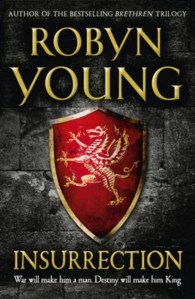
Insurrection by Robyn Young

Insurrection - Robyn Young Insurrection is the first in a trilogy telling the story of Robert the Bruce, who was King of Scotland in the 14th century. The second book, Renegade is available now and the third, Kingdom, will be out this summer. In this first novel, beginning in 1286, we meet Robert as a young boy in a Scotland torn apart by the sudden and unexpected death of King Alexander III. The King has died without a male heir, leaving the succession to the throne undecided. The Bruces believe they have a strong claim, but they face competition from their enemies, John Balliol and the Comyns.

In England, meanwhile, King Edward I is forming his own plans for Scotland. Beginning a search for four ancient relics that will enable Merlin’s Last Prophecy to be fulfilled, Edward enlists the help of a group of young noblemen known as the Knights of the Dragon. When Robert, sent to England to restore his family’s reputation, is approached by the Knights, he must decide exactly where his loyalties and ambitions lie.

Insurrection is exactly the sort of historical fiction I love. As someone who reads a lot of historical novels I often find that they either focus too much on romance and court intrigue or are too action-packed with one long battle scene after another. I had neither problem with this book; I found it to be a fascinating, atmospheric tale of kings and knights, witches and soldiers, treachery, murder and war. The descriptive writing is wonderful and the battles (yes, there are a few) are well written and easy to follow. I admit that my heart sank when I discovered this was yet another book with an ‘ancient prophecy’ storyline, but I needn’t have worried because it is only one small part of the plot and I thought it actually felt quite plausible as it’s true that Edward I really did have a fascination with Arthurian legend.

Robert the Bruce is a name I’ve always been intrigued by without really knowing much about him. I have a memory from years ago of going out with my parents one Sunday afternoon on what my dad always called ‘an aimless drive’ and ending up in Dumfries and Galloway in Scotland where we noticed a sign pointing to ‘Robert the Bruce’s Cave’ – the cave where Robert supposedly went into hiding from Edward I in 1306 and was famously inspired by a spider weaving its web. Not one of the most exciting places I’ve ever visited (there wasn’t even a spider in sight when we went to look inside the cave), but it has stayed in my mind all these years later!

Because I knew so little about Robert and this period of history, I felt that I was really learning a lot from Insurrection. Everything felt accurate and thoroughly researched and although I had to concentrate to keep track of the complex politics and relationships between the characters, I was never bored. At the end of the book there’s a character list, glossary of medieval terms and a chart showing the order of succession to the Scottish throne, all of which I found useful.

Of course, this is a work of fiction rather than non-fiction so there are times when the author doesn’t stick exactly to the known facts. For example, the deaths of Alexander III and his granddaughter Margaret, Maid of Norway may have had more innocent causes than those described in the book. The Knights of the Dragon is also a fictional order, although the men who belong to it really existed. Robyn Young explains some of her choices in her author’s note so that we can see where she has used her imagination to fill in some gaps and provide motivations for the actions of her characters.

I know this book will not suit all tastes in historical fiction (some readers might dislike the inclusion of prophecies and witchcraft or will be disappointed by the lack of significant female characters and the fact that Robert himself is not always easy to like) but I absolutely loved it. I’m looking forward to reading Renegade and Kingdom and also exploring Robyn Young’s earlier trilogy on the Knights Templar.

The Chains of Fate by Pamela Belle

The Chains of Fate This is the second book in Pamela Belle’s Heron series, set in the 17th century and following the adventures of Thomazine Heron and her family in an England torn apart by civil war. I loved this one almost as much as The Moon in the Water, which I read last month, and would highly recommend these books to anyone who enjoys family saga-style historical fiction. The only problem is that they are now out of print, but I definitely think it’s worth trying to find copies.

*Spoiler warning – As this is a sequel and as the previous book ended on such a big cliffhanger, it would be almost impossible for me to discuss this novel without making references to the first one. If you’re interested in this series, please see my review of The Moon in the Water before reading any further!*

The Chains of Fate begins where The Moon in the Water ended, with Thomazine embarking on a journey north to Scotland in search of her cousin and lover, Francis Heron. Believing Francis to have drowned, Thomazine had married Dominic Drakelon before discovering that she had been misled and he was not dead after all. Leaving her husband and baby son behind, she sets off to find Francis with only her friend Grainne, servant Holly and Grainne’s two young children for company. The road north through a country at war is not without its dangers but Thomazine eventually arrives at the Borders home of her Graham cousins – only to discover that convincing Francis of her innocence will not be as easy as she’d hoped.

Will Francis and Thomazine find happiness together in the end or will they be separated forever by war or by the evil scheming of cousin Meraud? I’m not going to say any more because the story that unfolds throughout The Chains of Fate is a wonderful, epic tale of love, war and betrayal and I wouldn’t want to spoil a single page of it for you.

Much as I enjoyed reading this book, however, it’s not without a few flaws that prevented me from loving it quite as much as the first book. While I love Thomazine as a narrator, the fact that she is telling her story in the first person means that she is usually far removed from the centre of the Civil War action. The outcomes of various battles and the movements of the armies are described to Thomazine through letters or gossip picked up in taverns and I thought this became a bit tedious at times. Having said that, I am not a big fan of battle scenes, so I did appreciate the focus on ordinary families and the people who were forced to stay behind, worrying about their loved ones in the thick of the fighting.

I was also slightly disappointed that Thomazine and Francis are kept apart for such long stretches of the book. The other storylines the author brings into the novel – the relationship between Thomazine and her little boy, Kit; the love affairs of Grainne, Lucy and Jamie; and the question of who will inherit Goldhayes – were compelling too and did interest me, but I still found myself getting impatient wondering when Francis was going to make another appearance!

Anyway, this was another great book and I’m now looking forward to reading the third one, Alathea – but apprehensive too because I’m aware that it’s about the next generation of Herons and in my experience sometimes a series is not as good once we leave the original characters behind. I’m hoping this won’t be the case with Alathea and it shouldn’t be too long before I have the chance to find out.

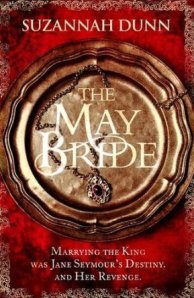
The May Bride by Suzannah Dunn

The May Bride One day in May 1536, Jane Seymour became Henry VIII’s third wife – but she is not the only May bride in Suzannah Dunn’s new novel. The other is Katherine Filliol, the wife of Jane’s elder brother, Edward. Jane is only fifteen when Edward first brings Katherine to Wolf Hall, the Seymour family home, and she is instantly captivated by her beautiful new sister-in-law. Jane and Katherine become close friends – or so Jane thinks, but gradually she discovers that Katherine has been keeping secrets from her and that her marriage to Edward may not be as perfect as it first appeared.

I had my doubts about this book before I started reading it because I had tried to read another of Dunn’s books a few years ago, The Confession of Katherine Howard, and didn’t get very far with it before giving up, not having connected with the writing style or the characters at all. I wondered if I would have the same experience with this book, but luckily that didn’t happen; I found this one much more enjoyable and easier to get into.

I’ve read a lot of novels set during the Tudor period, but this one is slightly different, for several reasons. First, it is a very domestic story, being set almost entirely at Wolf Hall with only the final, shortest section of the book covering Jane’s time at court as lady-in-waiting to Katherine of Aragon and Anne Boleyn. Until that last section there are so few mentions of politics, court intrigues or famous people of the period (apart from the Seymours themselves) that it could almost have been a story about any other wealthy Tudor family going about their daily lives.

I also found it intriguing that although Jane is the most famous Seymour and the one who is narrating, this novel is actually about Katherine Filliol as much as it is about Jane. I didn’t know anything about Katherine before reading the book and although Suzannah Dunn admits in her author’s note that there is very little historical information available on Katherine (and no record of what eventually happened to her) I still appreciated the fact that she had chosen to focus on a little-known character who is not usually the subject of historical fiction.

Finally, this book is written in a style that feels very modern and there is no real attempt to use language appropriate to the period. This is something that usually irritates me, but in this case I think it actually worked quite well once I got used to it. Because this is a family drama, with the emphasis on exploring the relationships between Katherine, Jane and the other Seymours, the fresh and contemporary feel made it easy to identify with the characters. I thought Jane’s brothers, Edward and Thomas, with their very different personalities, were particularly well drawn.

Compared with some of Henry VIII’s other wives, Jane Seymour as queen is often portrayed as quiet and uninteresting but here the young Jane comes to life as a loyal and loving person who is able to see the best in everyone. Unfortunately I didn’t share her fascination with Katherine, but I suppose that’s because I was able to pick up on clues and nuances that wouldn’t have been obvious to an innocent fifteen-year-old girl who is dazzled and enchanted by her new friend.

Although I maybe haven’t learned as much about Jane as I would have done from a more conventional historical novel, I did enjoy reading about her early life and the experiences that shaped the woman and queen she would become.

I received a copy of this book for review from the publisher via NetGalley

The Gondola Maker by Laura Morelli

The Gondola Maker The Gondola Maker is set in Venice in the 16th century and tells the story of Luca Vianello, the son of a gondola maker. As the novel opens in 1581, Luca’s future seems secure – he will marry Annalisa Bonfante, the blacksmith’s daughter, and on his father’s death he will inherit the family business. However, when a tragedy unexpectedly tears the Vianello family apart, Luca is forced to leave the squero (boatyard) behind to seek a new life and career for himself.

I was lucky enough to visit Venice for the first time last year and reading The Gondola Maker reminded me of what a beautiful, unique city it is and how I would love to go again. The author’s descriptions are so vivid that whether or not you’ve been to Venice you’ll be able to picture the grand palazzos of the rich merchants and noblemen lining the Grand Canal, the sun setting behind the basilica of San Marco, the view across the lagoon to the island of San Giorgio Maggiore, and the inside of a prison cell in the Doge’s palace.

Being a novel about a family of gondola makers, it’s no surprise that we are given lots of information on the art of gondola making. And it really is an art! As we accompany Luca on a mission to restore one of his grandfather’s old gondolas, we see how many different people are involved in the process, from the remèri who make the oars and the fórcole (rowlocks which secure the oar) to the blacksmiths who construct the ferri (the metal decorations at the prow). Each of these artists pours their skill, knowledge and love into their work so that each complete gondola is an object of beauty and perfection.

This was all much more interesting to read about than I had expected, but of course there is more to this story than just the making of boats. While it’s true that most of Luca’s time is spent among fellow craftsmen and gondoliers, after he leaves the family squero his adventures also bring him into contact with a successful portrait painter, a maker of costumes for balls and carnivals, and a beautiful young woman who becomes his love interest. Luca himself is a character I found easy to like, which is fortunate as he is narrating his story in the first person, meaning we spend the entire novel in his company.

This is not a particularly fast-paced book and Luca’s story is not always very dramatic, but despite this I did enjoy The Gondola Maker. I found the ending of the book too abrupt and the conclusion of the romantic storyline wasn’t very satisfying which was a bit disappointing, but this didn’t spoil the rest of the novel for me. It was good to have an opportunity to learn about the creation of gondolas, a subject I had never read about or even thought about before – and I loved visiting Venice again, albeit through fiction this time, instead of in person!

1-iRead Button small(1) I read The Gondola Maker as part of an iRead Book Tour. For more reviews, interviews and giveaways please see the tour schedule.

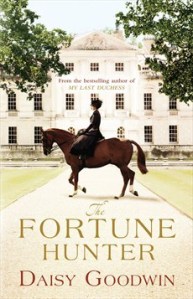
The Fortune Hunter by Daisy Goodwin

The Fortune Hunter Set in 1875, this is the story of two women and their love for the same man, Captain Bay Middleton, a cavalry officer and renowned horseman. One of these women is Charlotte Baird, heiress to a fortune, whose brother is a friend of Bay’s from the army. Bay asks Charlotte to elope with him but she convinces him that it will be best to wait nine months until she comes into her inheritance. However, this could be a mistake because in the meantime the Empress Elizabeth of Austria and her retinue arrive at nearby Easton Neston for the hunting season.

Elizabeth – or Sisi, as she is known to her friends – is the wife of Franz Joseph of Austria. Bored with her marriage and with constantly being in the public eye, Sisi is looking forward to spending some time in the English countryside riding and hunting. Sisi is an excellent horsewoman herself, and when Bay Middleton is given the job of acting as her ‘pilot’ (or guide), she and Bay find that their shared passion for horses leads to passion of a different sort. They are unable to keep their affair secret and when people begin to gossip about the Empress and her relationship with her pilot, Bay must decide whether his fascination with Sisi is more important than his love for Charlotte and his dream of winning the Grand National.

This novel is based on a true story – Sisi, Bay and Charlotte are all people who really existed – but it’s probably not one that many people will be familiar with. I certainly wasn’t. However, having read the author’s note and also the small amount of information I could find online, it seems that The Fortune Hunter is largely fictional and only loosely based on the real life story. There are some significant differences, such as the fact that the events of the novel take place over just a few months while in reality, Bay was Sisi’s pilot for five years. But whether or not the characters and their actions were completely true to life, it didn’t matter to me because the author made them feel so real and made me care about them so much that I found myself thinking about them even when I wasn’t reading the book.

The Empress Sisi, who I admit I knew nothing about before starting this book, must have been a fascinating woman. She was also known as a woman of great beauty and I was interested to read about how she would have her floor-length hair tied to the ceiling at night to relieve the pressure of its weight on her head and how she would cover her face in strips of raw meat to freshen her complexion. I particularly enjoyed a scene in the novel where Sisi meets and makes conversation with Queen Victoria, a very different type of monarch with very different views!

Although I was unable to find out anything about the real Charlotte Baird beyond her name, the fictional Charlotte is another character I loved. I enjoyed reading about her experiments with photography, a hobby that in Victorian England was not considered entirely appropriate for a young woman. But the character I was drawn to the most was Bay Middleton. I never doubted that he loved Charlotte but it was easy to see how he became captivated by the Empress and why he was ashamed of his behaviour while at the same time being unable to stop himself. It was not clear to me what the outcome of the story would be for Bay, for Charlotte or for Sisi and I was kept in suspense until the final chapter.

There are also some great secondary characters including Caspar Hewes, a flamboyant American photographer; Augusta Crewe, who is engaged to Charlotte’s brother; and Chicken Hartopp, a disappointed suitor of Charlotte’s. Another favourite was Bay’s grey mare, Tipsy – I thought the relationship between Bay and his horse was well written and very touching. There’s a lot of period detail too and the setting feels believably Victorian, with no irritating anachronisms or language that feels inappropriately modern.

This is a long novel (there were more than 600 pages in the version I read) but I was so engrossed in the story that I didn’t really notice the length. I loved this book and now I need to find a copy of Daisy Goodwin’s first novel, My Last Duchess.

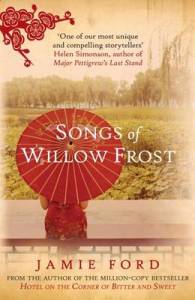
Songs of Willow Frost by Jamie Ford

Songs of Willow Frost William Eng has spent the last five years of his life in the care of the nuns at Seattle’s Sacred Heart Orphanage. It’s 1934 and living conditions at the orphanage are very poor, particularly for William who is Chinese-American and considered inferior to most of the other children. But William is not at all sure that he is actually an orphan – although he has never known his father, the last time he saw his mother she was being carried out of their apartment by a doctor, promising that she’d be coming back soon.

On William’s twelfth birthday he and the other boys are taken to see a film as a special treat and William becomes convinced that one of the actresses he sees on the screen, Willow Frost, is his mother. With the help of his best friend, a blind girl called Charlotte, he sets out to find Willow Frost in the hope that she can answer the question that has been troubling him for five years – what can lead a mother to abandon her child?

Having loved Jamie Ford’s previous novel, Hotel on the Corner of Bitter and Sweet, I was looking forward to reading this one. If anything, this book was even more ‘bitter and sweet’ than the first! At times it was so sad that I wasn’t sure if I could bear to continue reading, but even while my heart was breaking for William and his mother it was obvious that they loved each other and that gave me a glimmer of hope. I wanted them to find the happiness they deserved and that was what kept me turning the pages.

Although we begin in 1934 with William in search of Willow Frost, at least half of the novel is actually set several years earlier in 1921 and follows the story of the young Willow – or Liu Song as she was originally known. It was the 1921 section of the story that I found particularly upsetting to read; being Chinese, a woman and unmarried, life is not easy for Liu Song and it seems that every bad thing that could possibly happen to her does happen. While her stepfather, Uncle Leo, is the villain of the book, I was equally furious with the attitude of a social worker who supposedly had William’s best interests at heart but was clearly only concerned with punishing his mother for what she claimed was immoral behaviour.

Despite the overwhelming sadness, I enjoyed Songs of Willow Frost. There are some great descriptions of Seattle in the 1920s and 1930s and we are given some fascinating insights into the city’s Chinese community and the lives of people struggling to survive during the Depression. I didn’t find this book quite as satisfying as Hotel on the Corner of Bitter and Sweet and there were one or two aspects of the plot that didn’t resolve the way I would have liked them to but overall I thought this was a wonderfully poignant and moving story.

Thanks to Lovereading for the review copy

Kingmaker: Winter Pilgrims by Toby Clements

Winter Pilgrims On a cold winter’s morning in 1460, a band of armed horsemen approach the Priory of St Mary near Lincoln. One of the monks, Thomas Everingham, is outside the priory walls that morning, having been sent out to kill a fox that has been caught in a trap, and when he notices that the soldiers are about to attack two nuns (one of whom is Sister Katherine, a young woman who has spent most of her life in the priory) he decides to intervene. In the scuffle that follows, Thomas seriously injures one of the men, who happens to be the son of the nobleman Sir Giles Riven. With the furious Sir Giles seeking revenge, Thomas and Katherine (disguised as a boy called Kit) are forced to flee the priory.

After living for so many years in their isolated religious community, Thomas and Katherine have little knowledge of the world beyond and are surprised to find that England is in the midst of war. Henry VI is still on the throne but is under threat from the Duke of York and Earl of Warwick, whose armies are gathering in Calais in preparation for the next stage of what will become known as the Wars of the Roses.

With the help of pardoner Robert Daud, who leaves them a bag containing a mysterious book, Thomas and Katherine reach Calais and join the company of two of Warwick’s men, Sir John Fakenham and his son, Richard. Here Thomas learns to use a bow and Katherine increases her knowledge of healing, skills they will need when they return to England to face their enemy, Sir Giles Riven, and to play their part in the bloody battles of Northampton and Towton.

Although this book has already received lots of glowing reviews, I’ll admit that I had my doubts about it before I started reading. I thought it might be too similar to Conn Iggulden’s Wars of the Roses novel, Stormbird, which I read last year and struggled with. Luckily, while there were some similarities and I suspect that most people who did love Stormbird will love this book too, I did enjoy this one quite a bit more.

This is one of my favourite historical periods but I never get bored with reading about it; each book I pick up offers something new and adds to my knowledge of the subject. This novel is slightly different from most of the others I’ve read that are set during the Wars of the Roses, because instead of concentrating on the kings and queens, the rich noblemen and powerful battle commanders, the focus here is always on the ordinary people – people like Thomas, Katherine and their friends who have no involvement in politics and decision-making, but are risking their lives for York or for Lancaster.

I was interested to learn that Toby Clements had attended re-enactments and living history camps and even tried using a longbow, all as part of his research for this novel. The research has really paid off because his writing has a feel of authenticity that is sometimes lacking in other books. I could almost imagine that I really was standing in the middle of a muddy battlefield with arrows flying around me, walking through a smelly, bustling market place or watching Katherine performing surgery without the benefits of modern medicine. There’s certainly nothing glamorous about this story!

I only have two minor complaints about the book – and both are entirely a matter of personal taste. First, it is written in present tense which is something I almost always find slightly irritating. It seems to be an increasingly common choice of authors these days and is becoming difficult to avoid, but I still don’t like it and find past tense much easier to read. Clements also devotes more time to the battles (and fights, brawls, archery sessions etc) than I would have liked, but although I didn’t particularly enjoy reading these scenes I can appreciate that they were written very well, especially the Battle of Towton. As I said, though, other readers will not necessarily have a problem with either of these things.

Kingmaker: Winter Pilgrims is the first in a series. At the moment I’m undecided as to whether I want to continue with the second book, but I did end up enjoying this one for the different perspective it offered on a period I love.

I received a copy of this book from the publisher for review via NetGalley