Frog Music by Emma Donoghue

Frog Music This is the second book I’ve read by Emma Donoghue – the first was Room, which I enjoyed, and since then I’ve been wanting to try one of her historical fiction novels. This new one, Frog Music, is set in San Francisco in 1876 and is based on a true crime story.

Twenty-four-year-old Blanche Beunon, once a star of the Cirque d’Hiver in Paris, is now a dancer in a San Francisco burlesque club. She lives in the city’s Chinatown with her lover, Arthur Deneve, and his friend – and former partner on the flying trapeze – Ernest Girard. One week in August, two newcomers enter their little circle. One of these is P’tit, Blanche and Arthur’s baby boy, reunited with his parents after a year of separation. Blanche has rarely even thought about her baby during his absence, but now she discovers what being a mother really means.

The other new arrival is a woman called Jenny Bonnet, just released from jail after being arrested for the crime of dressing in men’s clothes. Jenny, who makes her living from catching frogs and selling them to French and Chinese restaurants, is like nobody else Blanche has ever met and makes her think differently about herself and her life. But when Jenny is shot dead, Blanche is convinced that she herself was the intended victim. Can she find the murderer before he kills again and before she loses P’tit again forever?

The real life murder case on which Frog Music is based remains an unsolved crime to this day, but the solution Donoghue provides is believable and consistent with what we have learned about the personalities and motives of the characters involved. The author also includes a detailed Afterword in which she explains which of the characters and events in the story are factual and which are purely fictional.

While there are some very unpleasant, unlikeable people in this novel, I thought the central character, Blanche, was wonderful. Her personality is a mass of contradictions: she’s tough yet vulnerable, intelligent yet naïve, self-absorbed yet sensitive. She’s such a well drawn character and felt completely real. I loved her and desperately wanted her to find some real happiness. Her story is so sad at times – I don’t want to say too much, but the circumstances surrounding the reappearance of P’tit are shocking and heartbreaking; I found that part of the book quite painful to read. As for Jenny, she remains a secretive and mysterious character throughout the novel. It is only towards the end of the book that we (and Blanche) begin to see beneath her protective outer shell and are finally given some glimpses of the real Jenny Bonnet.

The sense of time and place is very strong. I’m not sure I’ve read a book set in 1870s San Francisco before and I found it a vivid, atmospheric setting. The action takes place during both a heat wave and an epidemic of smallpox and both have an impact on Blanche’s story. Another interesting element of the novel is the role of music. Many songs and rhymes are quoted from in the book and information on each of them is given in an appendix. I thought this really added something to the story, helping to provide context and historical background. As Blanche and the other main characters are French and often use French slang, there is a glossary provided at the back of the book too, if you need help in translating any unfamiliar words.

My only criticism of this book is that the way the story is structured could cause confusion. It follows two time periods – one in Blanche’s present, describing Jenny’s murder and its consequences; the other flashing back to the beginning of their friendship a month earlier. Gradually the two storylines converge until they are only a day or two apart and at this point it becomes slightly difficult to follow the chronological sequence of events. Sometimes we are given the date, but not always, so it’s not immediately clear which thread of the story we are reading.

One other thing I should mention is that as Blanche is an exotic dancer there are some quite graphic descriptions of her work. It was maybe a bit excessive, but I could appreciate that it was all part of who Blanche is and it would have been hard to convey the realities of her life without being explicit at times.

Frog Music is not a book that will appeal to everyone (though you could say the same about any book, I suppose) but I thought it was great and having enjoyed this one and Room I’ll be looking for more of Emma Donoghue’s books soon.

The Crimson Ribbon by Katherine Clements

The Crimson Ribbon The Crimson Ribbon is a new historical fiction novel set during the English Civil War. As the story begins in 1646, our narrator, Ruth Flowers, is a servant in the household of Oliver Cromwell. When her mother is hanged for witchcraft, Ruth is forced to flee to London to the home of Master Poole and his daughter, Elizabeth (Lizzie), friends of Cromwell’s mother. On the journey she meets a former Parliamentarian soldier, Joseph Oakes, who has deserted after the Battle of Naseby and is hoping to become a printer’s apprentice so that he can continue the fight using words instead of violence.

Still haunted by her mother’s death, Ruth finds it difficult to trust Joseph and separates from him when they reach London, expecting never to see him again. As she settles into her new life at the Pooles’ house, Ruth becomes captivated by the beautiful Lizzie Poole and is delighted to find that Lizzie returns her love. But when Lizzie’s religious and political beliefs draw her into the conflict between King Charles I and Oliver Cromwell, the lives of both women could be in danger.

Ruth is a fictional character and her story is imagined by the author, but Elizabeth Poole was a real historical figure who really did claim to have visions and argued against the execution of King Charles I. It seems that there is not a lot of information available about Elizabeth’s life and she eventually disappears from historical records, allowing Katherine Clements to come up with an interesting conclusion to her story. In her author’s note she does explain where the story has moved away from the known facts about Lizzie.

This book is set during a fascinating period of history and one that I wish more historical fiction authors would write about. Ruth’s relationships with Lizzie, with Joseph and with Oliver Cromwell form the basis of the novel, but other subjects and themes are included too, particularly witchcraft and the witch hunts that were so common in seventeenth century England. These were superstitious times and anyone who led an unconventional life could find themselves under suspicion. Through Joseph we also learn a little bit about army life and what happened at Naseby, while Lizzie’s storyline involves prayer meetings and the writing of religious pamphlets.

As the story is narrated by Ruth in the first person, I felt that I got to know her better than any of the other characters. However, I didn’t like the character of Elizabeth Poole and this made it hard for me to understand Ruth’s love for her. It frustrated me that she continued to remain so devoted and loyal, despite the way Lizzie often treated her. Apart from this, my only problem with the book was that it was written in the present tense which I almost always dislike, although I can understand the reasons for choosing to write in that way – it does give the story a sense of immediacy and intimacy.

I did enjoy The Crimson Ribbon and as this is Katherine Clements’ first novel I will be looking out for news of a second!

Thanks to Headline for sending me a review copy of this book.

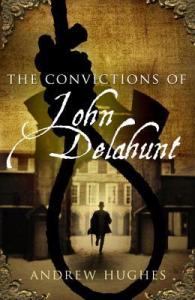
The Convictions of John Delahunt by Andrew Hughes

The Convictions of John Delahunt Imagine you’re a poor student at Dublin’s Trinity College in the 1840s. You’re newly married and living with your wife in a squalid tenement, cut off from friends and family. The future looks bleak, so when the authorities at Dublin Castle suggest that you become an informer, it seems to be the perfect solution. You will be rewarded well for any information you can give them leading to a conviction…and if you could just manage to witness a few murders, your money troubles could be over!

This is the situation in which our narrator finds himself in this wonderfully moody and sinister historical crime novel, The Convictions of John Delahunt. As the novel opens, John is sitting in a prison cell awaiting his death. We’re not sure exactly what he has done, except that it appears to involve the murder of a child. As he begins to write his final testimony, we are taken back to the origins of John’s dangerous career as an informer and discover how and why this young student of natural philosophy has been sentenced to hang.

Andrew Hughes is also the author of a non-fiction book about the residents of Dublin’s Fitzwilliam Square, Lives Less Ordinary, and so he has been able to draw on his knowledge of the city’s history to make John Delahunt’s world feel authentic and real. Because of the circles in which Delahunt moves, the focus is on the darker side of society – workhouses, grave robbing, illegal abortions, rat-killing and laudanum addiction are all explored. Dublin’s streets and alleys, taverns and parks, courtrooms and drawing rooms are all vividly described and although the language the author uses is modern enough to be accessible and easy to read, it never feels out of place with the Victorian setting.

John Delahunt himself is an intriguing narrator, though not always entirely reliable. He is certainly not easy to like – one of his first actions in the book is to tell a lie to the police that leads to a friend being found guilty of a crime he didn’t commit – yet I could still feel for him when things didn’t go according to plan and when he saw his life beginning to disintegrate around him.

A large part of John’s story revolves around his relationship with his wife, Helen, who is another interesting character – although we never get to see things from her perspective as John is narrating in the first person. At first Helen seems to be on the same wavelength as her husband, attending a hanging with him and even helping him to compile a list of friends, family and neighbours to inform on. Later in the book she experiences a personal tragedy and after this she seems to undergo a change, though because we only see her through John’s eyes, her true thoughts and emotions are not very clear.

I loved this dark and atmospheric book and was completely gripped by John Delahunt’s fascinating story (based on true events, by the way). A word of advice to potential readers – don’t start reading it in your lunch break at work or in bed when you need to be up early the next day, as you may find that you really don’t want to put it down!

Thanks to the publisher for providing a review copy via NetGalley

Girl on the Golden Coin by Marci Jefferson

Girl on the Golden Coin For more than three hundred years, an image of Britannia with her shield and spear or trident has been depicted on the reverse of certain British coins. In the 17th century, the model for Britannia was said to be Frances Stuart, who was described by Samuel Pepys as a great beauty and who famously refused to become a mistress of King Charles II. Girl on the Golden Coin is Frances Stuart’s story.

At the beginning of the novel, Frances is one of a family of Royalists who have been living in exile in Paris since Charles I was defeated in the English Civil War. With the Restoration of the monarchy in 1660, the Stuart family return to favour and Frances joins the household of Henriette Anne, Charles II’s younger sister, who has just married the brother of Louis XIV of France (the ‘Sun King’). When Frances catches Louis’ eye, he sends her to the English court where she is faced with the task of seducing Charles, converting him to Catholicism and helping to form an alliance between England and France.

The rest of the novel follows Frances at the court of Charles II, exploring her relationships with the King, his noblemen and the other women of the court including the young Queen, Catherine of Braganza, and the King’s favourite mistress Barbara Palmer, Lady Castlemaine. As Frances grows closer to Charles and begins to replace Castlemaine in his affections, she finds herself under pressure from the Queen Mother, the French ambassadors and various courtiers to use her influence with the King to help further their political intrigues – and failure to do so could result in her own family secrets being exposed.

Girl on the Golden Coin is Marci Jefferson’s first novel and was only published in February, but has been attracting some excellent reviews already. I can see its appeal, but unfortunately I didn’t enjoy it as much as most other readers have. It was fun to read but it was too light for me and didn’t have the depth I prefer in my historical fiction – although to be fair, that’s what I had suspected before I started reading but decided to still read it anyway as the Restoration is such an interesting period of history and I had never come across a book written from Frances Stuart’s perspective before.

I suppose given who Frances was and her position at court, it’s understandable that so much of the novel concentrates on her love life, but I would personally have preferred less romance, fewer descriptions of pretty silk dresses and beautiful jewels, and more focus on the history. The novel does touch on important issues such as religious conflict (in the form of two of Frances’ servants, one of whom is a Catholic and the other a Quaker), and the Anglo-Dutch War but I was disappointed that there were only a few pages devoted to some of the most significant historical events Frances lived through, such as the Great Plague and the Great Fire of London. I couldn’t help making comparisons with Forever Amber by Kathleen Winsor, another historical romance set at the court of Charles II, but which captures the drama and atmosphere of the Restoration period in a way which, in my opinion, this book doesn’t.

I don’t want to sound too negative because I didn’t actually dislike Girl on the Golden Coin – it was a quick read that kept me entertained for a few days and a good introduction to the life of Frances Stuart, someone I previously knew almost nothing about. As the response to this novel so far has been overwhelmingly positive I’m sure Marci Jefferson has a very successful career ahead of her. This just wasn’t the right book for me.

Thanks to the publisher for providing a review copy via NetGalley.

Crippen by John Boyne

Crippen I read my first John Boyne book, the Gothic ghost story This House is Haunted, last year just in time for Halloween. Since then I’ve been wanting to read another of his books and this novel, based on a real-life crime which took place in London more than a century ago, is the one I chose. It turned out to be a good choice because I enjoyed it as much as I enjoyed This House is Haunted, although the two books are quite different.

Crippen is a fictional account of the life of the notorious murderer, Dr Hawley Harvey Crippen, who was found guilty of murdering his wife and hiding the remains in the cellar of his home at 39 Hilldrop Crescent. It sounds very morbid and gruesome, I know, but the book is actually not as dark as you might imagine thanks to Boyne’s sense of humour, colourful characters and storytelling flair.

The story begins in the summer of 1910 and introduces us to a group of passengers on board the SS Montrose, sailing from Belgium to Canada. There’s Mrs Drake, a demanding, overbearing woman, and her daughter, Victoria, who is hoping to find romance on the journey. Then there’s Martha Hayes, who would prefer to hide herself away in her cabin with a pile of novels than mix with the other passengers, and Matthieu Zela, a Frenchman travelling with his obnoxious nephew, Tom. And finally, we meet Mr Robinson and his teenage son, Edmund, who are hoping for a quiet and uneventful journey.

If you’re not already familiar with the Crippen murder case, you might be wondering what the relevance is of the Atlantic voyage I’ve just described. I can promise you it is very relevant, although we don’t find out why until later in the book. Before we reach that point, we go back in time to the 1860s where we follow the young Hawley Harvey Crippen through his childhood in Michigan. As a teenager he decides he wants to study medicine, but when his parents refuse to help him financially it seems unlikely that Hawley will ever become a fully qualified doctor. After marrying Cora Turner, a music hall singer, the Crippens move to London where Hawley becomes an assistant in a homeopathic medicines company. Several years later, Cora disappears, her friends become convinced she has been murdered, and Hawley finds himself under suspicion…

Before beginning this book, I had heard of Dr Crippen but didn’t know any of the details of the case. I didn’t even know that there was so much controversy surrounding it. Boyne presents an interesting theory as to what may have actually happened, though I have no idea whether there could be any truth to this theory or not – I suspect there probably isn’t, but the book certainly does show Crippen in a much more sympathetic light than you might expect. It would be hard not to feel sorry for Boyne’s portrayal of a boy forced to abandon his dreams, a quiet and mild-mannered man bullied and abused by his selfish, manipulative wife.

My only complaint is that it was difficult to know exactly which parts of the novel were fictional and which weren’t. I looked up some factual information about Hawley Harvey Crippen after I read the book and was surprised to find that Boyne had changed so many biographical details, such as the names of Crippen’s parents and the fact that his first wife had actually died of a stroke rather than a road accident as described in the novel. When writing a fictional account of a real person’s life, it’s obvious that things like conversations, thoughts and emotions will have to be invented, but I’m not sure what the point was in altering all those little details.

Anyway, I didn’t worry about any of this until after I’d finished the book. While I was reading I was completely captivated by the twists and turns of the story and by Boyne’s wonderful writing style. I’m looking forward to exploring the rest of his novels now!

A Dangerous Inheritance by Alison Weir

A Dangerous Inheritance The disappearance of the ‘Princes in the Tower’ (twelve-year-old Edward V of England and his younger brother Richard, Duke of York) remains a mystery to this day. Some believe that they were murdered by their uncle, Richard III, some suspect Henry VII or the Duke of Buckingham, and others prefer to think that one or both of the Princes managed to escape. My fascination with this mystery leads me to want to read everything I can find about it, even books like this one, written by an author whose views on the subject are entirely different from mine.

Alison Weir is an author of both historical fiction and non-fiction and A Dangerous Inheritance is one of her works of fiction. I had enjoyed a previous novel of hers, Innocent Traitor, which told the story of Lady Jane Grey, so I thought I would try this one despite knowing that Weir does not like Richard III at all and I was unlikely to agree with any conclusions she might come to.

Actually, this novel is only partly about Richard and the Princes; at least half of the book is set eighty years later and follows the story of Katherine Grey, the younger sister of the ‘nine-day queen’, Lady Jane Grey. After Jane’s very brief reign as Queen of England comes to an end when she is deposed by Mary I and beheaded, Katherine herself moves one step closer to the throne. To her disappointment, Mary is followed by Elizabeth I, who refuses to acknowledge Katherine as her heir and treats her badly. When Katherine marries the man she loves against Elizabeth’s wishes, she finds herself imprisoned in the Tower of London.

Katherine Grey’s story alternates with the story of another Katherine – Katherine Plantagenet (referred to as Kate to avoid confusion), an illegitimate daughter of Richard III. Kate loves her father and refuses to believe that he had any involvement in the disappearance of the two young princes. After Richard is defeated at Bosworth in 1485 and Henry Tudor takes his place on the throne, Kate’s loyalty to her father and her determination to clear his name could be considered treason. Several generations later, Katherine Grey discovers some letters written by Kate, learns of Kate’s connection with the princes and decides to continue investigating the mystery from within the Tower.

On the subject of the princes, I do find it fascinating that different authors and historians can begin with the same facts and come to entirely different conclusions! As nothing has ever been proven either way regarding the disappearance of the princes and the other controversies surrounding Richard III, I’m happy for it to remain a mystery. Having read quite a lot on the subject over the last few years, I personally find the pro-Richard viewpoint much more convincing than the anti-Richard one, but I can accept that we’ll probably never know the truth and that everyone is entitled to their own opinion.

For Alison Weir, although she states in her author’s note that she likes to keep an open mind, there is clearly no mystery: Richard was guilty of everything. As I was familiar with her views before beginning the book, I suppose I shouldn’t really complain! I was disappointed, though, that the main source Katherine uses in her investigations appears to be Thomas More (who was only seven years old at the time of Bosworth, is thought to have relied upon Richard’s enemy, Archbishop Morton, as his own primary source, and wrote his histories during the Tudor period, when it was obviously to his advantage to please the Tudor monarchs by discrediting their predecessors). However, as Weir explains in the author’s note, she could only use sources that would have been available to Katherine in the mid 16th century.

I did like the fact that this was a dual time period novel where both time periods were historical, rather than one being set in the present day, though I did sometimes feel that I was reading two separate stories that didn’t really belong in the same book. Apart from the fact that both main characters were Katherines and both suffered from being close to the throne, there was very little to link the two. It’s only in the final 100 pages of this 500-page book that Katherine Grey begins to investigate the mystery of the princes and parallels start to be drawn between the two storylines – some of them of a paranormal nature, which you may or may not appreciate!

Of the two, I enjoyed the Katherine Grey storyline the most. I found Katherine a much more engaging character, which is probably not surprising as she narrates in the first person while Kate doesn’t. Also, there is almost no historical information available on Kate Plantagenet, which meant that her sections of the book were largely fictional. I couldn’t help feeling that Katherine Grey’s life story would have been interesting enough to form the basis of a whole novel on its own without the addition of a second, imaginary storyline and without squeezing the Princes in the Tower into the same book as well.

Have you read anything about the Princes in the Tower? Who do you think was responsible for their disappearance?

After Flodden by Rosemary Goring

After FloddenThe Battle of Flodden in 1513 was the largest and bloodiest battle fought between England and Scotland. The battle was fought near Branxton, Northumberland, in the north of England and despite the Scots having the biggest army in numbers, the result was a decisive victory for the English. It is estimated that while there were between 1,000-4,000 losses on the English side, there may have been over 10,000 Scottish casualties, including King James IV of Scotland.

After Flodden is a fictional account of the battle and its aftermath. Among the men who went to Flodden and never came back is Louise Brenier’s brother, Benoit. Since coming to Scotland from France several years earlier, the Brenier family have had more than their fair share of troubles, including the death of Louise’s sister, a mistress of James IV. Unwilling to accept that her brother could also be dead, Louise decides to search for him – but finding out the fate of one man among thousands is not going to be easy.

Accompanied by her faithful dog, ‘the vixen’, Louise leaves her home in Edinburgh behind and heads for the dangerous, lawless English/Scottish Borders. She is joined on her journey by two very different men: Gabriel Torrance, a nobleman from the court of King James, and Adam Crozier, leader of one of the Border clans. When both men offer to help look for Benoit, Louise must decide which of them she can trust.

After Flodden is Rosemary Goring’s first novel, published in 2013 to coincide with the 500th anniversary of the battle and having seen some very positive reviews of it last year I was looking forward to reading it myself. Now that I’ve read it, my feelings are mixed. After a slow start I did find myself enjoying the story but I didn’t think it was anything special – though maybe I was just expecting too much from it.

One thing I did love about this book was the choice of subject. Flodden has been mentioned briefly in other books I’ve read, but I have never come across a whole novel devoted to it until now. So many historical fiction novels are the ‘sweeping epic’ sort, covering several decades of history and spanning continents, so it was refreshing to see a book that was so tightly focused on one specific historical event. Reading After Flodden has helped me understand the reasons for the battle and why it was a disaster for the Scots.

In addition to the plot I’ve outlined above, other aspects of the battle and its consequences are also explored. The descriptions of the military preparations for the battle and the weapons and tactics involved are balanced by the more personal, human side. As well as seeing how Louise and her mother react to what has happened, we also meet a young boy who has carried his dying father from the battlefield. Some of the most emotional parts of the book are from the perspective of Patrick Paniter, secretary to James IV, who was one of the men advising the King before the battle and who feels responsible for the disastrous outcome.

I also found the sections of the book describing Louise’s journey south and her encounters with the Border clans very interesting as I only live around 60 miles from the border myself (on the English side). The history of this region is fascinating and I’m surprised it isn’t a more popular choice for historical fiction authors (The Disorderly Knights by Dorothy Dunnett features a feud between two rival Border families, the Scotts and the Kerrs, but I can’t think of many other books that I’ve read that even touch on this subject).

Dialogue is a difficult thing to get right in historical fiction but Goring’s attempt is reasonably good; it doesn’t sound too modern and she uses some Scottish dialect, but not too much. I was less convinced by the way she drops the occasional French word into Madame Brenier’s speech – it didn’t feel natural at all. A bigger problem, for me, is that the story is not told in chronological order but jumps around in time, which I found very confusing. It seemed unnecessary and made it difficult to follow the order of events.

The story was also too predictable, which is not always a bad thing, but when part of the plot revolves around the identity of a traitor it’s disappointing that it’s so easy to guess who that traitor is. It would have been nice to have been kept in suspense until Louise worked out the truth! On the plus side, the book included some useful character lists and a map so that readers can trace Louise’s journey through the Borders. I had to laugh at a misprint listing the members of the ‘Sottish Court’ (though knowing what some of these sixteenth century courts were like, maybe that was an accurate description!)

Although I didn’t enjoy this book as much as I’d hoped to, it was good to have the opportunity to learn more about this important battle.