The Secret Countess by Eva Ibbotson

The Secret Countess The Secret Countess (also published as A Countess Below Stairs) is set in 1919 and the title character is Anna Grazinsky, the daughter of a Russian count and countess. During the Russian Revolution, she and her mother and brother are forced to flee their home in St Petersburg for safety in England, but on the journey they lose their remaining family jewels and arrive in England with nothing. Determined to get a job so that she can help to support her family, Anna finds a position as a maid at Mersham, the estate of the Earl of Westerholme. With Selena Strickland’s The Domestic Servant’s Compendium as her guide, she settles into her new job and earns the respect and friendship of the other servants, who are unaware that she is a countess.

The young Earl, Rupert Frayne, is returning to Mersham for the first time since leaving to fight in the First World War and has announced that his fiancée, Muriel Hardwicke will soon be joining him. At first the Fraynes, their friends and their servants are pleased with the news of Rupert’s forthcoming marriage because Muriel is a rich heiress and her money means that the future of Mersham will be safe. But while Rupert is awaiting Muriel’s arrival, he notices the new Russian housemaid and finds himself falling in love.

It was not hard to predict what was going to happen in The Secret Countess! From the beginning it was obvious how it was going to end, but that didn’t make the book any less enjoyable. After finishing the dark and disturbing Gretel and the Dark I wanted something light and gentle to read next and this book was the perfect choice. I thought it was a lovely story with a magical, fairy tale quality and an old-fashioned feel (the book was first published in 1981 but could have been much older than that). The romance between Anna and Rupert is a subtle, understated one and doesn’t ever really dominate the story, but I never doubted that there would be a happy ending and that they would somehow overcome the obstacles in their path.

While my preference is usually for books that are less predictable and with characters that are more complex and nuanced (most of the characters in this book are either completely ‘good’ or completely ‘bad’ with nothing in between) that didn’t really bother me this time. Anna could easily have been one of those sickening heroines who is too good to be true – she’s beautiful, generous, sweet, kind and loving – but I couldn’t help liking her anyway. In the same way, the character who turns out to be the villain of the novel is horrible in every way, yet perfect in the context of the story. Another of the strengths of this book is its wonderful supporting characters. My favourite was the Honourable Ollie Byrne, the little girl who loves life despite its unfairness towards her, but all of the others are given a distinctive personality of their own too – even Rupert’s dog, Baskerville.

If I’ve understood correctly, this book was originally written as a book for adults but has now been repackaged to appeal to YA readers. I honestly think this is a book that could be equally enjoyed by both adults and younger readers and it would be a shame if anyone missed out on reading it because it has been marketed in a certain way. This is only the second book I’ve read by Eva Ibbotson (the other was Madensky Square) and I’m pleased that I still have so many of her other books to explore!

Gretel and the Dark by Eliza Granville

Gretel and the Dark One night in 1899, Benjamin discovers a young woman lying on the ground near Vienna’s mental hospital, naked and bruised, and takes her to the home of his employer, the famous psychoanalyst, Dr Josef Breuer. The girl, whom Dr Breuer names Lilie, insists that she is not human, that she’s just a machine. Her mission, she says, is to destroy a monster. The doctor enlists Benjamin’s help in trying to uncover the truth about his young patient, but both men find themselves increasingly drawn to the mysterious Lilie.

Many years later, in Germany, we meet a spoilt and badly behaved little girl called Krysta. She has recently moved house with her father, another doctor, to be nearer his job working with ‘animal people’ at what Krysta believes is a zoo. Krysta’s father is busy with his work, leaving his daughter to entertain herself by remembering the fairy tales she was told by her old nurse, Greet, and making friends with Daniel, a lonely little boy she discovers eating worms in the grounds of the ‘zoo’. When an unexpected tragedy throws Krysta’s life into turmoil, she learns that Greet’s stories can provide an escape from the horrors that are going on around her.

Well, this is proving to be a very difficult book to write about without giving too much away! Gretel and the Dark is one of those books where it is not immediately obvious what is happening. For a long time I was confused. What was the link between the two storylines? Was Lilie a real person or was she a machine, as she claimed? How did she seem to have so much knowledge of the future? And who was Gretel supposed to be?

I think I spent about 300 of the book’s 350 pages trying to figure out the connection between Krysta and Lilie and coming up with theories, most of which were completely wrong. I only started to guess the truth shortly before it was revealed and when everything began to come together in the final chapters of the book, I discovered that the story I had actually been reading was not quite the one I’d thought I was reading!

Despite the allusions to fairy tales and the fact that some of the main characters are children, this is actually a very, very dark novel. Again, I can’t really discuss any of the issues the book raises because it would be best to know as little as possible before starting to read – though I don’t think it would be too much of a spoiler to say that the place where Krysta’s father works is not really a zoo at all, but something much more sinister. And the fairy tales Krysta recalls throughout the book are not the light, whimsical kind, but the dark and gruesome ones. Hansel and Gretel is one of her favourites and she enjoys using her imagination to push various enemies into the witch’s oven! Later in the book, when something particularly horrible happens to Krysta, another of the tales Greet told her takes on new meaning.

I liked Eliza Granville’s writing but I didn’t find this an easy book to read because some parts of the story were so disturbing and unpleasant. Although it was not a book I could describe as ‘enjoyable’ it was certainly very clever and unusual…and I can almost guarantee you’ll still be thinking about it long after reaching the final page.

Thanks to Penguin Ireland for the review copy.

Falls the Shadow by Sharon Penman

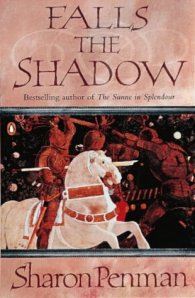
Falls the Shadow Although I just finished reading this book at the weekend, it was actually one of the first books I started in 2014. While I think Penman’s novels are wonderful, they are not quick reads, for me at least; they’re long, complex and emotionally intense and I like to give them the time and attention they deserve.

Falls the Shadow is the second in the Welsh Princes trilogy which began with Here Be Dragons, the story of King John’s daughter Joanna and her husband Llewellyn Fawr, Prince of Gwynedd. Falls the Shadow begins where Here Be Dragons ended, but while you may prefer to read them in order so that the end of the previous book is not spoiled for you, it’s not essential. This is a complete novel in itself and tells the story of Simon de Montfort, 6th Earl of Leicester, the French nobleman who ruled England for more than a year after leading a rebellion against King Henry III in 1264.

The story begins with Simon visiting his cousin, the Earl of Chester, to ask him to restore to him the earldom of Leicester which he believes is rightfully his. The Earl agrees to his request, but Simon’s visit is also successful in another way because it is here that he meets his future wife, Eleanor (known as Nell), the sister of King Henry III. Henry reluctantly agrees to the marriage between Simon and Nell, but a dispute over debts soon leads to Simon being temporarily exiled from England – and this is only the start of the turbulent relationship between the two men.

In contrast to Henry, who is portrayed as a weak, incompetent king, Simon is a great soldier and leader who believes in a more democratic form of government. Simon’s growing disillusionment with Henry, as well as his reluctance to abandon his principles and his hopes for England, leads him into war against his King. As one character comments, “it was not treason, was but a dream bred before its time”.

We are also reacquainted with some of the Welsh characters we first met in Here Be Dragons. After Llewellyn Fawr’s death, we see that the united Wales he had worked so hard to achieve is now at risk of division and disintegration again as his descendants fight amongst themselves. It seems that only his grandson, another Llewellyn, shares his vision of a strong and independent Wales. Llewellyn’s family have some blood ties with the English royal family (Joanna was the half-sister of Henry and Nell) and the events in England also have an impact on the lives of our Welsh characters.

Thanks to Dan Jones’ book on the Plantagenets which I read recently, I was able to begin Falls the Shadow knowing some of the basic facts surrounding the de Montfort rebellion and the reigns of Henry III and his son, Edward I, but this is still a period of history I know very little about. I think this was actually an advantage because it meant the story felt fresh and new to me and I didn’t always know what was going to happen next. I am always amazed by the accuracy of Penman’s novels, right down to the smallest details, and impressed by both the extent of her research and the fact that so much information has survived through so many centuries! The way in which one particular character died, for example, seemed a bit too dramatic to be likely, but when I looked it up, yes, that was how it really happened.

Penman is also one of the few authors who writes battle scenes that I actually enjoy reading. She manages to explain the tactics and strategies in a way that I can understand and follow without becoming bored or confused. There are two main battles in this novel, both part of the Second Barons’ War – the Battle of Lewes and the Battle of Evesham (described by the medieval chronicler Robert of Gloucester as “the murder of Evesham for battle it was none”).

I loved this book, but it did feel slightly unbalanced. In the first half the Welsh story runs parallel with the English one, but in the second half Simon and Nell’s story dominates completely and very little time is spent with the Welsh characters. Having finished the book and read the author’s note, she says this was intentional; there was too much material to fit into one novel, so she made the decision to devote this one to Simon and the next one to the Princes of Wales. At first I was disappointed that the Welsh storyline was virtually abandoned halfway through the book, as I was enjoying following the rivalries between Llewellyn’s sons, Davydd and Gruffydd, and later between his grandson, the younger Llewellyn, and his three brothers, but I didn’t mind too much because Simon’s story was so compelling as well.

I didn’t realise quite how much Penman had made me love Simon until I reached the end of his story. Not knowing much about the real Simon de Montfort, it’s possible that she has romanticised his character, but I do think she did a good job of showing both his good points and his flaws. As with The Sunne in Splendour (Penman’s Richard III novel) where I approached the final chapters with a growing sense of dread, it was the same with this book as I knew there wasn’t going to be a happy ending – and yes, it was as tragic and heartbreaking as I’d expected, and yes, I cried! I’m now looking forward to the final book in the trilogy, The Reckoning, and hoping to enjoy it as much as the previous two.

Norah by Cynthia G. Neale

Norah Norah McCabe is a young Irish woman living in Five Points, New York City in the 1850s. Having left Ireland during the Famine to come to America as an immigrant, Norah is determined to work hard and escape a life of poverty. Her first venture is a used clothing store called A Bee in Your Bonnet which she runs with her friend, Mary, but when the purchase of an expensive dress leads to them both being implicated in a murder inquiry this proves to be an unexpected turning point in Norah’s career. Offered a job as a reporter for the Irish-American newspaper, she meets a man who introduces her to revolutionary politics – and finds herself both in love and in serious danger.

Cynthia Neale has previously written two young adult books about Norah McCabe, The Irish Dresser and Hope in New York City, which tell the story of Norah’s journey to America as a teenager and her first years in her new country. This book, subtitled The Making of an Irish-American Woman in 19th Century New York, is the author’s first adult novel and continues Norah’s story. The fact that this is actually the third Norah McCabe book probably explains why from the very first chapter Norah feels like a fully developed, three-dimensional character.

I didn’t always like Norah or agree with her decisions – she can be sharp tongued, impulsive and reluctant to take advice – but she is also ambitious, courageous and resilient. Some of the terrible situations she finds herself in could possibly have been avoided, which was frustrating, but I was pleased to find that she does learn from her mistakes and continues to mature over the course of the novel. While I’m not Irish, not an immigrant and not living in 1850s New York, I could still relate to parts of Norah’s story and enjoy watching her use her wits and intelligence to overcome the obstacles that are constantly being placed in her path.

As a work of historical fiction, the background to the novel has clearly been well researched. Life in the poorer areas of New York during this period was not easy and not always very pleasant and the author doesn’t shy away from describing the violence, corruption and prejudice that Norah encounters. But this is also a book about love, about the importance of family and friends, and about what it was like to be a woman in the 19th century – a woman with dreams and ambitions and the determination to try to make them a reality.

Although the pace was slow at the beginning of the book, there was plenty of drama in the later chapters to make up for it. I found this quite an enjoyable, inspirational read and I’m pleased to have had the chance to get to know Norah McCabe.

Norah book tour

I read Norah as part of a Virtual Book Tour organised by Fireship Press, an independent publisher of historical and nautical fiction and non-fiction. For more reviews, guest posts and giveaways please see the tour schedule.

A Burnable Book by Bruce Holsinger

There seem to have been a lot of historical thrillers in recent years that focus on the search for a valuable item – a book, a crown or a manuscript. A Burnable Book is another one, but with enough differences to make it feel refreshing and original. While many authors (CJ Sansom, SJ Parris, Nancy Bilyeau to name a few) set their stories in the Tudor period, this one is set in the 14th century, during the reign of Richard II, a period covered less often in historical fiction. The missing item in question is a book of prophecies which accurately predicts the deaths of the previous twelve Kings of England…and the one who is currently on the throne, King Richard II.

This book – and the embroidered cloth in which it is wrapped – has fallen into the hands of Agnes Fonteyn, a ‘maudlyn’ (or prostitute), who receives it from another girl whom she meets just outside London’s city walls. Minutes later this girl is murdered, leaving Agnes, who is unaware of the book’s contents, wondering what is so special about it that someone was prepared to kill for it.

John Gower, poet and ‘trader in information’, hears about the book from his friend, Geoffrey Chaucer, who asks John to find it for him but refuses to explain exactly why he wants it so desperately. When John begins his search for the book he soon discovers that he and Chaucer are not the only ones looking for it and that the prophecies it contains could implicate one of England’s most important noblemen in a plot against the King. As the action moves from one side of London to the other, over the Thames to Southwark, to the libraries of Oxford and then to Florence and back again, the history of this ‘burnable book’ is slowly revealed.

The name of the author, Bruce Holsinger, should be familiar to anyone who took the Coursera course “Plagues, Witches and War: The Worlds of Historical Fiction” last year (Holsinger was the instructor). This is his first novel and after listening to him talk about other works of historical fiction during the course, I was interested to see what his own book would be like. I’m pleased to report that it’s very good! The setting is believable, the historical background feels thoroughly researched, the plot is cleverly constructed and the story is exciting.

I did have a slight problem with the number of characters in the book as I found some of them difficult to distinguish from each other, particularly some of the bishops and noblemen who only played a minor role in the story. After a while, though, several characters began to emerge as stronger and more interesting than the others: John Gower, whose strained relationship with his exiled son, Simon, is tested during the course of his investigations; Millicent Fonteyn, sister of Agnes, who will do anything to avoid returning to life in the brothel where she grew up; and Edgar/Eleanor Rykener, born “a man in body, but in soul a man and woman both”. I liked the fact that the novel shows us the lives of people from all levels of society, from the nobility and clergy of England to London’s lower classes, including butchers’ apprentices and the ‘maudlyns’. Eventually the stories of each of these characters and more begin to come together, connected by the common thread of the burnable book and its treasonous prophecies.

Bruce Holsinger is a medieval scholar and it shows in his portrayal of the 14th century world which feels accurate and authentic. I can’t say the same for the dialogue, which is too modern for the period, but this didn’t irritate me as much as it sometimes does and the slang probably reflected the way some of the characters would have spoken. When reading the author’s note at the end I was interested to find that some of the things I’d assumed were fictional were actually based on fact. The character of Edgar or Eleanor Rykener, for example, was inspired by historical records of a transvestite prostitute. The poet John Gower really existed but not many details of his life are known, so Holsinger was able to use his imagination to fill in the gaps.

I think my favourite aspect of the novel was the concept of the ‘burnable book’ itself and the cryptic messages it contains. It was fascinating to learn more about the process of creating and breaking ciphers and codes and to watch as various characters tried to interpret the meanings of the prophecies. I also enjoyed following Gower’s mission to locate the book and identify its author, and the problems faced by Agnes and the other maudlyns in deciding what to do with such a dangerous possession. I don’t know if Bruce Holsinger is planning to write a sequel to A Burnable Book but I hope so as I would love to meet some of these characters again!

One Night in Winter by Simon Sebag Montefiore

One Night in Winter It’s Moscow, June 1945 and a Victory Parade is taking place to celebrate the defeat of Nazi Germany. A group of teenagers, all members of a secret literary society called the Fatal Romantics’ Club, meet on a bridge during the parade to re-enact a duel scene from the poet Pushkin’s Eugene Onegin. It’s supposed to be a game, but something goes tragically wrong and two of them are shot dead.

The secret police begin to investigate at the orders of Stalin himself, but it’s not clear whether the deaths were the result of an accident, a suicide pact or a murder. Because the teenagers involved in the incident are the children of some of the Soviet Union’s highest-ranking officials, they find themselves suspected of conspiring to overthrow the government. When the children are arrested and questioned they discover that the answers they give could incriminate their families and that innocent people could suffer.

More and more people are gradually drawn into the investigation and taken to Moscow’s Lubianka Prison where they are interrogated. As well as the members of the Fatal Romantics’ Club themselves (including eighteen-year-olds Serafima Romashkina, the daughter of a famous actress, and Andrei Kurbsky, son of an ‘Enemy of the People’), questions are also asked of their school teachers, parents and even two younger children aged just ten and six.

One Night in Winter is based on a real incident that occurred in 1943 and as you would expect, some parts of the book are quite harrowing, especially the descriptions of frightened children being made to testify against their own families, knowing that if they say the wrong thing they could be condemning a parent to death. Some of the parents, such as Hercules Satinov, have to continue working with and obeying Stalin even while knowing that he is responsible for the imprisonment of their children.

But this is also a book about love – in many different forms, whether it’s the romantic love between a man and a woman or the special bond between a parent and a child. Almost everyone in the novel seems to be in love with someone else and some of them are involved in secret romances. Over the course of the novel we see how far our characters are prepared to go to protect the ones they love. The secret police believe that a mysterious lover of Serafima’s could hold the key to the whole mystery. And the idea behind the Fatal Romantics’ Club is that “if we cannot live with love, we choose death”.

Simon Sebag Montefiore is a historian and the author of several historical non-fiction books which include a biography of Stalin. It’s obvious that he has an excellent knowledge of the period and its historical figures (Stalin himself has an important role to play in the novel) and his portrayal of life in Stalinist Moscow feels thoroughly researched and authentic. The settings include School 801, the exclusive school attended by all of the children in the story, the interior of Lubianka Prison, the dirty communal apartment where Andrei and his mother live and the luxurious homes of the Bolshevik leaders.

The only thing that was lacking in this novel was emotional impact and I do think this could have been improved if the author had chosen to focus on the viewpoint of just one or two characters, rather than switching between so many different characters. There are such a lot of people to keep track of that I found the character list at the front of the book absolutely essential and while I can understand the reasons for telling the story from different perspectives, it meant I struggled to form any strong emotional connections.

Simon Sebag Montefiore is a new author for me, but I am now interested in reading his other Russian novel, Sashenka.

I received a copy of this book from the publisher for review

Quicksilver by Neal Stephenson

Quicksilver Quicksilver is the first of Neal Stephenson’s Baroque Cycle, a series of novels set during the 17th century. I had been interested in reading this book for a long time but was putting off reading it because of its length (over 900 pages) and its reputation for being a very difficult, challenging read. I don’t have a problem with long, difficult books but need to be in the right frame of mind to begin reading them.

At the beginning of the novel, the mysterious Enoch Root arrives in Boston, Massachusetts, to deliver a letter to Daniel Waterhouse, an English Puritan and natural philosopher, asking him to return to England to solve a dispute between the mathematicians Isaac Newton and Gottfried Wilhelm Leibniz over who was first to invent calculus. As Daniel voyages home across the Atlantic, pursued by the pirate Edward Teach, we are given a series of flashbacks to the 1660s and his time at Trinity College, Cambridge where he first met Isaac Newton and the other famous scientists of the period.

At the end of the first part, we leave Daniel Waterhouse’s story behind for a while, to be picked up again later. The middle section of the book follows the adventures of Jack Shaftoe, a ‘vagabond’, who rescues a beautiful slave, Eliza, from a Turkish harem during the 1683 Siege of Vienna. Together they travel across half of Europe, ending in Amsterdam, where Eliza becomes involved in the world of trade and banking. We then rejoin Daniel Waterhouse again just before the death of King Charles II and the Glorious Revolution.

In the two paragraphs above I have only given a very basic outline of what Quicksilver is about. It would be impossible for me to mention everything! The book covers almost every important historical event of the period including the plague, the Great Fire of London and the Restoration – and there are appearances from everyone you can think of, from Newton and Leibniz to Samuel Pepys, William of Orange and Benjamin Franklin. Stephenson also mixes some different forms of writing into the novel, so that although most of the book is written in normal prose there are also some sections presented as a play or as minutes from a meeting or letters written in code.

As I said, I had been curious about this book for a while but now that my curiosity has been satisfied I can safely say that I won’t be continuing with the other two books in the trilogy! There were parts of the book that I enjoyed but overall I thought it was too much effort for too little reward – and I say that as someone who is usually happy to read big, complex books that require effort from the reader. Part of my problem could have been that I probably tried to rush through the book too quickly (if you can call spending two months on a book ‘rushing’; I started reading one day in November and finished just before the New Year). Maybe I should have tried reading it over six months or even a year, putting it aside for a while when I got bored with it – looking at other reviews, this seems to be what a lot of people recommend. But really, once I got halfway through I just wanted to be finished with it.

I should point out that I didn’t actually hate Quicksilver and there were times when I became completely immersed in its world. I enjoyed reading about the early days of the Royal Society and the work of its members and here I was reminded of An Instance of the Fingerpost by Iain Pears. There were detailed descriptions of their experiments and discoveries and we learn about a wide range of scientific topics including sundials, clocks and telling the time, the development of language and vocabulary, the formulation of the laws of gravity and the development of calculus. Most of this was fascinating (though be warned that there are some gruesome experiments on animals described in graphic detail) and I particularly loved the characterisation of Isaac Newton as an eccentric genius, forgetting to eat and sleep, and sacrificing his health in the name of science. Often, though, the story seemed to disappear under pages and pages of exposition (sometimes complete with diagrams and notes) and I felt I was reading a science textbook rather than a work of fiction.

There were also a few other things that I found very irritating, such as the spelling of the word fancy as phant’sy and the fact that, in the middle section of the book in particular, there is absolutely no attempt to use dialogue suitable to the time period. I understand that this is not your average ‘historical fiction’ novel and Stephenson probably had a good reason for his choice of language, but modern slang spoken by historical characters is something that nearly always annoys me, whatever the reason.

But the biggest problem, for me, was that the novel has no real plot – or at least, there’s no single plot that runs through the book from beginning to end. Instead there are lots of disjointed subplots, lots of ideas and concepts, but they never come together at any point to form an engaging story. When I came to the end of the book I didn’t feel the sense of accomplishment and satisfaction that I felt on finishing other long books like War and Peace, for example, or Clarissa or Les Miserables; all I felt when I finished Quicksilver was relief – and that was disappointing after the time I’d invested in it and the high expectations I’d had. On a more positive note, I do feel that I’ve learned a lot about 17th century science, religion and politics – though whether I understood it all is a different matter!

I think I’ll end this post here before it becomes as long as Quicksilver itself. Clearly there are a lot of people who have loved this book and the other two in the Baroque Cycle, so if this sounds like something you would enjoy please don’t let me put you off it!