Captain Blood by Rafael Sabatini

Captain Blood

“Thief and pirate is what you heard Miss Bishop call me today – a thing of scorn, an outcast. And who made me that? Who made me thief and pirate?”

One of my favourite books of last year was Scaramouche by Rafael Sabatini, a classic historical adventure novel set during the French Revolution. I loved it so much I immediately added two more of Sabatini’s books to my Classics Club list – Captain Blood and The Sea-Hawk – though not without some reservations as these are both books about pirates and with my general dislike of books set on ships I thought the seafaring elements might be too much for me. I was wrong. Captain Blood is another wonderful book and I enjoyed it almost as much as Scaramouche!

Peter Blood, an Irish physician and former soldier, is arrested during the Monmouth Rebellion of 1685 when he is discovered tending the wounds of an enemy of King James II. Wrongly found guilty of treason, he is lucky enough to avoid hanging but instead he is sent into slavery on a sugar plantation in Barbados. Here Blood meets two people who will have a huge influence on his future: Colonel Bishop, the cruel, brutal plantation owner and his beautiful niece, Arabella, with whom Blood falls in love. When the island is attacked by Spanish raiders, he seizes his chance to escape by commandeering one of their ships and after transforming himself into the notorious Captain Blood, our hero becomes a pirate both feared and respected throughout the Caribbean.

Sailing up and down the shores of Barbados, Jamaica and Tortuga, Captain Blood becomes involved in a series of exciting adventures and daring escapades, while being pursued by both Colonel Bishop and a Spanish rival, Don Esteban, who has sworn revenge – but what sets Blood apart from the other pirates he meets is his sense of honour and his dream of one day clearing his name and settling down to a peaceful life with Arabella. To the reader, it’s obvious that Peter Blood has become a pirate because he feels he has no choice – his only other option is to remain in slavery – but Arabella doesn’t understand this and when she tells him she can never love a “thief and pirate”, he must find a way to redeem himself in her eyes.

It amazes me that Rafael Sabatini’s books are not more widely read. As well as his great writing style, clever plots and vividly described characters, his novels also have well-researched and believable historical settings. While I was reading this book, I never questioned that I was in the Caribbean of the 17th century, just as when I read Scaramouche I was fully immersed in revolutionary France. And my fears that I might struggle with the pirate theme proved to be completely unfounded!

Sabatini keeps the sailing terminology to a level that even I could cope with and I found that even without understanding every nautical reference it didn’t affect my understanding of the story (which is what I also discovered when I read Master and Commander by Patrick O’Brian earlier this year). Although there were a lot of sea battles, they weren’t too difficult to follow and in fact, not only could I follow them but I actually enjoyed them too, which is something I never thought I would say! I suspect that the descriptions of these battles were not completely realistic and in real life Blood would never have been able to overcome such great odds every time, but with my total lack of naval knowledge I’m happy to pretend that he could.

But Captain Blood is more than just a swashbuckling adventure story and even if it had only been half as exciting, I would still have loved it solely for the great characterisation of Peter Blood, a true romantic hero (in the old-fashioned sense of the term). Like Andre-Louis Moreau from Scaramouche, Edmond Dantes from The Count of Monte Cristo or Francis Crawford from the Lymond Chronicles, Blood is one of those characters who can sometimes seem to be almost superhuman. He has an intelligence and wit superior to everyone else’s, he’s charismatic and quick thinking, multilingual, as talented a swordsman as he is a surgeon, and when it comes to buccaneering, he’s a brilliant leader and tactician. However difficult the situation he and his men might find themselves in, he never fails to come up with an imaginative and ingenious way to get out of it. But despite his perfection or perhaps because of it, things don’t always go smoothly for Captain Blood and like the other characters I’ve mentioned, he experiences a series of injustices and misfortunes that makes him a character we can sympathise with and believe in.

Captain Blood was published in 1922 and is available online as a free ebook, though the edition I read was the Vintage Classics paperback pictured here. I recommend giving it a try even if pirate stories don’t sound appealing to you, as it’s worth reading this one just to meet Peter Blood!
The Lions of Al-Rassan by Guy Gavriel Kay

The Lions of Al-Rassan Guy Gavriel Kay is only a recent discovery for me, but after reading Tigana in June I knew I wanted to read more of his work. Leander of The Idle Woman mentioned that she had been wanting to re-read The Lions of Al-Rassan, one of her favourite books, so we decided it would be interesting to read it at the same time and exchange our thoughts on it.

I should start by saying that although Kay is known as a fantasy author, this book has few, if any, elements that I would describe as ‘fantasy’ and is much closer to historical fiction. The story is set in a fictitious world very similar to medieval Spain. In the north, we have the sun-worshipping Jaddites – brave warriors and horsemen. The Jaddite lands have become divided and weakened over the years due to rivalries between their three kings but they still hope to one day ride south and reconquer the rest of the peninsula. In the south is Al-Rassan, the land of the Asharites, who worship the stars and who value poetry, music and beauty. After the death of their last Khalif, Al-Rassan has also become divided and is not as strong as it once was. Caught between the two are the wandering Kindath people, who pray to the two moons that shine in the sky, one blue and one white. Even with my very limited (almost non-existent) knowledge of Spanish history I could immediately see that the Jaddites represented Christians, the Asharites Muslims and the Kindath Jews.

As tension builds between the Jaddites and the Asharites and war begins to look inevitable, there are big consequences for the novel’s three central characters. One of these is Rodrigo Belmonte, Captain to a Jaddite king and one of the Jaddites’ greatest soldiers. When Rodrigo is exiled by his king he and his company find themselves in the Asharite city of Ragosa. Here he meets another great man, Ammar ibn Khairan, an Asharite who is also in exile, and the two form an instant connection. Our third protagonist is a woman, Jehane bet Ishak, a Kindath physician who joins Rodrigo’s company and becomes close to both men. With the peninsula heading rapidly towards conflict, will the bonds between Rodrigo, Ammar and Jehane be able to survive?

Now that I’ve read two of Guy Gavriel Kay’s novels, it’s hard to say which I liked best because both were such great books. I think I found Tigana more fun to read (simply because I read fantasy so rarely these days and it was something a bit different for me to read a book with magic and wizards) but I found the writing in The Lions of Al-Rassan more powerful and the characters more fully developed. Ammar, Rodrigo and Jehane are all characters that I could love and admire, and considering their very different backgrounds and cultures, it’s quite an achievement that Kay could make it possible to identify with and care about all three of them.

Although this novel is set in a fictional land, the parallels with a real period of history made me feel that I was gaining a better understanding of medieval Spain. But as well as the history, there’s also a lot of drama and excitement throughout the novel: among other things, there are battles, assassination attempts (both successful and unsuccessful), and a masked Carnival. What I really loved about this book, though, was the portrayal of the three main characters and the relationships between them. It’s not as simple as Jehane being in love with both men (or them being in love with her) and having to choose between them; although there is a romantic aspect, the relationships are much deeper and more complex than that and encompass not just love but also friendship, loyalty and trust.

There’s a growing sense of sadness too as you start to approach the end of the book and wonder whether all three of Ammar, Jehane and Rodrigo will survive the coming conflict and how they will cope if they find themselves on opposite sides. The final chapter was one of the most tense and emotional I’ve read for some time, though I thought it would have been even more effective without the epilogue that followed (I was pleased to see that Leander felt the same as I was wondering whether I was the only person who would rather not have had the loose ends tied up).

I’m excited about the prospect of working my way through the rest of Kay’s books, but I’m sure I’ll want to re-read this one at some point too – preferably after I’ve had a chance to read up on Spanish history! If you would like to see what Leander thought of The Lions of Al-Rassan, you can read her post here.

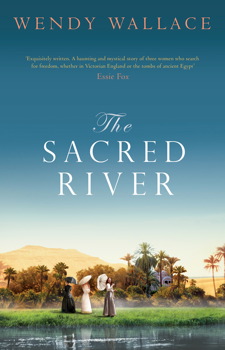
The Sacred River by Wendy Wallace

The Sacred River This is Wendy Wallace’s second historical fiction novel. I remember hearing about her first, The Painted Bridge, last year but never got round to reading it so I was pleased to have a chance to read this one, The Sacred River. This book is set in the nineteenth century and is the story of three women and how their lives are changed during a visit to Egypt.

Harriet Heron is twenty three years old but still feels that she is treated like a child. She has suffered from severe asthma for many years and feels stifled by her over-protective parents. Having always been fascinated by the Ancient Egyptians, Harriet is delighted when the doctor manages to convince her mother and father that a trip to Egypt for a change of air will improve her health. Finally she has a chance to escape from her sheltered life in London and see the world.

Harriet soon sets off on her voyage to Egypt in the company of her mother, Louisa, and her Aunt Yael but before they reach their destination, Alexandria, a meeting with an artist on board the ship causes tension between Harriet and her mother. It seems that the secrets of Louisa’s past could be about to be revealed, destroying Harriet’s happiness in the process. But this is not just the story of Harriet and Louisa; another character with an interesting story is Yael, Harriet’s aunt. On their arrival in Alexandria, Yael is shocked by the lack of health care available to the city’s children and plans to start a clinic to educate their mothers, but she soon discovers that the people she had been relying on to help her are reluctant to get involved.

Harriet is a wonderful character and I loved the way she grew and blossomed as a person over the course of the novel, as her health improved and she began to find the freedom she had always longed for. But I also liked Yael and admired her for her energy, determination and desire to make a difference. Like Harriet, she discovers a happiness and fulfilment in Alexandria that was lacking from her life at home in England. Louisa is the only one not enjoying life in Egypt and the reason for this is only revealed very slowly. We know it’s due to something that happened in her past and that it involves Eyre Soane, the artist the women meet on the ship, but the details remain a mystery until later in the book.

Egypt is always a fascinating and atmospheric setting, yet I don’t seem to have read many books that are set there. Harriet’s (and presumably the author’s) enthusiasm for the wonders of the ancient world, for archaeology and hieroglyphics shines through and it was good to have the opportunity to learn a little bit about the subjects Harriet is so passionate about. I must remember to look out for Wendy Wallace’s first novel, The Painted Bridge, having enjoyed this second one so much!

Thanks to Simon & Schuster for providing a review copy.

Philippa Carr’s Daughters of England, Volumes 1-3

The Daughters of England Philippa Carr is one of the pseudonyms of the author also known as Jean Plaidy, Victoria Holt and others. As Victoria Holt she wrote gothic romance/suspense novels, as Jean Plaidy she wrote more serious historical fiction and it seems that her Philippa Carr books are somewhere between the two. The Daughters of England is a long series of twenty novels following successive generations of one family from the sixteenth century to the twentieth, where the narrator of each book is the daughter of the narrator from the previous one. The series was originally published between 1972 and 1995 but has now been released in ebook format by Open Road Media and I received the first three volumes from the publisher through Netgalley in the form of a 3-in-1 book, which is why I’ve waited until I’ve finished all three before writing my review.

The Miracle at St Bruno’s is where it all begins. Our narrator is Damask Farland, the daughter of a rich lawyer, who grows up in Tudor England during the reigns of Henry VIII, Edward VI and Queen Mary I, a time of political and religious change. The story revolves around Damask’s relationship with Bruno, a boy from the neighbouring St Bruno’s Abbey who believes he must be a miracle child because he was found as a baby in the Abbey’s Christmas crib.

This was a good introduction to the series and an excellent portrayal of what life was like during this time period. While Damask and her family may have been secure and prosperous during the reign of one monarch, as soon as the next one came to the throne with his or her different religious views, their safety was no longer guaranteed. I did find the plot very predictable and could see every ‘surprising’ revelation and dramatic twist coming a mile away, but maybe I’ve just read too many of this type of book!

Book Two, The Lion Triumphant, is the story of Damask’s daughter, Cat Kingsman, and is an exciting historical adventure novel. The setting this time is Elizabethan England and with the country preparing to defend itself against the Spanish Armada, England’s brave sailors are the heroes of the day. One of these sailors, Jake Pennlyon, captain of the Rampant Lion, is determined to make Cat his wife. Cat does everything in her power to convince him that she will never marry him, but when she is captured and taken aboard a Spanish galleon bound for Tenerife she finds herself at the mercy of Don Felipe, the Governor of the Canary Islands, who has sworn revenge against Jake and the woman he loves.

This was a great story and my favourite of the three books, though I actually felt guilty for enjoying it so much because the ‘hero’ is such a violent, arrogant man. Despite the female protagonists and the focus on history from a woman’s perspective, these really aren’t good books from a feminist point of view. Even by sixteenth century standards I’m not sure Jake’s behaviour (and Colum Casvellyn’s in the next volume) would have been considered acceptable! Still, at least Jake does have some redeeming qualities, unlike Colum…

The third book in the series, The Witch from the Sea, is narrated by Cat’s daughter, Linnet. With the Armada defeated and the Elizabethan era coming to an end, Linnet’s father is planning to set up a trading company with a friend, Fennimore Landor. It is expected that Linnet will marry Fennimore…until the night she is abducted by local squire Colum Casvellyn. Colum is a character who makes Jake Pennlyon seem like a saint, yet Linnet is attracted to him and eventually agrees to marry him.

Settling into Colum’s home, Castle Paling in Cornwall, Linnet gradually discovers exactly how her husband has made his fortune and is horrified by what she learns. Life at the castle becomes even more difficult for Linnet after a beautiful woman is found shipwrecked on the shore nearby and becomes part of the household. It will be left to Linnet’s daughter, Tamsyn, to solve the mysteries of Castle Paling and uncover the truth about the ‘witch from the sea’.

This book has a darker, more gothic feel than the first two, with descriptions of the castle and its haunted towers, shipwrecks, ghost stories, and the mysterious Halloween appearances and disappearances of the ‘witch’ Maria. It’s also a sad story at times, as we have to say goodbye to some of the characters who have been around for two or three books. Not as good as The Lion Triumphant, but I still enjoyed this one.

My verdict on the Daughters of England series:

These books will be too melodramatic and romance-based to appeal to everyone (especially if you can’t deal with the chauvinistic male characters and the way the women react to them), but I found them to be interesting, entertaining historical fiction novels and there’s no doubt that Philippa Carr has a good knowledge of the time periods she is writing about. While all three of these books focus on fictional characters and their personal stories, they have a strong historical background covering all the major events of the sixteenth and early seventeeth centuries. I had fun reading these three novels, particularly The Lion Triumphant, though I suspect I would probably have enjoyed them more when I was younger and just starting to get into historical fiction.

I would definitely like to continue with the series – but not immediately as even with their different settings the books do all seem to be very similar and reading three in such a short space of time was a bit too much for me. I’ll probably wait a while before picking up the fourth one, Saraband for Two Sisters.

Midnight in St Petersburg by Vanora Bennett

Midnight in St Petersburg Midnight in St Petersburg begins in the year 1911 and tells the story of Inna Feldman, a young Jewish woman from Kiev. Inna is an orphan living with relatives but when they decide to leave for Palestine to escape the anti-Jewish violence in Kiev, she is left to make her way to St Petersburg on her own to seek refuge with a distant cousin, Yasha Kagan. For a girl travelling alone carrying stolen identity documents, the journey north is dangerous, especially as the Russian Prime Minister has recently been assassinated during a visit to the theatre in Kiev, but with the help of a peasant who calls himself Father Grigory, Inna is able to find her cousin’s home. Through Yasha she meets the Leman family and is given a job in their violin-making workshop.

As the political situation in St Petersburg becomes more unsettled and the country heads towards revolution, Inna finds herself torn between two very different men. The first is her rebellious cousin Yasha, a revolutionary activist who shares her love of violin music. The second is Horace Wallick, a respectable Englishman who paints miniatures for the famous jeweller, Fabergé. Inna must choose between these two men and the completely different lifestyles they offer: one passionate but filled with danger; the other more predictable but secure and safe.

I received a review copy of this book unexpectedly a few months ago and despite being immediately attracted by the title (I love books set in Russia, especially St Petersburg) it has taken me a while to find time to actually read it. I regret not reading it earlier as it turned out to be such an interesting read. The author explained the politics of the period very well, making everything clear and easy to follow, and I liked the fact that we were shown the effects of the revolution on a wide variety of people from different social and cultural backgrounds.

The only problem I had with this book was that I just didn’t find the central romantic storyline very exciting or convincing. This is probably because, for a long time, I didn’t like either of Inna’s two love interests, so wasn’t particularly bothered which of them she would eventually choose. I did start to warm to them both towards the end, though, and after finishing the book and reading the author’s note I was fascinated to discover that Horace’s character was based on the story of Vanora Bennett’s own great-great-uncle who also worked as an artist in pre-revolutionary St Petersburg. I thought this personal connection helped to add a real touch of authenticity to the story I had just been reading.

Luckily, even without being very interested in Inna’s romantic relationships, there were still plenty of other things I could enjoy. One of the most intriguing storylines within the novel, for me, was the one involving Father Grigory, the man Inna met on the train to St Petersburg near the beginning of the book. If you know your Russian history you will know, or be able to guess, who Father Grigory really was, but if not then I’ll leave you to find out for yourself. I also really liked the violin-making aspect of the story as it was something different and unusual. I took violin lessons myself for a few years when I was younger (though I certainly wasn’t as talented as Inna) so I found it interesting to read about the processes of making and repairing violins.

I’m not sure if I liked Midnight in St Petersburg enough to want to look for more of Vanora Bennett’s novels (I know she has written three or four other historical fiction novels) but I did enjoy learning about a period of Russian history I didn’t know much about.

Thanks to the publisher for providing a review copy of this book

Paris by Edward Rutherfurd

Paris Of all the new books being published this year, this is one that I’ve really been looking forward to, having read and enjoyed all seven of Edward Rutherfurd’s previous books – my two personal favourites, Sarum, set in and around the English city of Salisbury, and Russka, which covers almost two thousand years of Russian history; his other two ‘big city’ novels, London and New York (probably the two I’ve enjoyed the least); his two books on the history of Ireland, Dublin and Ireland Awakening; and The Forest, the story of England’s New Forest.

After reading all of those, I thought I knew exactly what to expect from Paris but I was surprised to find that I was wrong. With all of his other novels, Rutherfurd has followed the same format: beginning in the distant past then moving forward chronologically through the centuries, he attempts to tell the story of a city or a country’s entire history by following several families down through the generations. Paris has a very different structure.

In this book we concentrate on one set of characters who are living in Paris during the late 19th and early 20th centuries (the era known as the Belle Époque). Most of these characters are introduced in the first few chapters of the book and belong to six families, all of different social classes and political backgrounds. First, there’s the bourgeois Blanchard family – Jules Blanchard, the owner of the Josephine department store, and his three children, Gerard, Marc and Marie. Next, there’s Thomas Gascon, an iron worker, and his charismatic younger brother, Luc. There’s the aristocratic Roland de Cygne and his enemy, the revolutionary Jacques Le Sourd. And finally, a Jewish family, the Jacobs, and the Renards, who are merchants. The personal stories of all of these people and their ancestors are cleverly woven around the events that shaped the history of Paris.

Interspersed with this main storyline are several chapters in which we go further back in time and meet some of the earlier generations of our six families. There’s a chapter telling the story of the St Bartholomew’s Day massacre of 1572, for example, and another set in the city’s Jewish community in the 14th century. However, I was disappointed that some of the earlier periods in France’s history were given very little attention at the expense of the Belle Époque chapters. There was nothing prior to the 13th century so the Romans were completely ignored, Napoleon was barely mentioned at all, and I also couldn’t believe that we were only given one short, thinly plotted chapter on the French Revolution. I can see that choosing to focus more on the 1875-1940 thread of the novel allowed Rutherfurd to develop more complex storylines, but unfortunately his characters are just not strong enough to make this new format work. I still thoroughly enjoyed Paris and don’t want to give the impression that I didn’t; it’s just that I’m sure I would have loved it more if it had followed the same chronological structure as the previous books.

While I don’t have any problems with the factual content of Rutherfurd’s books, they do require you to suspend disbelief. You have to be able to accept that Thomas Gascon works on both the Statue of Liberty and the Eiffel Tower and is singled out by Gustave Eiffel from all the other hundreds of workers, that another of our fictional characters spends an evening with Ernest Hemingway and another one models for Coco Chanel, to give just a few examples. Another method he uses is to have the characters conveniently taking sightseeing tours of famous buildings and landmarks, such as the Palace of Versailles or the Père Lachaise cemetery. But although this kind of name-dropping can be annoying in other historical fiction novels, I actually don’t mind it in Rutherfurd’s books and I know he does it because it enables him to show us as many of the city’s famous figures and important events as he possibly can. Sometimes, though, it’s the smaller details and snippets of information that I enjoy the most – a description of a beautiful mille-fleur tapestry or a mention of the famous book shop, Shakespeare and Company.

I know these aren’t the sort of books that would appeal to everyone, though, as you do need to be genuinely interested in learning about the history of the locations each book covers and you also have to be prepared for the fact that most of his books are around 800-1000 pages long. I think of Rutherfurd’s books as interesting, entertaining history lessons. The quality of his writing is nothing very special and his characters are often very thinly drawn, but when you reach the end of one of his novels you feel that you’ve really learned a lot and have gained a good understanding of the place you’ve been reading about.

While this book was not without its flaws, I did love Paris. It’s not his best book by any means, and I definitely prefer the more linear structure of Sarum, Russka and the others, but this book was still a big improvement on his last one, New York. One problem I had noted with New York was that Rutherfurd seemed to run out of ideas towards the end, making the last few chapters very weak. This was not the case at all with Paris – in fact, the final chapter, on World War Two and the French Resistance was one of my favourites. It has definitely been worth the time and effort it took to read this book – and it has left me wanting to visit Paris again soon. I’m not officially taking part in Paris in July (I read this book in June) but Paris would have been a perfect choice!

Queen’s Gambit by Elizabeth Fremantle

Queen's Gambit So many novels have been written about the six wives of Henry VIII I wasn’t sure if I really wanted to read another one. Queen’s Gambit seemed to be getting such good reviews, though, so I thought I would give it a chance. I was intrigued by the comparisons to both Philippa Gregory and Hilary Mantel, two very different authors, (though now that I’ve read it, I can tell you I found it more similar to the former than the latter) and I also liked the fact that, at least with this edition, the publisher has avoided the usual front cover image of a ‘headless/faceless woman in a pretty dress’ which most recent Tudor court novels seem to have.

Queen’s Gambit tells the story of Katherine Parr. If you’re familiar with the rhyme used to remember the fates of Henry VIII’s six wives (Divorced, beheaded, died; divorced, beheaded, survived), Katherine Parr was the sixth and final wife – the one who ‘survived’. While Katherine’s story may not have been covered in historical fiction as often as some of the other wives, particularly Anne Boleyn, I have read about her before so already knew the basic facts about her life.

Katherine comes to the court of Henry VIII after her husband Lord Latimer dies leaving her a widow for the second time at the age of thirty-one. Soon after her arrival, she falls in love with Thomas Seymour, one of the brothers of the late queen, Jane Seymour. However, Katherine has also caught the eye of the King, who plans to make her his sixth wife. By this stage of his life, Henry is no longer the handsome prince he once was: he has grown fat, he’s suffering from an ulcerated leg, and added to the fact that his previous wives have met such unhappy fates, Katherine has no desire to marry him. She doesn’t dare defy the King’s wishes and accepts his proposal of marriage, but during the years that follow she is unable to forget Thomas Seymour, even after he is sent away from court on a diplomatic mission. Meanwhile, life at court is growing increasingly dangerous for Katherine and as she becomes more deeply involved in the reformed religion she realises that she needs to be very careful if she’s going to survive.

This story is told from two very different perspectives: one is Katherine’s and the other is Dorothy Fownten’s. Katherine is a dignified, mature and intelligent person which makes her easy to like and sympathise with as she learns to cope with life in the treacherous, unpredictable Tudor court, never being sure who can and cannot be trusted, and knowing that two of her predecessors have already lost their heads. Dorothy, known as Dot, is Katherine’s maid and while Katherine moves in the innermost circles at court, Dot is on the outside and can take a more observant and unbiased view of things. I liked both women but I found Dot a more engaging character. Having read a few books about Katherine now, I don’t think she’s really a great subject for historical fiction – there are a lot of other queens’ lives that are much more dramatic and interesting to read about – so some of my favourite parts of the book were actually those that concentrated on Dot’s personal story rather than Katherine’s. When I read the author’s note at the end I was surprised to discover that there really was a maid of that name who served Katherine Parr, though the way she is portrayed in the book is largely fictional.

Another character I enjoyed reading about was Dr Robert Huicke, the King’s physician who becomes a good friend of Katherine’s. Through Huicke we also meet Nicholas Udall, the playwright most famous for writing one of the first English comedies, Ralph Roister Doister. Huicke’s relationship with Udall, as well as his friendship with Katherine, adds another interesting angle to the story.

As I mentioned at the start of this post, I thought this book felt more like a Philippa Gregory novel than a Hilary Mantel and I don’t think the comparisons with Wolf Hall are justified, but I did still enjoy it. Queen’s Gambit is apparently the first in a Tudor trilogy – the second one will explore the lives of Lady Jane Grey’s two sisters, Catherine and Mary, and the third is going to be set in the Elizabethan court. I’m looking forward to reading both.

I received a copy of this book through Netgalley for review.