The Master of Verona by David Blixt

The Master of Verona by David Blixt The Master of Verona is set in Northern Italy in the early 14th century. At the beginning of the novel the great poet Dante Alighieri, after years of exile from Florence, has been invited to the city of Verona by its ruler, Francesco della Scala, known as Cangrande. Dante and his two sons, Pietro and Jacopo, arrive in Verona at a turbulent time for the city; not only has war broken out with Padua, but Cangrande’s heir, Cesco, has been the target of an assassination attempt.

When seventeen-year-old Pietro impresses Cangrande with his courage and loyalty, he becomes caught up in Verona’s battles with Padua and is also entrusted with trying to help protect the life of baby Cesco. As if this wasn’t enough, Pietro’s two best friends, Mariotto Montecchio and Antonio Capecelatro have both fallen in love with the same girl and an ancient feud between their two families looks set to be reignited…

This was one of the final books I read in 2012 and I finished it just in time for it to make my list of favourite books of the year. It has taken me a while to actually write this post as there’s so much going on in the novel and so many different aspects to the story, it’s difficult to know where to begin! First, there’s a link with Romeo and Juliet; although this is not a retelling of Shakespeare’s play, Blixt suggests a possible theory to explain how the feud between the Montagues and Capulets may have originated. I noticed allusions to some of Shakespeare’s other plays too, but the story could still be understood and enjoyed even if you have no knowledge of Shakespeare at all as this is just one small element of the novel.

The plot does become quite complicated and some concentration is needed at first to keep all the characters straight, especially as many of them are also referred to by their titles or nicknames (Cangrande, for example, is sometimes referred to as Francesco della Scala, the Scaliger, the Greyhound or the Capitano). However, I never had any problems understanding what was happening and could even manage to follow the battle scenes! This is a great book for those of us who like our historical fiction novels long, detailed and complex but with plenty of action at the same time. There’s always something happening, whether it’s a battle, a chase, a festival or a duel. One of the most memorable episodes of the story describes Pietro’s participation in the Palio, a dramatic horse race through the streets of Verona. It’s all breathtakingly exciting and makes the book a much quicker read than you might expect considering the length of it.

But it’s not all non-stop action; in quieter moments, the characters have lots of discussions on religion and philosophy, mainly with reference to Dante’s work – the concepts of Heaven and Hell, the significance of stars, etc – which made me wish I had actually read Dante so I knew what they were talking about! He is definitely on my list now for future reading. There are also some fascinating passages in which we see the 14th century literary world of booksellers and scribes through the eyes of Dante’s daughter, Antonia Alighieri.

Many of the characters in the book are real historical figures of the period. Cangrande, the ‘Master of Verona’ who is believed by some to be the legendary ‘Greyhound’ or saviour of Italy, is fascinating and charismatic, a complex character with several different sides to his personality. As all good historical fiction novels should, this book left me wanting to know more about the real life Cangrande. Dante himself is someone I have never read much about, so knowing very little about his life, I have no idea how accurately he was portrayed in this book. The spelling Alaghieri is sometimes used in place of Alighieri but the author explains his reasons for this both in the text of the story and in his notes at the end of the book, and again, I don’t really have enough knowledge of Dante to be able to comment on this. There are some strong and interesting female characters in the book too: I’ve already mentioned Antonia, but there’s also Katerina della Scala, Cangrande’s sister. And even little Cesco, despite being not much more than a baby, has a very strong personality of his own.

The only negative thing I can say about this book is that the dialogue felt a bit too modern at times (I’m sorry for mentioning this yet again – I feel as if I’ve been complaining about the dialogue every time I’ve reviewed historical fiction recently!) but luckily I was enjoying the story so much I could overlook the occasional word that didn’t sound right.

This book is the first in a series and I’m already looking forward to reading the second one, Voice of the Falconer!

The Beggar King by Oliver Pötzsch

The Beggar King It’s 1662 and the Schongau hangman, Jakob Kuisl, is travelling to Regensburg to visit his sister Lisbeth who has sent him a message saying she is seriously ill. Arriving in the city, Jakob discovers that he has walked into a trap: his sister and her husband are found dead in their bathhouse and Jakob is arrested on suspicion of murder. Imprisoned and tortured, he awaits his execution in one of the city’s dungeons.

Jakob’s daughter, Magdalena, vows to help her father and sets off to Regensburg with her lover, doctor’s son Simon Fronwieser. As they begin to investigate, Magdalena and Simon meet a variety of characters including a Venetian ambassador, a raftsman, a brewmaster – and the city’s community of beggars and thieves, led by Nathan the Wise, the ‘Beggar King’ of the title. They must decide who can and cannot be trusted and come up with a plan to rescue Magdalena’s father before it’s too late.

The Beggar King is the third in a series of historical mystery/thrillers following the adventures of 17th century Bavarian hangman Jakob Kuisl and his daughter Magdalena. The first two in the series are The Hangman’s Daughter and The Dark Monk; I haven’t read either of these but starting with the third book was not really a problem as this was a complete story in itself and not dependent on things that had happened in the previous books. If I had read the others I might have got more out of the story, as there were relationships that had obviously been developing over the course of the series, but I was still able to follow what was happening easily enough.

There were things that I liked about The Beggar King and the fast-paced, action-packed story did keep me entertained, but I don’t think I will be looking for any of the others in the series. The problem I had with the book was the language used in the dialogue. Would people in the 1660s really have called each other ‘lowlife drifters’ and would they have said something like “Just my luck that I wind up in the hands of a quack like you”? A lot of the terms and phrases that were used just sounded wrong to me. I’m aware that the book has been translated into English from its original German, so it’s hard to tell how much of this is down to the original text and how much to the translation, but when I read historical fiction I like to feel that I’ve been transported back in time and because of the dialogue I did not get that feeling at all with this book. As well as the language being too modern, the way some of the characters thought and behaved also felt too modern and I found it particularly difficult to believe in Magdalena as a realistic 17th century woman.

What I did enjoy was all the information we are given on the living conditions and medical history of the time, things I always find interesting to read about. Magdalena’s lover Simon is a ‘medicus’ (physician) and she herself is training to be a midwife. Jakob Kuisl also has some medical skills – it seems that the town hangman did much more than just carry out executions and was also involved in operating the instruments of torture during the interrogation of prisoners, and ironically, was responsible for tending the prisoners’ injuries after he had finished torturing them. In this way, the hangman gained a good knowledge of human anatomy and physiology.

I also loved the setting and the descriptions of the Bavarian village of Schongau and the city of Regensburg on the River Danube where most of the action takes place. I haven’t read much, if anything, about Germany in the 17th century and I enjoyed the author’s note at the end which takes us on a journey through Regensburg and tells us more about some of the places mentioned in the novel.

Inappropriate dialogue is something that often irritates me in historical fiction, but I know not everyone will be bothered by it. Looking at other reviews of The Beggar King, it does seem that the general opinion is overwhelmingly positive and a fourth book is already on its way!

I received a review copy of this book from the publisher via Netgalley

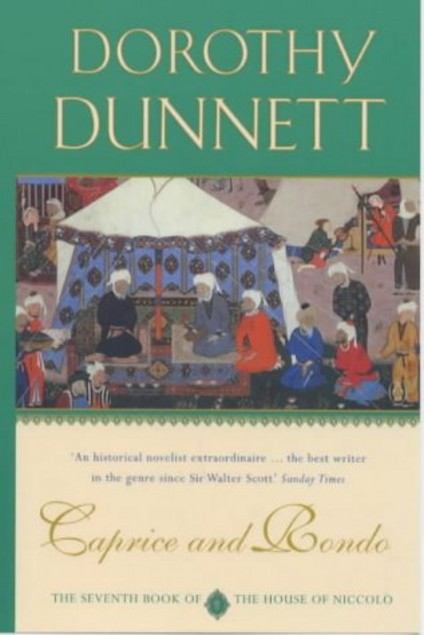
Caprice and Rondo by Dorothy Dunnett

Caprice and Rondo The seventh in the House of Niccolò series and another one I enjoyed, although it was actually one of my least favourites so far. I know other readers will disagree, but in an eight-volume series it’s inevitable that there are going to be some that I don’t love as much as others and this was one of them. Before I try to explain why, I’ll repeat my usual warning that if you have not read the previous six Niccolò novels, you will encounter some spoilers below – it’s impossible to avoid them at this stage in the series!

*

At the beginning of Caprice and Rondo, we find Nicholas in exile following the revelations at the end of the previous book, To Lie with Lions. After allowing his rivalry with his wife, Gelis, to cause financial problems for his bank and almost destroy the nation of Scotland, it seems that his friends and colleagues may not be able to forgive him this time. Spending the winter drinking with the pirate Paúel Benecke in Danzig, Poland, Nicholas appears to be without aim and direction, until the opportunity arises for him to travel to Caffa on the Black Sea in the company of the mysterious Anna von Hanseyck. He is also still searching for the African gold that was stolen from his ship in Scales of Gold, as well as trying to protect Gelis and their son, Jodi, from their numerous enemies who include the former Vatachino agent, David de Salmeton.

I think part of the problem I had with this book was that we are taken to such a lot of different geographical locations and yet none of them really came to life for me as vividly as the settings in the previous books. I realise the cold, subdued atmosphere of the Danzig chapters was probably intended to match Nicholas’s mood and the state of mind he had found himself in, rather as the frozen landscapes of Russia matched Lymond’s in The Ringed Castle, but for me, this was probably the least successful of all the settings in any of the Dunnett novels I’ve read. Caffa is beautifully described, but I couldn’t help thinking the whole section of the book that took place in the Crimea felt a bit irrelevant, though maybe that’s partly because I was finding it difficult to really get interested in the intricacies of Tartar politics. I was much more interested in the other main thread of the story which involved Gelis, with the help of Tobie, visiting Thibault de Fleury and trying to unearth the truth about Nicholas’s parentage. I found myself liking Gelis again in this book after being so frustrated and confused by her since the end of Scales of Gold. I had never doubted that she and Nicholas loved each other and it’s so sad that they had wasted all those years when they could have been together as a family.

We also get a new villain in this book: Julius’s wife, Anna. I was suspicious of Anna from the beginning having learned not to trust characters who seem too good to be true, though I hadn’t guessed who she really was (or not until Adelina’s background was discussed, after which it was quite easy to make the connection) so that was a surprise. I was a bit disappointed though that our established villains, Jordan de Ribérac and Simon de St Pol, never appeared in this book.

While some new questions were raised – the identities of the six children, for example – it also felt as though a lot of things were being tied up in this book in preparation for the final one, such as the death of Nicholai Giorgio de’ Acciajuoli and the end of the mercenary company led by Astorre (I thought Astorre’s death at Nancy was one of the most moving scenes in the book). And of course, the Duchy of Burgundy itself was thrown into disarray with the Duke also losing his life in the battle of Nancy. I also, like Nicholas, finally began to have a better understanding of Ludovico da Bologna who seems to have popped up all over the place in whichever obscure corner of the world Nicholas has been visiting.

“Josaphat Barbaro, speaking of him in Persia, had said, ‘One meets him everywhere, does one not, as one might expect to see the ubiquitous God? But what one meets is not God, but one’s own conscience’.”

Although I started this post by saying this was one of my least favourite Niccolo books, ironically I also found it one of the quickest and easiest to read and I flew through it in a few days over Christmas. I’m reading Gemini now and can’t wait to see how the series concludes!

The Aviator’s Wife by Melanie Benjamin

The Aviator's Wife Melanie Benjamin picks such interesting subjects for her novels, introducing us to historical figures who, despite their significance, we may not know much about: first Alice Liddell, the inspiration behind Alice in Wonderland, then Lavinia Warren or ‘Mrs Tom Thumb’, and now Anne Morrow Lindbergh, wife of the famous aviator, Charles Lindbergh.

We first meet Anne Morrow, daughter of the US ambassador to Mexico, in 1927 at a reception attended by Charles Lindbergh who has recently completed his first solo flight across the Atlantic. Everyone expects Lindbergh to be drawn to Anne’s beautiful older sister, Elizabeth, but instead it is the shy, quiet Anne who catches his eye and when he takes her up in his plane for a private flight, she finds that she shares his love of flying. Soon Lindbergh proposes and Anne accepts, but she quickly discovers that being married to one of the most famous men in America is not going to be easy.

Before reading this book I had heard of the Lindberghs but knew almost nothing about them so, for me, The Aviator’s Wife was very educational as well as being an enjoyable story. I’ve never given much thought as to what being an aviator actually involved and it was interesting to see how the Lindberghs use their roles as aviators to perform a range of useful and varied tasks including charting new routes and mapping flight paths for passenger planes, flying over places of interest to take aerial photographs, and delivering aid to disaster zones. Flying in those early aircraft must have been an amazing experience – the description of Anne’s first flight with Lindbergh is wonderfully written and sounds both terrifying and exhilarating.

This book gives us some fascinating insights into what it is like to be a celebrity. The Lindberghs have very little privacy and everything they do attracts attention from the world’s media. They are followed by reporters and photographers everywhere they go, though as quiet, reserved people neither Charles nor Anne seem very comfortable with being constantly in the spotlight. Charles has already learned to deal with it in his own way, but Anne often finds it difficult. Their fame eventually leads to tragedy – I won’t go into details here (if you’re familiar with the Lindberghs’ lives you will know what this tragedy was and if not I won’t spoil the story for you) but this part of the book was heartbreaking and made even worse by the fact that the way Charles chose to deal with the disaster was completely inadequate.

The relationship between Anne and Charles becomes more and more tense and strained as the years go by, but even as Charles grows increasingly cold and distant, Anne tries to stay loyal to her husband and is supportive when he expresses his controversial views on Hitler and the Nazis, despite the fact that she’s not convinced that he’s right. Charles is portrayed as a complex person with some good qualities but also a lot of bad ones. He tries to control every aspect of Anne’s and their children’s lives and at first it’s frustrating to see how Anne allows him to do this, but eventually she begins to move out of his shadow and finds some independence. As well as being her husband’s co-pilot, navigator and radio operator, Anne becomes an accomplished pilot in her own right and is also the first American woman to obtain a glider pilot’s licence. She later starts to build a successful career of her own as an author, publishing books including the best-selling Gift from the Sea.

I’ve enjoyed all three of Melanie Benjamin’s books but I think this one is her best so far. I was left wanting to learn more about Anne Morrow Lindbergh and feeling that she really deserves to be known as more than just ‘the aviator’s wife’!

I received a review copy of this book from the publisher via Netgalley

Three nurses, a ghost and a computer genius

The Nightingale Girls by Donna Douglas / For One More Tomorrow by Elizabeth Bailey / Goodbye for Now by Laurie Frankel

Happy New Year! With a backlog of books read near the end of 2012 still to write about, I am starting 2013 with reviews of not just one book but three. Apologies in advance for the length of this post…I thought these were going to be mini-reviews but they turned out to be longer than I expected!

The Nightingale Girls The Nightingale Girls by Donna Douglas

The Nightingale Girls is set in the 1930s and follows the stories of three student nurses at one of London’s top teaching hospitals, the Nightingale.

Life is not easy for Dora Doyle, who comes from a poor, working class family from the East End of London. Dora sometimes feels out of place among the other, richer girls at the Nightingale and is struggling to find money to buy the books she needs, but she is determined to succeed, partly because she’s passionate about nursing but also because she’s desperate to get away from her abusive stepfather. The aristocratic Lady Amelia Benedict, known as Millie, is from a very different social background to Dora, with whom she shares a room. Millie wants to build a life for herself away from her luxurious home and glamorous friends, but as she is constantly finding herself in trouble and has already failed her preliminary training exams once, it’s going to be difficult to prove that she’s serious about her nursing. The third girl we meet is Helen Tremayne, a second year student. Her domineering mother is on the hospital’s board of trustees and her brother is a doctor, so expectations are high. Helen works hard, but has trouble making friends, especially as the other girls don’t trust her because of her mother.

At first it seems that Dora, Helen and Millie have nothing in common but as they get to know each other during their long, hard days at the Nightingale, a bond begins to form between the three of them. I didn’t feel I got to know Helen as well as the other two but I loved both Dora and Millie. Dora was completely inspirational and a perfect example of someone managing to fulfil her dreams through sheer determination and hard work. And the rebellious but warm-hearted Millie was so endearing. Through her story we see that money and possessions are not everything and that true happiness can come through doing something that we love. There are some great secondary characters too, including the spiteful and snobby but bitterly unhappy Lucy Lane, and the Doyles’ neighbour, Nick, who is desperately trying to make enough money to take his little brother to America. Dora’s grandmother, Nanna Winnie, was another favourite.

It was so interesting to see what was involved in being a trainee nurse in the 1930s. The book shows us the hardships of nursing, but there are also lots of moments of fun and humour, including one hilarious scene involving false teeth. As a historical novel, the setting of 1930s London is wonderful, whether we’re reading about the streets in the East End where the Doyle family live or an afternoon eating cakes and drinking tea at Lyons’ Corner House! The Nightingale Girls is the first in a series of novels about the Nightingale Hospital and I will look forward to reading the others.

Thanks to Random House for sending me a review copy of The Nightingale Girls

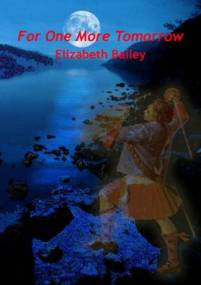
For One More Tomorrow For One More Tomorrow by Elizabeth Bailey

For One More Tomorrow, currently available as an ebook, tells the story of Sadie Grey, who is directing a production of Shakespeare’s play, Macbeth. Growing frustrated and disillusioned with some of the actors in the play and their inability to inject real passion into their roles, Sadie is stunned when she meets the ghost of Macbeth himself. Soon Mac, as Sadie calls him, seems to be invading her thoughts and taking over her life, and as her relationship with the ghost develops there are some surprises in store for both Sadie and the reader!

At first Sadie wonders whether Macbeth’s ghost has been produced from her own imagination – he looks and sounds exactly as she had pictured him in her mind, even wearing tartan like the characters in Sadie’s play despite the fact that she knows the real Macbeth would not have done so. And yet it seems that Mac does have an existence of his own outside of her imagination, and some sections of the story are seen from his point of view, as he roams the streets alone or watches rehearsals from the shadows at the side of the stage. Through his own thoughts and his conversations with Sadie, we see that he is not very pleased at the way the story of his life has been distorted by Shakespeare; he’s angry and hurt that his reputation has been damaged and history has been altered in the name of entertainment.

I haven’t read all of Shakespeare’s plays but I have read Macbeth more than once and it’s probably the play I’m most familiar with. I could sympathise with Sadie, who clearly has a real understanding and love of the play; she knows how she wants the actors and actresses to play their roles and it annoys her when they do not portray their characters as she wants to see them portrayed…especially Curtis, the man who is playing Macbeth. I did enjoy the parts of the book that deal with the rehearsals for the play and the problems Sadie encounters as director, but my favourite scenes were those in which Sadie is interacting with the ghost. For One More Tomorrow was an unusual and imaginative story and I’m sure the next time I read Macbeth I’ll remember Mac and how he felt about Shakespeare’s words.

Thanks to the author for sending me a review copy of this book

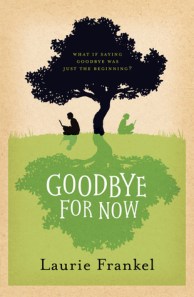
Goodbye for Now Goodbye for Now by Laurie Frankel

Sam Elling is a computer software engineer who works for an online dating company based in Seattle. Sam has created a new computer algorithm to help people find their perfect partner, but it proves to be too successful as people are meeting their soulmates too quickly and don’t need to use the dating agency anymore. As a result he loses his job but it’s not long before he comes up with another invention.

When Sam’s girlfriend Meredith loses her beloved grandmother, Livvie, she tells him she wishes she could speak to Livvie one more time. Wanting to help in any way he can, Sam creates a computer program based on the online presence Livvie has left behind, including emails, texts and videos. Meredith is shocked but overjoyed to discover that she can now continue to chat to Livvie and exchange emails just as she used to when her grandmother was alive. Soon Sam and Meredith decide to give other bereaved people the same opportunity to communicate with loved ones who are no longer with them, but they are not prepared for the number of moral issues they will have to face.

Different people have different ways of dealing with grief and what works for one person will not necessarily work for everyone. I can’t imagine ever wanting to use this type of technology myself and I tend to agree with the characters in the story who found the whole idea creepy and disturbing. However, I still thought it was fascinating to read about. There’s nothing paranormal involved and the software Sam invents sounds completely believable from a scientific point of view.

With death and grief forming such a big part of this book I had expected something very sad and emotional, but the story was actually not as moving as I had thought it might be. That could be because the main characters – Sam, Meredith, her cousin Dashiell and their clients – are all so ‘nice’ that I had difficulty believing in them as real people and didn’t manage to fully connect with them. What I did love about this novel was the number of thought-provoking questions it raises by showing us how the world reacts to Sam’s controversial new technology and telling the stories of the people who decide to use it.

Is chatting to a computer generated image of a friend or relative who has died really a good idea or is it better to let the grieving process take its natural course? Can social media actually be isolating rather than social? Are there things that our loved ones may have said or done online that we would be better off not knowing about? What about privacy? Nobody seemed to have any problems with allowing Sam to access their family member’s emails, blog, internet browsing history or Facebook and Twitter accounts, but I know I wouldn’t feel comfortable with that. Goodbye for Now may not have been a perfect novel but has left me musing on all of these questions and more.

Thanks to Headline for the review copy of Goodbye for Now

To Lie with Lions by Dorothy Dunnett

To Lie with Lions To Lie with Lions is the sixth volume in the House of Niccolò series and although I loved it, this is not the place to start if you’re new to Niccolò. To be able to fully appreciate this book, you really need to have read the series from the beginning and, in particular, you need to read the fifth book, The Unicorn Hunt, before this one. To Lie with Lions picks up a lot of the threads from The Unicorn Hunt and in some ways I thought they almost felt like two halves of the same novel, so please be aware that if you haven’t read all of the previous five books yet you will encounter spoilers in the rest of this post.

***

In To Lie with Lions, Nicholas de Fleury returns to Scotland with his wife, Gelis, and son, Jodi. On the surface it may appear that he and Gelis have been reconciled; in reality, the mysterious ‘game’ they are playing is about to enter its final stages. Meanwhile, as Nicholas continues to make himself indispensable to the young King James III of Scotland and his court, he also becomes embroiled in the conflict in Europe between the King of France and the Duke of Burgundy – but which, if either, is he really working for?

Previous books have dealt with the trade of alum, silks, sugar, gold and slaves; this book looks at the trade of another commodity: stockfish (dried, unsalted fish). To find these supplies of fish, Nicholas must embark on a sea voyage to Ultima Thule – Iceland and the Westmann Islands. As usual, he has more than one reason for this trip, and to make things even more interesting, the Bank of Niccolò’s rivals, the Vatachino and Anselm Adorne, as well as Paúel Benecke of the Hanseatic League, are also on their way to Iceland. There were a lot of dramatic scenes and set pieces in this book – a walk through the ducal château of Hesdin where traps and practical jokes lie around every corner; a game of Florentine football on the castle walls in Edinburgh; skating on the frozen Nor’ Loch – but it was this excursion to Iceland in the middle of the novel that I found the most memorable. There’s some beautiful descriptive writing in this section of the book, bringing to life all of Iceland’s distinctive natural features – the glaciers, geysers, hot springs and volcanoes – and the wildlife – the eagles, ‘white bears’ and ptarmigans. The descriptions of the volcanic eruptions are stunning and made me think how much more frightening and awe-inspiring such phenomena must have been in Nicholas’s time.

“The Mouth of Hell opened when they were a long way out to sea, and the glacier over Katla lifted its city of ice into the sky…Now, you could no longer diminish what was happening by translating it into human dimensions. This was not a play. This was the hurling into the sky of thousand-ton blocks of ice, glinting and roseate in the thundering night. This was the discharge of millions of gallons of boiling water, plunging down from the mountain in a wild dashing glitter, outrunning the billows of its own pink-flushed steam.”

As with all of Dunnett’s novels, there are things that seem confusing at the beginning but have taken on new meaning by the end of the book. Among other things, we finally discover, after endless hints about ‘the game’ Nicholas and Gelis were playing, what it was all about and what each of them was hoping to achieve; we learn why Godscalc had been so determined to keep Nicholas from returning to Scotland; and the reason for Nicholas’s reaction to the Nativity Play he had worked so hard on and received so much praise for. After disliking Nicholas throughout most of The Unicorn Hunt, I found him more likeable again in this book, rather like Tobie, who returns to Nicholas’s side filled with hope that perhaps he is not beyond redemption after all. Tobie, with his ever-changing opinion of Nicholas, is someone I can definitely identify with! We do see some evidence of Nicholas’s warmer, more human side again in the relationships he forms with Kathi Sersanders and Robin of Berecrofts (two of my favourite characters) in Iceland and in the effort he makes to bond with Jodi.

It seems, though, that Nicholas often gets so carried away with the intricacies of his elaborate machinations that he forgets, or ignores, the fact that his schemes are affecting real people’s lives. And after feeling so much more sympathetic towards him during this book than I did during the last one, the revelations in the final chapters caused me, like many of his friends and colleagues, to become disillusioned with him again. Still, I was pleased that the contest between Nicholas and Gelis had finally come to an end and I was left with the feeling that one episode is over and a new one is about to begin.

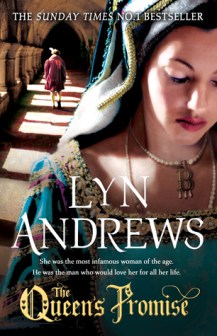
The Queen’s Promise by Lyn Andrews

The Queens Promise Everyone knows that Anne Boleyn was one of the six wives of Henry VIII, but did you know that before her marriage to the King, Anne was secretly betrothed to another Henry – Henry Percy, son and heir of the 5th Earl of Northumberland? The Queen’s Promise is the story of Anne and Henry’s relationship.

When you try a new author for the first time you can never be quite sure what to expect. Until I read The Queen’s Promise I was unfamiliar with Lyn Andrews’ work, but after doing some research I discovered that she has written many bestselling family sagas which, although they have obviously been very successful, don’t look like books that would appeal to me. The Queen’s Promise seems to be a new genre for Andrews; I think this is her first historical fiction novel and based on this one, I hope she writes more. I’ll admit that when I first started to read it I thought it would be just another Tudor court romance – an impression not helped by the title and cover of the novel which do absolutely nothing to set the book apart from others of this type – but I was pleased to find that although there was certainly a romantic aspect to the story, it also had a detailed and well-researched historical background with almost as much attention given to the history and politics of the period as to the romance between Anne and Henry Percy.

Anne’s marriage to Henry VIII and the events leading to her death have been well documented in both fiction and non-fiction. However, in this novel there is actually more focus on Henry Percy than there is on Anne, which was the right choice in my opinion. Anne is such a popular subject for historical fiction and there’s not much that can be said about her that hasn’t been said before, but Henry Percy, on the other hand, is a historical figure who is less well known and Andrews does go into quite a lot of depth on not just his relationship with Anne, but also his life before and after Anne.

As so much of Henry’s life was spent in Northumberland, we are given a lot of information about the Border Reivers, who raided both sides of the English/Scottish border, and Henry’s role as Lord Warden of the Marches. Life in the borders was wild and dangerous in those days and it was not easy to maintain law and order there. We see how difficult it was to keep the peace between Northumberland’s feuding families and protect the people from outlaws while always being aware that there could be an attack from the Scottish side of the border at any time. I’m always looking out for books set in Northumberland as I’m from the North East myself and it was interesting to read about so many places I know – Alnwick, Hexham, Prudhoe, Warkworth – and to have the chance to add to my knowledge of the region’s history.

I really liked the way Henry Percy is portrayed as being refreshingly different to most of the other young men at the Tudor court – loyal, sincere and honest, but also quiet, cultured and sensitive, qualities which sadly make him a disappointment to his father, the Earl. It’s not a happy story for Henry – he also has to fight a recurring illness and to come to terms with being forced into a loveless marriage to Mary Talbot, the Earl of Shrewsbury’s daughter – and of course it isn’t a happy story for Anne either. I did like the young Anne we meet in the earlier chapters of the book, though after she begins her rise to becoming Queen she becomes much harder and a less sympathetic character.

Much of Henry’s and Anne’s story is seen through the eyes of Henry’s friend and squire, Will Chatton, who joins Henry’s household as a boy of eleven and later becomes a successful merchant. Will and his family are purely fictitious characters but they add another interesting angle to the story. As well as allowing us to observe Henry and Anne from a third perspective, the inclusion of the Chatton family gives us the chance to explore another side of Tudor society, away from life at court.

I enjoyed this book, after my initial concerns had proved to be unfounded. It was interesting, very readable and the focus on Henry Percy makes it slightly different from other Anne Boleyn-based historical fiction. It also raises the intriguing question of whether, if Anne and Henry had been allowed to be together as they wished, what impact would this have had on the future of the royal family and the whole course of history?