The Poisoned Island by Lloyd Shepherd

The Poisoned Island In June 1812 the Solander returns to London from a voyage to Tahiti financed by Sir Joseph Banks of the Royal Society. The ship is carrying a cargo of rare and exotic plants destined for the Kew Gardens. But why is Banks so interested in one particular specimen? Could there have been another motive behind the voyage?

When one of the Solander’s crew is found dead under suspicious circumstances, the magistrate John Harriott and Constable Charles Horton of the Thames River Police begin to investigate. Soon more murders take place – and when he learns that all of the victims were members of the crew, Horton must find out how the deaths could be connected with the recent trip to Tahiti.

I’ve been looking forward to this since I read Lloyd Shepherd’s first novel, The English Monster, last year. When you loved an author’s debut novel there’s always the worry that their next book might be a disappointment, but that was definitely not a problem here because I thought The Poisoned Island was even better than The English Monster! Both novels are complete stories in themselves and it’s not necessary to read them in order, but they do have a few things in common. They each explore the darker side of the British Empire, trade and colonialism (it seemed clear to me that one of the messages of The Poisoned Island is a warning against the dangers of exploiting a country for its resources), they both involve the Royal Society, and there are also some recurring characters, including Harriott and Horton of the River Police.

It’s interesting to see how Horton uses methods of crime-solving that in 1812 are new and innovative. Instead of merely watching and observing or relying on witness statements, he is actively investigating the crimes, looking for clues, searching for evidence, interviewing suspects and trying to find motives. This arouses the suspicion and dislike of London’s other police constables and magistrates but Harriott has faith in him and can see the value of his detection methods. Horton’s wife, Abigail, makes a few brief appearances in the novel too and I thought she had the potential to be a great character. The fact that Abigail was so underused was the only thing that disappointed me about this book; she’s intelligent, courageous and with her interest in natural science I had expected her to play a bigger part in the story.

Interspersed with the main storyline are some chapters set in Tahiti (or Otaheite as it was known at the time) following the adventures of a young Tahitian prince and showing us what happened to the island when Europeans first arrived bringing guns, alcohol and disease with them. But while The English Monster was a dual time period novel with alternating chapters set in different centuries, The Poisoned Island concentrates on Horton and Harriott’s London with only a few flashbacks to an earlier time. Although the murder mystery forms the central plot, there’s also a lot of historical detail that helps to bring the Regency period to life. And I enjoyed learning about the Kew Gardens, the process of collecting and studying botanical specimens, and the work of Joseph Banks’ librarian, the botanist Robert Brown. I’m hoping there will be more Harriott and Horton novels, but if not I will still look forward to whatever Lloyd Shepherd writes next.

I received a review copy of The Poisoned Island from the publisher

The Master of Bruges by Terence Morgan

The Master of Bruges The Master of Bruges is presented as the fictional memoirs of the 15th century artist, Hans Memling. In December 1464, following the death of his master, the Flemish painter Rogier van der Weyden, Hans travels to Bruges where he works at the Burgundian court, painting portraits of the nobility. As an artist, Memling is naturally a very observant, perceptive person and can offer the reader some insights into both the politics of the period and the lives and personalities of the people he meets in Bruges.

One night two strangers calling themselves ‘Ned and Dick Plant’ come to seek refuge at Memling’s house and Hans finds himself drawn into the drama and intrigues of the Wars of the Roses, the conflict between England’s House of York and House of Lancaster. And when several years later he is invited to England and renews his acquaintance with Ned and Dick, he becomes caught up in one of history’s greatest mysteries: the disappearance of Edward IV’s sons, the Princes in the Tower, who many people believe were murdered by their uncle, Richard III.

Before reading this book I had heard of Hans Memling but was not familiar with his work. The only one of his paintings I knew anything about was his triptych The Last Judgment, which featured a portrait of the banker Tommaso Portinari being weighed in St Michael’s scales, and was captured by the Danzig pirate Pauel Benecke as it was being shipped to Italy. The only reason I was aware of this anecdote was because it formed a minor plot point in Dorothy Dunnett’s House of Niccolo series (specifically, in To Lie with Lions and Caprice and Rondo). Luckily, many of Memling’s paintings can be seen online and I can guarantee that you’ll want to look at them as you read. There are also some short chapters interspersed throughout the novel in which Hans shares with us his views regarding artistic technique, perspective, focus, colours, and some of the tricks artists use to please their sitters, and I enjoyed reading these. As well as being fascinating to read, these chapters are relevant to the story as Memling’s descriptions of his techniques are either directly or indirectly linked to aspects of the plot.

I thought the first part of the novel, which details Hans’ early days as an artist, worked very well but not the second part, after he travels to England. I was interested in learning about Hans and his portraits and I was also interested in the Richard III story – it was the way the two were combined that didn’t work for me. Despite the Wars of the Roses being one of my areas of interest in historical fiction, I think I would have liked this book more if it had continued to tell the story of Memling’s life in Bruges rather than changing focus halfway through to concentrate on the mystery of the Princes in the Tower.

I don’t expect historical novelists to always stick rigidly to the facts, otherwise they would be writing non-fiction rather than fiction, but this particular book stretches credibility too much for me. I appreciated the author’s note at the end of the book, but I wished it had given more information on exactly which aspects of the story were based on fact and which were fictional. As far as I can tell there is no evidence to suggest that Hans Memling ever came to England or had any involvement with the Plantagenets. I also found it hard to believe Morgan’s theories regarding what happened to the two princes (especially a plan of Edward IV’s to have them declared illegitimate), though they were certainly very imaginative ideas. I was happy enough with the characterisation of Richard III, though – he is one of my favourite historical figures and I am definitely of the opinion that he has been unfairly treated by history, so it was good to see him portrayed in a more positive light in this book.

Because of the problems I’ve noted above, I can’t say that I loved The Master of Bruges, but I’m glad I kept reading to the end as there were some big surprises within the final chapters. I think as long as readers are aware that this book does not always give an entirely historically accurate account of the period and that it sometimes takes a more speculative approach to what might possibly have happened, it can be enjoyed as something refreshingly different and fun.

The Florentine Emerald by Agustín Bernaldo Palatchi

The Florentine Emerald The Florentine Emerald is historical fiction set in Florence during the Renaissance. The story begins in 1478 at Cardona Castle in Spain, where Mauricio Coloma is visiting his father, Pedro, who has been chained in a dungeon after being falsely accused of treason. Knowing that he is facing execution, Pedro reveals to Mauricio the truth that until recently converting to Christianity, their ancestors had been Jews. Before he is put to death he also tells his son of a valuable emerald ring hidden under a tile in the floor of their home in Barcelona and advises him to take it to Florence to sell to the Medici, the powerful Florentine family of bankers.

Arriving in Florence with the priceless jewel, Mauricio finds himself in the right place at the right time to thwart an assassination attempt on Lorenzo de’ Medici, the man who rules the Florentine Republic. As a sign of his gratitude, Lorenzo helps Mauricio establish himself in Florence. But then he meets and falls in love with Lorena Ginori, a girl whose parents are planning a more ambitious marriage for her with a man she dislikes. As the years go by, both Lorena and Mauricio have to confront some secrets from their pasts, while around them Florence is thrown into turmoil by the prophecies of the priest Savonarola and the conspiracies of those who want to cause the downfall of both Mauricio and the Medici.

This is an English translation of a Spanish novel by Agustín Bernaldo Palatchi, published by Barcelona eBooks, who if I’ve understood correctly are a spin-off of the Spanish publisher Roca Editorial and partners of Open Road Media, specialising in digital versions of Spanish and English translations. I was pleased to have the opportunity to read the ebook via Netgalley, but as I know not everyone likes or is able to read ebooks I thought it was only fair to point out that I’m not sure if or when The Florentine Emerald might be available in English in any other format.

Something I really enjoyed about this book was learning more about Renaissance-era Florence. In the fifteenth century, Florence was one of the most important centres of European trade and culture, which makes it an ideal setting for historical fiction. There were so many things happening both within Florence itself and in Europe in general during this period that had an effect on Mauricio’s story: outbreaks of plague; the voyages of Christopher Colombus; and the Spanish Inquisition and the threat to the Jews of expulsion from Florence. The first part of the novel is set during roughly the same period as Dorothy Dunnett’s House of Niccolò series which I read recently and so I was already familiar with some of the characters and events that were covered in the book (the papal alum monopoly, the Medici and Strozzi families, the Duke of Urbino and King Ferrante of Naples). This was useful as I would probably have found some of the historical details much more confusing otherwise!

I did find it a bit hard to believe that Mauricio would have been befriended by Lorenzo de’ Medici and given a position at the Medici bank almost as soon as he arrived in Florence and I had to suspend disbelief again as Mauricio immediately began to associate with Leonardo da Vinci, Christopher Columbus and so many other famous people of the period. However, this was only a small part of the story and overall I did enjoy the inclusion of so many real historical figures, especially as there were some I had previously known little or nothing about, including the philosopher Marcilio Ficino and the Dominican friar and preacher, Girolamo Savonarola who plans to reform Florentine society.

I thought the translation was generally good – the writing flowed well and I didn’t have any problems with it, except that it was maybe slightly lacking in emotion and passion. I enjoyed following the adventures of Mauricio and Lorena but something got in the way of me really being able to connect with them emotionally and whether that was due to the translation or not it’s difficult to say without having read the original. I liked the characterisation of Lorenzo de’ Medici, though, and it was interesting to read about the position of power and influence he held in Florence and the much less successful rule of his son and heir, Piero, who followed him. All of this left me wanting to read a good biography of the Medici family or even another fictional account, so any recommendations are welcome!

The Iron King by Maurice Druon

The Iron King “This is the original Game of Thrones” it says on the front cover, but anyone picking this book up hoping for an epic fantasy novel is going to be disappointed. The French novelist Maurice Druon may have been George R.R. Martin’s inspiration (I haven’t read Martin’s books so wouldn’t know how strong the influence actually is), but this is definitely not fantasy – it’s an historical fiction novel and an excellent one too. While I think it’s good that Martin’s recommendation is encouraging people to read The Iron King, I do think it was maybe a mistake for the publisher to market the book in this way, as looking through the various reviews on Amazon it seems a lot of people have not got the novel they were expecting and as a consequence The Iron King has ended up with a lower rating than it deserves.

Anyway, now that we’ve established what type of book this is, let me tell you what it’s about! Originally published in the 1950s, this is the first in the seven-volume “Accursed Kings” series and tells the story of a fascinating period of French history. The Iron King of the title is Philip IV of France, who was also known as Philip the Fair. For seven years Philip has been persecuting the Knights Templar who he wishes to destroy because of their power and riches, and he finally succeeds in having their Grand Master, Jacques de Molay, burned at the stake. But before the Grand Master goes to his death, he puts a curse on the King and his descendants – “accursed to the thirteenth generation!”

Things soon start to go badly for Philip and his family when it emerges that his sons’ wives are cheating on them with two young courtiers. Philip’s daughter Isabella, who is in a loveless marriage to King Edward II of England, sees an opportunity to bring their adultery to light, with the assistance of her ambitious and vengeful cousin, Robert of Artois, who is forming a plot of his own to reclaim his lands from his hated Aunt Mahaut. It seems that the Grand Master’s curse has been successful…

As this is a novel first published in 1955 and translated from French, it does have a very different feel in comparison to most of the historical fiction novels that are being written today and this was something I really liked about the book. Unfortunately I don’t have the language skills to be able to read it in its original French, but as far as I could tell, the translator (Humphrey Hare) has done a good job and The Iron King was one of the most entertaining historical fiction novels I’ve read for a while. There were so many interesting things to learn about – the origins of the famous ‘Tour de Nesle affair’; the demise of the Knights Templar; the community of Lombard bankers in Paris – and with a plot involving murder, torture, poisonings, court intrigue, and family feuds, there was always something happening.

Don’t worry if you know nothing about this period of French history – I had absolutely no previous knowledge of Philip the Fair and his family before reading this book but that was not a problem at all because this edition of the book makes the story easy to understand and follow. Everything you need to know regarding the historical background, the politics or the causes of feuds and disputes is clearly explained in the notes at the back of the book and the character list at the front helped me remember who everyone was and how they were related to each other. I am now looking forward to the second Accursed Kings book, The Strangled Queen. I hope the publisher will continue to reissue the rest of the series!

Historical Fiction Virtual Book Tour: The Chalice by Nancy Bilyeau

The Chalice Today I’m taking part in a blog tour for Nancy Bilyeau’s new novel, The Chalice. This is the second in a series of historical thrillers set in the Tudor period and featuring Joanna Stafford, a former novice nun. Last year I read the first book, The Crown, and since then have been eagerly awaiting more of Joanna’s adventures.

In the previous book, the dissolution of the monasteries by Henry VIII meant that Joanna was forced to leave Dartford Priory before she had the opportunity to finish her period as a novice and become a full nun. It’s now 1538 and Joanna has had to rejoin the secular world where she is hoping to lead a peaceful life raising her cousin’s little boy, Arthur, and establishing her own tapestry business. But when she learns of a prophecy in which she plays an important role, she becomes caught up in a plot to overthrow the King and restore the Catholic religion in England.

Although this is the second Joanna Stafford book I don’t think it’s completely necessary to have read the previous novel before this one, but readers of The Crown will enjoy learning more about Joanna’s background and her past as both the daughter of one of Katherine of Aragon’s ladies and as a novice Dominican nun. Joanna is a great narrator, so easy to like and to sympathise with as she struggles to reconcile all the different sides of her character: her faith and her religious beliefs, her loyalty to her friends and her powerful connections as a member of the Stafford family. As she learns more about the prophecy and the international plot surrounding it, she has some difficult choices to make. How should she interpret what she has heard? And once she has listened to the prophecy is it her responsibility to ensure it is fulfilled whatever the cost?

Because Joanna is a Stafford and the niece of the late Duke of Buckingham, it’s believable that despite the life she has tried to choose for herself, she will inevitably come into contact with rich and powerful people, both close to the King and in opposition to him. In these dangerous times, filled with political intrigue and rebellion, Joanna (and the reader) is never quite sure who can and cannot be trusted, and this adds a lot of drama and suspense to Joanna’s story. Among the real historical people she encounters are her cousins Henry and Gertrude Courtenay (the Marquess and Marchioness of Exeter), the young Catherine Howard, and her old adversary Stephen Gardiner. She also meets the nun and prophet Sister Elizabeth Barton and a few other fascinating historical figures who I won’t name here so as not to spoil the surprise.

Joanna’s two love interests from The Crown are back again too – the former friar, Brother Edmund Somerville, and the constable, Geoffrey Scovill – and her relationships with both of these men are developed further in this book. I do enjoy Joanna’s interactions with Edmund and Geoffrey, who are both great characters, but the romantic aspect of the book never becomes too dominant and is well balanced by the mystery/thriller aspects.

Another area in which I think Nancy Bilyeau really excels is in the way she captures the atmosphere of Tudor England, with all its sights, sounds and smells. She also does a good job of portraying the political and religious tensions of the period, especially what it was like for the nuns and monks whose religious houses had been destroyed or closed down and who were now facing the difficulties of either building a new life for themselves or secretly trying to continue to lead their religious lives in any way they can.

I did find this book a bit confusing at first because unlike the previous book, in which Joanna’s mission was clear – to search for the legendary crown of Athelstan – this time I found it harder to follow what was happening and exactly what Joanna was expected to do. Once I got into the story, though, and the plot began to take shape, it had all the excitement and the page turning qualities I remembered from The Crown. I hope there will be more Joanna Stafford books, but if not I will still be looking forward to any future novels from Nancy Bilyeau.

The Chalice Tour Banner FINAL

I am the first stop on this blog tour – for more reviews, interviews, guest posts and giveaways see the tour schedule.

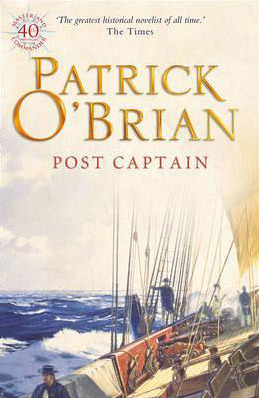
Master and Commander by Patrick O’Brian

Master and Commander I do not usually like books set at sea. However hard I try, I just can’t seem to keep track of the nautical terms and as soon as I see words like ‘mainsail’, ‘fo’c’sle’ or ‘bosun’ my brain just seems to switch off. As a fan of historical fiction, I have been unable to avoid this entirely – after all, until the 20th century the only way to cross the sea was by ship and many historical fiction novels do involve a sea voyage or two – but the thought of reading a book where seafaring forms a major part of the plot is always quite daunting for me. For this reason I’ve resisted reading the Aubrey/Maturin series for a long time, despite it being described as one of the best historical series ever written, but a couple of weeks ago I decided it was time I gave Master and Commander a try.

The story begins in Port Mahon, Minorca, with Jack Aubrey and Stephen Maturin meeting for the first time at a concert in the Governor’s House. After an initial disagreement that almost results in a duel, Aubrey and Maturin discover a shared passion for music and a friendship begins to develop. Jack Aubrey has just been given his first command of the sloop, HMS Sophie, and after discovering that Stephen is a physician, he invites his new friend to join him as ship’s surgeon. With Britain at war with France (it’s the year 1800), life at sea is both dangerous and exciting and as the Sophie cruises the Mediterranean she becomes engaged in a series of sea battles and encounters with enemy ships.

I loved Patrick O’Brian’s writing style from the beginning, but as soon as the Sophie set sail all my fears about naval novels were realised. I did try – there’s a useful diagram at the front of the book and of course there’s always the option of looking up unfamiliar words and finding pictures of ships online (if, like me, you don’t know the difference between a brig and a frigate and have always thought a settee was something you sat on) – but in the end I decided not to worry about it and luckily, there were still plenty of things for a landlubber like me to enjoy, not least the wonderful characters. Too often characters in historical fiction are depicted as having modern sensibilities and come across as twentieth century people dropped into a historical background – that was thankfully not the case with this book; they felt realistic and believable. O’Brian’s prose and dialogue is completely appropriate for the time period and the same is true of the behaviour and thought processes of the characters.

I liked both of the main characters and the contrast between their very different personalities and am looking forward to getting to know them better over the course of the series. At the moment Stephen Maturin is my favourite; I also appreciated the fact that he doesn’t have much more knowledge of seafaring matters than I do and has to have even the most basic naval facts explained to him by other members of the crew. It was good to know that someone else shared my bewilderment of the nautical world and I loved the way even at moments of high drama at sea, he was more excited about spotting a rare bird or fish.

Master and Commander doesn’t have a lot of plot, being of a more episodic nature, but I finished the book with a better understanding of what conditions were like onboard a ship in the Napoleonic era and what daily life involved for a sailor in the Royal Navy. It seems that not being able to follow all of the terminology or the more intricate points of the various naval manoeuvres was not the problem I was afraid it would be. I didn’t instantly fall in love with this series, but I still enjoyed my first introduction to Aubrey and Maturin and I’m sure I’ll be reading the next one very soon!

The Specimen by Martha Lea

The Specimen The Specimen sounded like the type of book I usually love. A Victorian setting, a murder mystery, exotic locations, interesting and unusual female protagonists – these are all things I love in a novel, so I had high hopes for this one.

The story begins in 1866 with Gwen Carrick on trial for the murder of the naturalist Edward Scales who has been found dead at his home in London. The narrative then takes us back in time to show us how Gwen first meets Scales and the events that lead up to his death and the murder trial.

Seven years earlier, in 1859, Gwen is living with her sister Euphemia in their remote home in Cornwall. Both women are unmarried and are leading unconventional lives for the time period – Gwen is an artist who is fascinated by natural sciences and loves to draw butterflies, beetles and other insects, while Euphemia is a spiritualist with a talent for mimicking voices. The sisters have little in common and their relationship is a difficult one. When Gwen meets and falls in love with Edward Scales she leaves her sister behind and accompanies him to Brazil to study and illustrate specimens of the flora and fauna there, but on their arrival in South America she starts to discover that Scales is not quite the person she thought he was. Why did Scales really invite Gwen on the trip to Brazil? What is he hiding from her? And is Gwen guilty of his murder?

Sadly, despite sounding so promising, this book didn’t live up to my expectations. I struggled to engage with the characters (Edward Scales is particularly unlikeable) and the Brazilian setting never really came to life. But my biggest problem was that I found the plot so difficult to follow and even after reaching the final page I wasn’t sure I’d understood what had happened. I do like books that encourage the reader to think, but this one was just too confusing for me. This is probably a book that would benefit from a re-read as it’s the type of story that has lots of clues buried in each chapter, which don’t necessarily have a lot of meaning until you get to the end and can see the whole picture. I didn’t like the book enough to want to read it more than once but I do think that might be the only way I would be able to fully appreciate it!

I do like to read about women who were involved in the sciences during the Victorian period and it was interesting to read about Gwen’s interest in studying and drawing insects. Gwen does not always behave the way a Victorian woman is expected to behave; she values her independence and is struggling to find a place for herself and her work in a nineteenth century society dominated by men. Euphemia was an interesting character too, though again, I found her storyline confusing (and often bizarre) and I don’t think I completely understood what was going on with her.

The Specimen is full of fascinating ideas and themes, so I’m sorry I can’t be more positive about it. I think as long as you’re aware that you need some patience and concentration and don’t go into this book expecting the gripping melodrama promised by the blurb, you might enjoy it more than I did.

I received a review copy of this book from the publisher via Netgalley