The Glovemaker by Stacia Brown

The Glovemaker is set in Oliver Cromwell’s England, just after the execution of Charles I in 1649, and follows the trial of Rachel Lockyer, a glovemaker’s assistant who has been accused of killing her illegitimate child. A new law states that any unmarried woman who is found to have concealed the death of her baby must be guilty of murder. Apart from Rachel herself, nobody knows the truth about what happened, but Rachel is reluctant to speak up and defend herself, so it’s left to investigator Thomas Bartwain to examine the evidence and the jury to decide whether Rachel should be sentenced to death.

The time period Stacia Brown has chosen for this novel is one that does not seem to be widely covered in historical fiction – the years between the English Civil War and the Restoration, when Oliver Cromwell ruled (known as the Interregnum) – and this is what had drawn me to the book. But when I read historical fiction I like to get a good sense of the period the book is set in and to feel as if I’ve been transported there myself and unfortunately, this did not happen with The Glovemaker. It didn’t help that I kept noticing inaccuracies – houses here in England don’t have stoops, for example, and I’m fairly sure we wouldn’t have been eating cranberry biscuits in 1649 either. Just small things, but they meant that I was never able to feel completely immersed in the atmosphere of 17th century London.

I did think the parts of the book set in Newgate Prison and describing the conditions under which the prisoners lived were quite compelling. And I learned a lot about the Levellers, the political movement that some of the characters in the book are part of. One of the Levellers in the novel is William Walwyn, the father of Rachel Lockyer’s child, who I discovered from the author’s note was a real historical figure.

I thought The Glovemaker was interesting in that it portrayed what must have been a very real situation for a lot of women at that time who found themselves pregnant but without a husband. It seemed very unfair that if the woman’s illegitimate child died at birth she would be assumed by law to have murdered it and unless she could produce a reliable witness, she would be sentenced to death – and even more unfair when you consider that this law did not apply to married women.

But other than as a study of the 17th century legal system, I wasn’t quite sure what the purpose of this story was supposed to be. There was no mystery, because we were told in the opening pages that Rachel had concealed her child’s death (we see her burying it behind the Smithfield slaughterhouse in the prologue) – the only question was whether or not the baby had died naturally. I didn’t think the romance aspect of the book worked either: the affair between Rachel and William Walwyn formed quite a big part of the story but I never felt emotionally involved in their relationship. The one character who did interest me was Thomas Bartwain, the investigator in charge of Rachel’s case, whose conscience starts to trouble him as he interviews witnesses and learns more about Rachel’s story and the injustice of the law.

I just wish I had been able to care about Rachel as this could have been such a moving story. Instead I was left feeling disappointed that, for me, this novel didn’t live up to its potential.

This book has also been published under the US title of Accidents of Providence.

The Light Between Oceans by M.L. Stedman

The Light Between Oceans is the story of Tom and Isabel Sherbourne, a young couple living on the remote island of Janus Rock, off the coast of Australia. Tom, who has recently returned physically unharmed from fighting in the Great War, has taken a job as lighthouse keeper on the island.

One day in 1926, a boat is washed up on the shore of Janus, with a baby girl and a dead man inside. Isabel, who has just suffered the latest in a series of miscarriages and stillbirths, sees this as a second chance and is determined to keep the baby. Tom is not so sure, but he loves his wife and she convinces him that it’s the right thing to do. Raising Lucy as their own child, it’s not long before Tom and Isabel can’t imagine life without her, but their decision to keep her leads to other important choices that have to be made and could have heartbreaking consequences for everybody involved. What if the baby’s real mother is still alive somewhere, wondering what has happened to her daughter? And how will Tom cope with his feelings of guilt over what they’ve done?

The Light Between Oceans is a very impressive debut novel from M.L. Stedman. I loved the island setting and I was given a real sense of the isolation of Tom and Isabel’s lives. The Sherbournes are completely alone on Janus Rock, apart from a few times a year when supplies are brought by boat from the mainland. It sounded like a beautiful place to live but also a very lonely, solitary existence not without its difficulties and hardships. There are a few occasions when they visit Partageuse, the closest mainland town, and this setting is also brought to life through characters such as Isabel’s parents, Bill and Violet Graysmark, and the businessman Septimus Potts. Reading this book made me aware of how few novels I have actually read that are set in Australia, which is something I would like to change.

The First World War, the long term effects on the men who fought in it and the experiences of the many people who lost their loved ones forms a small but very important part of this novel. I don’t think I’ve ever read anything about Australia’s involvement in the war and so I really liked this aspect of the book. I also found it interesting to read about the role of a lighthouse keeper and what it involved. There are some quite detailed descriptions of the various parts of the job, but none of it was too difficult to understand.

But what I loved most about this book was the way the author allowed us to sympathise with all of the main characters; it wasn’t a case of one person being entirely in the right and another in the wrong. I could see why Isabel wanted so desperately to keep Lucy but I could also understand why Tom was struggling with his conscience and how the baby’s biological mother might have felt. The novel raises so many questions…If you know that you’ve done something wrong should you try to put it right even if doing so could cause even more heartbreak? Will trying to make amends actually make things better or worse? And most importantly, what will be best for Lucy herself? These questions are difficult to answer but they are what made this book such an interesting and thought-provoking read.

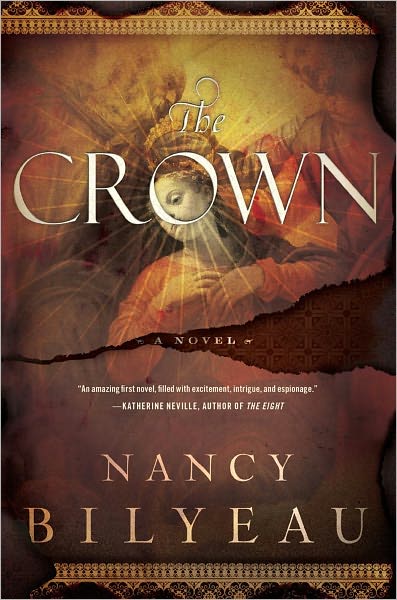
The Crown by Nancy Bilyeau

Nancy Bilyeau’s first novel, The Crown, is a historical mystery set during the Tudor period, beginning just before the death of Henry VIII’s third wife Jane Seymour. The story revolves around the search for a legendary crown which is said to possess special powers. Our heroine and narrator is Joanna Stafford, niece of the third Duke of Buckingham, and a novice nun at Dartford Priory.

When Sister Joanna escapes from the priory and travels to London to witness the execution of her cousin for treason she is unfortunate enough to be captured and taken to the Tower of London. Here she is visited by Stephen Gardiner, the Bishop of Winchester, who sends her back to Dartford on a mission to find the mysterious Athelstan crown which he believes could be hidden somewhere within the priory. As Joanna learns more about the crown she starts to wonder why the Bishop wants it so desperately, but with her beloved father also imprisoned in the Tower and threatened with torture, it seems she has no choice but to obey Gardiner’s orders…

This was one of the most entertaining Tudor novels I’ve read and a real page turner from beginning to end. When the search for the Athelstan crown began I was concerned it might become too much like The Da Vinci Code but that didn’t happen. The mystery of the hidden relic was an important part of the story, but not at the expense of the character development or the wonderful sense of time and place that the author creates.

I really liked Joanna Stafford. One of the things that makes her such an interesting narrator is the constant conflict between her commitment to the vows she’s required to take as a nun and her desire to do whatever is necessary to help her father, even if it means breaking some of these vows. The fact that she sometimes struggles with her conscience and doesn’t always make the right decisions helped me to believe in her as a character.

As a member of one of England’s most powerful families, Joanna meets a lot of famous names from the period including Katherine of Aragon, Anne and George Boleyn, Catherine Howard and Princess Mary, but unlike a lot of Tudor novels this one doesn’t really focus on the court. Instead we are given lots of details on life in a priory and what it was like to be a nun during the Dissolution of the Monasteries, when on the orders of Henry VIII the religious houses of England, Wales and Ireland were closed down, destroyed or sold. This is not something I knew much about before starting this book and I had no idea what happened to the monks and nuns after the monasteries were dissolved, so it was good to learn more about the process and what it involved. But although there’s plenty of history here, it really serves as a background to the plot and never slows the story down at all, so I think this book could be enjoyed by people who like thrillers and mystery novels as well as by fans of historical fiction.

The Crown is a complete story in itself, but the way it ended left me feeling that there were more adventures ahead for Joanna. Apparently Nancy Bilyeau has written a sequel and I’m already looking forward to reading it and entering Joanna’s world again.

I received a copy of The Crown through Netgalley

Queens’ Play by Dorothy Dunnett

Queens’ Play is the second of Dorothy Dunnett’s Lymond Chronicles. A few weeks ago I talked about how much I loved the first in the series, The Game of Kings, and I’m pleased to report that I enjoyed this one too, though maybe not quite as much. I never know how to write about the second book in a series as it’s very difficult to discuss it without giving away some of the things that happened in the previous book. So, while I’ll do my best to avoid spoiling too much, if you haven’t already read The Game of Kings then you might prefer to do so before reading any more of my posts on the series.

Queens’ Play starts two years after the end of The Game of Kings. Mary of Guise, the mother of seven-year-old Mary Queen of Scots, has asked Francis Crawford of Lymond to join them in France and help to protect the little Queen from a plot against her life. However, Lymond’s face and name are too well known in France and so he goes undercover, disguised as one of a party of Irishmen who are visiting the French court.

As with The Game of Kings, I was very impressed by the complexity of the characters and the intricate twists and turns of the plot, but Queens’ Play also gives us a vivid depiction of the court of Henri II with its splendour, extravagance and corruption. There are plenty of exciting, dramatic scenes and set pieces too – Lymond’s adventures in France include a hunt involving a cheetah and a wolfhound, a moonlit race across the rooftops of Blois, a wrestling match (I would never have thought I could find wrestling so thrilling to read about!), stampeding elephants and more than one attempted poisoning.

In the time between finishing Queens’ Play and posting this review I have been reading the third book, The Disorderly Knights (halfway through at the moment and loving it), and I’m already starting to see the importance of Queens’ Play in the context of the series. We are introduced to some new recurring characters and Lymond also learns a lot of important lessons in France – as well as battling some personal demons, he starts to understand what it means to be a leader, to care for the men under your control and to take responsibility for what happens to them.

As I mentioned at the start of this post, I thought Queens’ Play was a great book but I didn’t love it as much as I loved The Game of Kings. I think part of the problem was that at the end of The Game of Kings I had felt we were finally starting to see the real Francis Crawford, yet almost from the very beginning of Queens’ Play he was pretending to be somebody else – and although I was still enjoying the story, I wanted Lymond, not his alter ego. Still, as far as I can tell, a lot of people consider this to be the weakest book in the series, so if that’s true I’m really looking forward to the others!

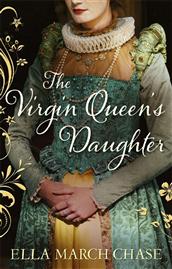
The Virgin Queen’s Daughter by Ella March Chase

This novel, as you can guess from the title, is based on the idea that Elizabeth I, the Virgin Queen, may have had a daughter. Although there’s no real evidence to support this claim, it was apparently rumoured that Elizabeth, as a young princess, had secretly given birth to an illegitimate child who might have been fathered by Thomas Seymour, her stepmother Katherine Parr’s husband. Elizabeth was also linked throughout her life with Robert Dudley and so another theory is that he could have been the baby’s father.

The Virgin Queen’s Daughter is narrated by Elinor de Lacey (Nell), Elizabeth’s newest lady-in-waiting, a young woman who shares Elizabeth’s hair colour and love of books and learning. Nell was brought up in the countryside by John and Thomasin de Lacey, believing them to be her parents, but after her arrival at court she begins to make some discoveries about her past. Could Nell be Elizabeth’s secret daughter?

If you’ve read lots of Tudor fiction I’m not sure The Virgin Queen’s Daughter offers anything very new, but although I’ve read quite a few Tudor novels I’m not at the point where I’m bored with the period yet and so I really enjoyed this book. Although I find it hard to believe that someone in Elizabeth’s position could have concealed the fact that she was pregnant and kept the birth of her child a secret, I still thought it was an interesting subject for a historical fiction novel.

Many of the famous names of the Tudor/Elizabethan period are here: as well as Elizabeth I herself, there’s Robert Dudley, the “spymaster” Francis Walsingham, the mathematician and astrologer John Dee, Elizabeth’s beloved governess Kat Ashley, and several of the Queen’s ladies – Lettice Knollys, Isabella Markham and Mary Grey (sister of Lady Jane Grey). But the strongest characters in the book are the fictional ones: Nell de Lacey and one of the noblemen she meets at court, Sir Gabriel Wyatt. Nell is an interesting and intelligent narrator – like the Queen she enjoys reading and studying, things women were not usually encouraged to do at that time. And Gabriel was such a great character I was a bit disappointed that he didn’t really exist!

I thought Ella March Chase did a good job of portraying the intrigue and danger of life at court, where you never knew who could and could not be trusted, and where anyone believed to be a threat to the Queen could find themselves locked in the Tower. And with two of the main characters being fictional, the author could take their story in some unexpected directions, which added plenty of tension and suspense to the novel.

The Virgin Queen’s Daughter doesn’t really stand out from other historical fiction novels of this type, but overall it was a fun and entertaining read which I would recommend to fans of Philippa Gregory, Alison Weir or Karen Harper.

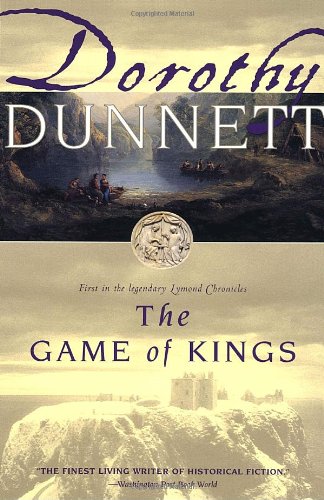
The Game of Kings by Dorothy Dunnett

The Game of Kings is the first of the Lymond Chronicles, a series of historical fiction novels by Dorothy Dunnett originally published in the 1960s and 70s. I’m actually quite surprised and disappointed that I had never come across these books before, especially as historical fiction is my favourite genre and for a few years was pretty much all I read. Anyway, I’ve discovered them now, which is the most important thing!

It’s 1547 and Francis Crawford of Lymond, accused of treason five years earlier, has returned to his home country of Scotland. As the leader of a band of outlaws he begins a search for the three men he believes might be able to clear his name. Lymond’s personal quest is played out during an important period in Scotland’s history: the English are hoping to marry the 4 year old Mary, Queen of Scots to 9 year old King Edward VI of England and unite the two countries – but the Scots are equally determined to prevent this from happening.

I really can’t tell you much more about the plot without spoiling the story, but I can promise you that this was one of the most gripping historical novels I’ve read for a long time – I was never bored for a minute. There are sad scenes, funny scenes, exciting scenes and moving scenes, not to mention the most thrilling sword fight I’ve ever read! I finished reading the book last weekend and since then have been trying to think of what I could possibly say about it that would do it justice…there were just so many things I loved: the wonderful plot, filled with twists and turns, surprises and revelations; the strong, memorable characters; the clever dialogue; and the accurate and well-researched historical setting. Most of all, of course, I loved Francis Crawford of Lymond, brilliant, charismatic and witty, but also very flawed and troubled. He is now high on my list of favourite fictional characters!

In fact, all of the characters in the book are incredibly well drawn. There’s so much I could say about Christian, Will, Sybilla, Kate, Richard, Mariotta and the others, but I won’t because it would be so much more fun for you to get to know these characters for yourself. They all felt like fully formed people rather than just words on a page and they lived on in my mind even when I wasn’t reading, which I always think is a sign of a good book. And I haven’t even mentioned yet the amazing sense of time and place Dorothy Dunnett creates. The amount of detail she goes into in building Lymond’s world is so impressive and everything feels completely accurate.

But much as I loved it, this was not the easiest of books to get into. There are a lot of characters to keep track of and some of them are referred to by more than one name or title, so the character list at the front of the book was very helpful! The novel also has a very, very complex plot and you really need to concentrate because the tiniest detail can turn out to be important later on. Lymond has a very good reason for almost everything he does but many of those reasons are not immediately obvious. Things that initially don’t make any sense suddenly take on new meaning a few chapters later and I found I had to keep re-reading previous sections so I could grasp what had happened.

I should also point out that Lymond’s dialogue is filled with quotes and references from history, literature, myth, nature, philosophy, nursery rhymes, songs and riddles (some of which are in French, Spanish, Latin or other languages, which are not translated for us). I soon realised there was no way I was going to understand all of the references, as unfortunately my education is sadly lacking in comparison to Lymond’s! Some of the things he says seem to mean nothing at all unless you recognise the context they are from, which in most cases I didn’t.

I know there are two Dorothy Dunnett Companions and other guides to the series that you can buy, but I think trying to read those along with The Game of Kings would have been too much for me on a first read! I decided just to enjoy the story and when I re-read the book, as I’m sure I will, I can look up the unfamiliar words and phrases then. In the meantime, there was always Google when I was desperate to know what something meant.

So, if you’re looking for a light, easy read The Game of Kings probably isn’t for you, but if you enjoy complex, well-written historical fiction then I hope you’ll give it a try. Although it could be challenging at times it was so rewarding and definitely worth the effort. I’ve already started reading the second in the series, Queen’s Play – I’m nearly 100 pages into it and loving it so far!

The Last Summer by Judith Kinghorn

In the summer of 1914, Clarissa Granville is almost seventeen years old and lives at Deyning Park, her family’s country estate. For Clarissa, her brothers and their friends, it’s a summer of parties, tennis games, walking by the lake, playing croquet, and having a good time. It’s also the summer when Clarissa meets Tom Cuthbert, the housekeeper’s son who is home from university. The two soon fall in love but their romance is in trouble from the start, as they both know that Clarissa’s parents will never allow her to marry the son of a servant. Then suddenly everything changes: Britain is at war and Clarissa’s whole world is altered forever.

So many different aspects of World War I are covered over the course of the novel, though with the story being told from Clarissa’s perspective the focus is on the effects of the war on British society and on the people left at home while their loved ones are away fighting. After the war is over we see how the world has become a very different place. We meet men who are trying to cope with the injuries and disabilities they’ve been left with, and the women who are trying to understand and to help them, as well as coming to terms with the loss of all the husbands, brothers, sons and fathers who never came home.

One of the biggest changes to Clarissa’s life is that the class structure that was in place before the war has been broken down. Many rich families like the Granvilles are left struggling financially, unable to afford to keep big houses like Deyning and all the servants they used to have. People who had previously felt secure in their comfortable, privileged lifestyles find themselves desperately trying to find a place in a new and unfamiliar world. But through it all, Clarissa will always remember that final perfect summer of 1914.

Although the story is narrated by Clarissa, we are also given occasional fragments of letters written by unnamed characters. These letters give us a different perspective on things, including some glimpses of life in France during the war, but who is writing them? It’s all revealed eventually and by the time you reach the end of the novel I can almost guarantee you’ll want to go back and read the letters again – they’ll make more sense the second time round.

The Last Summer is a beautifully written novel and one that I really enjoyed. I liked the characters, the time period is one of my favourites to read about, and Clarissa is a lovely, engaging narrator. Clarissa and Tom’s relationship is an interesting one to follow because nothing ever goes smoothly for them and so many obstacles are thrown in the way of their love. Not only are they separated by the war, they also face a lot of other problems including their differences in class and background, Clarissa’s disapproving mother, and their relationships with other people. I desperately wanted them to find happiness together but it was difficult to see how that could ever happen, and I will leave you to discover for yourself whether the book has a happy ending or not.

The Last Summer is my second book for the War Through the Generations reading challenge.