The Toll-Gate by Georgette Heyer – #1954Club

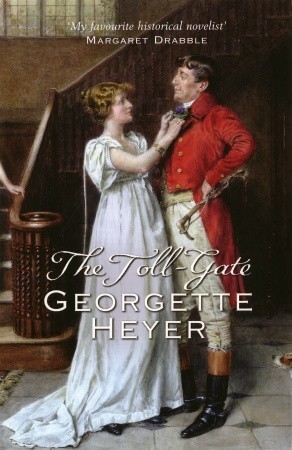
This is the first of two reviews I’ll be posting this week for Simon and Karen’s 1954 Club, one of their twice-yearly events where we all read and review books published in the same year. Georgette Heyer was such a prolific author I find there’s usually a book of hers to read for any year that is chosen! The Toll-Gate is her 1954 novel and one I hadn’t read before.

Like many of Heyer’s novels, this one is set in the Regency period. Our hero, the ‘overpoweringly-large’ Captain John Staple, has just returned from the Peninsular War and is finding it difficult to settle back into the monotony of civilian life. During a particularly tedious dinner party celebrating his cousin’s engagement, John decides to escape the next day and travel north to visit an old friend. Setting off alone on horseback, he becomes lost in the dark and rain and stumbles upon an isolated toll-gate somewhere in the Peak District. A frightened ten-year-old boy is collecting the tolls in the absence of his father, who has disappeared without explanation, so John decides to stay overnight to keep the boy company in the hope that his father will be back in the morning.

When the gatekeeper fails to return the next day, John finds himself helping to man the toll-gate for much longer than he’d expected, encountering highwaymen, thieves and Bow Street Runners. This is so much more exciting than one of cousin Saltash’s boring parties and John soon discovers that he’s in no hurry to leave, particularly when he meets Nell Stornaway, attractive, intelligent and, most importantly, tall – nearly as tall as John himself! Nell lives with her dying grandfather at nearby Kellands Manor and the old man’s heir has recently arrived, accompanied by a disreputable friend. But is it just the inheritance that has drawn them to Kellands or could they be mixed up in the disappearance of the gatekeeper?

Like The Quiet Gentleman, this is a Heyer novel where the focus is on the mystery rather than the romance. The romance is still there, but in a more understated way than usual. However, even though it’s love at first sight, it’s a romance I could believe in, because the hero and heroine seemed perfect for each other. I liked both of them – they are two of Heyer’s more sensible and mature characters, despite John’s love of adventure. And he certainly finds plenty of adventure when he chooses to spend the night at the toll-gate! The opening chapter set at Lord Saltash’s engagement party really doesn’t fit with the rest of the novel at all – it feels as though Heyer is setting up an Austen-style comedy of manners in that chapter, but once John sets out on his journey that aspect of the novel is abandoned and none of the characters we’ve met appear again. I was interested to learn that Heyer wrote the first chapter before deciding on the rest of the plot and had originally intended John’s family background to play a bigger part than it eventually did.

The dialogue is peppered with Heyer’s usual Regency slang, as well as the thieves’ cant used by characters such as Chirk the highwayman, and this adds colour and authenticity to the story. However, although I did enjoy this novel, it hasn’t become a favourite by Heyer; it seemed to lack her usual humour and I do tend to prefer her funnier books! Still, it was an entertaining read and a good choice for me for 1954 Club.

~

Other books from 1954 previously reviewed on my blog:

Jeeves and the Feudal Spirit by PG Wodehouse
Three Singles to Adventure by Gerald Durrell
Mary Anne by Daphne du Maurier

~

This is also book 17/50 read for the Historical Fiction Reading Challenge 2022.
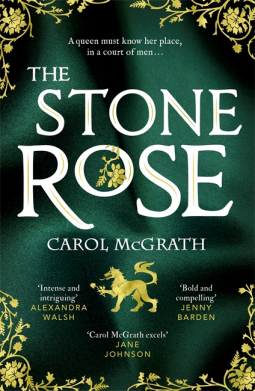
The Stone Rose by Carol McGrath

The Stone Rose is the final book in Carol McGrath’s She-Wolves Trilogy, but don’t worry if you haven’t read the first two – each one stands alone and tells the story (in fictional form) of a different medieval queen of England. In The Silken Rose we met Eleanor of Provence and in The Damask Rose Eleanor of Castile; now, in this latest novel, it’s the turn of Isabella of France. Isabella was the daughter of Philip IV of France and the wife of Edward II of England, but also a powerful and influential woman in her own right. The Stone Rose explores Isabella’s story both from her own perspective and through the eyes of Agnes, a female stonemason who designs Isabella’s tomb.

Isabella is only fifteen years old when the novel opens in 1311, and much as she tries to love her husband – at least at first – she is already becoming aware that Edward is perhaps not the best person to be ruling the country. He is too easily led by his favourites, particularly the handsome young Piers Gaveston, ignoring the advice of older, more experienced noblemen, and spends his time thatching roofs and digging ditches like a peasant rather than taking part in more courtly pursuits. Worse, he seems determined to send England into a series of battles with the Scots that nobody really has the heart for.

As the years go by, the pleasant and relatively harmless Piers is replaced by a new favourite, the scheming, ambitious Hugh Despenser the Younger, and Isabella begins to fear for her own position, especially when she starts to suspect that Edward loves Despenser more than he loves her. As tensions grow at court and across England, Isabella returns to France to visit her family – and here she meets Roger Mortimer, an English baron who has recently escaped from imprisonment in the Tower of London and shares her hatred of Hugh Despenser.

I won’t say much more about the plot, as if you’re familiar with the history you’ll already know what Isabella does next – and if you’re not, you’ll probably prefer to find out for yourself when you read the book. As far as I could tell, Carol McGrath sticks quite closely to the known facts, except where it’s necessary to use her imagination to help bring the characters to life and fill in gaps in the story or where there is some historical controversy, for example regarding the eventual fate of Edward II.

Despite Isabella’s “she-wolf” nickname (one which has also been applied to several other unpopular queens) I found her a sympathetic character here. It was sad to see her marriage gradually disintegrate as Edward spends more and more time with his favourites, falling completely under their power and refusing to listen to other points of view. I also found it interesting to read about Isabella’s interactions with the other women at court, particularly the three de Clare sisters, one of whom – Eleanor – is the wife of Hugh Despenser. Because of Isabella’s conflict with Eleanor’s husband, the two women can never be friends, but they are forced to spend long periods of time together over the years and their relationship, as you can imagine, is a very uncomfortable one.

The previous two books in this trilogy have each included a second protagonist, whose story unfolds alongside the queen’s and is given almost equal attention. In this third novel, that role falls to Agnes, the stonemason – a real historical figure who really did work on Isabella’s tomb. I was slightly disappointed that we don’t see very much of Agnes; there are only a few sections written from her point of view, with the focus very much on Isabella’s story. I understand, though, that Agnes only entered Isabella’s life in the 1350s and played no part in what came before, so maybe it would have been difficult to weave the two narratives together more closely. Still, The Stone Rose is a fascinating read and I enjoyed adding to my knowledge of Isabella, Edward II and Roger Mortimer. Now that the trilogy has come to an end I will have to try Carol McGrath’s earlier novels, while I’m waiting to see what she writes next!

Thanks to Headline for providing a copy of this book for review via NetGalley.

This post is part of the blog tour for The Stone Rose – you can see details of the other stops on the tour in the image below.

This is book 16/50 read for the Historical Fiction Reading Challenge 2022.

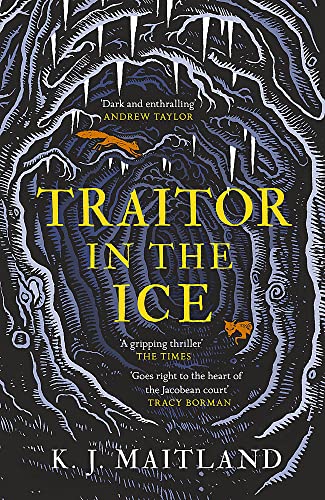
Traitor in the Ice by KJ Maitland

Traitor in the Ice is the second book in KJ Maitland’s new historical crime series set in the early 1600s during the reign of James I of England and VI of Scotland. The first, The Drowned City, introduces us to Daniel Pursglove as he searches for a mysterious Catholic conspirator known as Spero Pettingar in the aftermath of the failed Gunpowder Plot. That book is set in Bristol just after the devastating Bristol Channel Floods of 1607; Traitor in the Ice takes place the following winter – a particularly cold winter referred to as the Great Frost.

In these freezing, icy conditions a man has been found dead in the grounds of Battle Abbey in Sussex. The man was one of the King’s agents, sent to infiltrate the Montague household at Battle to try to root out those with Catholic sympathies. Lady Magdalen, Viscountess Montague is believed to be sheltering Catholic priests within the abbey walls, but the agent has been killed before having the chance to send his report to London. A replacement is needed, so Daniel Pursglove finds himself summoned by the King’s man, Charles FitzAlan, once more and sent to Battle to find evidence of treachery. He quickly discovers that almost everyone in the abbey has something to hide, but when more murders take place Daniel begins to wonder whether he is on the trail of the elusive Spero Pettingar at last.

One of the things I liked about the previous book in this series was the setting; I knew nothing about the Bristol floods and found the descriptions of the city in the aftermath quite eerie and otherworldly. The frozen landscapes of Sussex described in this second novel are equally atmospheric: the ‘withered brown bracken, each frond encased in its own ice-coffin’; the pink light of dawn ‘sending sparks of light shivering across the frost’. It’s the perfect setting for a murder mystery and Maitland weaves her usual mix of superstition and legend into the plot, adding to the sense of time and place. I was particularly intrigued by the practice of ‘night-creeping’, which Maitland explains in more detail in her very comprehensive author’s note at the end of the book.

I had hoped to learn more about Daniel Pursglove in this novel, but that doesn’t really happen and he is still very much a man of mystery by the final page. Although it’s not essential to have read the previous book first, I was pleased that I had as it meant I was familiar with at least some of Daniel’s background and wasn’t quite as confused as I might otherwise have been. I do like Daniel, though, and enjoyed following him through his investigations.

However, I had the same problem with this book that I had with the first one: there was just too much happening! The chapters set at Battle Abbey alternate with others set at court where through the eyes of two cousins, Richard and Oliver, we watch the rise to power of the King’s new favourite, Robert Carr. We also see Robert Cecil, Earl of Salisbury, working to maintain his own influence over King James, while in the streets and taverns of London violence is brewing between gangs of local youths and the Scottish courtiers who are newly arrived in the city. All of this is very interesting, but too much for one book on top of the murders and the Catholic conspiracies! With a tighter focus on just one or two threads of the plot, I think this would be a much stronger series. Anyway, I did enjoy this second novel overall and will be looking out for a third one.

Thanks to Headline for providing a copy of this book for review via NetGalley.

This is book 15/50 read for the Historical Fiction Reading Challenge 2022.
Mrs England by Stacey Halls

Mrs England is one of the books longlisted for the 2022 Walter Scott Prize for Historical Fiction. Although I hadn’t even heard of a lot of the titles on this year’s longlist, this particular book is one that I had been planning to read anyway. I enjoyed both of Stacey Halls’ previous novels, The Foundling and The Familiars, and was just waiting for the right moment to start reading this one.

The novel opens in 1904 with Ruby May, a trained children’s nurse from the prestigious Norland College, discovering that the family she works for are preparing to emigrate. Ruby is invited to accompany them, but turns down the opportunity, saying that she can’t be too far away from her younger sister and brothers. Instead, she finds a new position looking after the four children of Charles and Lilian England, a wealthy couple who own a cotton mill in the West Riding of Yorkshire.

On arriving at the Englands’ home, Hardcastle House, Ruby quickly senses that something is not right. Although Mr England is charming and friendly, Mrs England seems distant and withdrawn, showing very little interest in her children’s lives and leaving the running of the household to her husband. The other servants also make Ruby feel unwelcome, but she finds the four England children delightful and immerses herself in her work. As the days and weeks go by, Ruby becomes increasingly aware of the dark undercurrents within the household and wishes there was something she could do to help. However, there are mysteries lurking in Ruby’s own past and she has problems of her own to deal with. Why does she refuse to open letters from her father? Why is she so afraid of having her photograph taken? And what is the real reason for her reluctance to leave the country?

I think this is my favourite of the three books I’ve read by Stacey Halls. Although it’s quite a slow-paced novel, with most of the drama and revelations coming near the end, I was drawn completely into Ruby’s story from the beginning. As the novel’s narrator, Ruby is a genuinely nice person and I liked her immediately. It takes a long time for her back story to unfold and in the meantime I’d formed a few theories about what must have happened with her father – however, I wasn’t quite right! In her author’s note, Stacey Halls states that she based Ruby May’s story on a real person and incident that occurred in the late 19th century, but don’t be tempted to look at this until you’ve finished the book. The story that unfolds within the walls of Hardcastle House is even more intriguing and, again, I thought I knew what was going on only to find that, although I did guess some of it correctly, I was still missing some parts of the overall picture.

The descriptions of the Yorkshire scenery are very well done, particularly the parts of the book set in the Hardcastle Crags, as are the descriptions of the Englands’ cotton mill, the blacksmith’s forge and all the other locations Ruby and the children visit throughout the story. I also found it interesting to read about the Norland Nurses – the kind of training they received and the standards they were expected to conform to.

I enjoyed this book very much, but to be honest, I’m surprised it’s on the Walter Scott Prize longlist as it doesn’t seem quite as ‘literary’ as the books the judges usually go for. I hope it progresses to the shortlist next month, but we’ll have to wait and see.

This is book 14/50 read for the Historical Fiction Reading Challenge 2022.

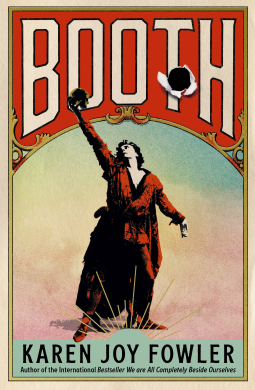
Booth by Karen Joy Fowler

This fascinating new novel by Karen Joy Fowler tells the story, in fictional form, of the Booths, the 19th century theatrical family who produced two of America’s most acclaimed actors, as well as one infamous killer – John Wilkes Booth, the man who assassinated Abraham Lincoln.

Although John Wilkes is, unfortunately, the best known Booth and probably the reason many readers will be drawn to this novel – to find out more about his background and what drove him to commit such a terrible crime – this is not just his story. In fact, he plays no bigger a part in it than several of the other Booths. For much of the first half of the book, the focus is on his father, the Shakespearean actor Junius Brutus Booth, who will have an important influence on the lives of each of his children – despite the fact that they rarely see him, as he spends so much time away on tour while the family stay at home on their farm near Baltimore.

Junius Brutus is a talented and successful stage actor, but as the years go by his alcoholism and eccentric behaviour make him increasingly unreliable, damaging his reputation and his financial situation. Still, he remains the centre of his children’s lives, and when three of his sons – Junius Jr (or June), Edwin and John Wilkes – follow in his footsteps and become actors themselves, they face a lifelong battle to avoid comparisons with him and with each other. It is Edwin who emerges from his father’s shadow to become one of the leading actors of his time and it is from Edwin’s perspective that we see part of the story unfold.

There are also two Booth daughters who survive to adulthood, Rosalie and Asia – and these are the other characters whose perspectives we see throughout the novel. Rosalie is the eldest and her viewpoint is particularly important early in the novel as she has experiences and memories that her younger siblings do not. As Rosalie grows into a sensitive woman who remains unmarried and close to her mother, she becomes known to the family as ‘poor Rosalie’, a sad and slightly tragic figure. Her younger sister Asia, a stronger personality who will become an author later in life, also offers some interesting insights into the dynamics of the Booth family; she has good relationships with both Edwin and John and feels caught in the middle as tensions begin to grow between the two brothers.

The murder of Abraham Lincoln doesn’t take place until near the end of the novel and there’s not much time left after that to explore the impact this terrible event has on the rest of the Booth family. Neither are we given any real answers as to what went wrong with John Wilkes Booth and what led him to carry out the assassination. It’s hard to say why, coming from a family who were loyal to the Union and largely anti-slavery, it is only John who ends up supporting the Confederacy and opposing abolition. All we can do is make our own assessment based on the information we are given, through the eyes of his siblings, about his childhood, his relationships, his education and his political views.

The novel has clearly been thoroughly researched (although in her author’s note, Karen Joy Fowler explains that as there’s very little information available on Rosalie Booth, it was necessary to use her imagination to fill in the gaps where Rosalie’s character is concerned). However, the book is incredibly detailed and this does slow the plot down a lot, particularly in the middle. We are also given some biographical information on Abraham Lincoln himself and on the events that lead to the Civil War and his presidency. These sections are interspersed with the Rosalie, Edwin and Asia chapters and are presented as non-fiction, which I didn’t really like as I felt it disrupted the flow of the story.

Despite the negative points I’ve just mentioned, I loved this novel. Even the use of present tense and heavy foreshadowing didn’t put me off. I enjoyed learning about a group of historical figures I’d previously known almost nothing about – I particularly liked the parts about the colourful theatrical careers of Edwin and Junius Brutus – and every time I picked the book up I looked forward to finding out what would happen to the family next. I haven’t read anything else by Karen Joy Fowler, not even We Are All Completely Beside Ourselves, but having enjoyed this book so much I’ll consider reading some of her others now.

Thanks to Serpent’s Tail for providing a copy of this book for review via NetGalley.

This is book 13/50 read for the Historical Fiction Reading Challenge 2022.
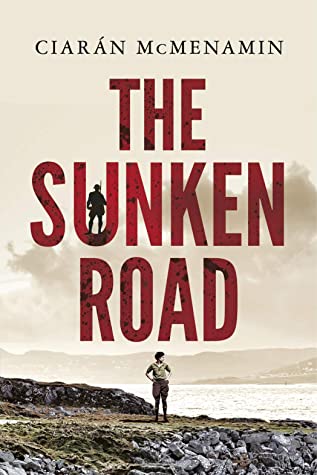
The Sunken Road by Ciarán McMenamin

I became aware of this book when it appeared on the Walter Scott Prize longlist in February and thought it would be a good choice for this month’s Reading Ireland Month (hosted by Cathy of 746 Books). Ciarán McMenamin is a Northern Irish actor and writer and The Sunken Road is his second novel.

The Sunken Road follows the story of Francis Leonard, known as Francie, who goes off to fight in the First World War with his best friend, Archie. Before he leaves, he promises Archie’s sister, Annie, that he will take care of her brother and bring him safely home when the war is won. Six years later, Francie is back in Ireland and has joined the IRA, fighting this time for his country’s independence. Finding himself a wanted man, pursued by Crozier, his former commander on the Western Front and now a member of the Ulster Special Constabulary, Francie is forced to go on the run. But what has happened to Archie and why has he not returned to Ireland? How will this affect Francie’s relationship with Annie, just when he needs her help more than ever? And what has he done to make Crozier hate him so much?

These questions are answered gradually as the story moves back and forth between 1915-16 on the battlefields of France and Belgium and 1922 in County Fermanagh and County Donegal, with occasional flashbacks to Francie’s childhood years, showing the beginning of his friendships with Archie and Annie. I found the jumping around in time a bit confusing at first, but as I got to know the characters better I was able to keep one timeframe separate from the other in my head and settle into the story. Although only six years have passed between the two periods, we can see how his experiences in the trenches have changed Francie, leaving him damaged, violent and desperate. Some of his actions since returning to fight in Ireland have been cruel and brutal and he is not an easy character to like, yet his interactions with Annie show that he is still capable of some tenderness and the fact that Annie – despite her heartbreak over what happened to her brother – doesn’t give up on Francie suggests that she thinks the man he once was is still there somewhere.

This book wasn’t entirely to my taste; I found it very violent, even for a war novel, and there’s a lot of focus on fighting, shooting and military life, things that I don’t particularly enjoy reading about. However, I was still gripped by the story and the very moving ending, although I wished I had a better knowledge of the history surrounding the formation of the Irish Free State as McMenamin doesn’t provide a lot of background information and just drops us straight into the action. If you do like a well-written war story and are looking for one set in Ireland, The Sunken Road would be an excellent choice. It’s written from such an interesting perspective – an Irish Catholic who fights in the 36th Ulster Division of the British Army against the Germans, then just a few years later finds himself fighting against the British for Ireland.

There are two other Irish novels also longlisted for the Walter Scott Prize: The Ballad of Lord Edward and Citizen Small by Neil Jordan and The Magician by Colm Tóibín. It will be interesting to see if any of them make the shortlist when it is announced in April.

Go Tell the Bees That I am Gone by Diana Gabaldon

Sometimes I wonder why I’m continuing to read this series. This is the ninth Outlander novel and the last one that I really enjoyed was the sixth; since then, each book has felt longer and less substantial than the one before. In this book, the final sequence – 100 pages or so – is excellent, but to get there you have to persist through 800 pages of irrelevant subplots that seem to lead nowhere and minor characters we barely know suddenly given large storylines of their own. As I’ve mentioned in previous reviews, though, part of my problem is that I’ve never been a fan of the Lord John Grey spin-off series, and Lord John and his family have played an increasingly large part in these most recent novels when I would prefer to be reading about other characters. I don’t mind Lord John himself but have very little interest in Hal, Ben, Amaranthus, Dottie or Percy!

Anyway, if you’re new to the series, should you start with this book? My answer would be no – definitely not! Start at the beginning, when 1940s nurse Claire Randall first steps inside a stone circle in Scotland and finds herself transported to the 18th century, then read the books in order, otherwise you’re going to be very confused.

Go Tell the Bees That I am Gone picks up where Written in My Own Heart’s Blood left off. It’s 1779 and the Revolutionary War is drawing ever closer to Fraser’s Ridge, the settlement in North Carolina where Claire lives with her husband, Jamie Fraser. Although Jamie had resigned his commission in the Continental Army after the Battle of Monmouth, with tensions growing between his tenants on the Ridge he knows he won’t be able to stay away from the action for long. Elsewhere, Jamie’s son William is still trying to come to terms with the discovery of his true father’s identity while also continuing the search for his missing cousin, Ben.

Meanwhile, Roger is finally about to achieve his dream of being ordained as a minister, but he and Brianna are becoming convinced that they are being pursued by someone from another time and are questioning whether they’ve made the right choices to keep their children safe. We also catch up, briefly, with Fergus and Marsali, who are discovering that printing newspapers can be a dangerous occupation in times of war, and we follow Ian, Rachel and Jenny as they travel north in search of Ian’s first wife.

It may sound as though a lot is happening in this book, but the things I’ve mentioned above are not enough to fill 900 pages and there seems to be a huge amount of padding: Frances Pocock, the orphan rescued from a brothel in the previous novel, trying to adjust to her new life at Fraser’s Ridge; William’s friend John Cinnamon searching for his father; a young girl, Agnes Cloudtree, escaping from an abusive stepfather; Silvia Hardman, Jamie’s Quaker friend, making a shocking discovery about her husband; and the usual assortment of difficult births, medical procedures, hunting expeditions, and all the minutiae of daily life on the Ridge. The focus on Claire and Jamie and their immediate family members, the relationships that made the earlier books so compelling, has been lost and the new characters just aren’t as interesting.

With no overarching plot to drive the story forward, it’s not until near the end that the pace eventually begins to pick up and I was reminded of why I used to love Diana Gabaldon’s books. We end on a cliffhanger which gives me hope that the next book will get off to a more exciting start! Book ten is apparently going to be the last and I suspect we could have another very long wait (the previous one was published in 2014, a seven year gap). I’ll definitely read it – I couldn’t not find out how it all ends after coming this far! – but I hope it will be better than this one and will concentrate on giving the main characters we know and love the ending they deserve.

This is book 11/50 read for the Historical Fiction Reading Challenge 2022.