Hamnet by Maggie O’Farrell

Maggie O’Farrell is an author I’ve heard a lot about over the years from other bloggers without ever feeling tempted to read myself, but the subject of her latest novel (the death of William Shakespeare’s son, Hamnet, at the age of eleven), appealed to me and I thought I would give it a try.

Despite the title, the focus of the novel is really Shakespeare’s wife, whom O’Farrell calls Agnes; she is more often known as Anne Hathaway, but Agnes is apparently the name by which her father referred to her in his will. Agnes, as she is depicted here, is an unconventional woman who flies a kestrel, has a knowledge of herbs and healing – and, some say, possesses the powers of second sight. Her husband, in contrast, is less well defined as a character. He is never even given a name; he is always ‘the husband’, ‘the father’ or, sometimes, ‘the Latin tutor’.

The novel begins with Hamnet alone in the empty workshop of his grandfather, a glovemaker, desperately searching for an adult who can help him; his sister Judith is unwell and he doesn’t know what to do. His father is in London and Agnes is away tending her beehives. It is some time later when Agnes returns home and hears the news of Judith’s illness and she will always wonder whether things might have played out differently if she had arrived earlier:

Every life has its kernel, its hub, its epicentre, from which everything flows out, to which everything returns. This moment is the absent mother’s: the boy, the empty house, the deserted yard, the unheard cry…It will lie at her very core, for the rest of her life.

Judith has a disease which appears to be the bubonic plague but we know from the historical records that it is Hamnet who will die. Knowing this in advance doesn’t spoil the story at all because we don’t know exactly when it’s going to happen or under what circumstances or exactly what impact Hamnet’s death is going to have on the people around him; these are things to be decided by the author and explored over the course of the novel. And although many people will be drawn to this book by the Shakespeare connection, I would describe it more as a book about grief and loss. O’Farrell’s portrayals of a grieving mother, a grieving father and grieving siblings – and the differences in the way each of these people handles their grief – are beautifully and poignantly written.

We are also taken back to an earlier time, before Hamnet was even born, when a Latin tutor arrives at the home of a sheep farmer to teach his young sons and becomes captivated with the boys’ half-sister. The tutor, despite not being named, is clearly Shakespeare, and the young woman, of course, is his future wife Agnes. The narrative moves backwards and forwards in time throughout the novel, alternating between the early days of Agnes and Shakespeare’s relationship and the story of Hamnet’s death, which takes place in the summer of 1596.

Although, as I’ve said, the writing is beautiful, the book is written in the third person present tense and that’s something I often dislike. It doesn’t necessarily stop me from enjoying a book (I don’t seem to have a problem with it in Hilary Mantel’s Thomas Cromwell books, for example) but in general I find it distancing and distracting and that was the case here. Another thing I found jarring was O’Farrell’s decision to avoid using Shakespeare’s name. I can understand that the reason for doing so must have been to keep the focus on Agnes and the children and to prevent it from becoming just another novel about Shakespeare, but she goes to such lengths to find alternative ways to describe him that I felt it actually drew attention to him rather than the other way around. This, and the decision to use the name Agnes instead of the more familiar Anne, makes me wonder whether the links to Shakespeare were really necessary at all; I think the story might have worked just as well with entirely fictional characters.

Finally, I want to mention one of the most memorable sections of the book: a detailed and imaginative description of how the plague which takes Hamnet’s life makes its journey from a glassmaker’s workshop in Venice to the faraway Warwickshire town of Stratford-upon-Avon. An aspect of the novel that turned out to be particularly timely and relevant, although O’Farrell couldn’t have known it while she was writing it!

If you enjoy reading historical fiction with a Shakespeare connection, here is a list of other books I’ve read either about or inspired by Shakespeare.
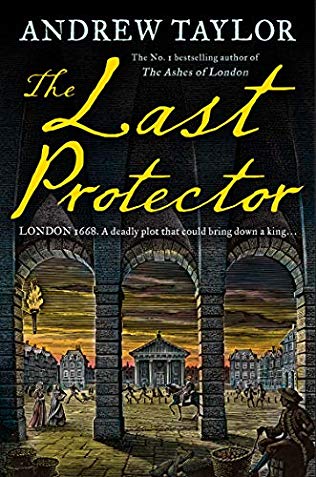
The Last Protector by Andrew Taylor

The Last Protector is the latest addition to Andrew Taylor’s wonderful Marwood and Lovett series set in England during the Restoration. It’s now 1668, and Charles II, restored to his throne eight years earlier, is beginning to lose the support of the people due to the extravagance of his lifestyle and the immoral behaviour of his courtiers. Many are starting to long for the days of the Lord Protector Oliver Cromwell and his son, Richard – and when Richard returns (in disguise) from exile, he becomes the centre of a conspiracy into which James Marwood and Cat Lovett are drawn.

At the beginning of the novel, government agent Marwood, still working for Joseph Williamson, Under-Secretary of State to Lord Arlington, is sent to spy on a duel between Lord Shrewsbury and the Duke of Buckingham, who is believed to be plotting against the king. Unfortunately, Marwood is seen by Buckingham’s men, making him a target of the Duke. Meanwhile, Cat, now married to the elderly architect Simon Hakesby (and not really enjoying the experience) has a chance encounter with a young woman she hasn’t seen for years. The woman’s name is Elizabeth Cromwell, the daughter of Richard, the last Protector. Richard has become caught up in Buckingham’s plans to gain power and he wants Cat and Simon to help him. In this way, Cat and Marwood are both pulled, via different routes, into the same circle of events and their two separate storylines become entwined.

This is the fourth book in the series and I would recommend reading them all in order if you can (the previous books are The Ashes of London, The Fire Court and The King’s Evil). It’s not really essential as the novels do all stand alone to a certain extent, but Marwood and Cat have a complex relationship and I think it’s best to follow their stories from the beginning. They don’t seem to have as many opportunities to interact in this book as they do in the earlier ones, but the occasions when their paths do cross are always worth looking forward to.

As usual, there’s also an interesting collection of secondary characters to get to know. One of the many things I enjoy about this series is the way the books incorporate both the lives of the nobility and the lower classes and there are two characters in particular who stand out this time: Ferrus, the ‘mazer-scourer’, a tall, skinny man whose job it is to squeeze himself down sewers to clear blockages underground, and Chloris, a kind-hearted prostitute who does her best to help Marwood despite her humble position in life.

Compared with the previous three novels, this book is more of a thriller than a mystery, still with plenty of twists and turns to the plot. And of course, the atmosphere and attention to detail are excellent, bringing to life the London of the period as the city continues to rebuild following the Great Fire of 1666. I hope there’s going to be a fifth book, especially as there’s a certain development towards the end of this one that has left me wondering what the future might hold for Cat and Marwood.

Thanks to HarperCollins for providing a copy of this book for review via NetGalley.

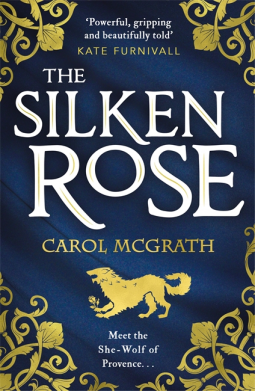
The Silken Rose by Carol McGrath

The Silken Rose is the first in a new trilogy of novels telling the stories of three medieval queens who have been referred to at one time or another as ‘she-wolves’ because of their unpopularity or because they managed to wield power or influence in a period dominated by men. The second and third books in the series are going to focus on Eleanor of Castile and Isabella of France, but this first novel is about Eleanor of Provence. Carol McGrath uses the alternative spelling of Ailenor, so I will do the same throughout the rest of this post.

Ailenor of Provence is not a queen I’ve ever read much about; I think it’s safe to say that she and her husband, King Henry III of England, are not the most popular subjects for historical fiction! They appear in Sharon Penman’s Falls the Shadow, but otherwise I’m struggling to think of other books I’ve read about them and that’s a good thing because it means that the story which unfolds in The Silken Rose feels fresh and different. It begins in 1236 with Ailenor, at the age of only thirteen, arriving in England from France for her wedding to Henry, a man more than twice her age. Although her new husband treats her with kindness and their marriage is not an unhappy one, Ailenor finds it difficult adjusting to life in a strange country and values the friendships she forms with two very different women.

One of these women is Henry’s sister, Eleanor, known as Nell, who has taken a vow of chastity after being widowed. Ailenor quickly discovers that Nell is in love with Simon de Montfort, one of the most powerful noblemen at Henry’s court, and she decides to help her sister-in-law break free from her oath and marry Simon. However, this marriage will eventually have serious repercussions for Henry and for England. The other friend Ailenor makes is Rosalind, a talented embroideress who is brought to court to teach Ailenor and her ladies to embroider intricate new patterns. Unlike most of the other characters in the novel, Rosalind is a fictional character, but she plays an important part in the story, providing a link between the nobility and the merchant classes.

Although Ailenor is the main focus of the novel, there are some sections written from Rosalind’s perspective (and occasionally from Nell’s), which helps to build up a full picture of the events that take place during this period, rather than only being limited to things that Ailenor experiences herself. The story Carol McGrath builds around Rosalind feels believable and fits seamlessly into Ailenor’s story – but despite this, I didn’t find her as interesting or engaging to read about as Ailenor and although I did understand the reasons for her inclusion in the book, I would have preferred it if the novel had stuck solely to the real historical characters. Apart from that, I really enjoyed The Silken Rose; there’s not a huge amount of drama, but I was never bored.

You may be wondering why Ailenor has been described as a ‘she-wolf’; well, it seems that this was partly due to the fact that she brought a large number of her relatives to England with her, where they were given positions of power and were able to influence the king. These included several of her uncles (the ‘Savoyards’), one of whom was made Archbishop of Canterbury, and her sister, Sanchia, who married the king’s younger brother. This and some of the other reasons for Ailenor’s unpopularity are explored in the novel, yet she remains a sympathetic character and one I very much enjoyed getting to know. I am looking forward to reading the other two books in the trilogy.

Thanks to Headline for providing a copy of this book for review via NetGalley.

This is book 3/20 from my 20 Books of Summer list.

Mrs Whistler by Matthew Plampin

Thanks to everyone who commented on my post earlier this month asking for recommendations of novels about artists; I now have a whole list of titles and authors to investigate – and as promised, here are my thoughts on one of my recent reads, Mrs Whistler by Matthew Plampin. The Whistler the title refers to is, of course, the American painter James Abbott McNeill Whistler, and ‘Mrs Whistler’ is his model, muse and mistress, Maud Franklin. Although I was familiar with a few of his most famous paintings, such as Arrangement in Grey and Black No.1 (known as Whistler’s Mother), I knew nothing about his personal life or what sort of man he was, and I’m sorry to say that I hadn’t even heard of Maud.

The story of Maud’s relationship with Whistler is played out against a backdrop of some of the significant events that occurred in their lives between 1876 and 1880. The first part of the novel concentrates on the controversial Peacock Room, a decorative interior Whistler creates in the dining room of Frederick Richards Leyland’s London townhouse. Leyland is not at all happy when he sees what Whistler has done and a bitter feud follows. Later, the novel explores Whistler’s decision to sue the art critic John Ruskin for libel after he describes Whistler’s painting Nocturne in Black and Gold as ‘flinging a pot of paint in the public’s face’.

These two incidents form the basis of the plot and as I had no prior knowledge of any of this, I found that I was learning a lot about Whistler, his paintings and his life. But this is not so much a book about Whistler as a book about what it was like to know Whistler, to be near him and to share both his triumphs and his troubles. Maud Franklin must have known him as well as anyone – she was with him for around fifteen years and they had two children together (whom she had to see raised by foster parents), which makes her a logical choice of character to focus on. However, according to Plampin’s author’s note the real Maud had refused to talk to Whistler’s biographers who complained that ‘Maud could tell the whole story, but she will not’. This means Plampin has had to use his imagination to decide how Maud felt about Whistler and the other people in his life and how she may have thought, spoken and reacted.

Whistler, at least as seen through the fictional Maud’s eyes, does not come across as a very pleasant man. He’s self-absorbed, he treats Maud badly at times and often lacks awareness and judgement, which is particularly illustrated by his relationship with his friend Charles Augustus Howell, known as Owl. It is obvious to the reader that Owl cannot be trusted, but Whistler remains irritatingly loyal to him, not able to see what we and (eventually) Maud can see. I did have sympathy for Maud and wouldn’t have blamed her if she had left Whistler, but she stayed with him, I suppose, through a combination of love and a need for security. It’s a sad and often frustrating story, but told in a way that I found believable and convincing.

This is the first book I have read by Matthew Plampin, but I know he has written four others. If you’ve read any of them, maybe you can help me decide which one I should read next.

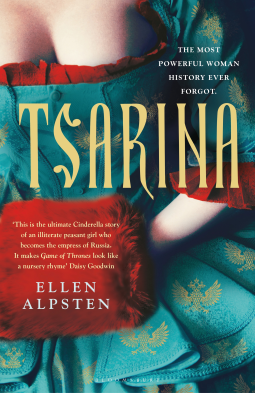
Tsarina by Ellen Alpsten

Tsarina is the story of Catherine I of Russia – not to be confused with Catherine the Great! Born Marta Skowronska in 1684, we first meet her as an illiterate peasant growing up in Livonia. When a rich merchant passes through her village, Marta’s family sell her to him as a maidservant and she is forced to leave her home behind and embark on a new and very different life. From these humble origins, we follow Marta’s rise to become the most powerful woman in Russia, first through her marriage to Peter the Great, who renames her Catherine Alexeyevna, and then as Empress in her own right.

I wasn’t sure what to expect from this book. I had initially been put off by the cover, which hinted that it would be more of a bodice ripper than the serious sort of historical fiction I prefer, but as I had seen some very positive reviews I decided to give it a try anyway. Although I’ve read quite a lot of novels set during other periods of Russian history, I’ve never read any that cover the life of Catherine I, so I thought if nothing else this would be a good introduction to a woman of whom I previously knew very little. And in that respect, it was a success because I finished it feeling that I’d learned a lot and had come away with a good knowledge of Catherine’s life and significance, while remembering that the book is a work of fiction and not everything in it can be assumed to be completely true – particularly in the early chapters, as so little is known for certain about Catherine’s early years.

Tsarina is a long novel and I could tell the author had put a lot of effort into researching it and trying to create a complete and believable 18th century Russian world. The book begins with a map of Russia under Peter the Great and a full list of characters, including all the members of the Tsar’s large family, the many courtiers at the Russian Imperial Court and the serfs and peasants with whom Marta/Catherine grew up in her village in the Baltics. Despite all of this I didn’t find the book quite as immersive as I would have liked, and although some parts of the story are certainly very gripping, I found myself struggling to get through other sections. As I’d suspected, there’s a lot of focus on Catherine’s sex life and many pregnancies, as well as a lot of long and graphic descriptions of the general violence, drunkenness and debauchery of Peter’s court – and while I’m sure it was all quite accurate, it did become repetitive after a while.

Still, it would be hard not to have some admiration for a woman like Catherine who overcame so much hardship in life (I won’t spoil the plot for those of you who know nothing about Catherine, but the novel shows how she was repeatedly exploited as a young woman and treated with brutality and unkindness) and even after she began to rise to power, she knew that her position was precarious and that she couldn’t afford to be caught off guard even for a moment. As for Peter, the author captures the many different facets of his personality, from his monstrous cruelty and ruthlessness to his intelligence and his vision of Russia as a modern western empire.

Although this wasn’t really the right book for me (or maybe I was just in the wrong mood for it) it was good to have the opportunity to get to know Catherine I. If any of you have read any other books about her, I would love to hear about them.

Thanks to Bloomsbury for providing a copy of this book for review via NetGalley.

This is book 1/20 from my 20 Books of Summer list.

The Irish Princess by Elizabeth Chadwick

I love Elizabeth Chadwick’s books and some of her very best, in my opinion, are the ones she has written about William Marshal – described as ‘the greatest knight that ever lived’ – and his family. In The Scarlet Lion we met William’s wife, Isabelle de Clare; now The Irish Princess tells the story of Isabelle’s parents, Richard de Clare and Aoife MacMurchada. There’s not really a lot of historical information available on Aoife (even how and when she died is unknown) but I know that Elizabeth Chadwick is an author who does her research and I’m sure this novel is as accurate as she could possibly make it.

Born in Ireland in the middle of the 12th century, Aoife is the daughter of Diarmait MacMurchada, King of Leinster. Growing up during a turbulent period of Irish history, Aoife is loved by her father but also valuable to him as a way of forming alliances with those who may be able to help him gain power. When his lands are invaded by a rival and he loses his kingdom of Leinster, Diarmait is forced to flee to Wales and then to England, where he seeks the help of King Henry II. Henry gives him permission to recruit men to try to reclaim his lands – and one of those who agrees to join him is Richard de Clare, lord of Striguil.

Richard had fought on the ‘wrong side’ in the recent civil war between Henry II’s mother, Empress Matilda, and her cousin, King Stephen. Now that Henry has come to the throne of England, Richard, who had been one of Stephen’s supporters, has found himself disinherited and out of favour with the new king. When Diarmait offers him Aoife as a wife in return for his assistance in Ireland, Richard sees this as an opportunity to regain power and influence. But this is no unhappy, forced marriage; when Aoife meets the man who is to become her new husband, she finds that he is a man she is able to love and trust.

I liked Aoife and thought she was a great subject for historical fiction, particularly as she’s somebody who isn’t written about very often. Although it may seem at first that she is little more than a pawn to be used in the schemes of men, it quickly becomes clear that Aoife has a mind of her own and is quite capable of coming up with her own plans and schemes, especially in her dealings with Henry II, in order to get what she wants from life. Richard proves to be the perfect partner for her; although they don’t always see eye to eye they treat each other with respect and I loved watching them settle into their marriage over the course of the novel. Richard, nicknamed Strongbow (thought to be derived from the word ‘Striguil’ rather than a reference to his skill with a bow), is also an interesting character in his own right and I enjoyed getting to know him as well as Aoife.

Although the relationship between Aoife and Richard is at the heart of the novel – there is a stronger romantic element here than in Chadwick’s last few books, I think – their personal stories fit seamlessly into the history of the period and the events of the Anglo-Norman invasion of Ireland are clearly described so you should find it all easy enough to follow even if, like me, you start the novel with little or no knowledge. I don’t think I would rank this book amongst my favourites by Elizabeth Chadwick as I found it a bit too long for the story being told and slightly repetitive at times, but it’s still a very enjoyable read and a good opportunity to meet two historical characters who are rarely given much attention.

Thanks to Little, Brown Book Group UK for providing a copy of this book for review via NetGalley.

Castle Dor by Daphne du Maurier

My choice for this year’s Daphne du Maurier Reading Week (hosted by Ali of Heavenali) is one of du Maurier’s more obscure novels; in fact, it’s debatable whether it should really be considered one of her novels at all, as it was begun by another author, Sir Arthur Quiller-Couch, also known as Q. At the time of his death, Quiller-Couch had left the novel unfinished and du Maurier completed it at the request of his daughter. I have seen some very mixed reviews of this book so wasn’t expecting too much from it; however, I have now read all of her other books – apart from some of her non-fiction – so I wanted to read this one as well for completion.

Published in 1961, Castle Dor is set in 19th century Cornwall and is based on the legend of Tristan and Iseult. The novel opens with a chance encounter between Linnet Lewarne, a young woman married to a much older man, and Amyot Trestane, a Breton onion seller, who fall in love and embark on a romance which will closely follow the events of the legend. Linnet and Amyot themselves are unaware of the parallels with that much older love story, although they know that something unusual is happening to them – that they have knowledge they really shouldn’t possess, are using words that should be unknown to them, and are behaving in ways they cannot control.

Local doctor and scholar Dr Carfax has a particular interest in Cornish legends and as he observes Linnet and Amyot together, he grows more and more concerned about the relationship between them and how it is mirroring the tale of Tristan and Iseult – and he begins to wonder whether he himself is playing a role in the retelling of the story.

If you’re not familiar with Tristan and Iseult, I won’t tell you what happens, but like most legendary love stories, it’s dramatic and tragic. Something in the way the novel is written, though, makes it feel less dramatic and tragic than I had expected, which was disappointing; the characters feel strangely flat and never really come to life and I struggled to believe in the romance between Linnet and Amyot. I expect that is at least partly due to the change in authors in the middle of the book; we will never know how Q had planned to develop the characters or how du Maurier would have depicted them if she had written the book from the start.

The exact point where du Maurier takes over from Q is not known and the transition is smooth and seamless so it’s not easy to detect the change, but I definitely noticed a difference in the writing style in the later parts of the book. The earlier chapters, which we know were definitely written by Q, are more heavily laden with historical and geographical detail as Carfax and his friends discuss various sources of the Tristan and Iseult story and try to locate some of the landmarks associated with the legend. I found this interesting, but not particularly compelling; the second half of the book was faster paced and more engaging as du Maurier brought the story towards its conclusion.

Although there are some similarities with du Maurier’s later time travel novel, The House on the Strand, this book is not really representative of her work (I think it’s unfair that Quiller-Couch is not credited on the cover). Unless you’re particularly interested in Tristan and Iseult, I think it’s one you should come to after reading some of her other novels first; it definitely wouldn’t give you the best impression of the qualities I love in her work. Still, Castle Dor was an interesting read and I have now reached my goal of reading all of Daphne du Maurier’s novels!

This is also book 16/50 read from my second Classics Club list.