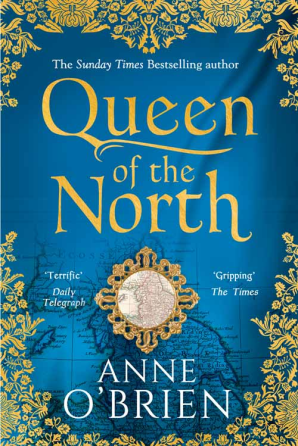
 Having enjoyed some of Anne O’Brien’s previous books, I was excited to learn that her latest novel, Queen of the North, was going to tell the story of Elizabeth Mortimer, wife of the famous Harry Hotspur, heir to the Earl of Northumberland in the late 14th and early 15th centuries. So much English historical fiction concentrates on London and the south, it’s always nice to find something set in my part of the country instead.
The novel opens in 1399; King Richard II is still on the throne, but for how much longer? His power is weakening rapidly and the exiled Henry of Lancaster is preparing to return to England and reclaim his lands. Elizabeth Mortimer’s husband, Harry Percy (known as Hotspur), and his father, the Earl of Northumberland, are among the northern Lords who decide to take Lancaster’s side against the King. This worries Elizabeth, who is convinced that Lancaster’s ultimate goal is the throne of England itself – and soon she is proved right.
Although Lancaster is Elizabeth’s cousin, she is disappointed when the Percy family support him in deposing Richard and claiming the crown. She believes that her young nephew, Edmund Mortimer, has a stronger claim and she is determined to do whatever it takes to help him take his rightful place as King. This will bring Elizabeth into conflict not only with the newly crowned Henry IV but also with her husband and she will have to decide where her loyalties truly lie: with the Mortimers or with the Percys?
Elizabeth’s efforts on Edmund’s behalf eventually lead her to Wales, where Owain Glyn Dŵr is planning a rebellion and looking for support from the Mortimers and Percys. Alliances are formed and broken, friends become enemies then friends again in an instant; it’s a dangerous time, but a fascinating one to read about!
I loved Queen of the North; I think it’s my favourite of the five Anne O’Brien novels I’ve read so far. As I’ve said, I really liked the northern setting, which gave me some glimpses of places I know and have visited, such as the Percy stronghold of Warkworth Castle when it was a living, working building rather than the semi-ruin it is today. The Percys were one of the most powerful and influential families in the north of England at that time; they were wardens of the Marches (the area surrounding the border with Scotland) and virtually ruled the north on behalf of the king, but this did not mean they could not be brought down and replaced if they fell out of royal favour. Anne O’Brien does a great job of showing how precarious their position actually was, when an error of judgement, a wrong decision or an act of betrayal could mean their downfall.
The central two characters in the novel are well drawn, strong and convincing. I liked Elizabeth – although her obsession with putting her nephew on the throne becomes frustrating at times (partly because we already know from history that she wouldn’t succeed), but it’s obvious that it means a lot to her and that she is only doing what she believes is right. With her husband reluctant to help and the old Earl completely in opposition, she takes matters into her own hands and although her actions are not always sensible I did admire her courage and persistence. I also liked Harry, nicknamed Hotspur because of his brave, reckless and impulsive nature. His relationship with Elizabeth is very convincingly portrayed – their personalities clash at times and they don’t always see eye to eye, but their love is strong enough to survive these differences of opinion.
Because we are seeing things through Elizabeth’s eyes, a lot of important events – such as battles, rebellions and some of Hotspur’s meetings with Henry IV – take place ‘off the page’. However, this does not mean that Elizabeth’s personal story is boring; she has plenty of adventures of her own as she tries to navigate her way through the various plots and schemes of the shrewd old Earl of Northumberland, the Welsh hero Owain Glyn Dŵr, and her own Mortimer relatives. There’s never a dull moment and in comparison to Anne O’Brien’s last book, on Joan of Kent, I think this is a much more exciting and compelling novel. Speaking of O’Brien’s other books, there is also some overlap here with The Queen’s Choice, which tells the story of Henry IV’s wife, Joanna of Navarre.
I really enjoyed Queen of the North – and have been reminded that I never did look for the final two books in Carol Wensby-Scott’s Lion trilogy, which was my only other encounter in fiction with Elizabeth and Hotspur. Can anyone recommend any more books set in this time and place?
Thanks to the publisher HQ for providing a copy of this book for review via NetGalley.