Witch Week: The Wicked Day by Mary Stewart

This week Lory of The Emerald City Book Review is hosting her annual Witch Week event, a celebration of fantasy books and authors. This year’s theme is Dreams of Arthur – books which draw on the Arthurian legends. Having read and loved Mary Stewart’s Merlin trilogy a few years ago, I thought this would be the perfect opportunity to read The Wicked Day, another of her Arthurian novels.

There is some overlap between The Wicked Day and the events of the final Merlin novel, The Last Enchantment, but in this book the focus switches to Mordred, the son of King Arthur and his half-sister, the witch Morgause. At the beginning of the novel, Mordred is being raised by peasants in the Orkney Islands and is unaware of his true parentage. It is only by chance that he is brought back into contact with his real mother, Morgause, by now the widow of King Lot of Lothian and Orkney, with whom she has had four more sons. Aware of Merlin’s prophecy suggesting that Mordred will be the cause of Arthur’s death, Morgause takes the boy into her household, sensing that he could be a useful weapon against Arthur.

Eventually, Morgause and her sons are summoned south to Camelot and Mordred will have to decide where his loyalties lie. But even if he chooses Arthur, will he be able to defy the prophecy or will he prove to be his father’s downfall after all?

I enjoyed this book, though maybe not quite as much as the three Merlin novels, which is probably because I found Merlin himself a more appealing character than Mordred. Having said that, Mary Stewart’s portrayal of Mordred is much more sympathetic than I had expected. Although my knowledge of Arthurian legend is very limited, I had gained the impression from other sources that Mordred was a villain, a traitor who betrayed Arthur. Stewart’s Mordred is not like that at all. He’s by no means perfect – he does have flaws and makes mistakes – but he always has the best of intentions and although he is ambitious any trouble he does cause for Arthur is largely due to circumstances outside his control.

As well as Mordred’s relationship with Arthur, his interactions with his four half-brothers – Gawain, Agravain, Gaheris and Gareth – are also explored. Their attitudes towards Mordred range from suspicion and rivalry to reluctant acceptance and respect. As I’ve said, I don’t know a lot about the Arthurian legends, so although I had heard of King Lot’s four sons and had a basic idea of how their stories would play out, it really was only a basic idea! The advantage of going into a book knowing very little about a subject is that you can be kept in suspense wondering what is going to happen and enjoy the story for its own sake, without any preconceived opinions; on the other hand, it would have been nice to have had other versions of the story and characters in mind so that I could have made comparisons and looked for similarities and differences.

At the end of the book we are given brief retellings of the sections of Sir Thomas Malory’s Le Morte d’Arthur and Geoffrey of Monmouth’s The History of the Kings of Britain which deal with the Mordred legend. Stewart then goes on to explain why she chose to interpret Mordred’s character the way she did; I found it interesting to read that while she was writing the earlier Merlin novels she had accepted the traditional view of Mordred as a villain and only changed her mind when she came to research his story in detail.
As with Mary Stewart’s other Arthurian novels, the elements of fantasy in The Wicked Day are very subtle and understated, amounting to not much more than a few prophecies and visions. The 6th century Britain that she recreates is a real, believable place and her books feel much more like historical fiction than fantasy, which is possibly why I like them so much. I am planning to read her final Arthurian novel, The Prince and the Pilgrim, and will then see how other authors have approached the legends. When I reviewed The Last Enchantment I received lots of ideas for future reading in the comments, so I have plenty of books and authors to explore. Chris of Calmgrove has also put together a very informative guest post for Witch Week with more suggestions and recommendations.
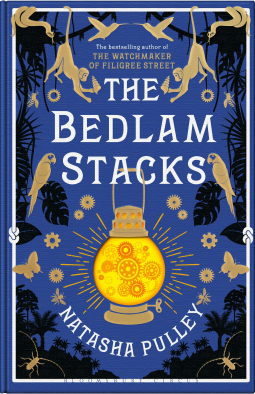
The Bedlam Stacks by Natasha Pulley

This is Natasha Pulley’s second novel. I remember seeing lots of very positive reviews of her first, The Watchmaker of Filigree Street, a year or two ago and thinking it sounded interesting. I never got round to reading that book, but when I heard about her new one, The Bedlam Stacks – which sounded just as intriguing – I decided to give it a try.

Set mainly in Peru in 1860, The Bedlam Stacks is narrated by Merrick Tremayne, a former opium smuggler and an expert in botany. Confined to his family estate in Cornwall due to a leg injury, Merrick is trying to come to terms with the fact that he will now have to put his adventuring days behind him and find something else to do with his life. Just as he is beginning to lose hope, his old friend Clem Markham arrives with a request from Merrick’s former employers, the East India Company. To tackle the problem of treating malaria in India, a supply of quinine is urgently needed – and Merrick’s expertise with plants makes him the ideal person to travel with Clem to Peru to take cuttings of the quinine-rich cinchona tree.

At first Merrick is reluctant to agree, knowing that his disability will make it difficult for him to travel through dangerous terrain – not to mention the fact that the Peruvians have a monopoly on the trees and are not about to let anyone else steal them. The alternative, though, is to stay at home and follow his brother’s suggestion of becoming a parson, so it doesn’t take him long to reach a decision! Venturing into the uncharted depths of Peru, Merrick and Clem finally arrive in the holy town of Bedlam, a place where the boundaries between magic and reality begin to merge.

The magical realism elements in The Bedlam Stacks are much more dominant than I had expected. There are moving statues, exploding trees and several other surprises which I will leave you to discover for yourself! This wasn’t really to my taste – I think I would have found it just as enjoyable to read a novel about an expedition to Peru that was based entirely on fact, without the touches of fantasy – but it was certainly imaginative and original. I did love the concept of the Markayuq statues, which apparently really exist and are still found in the countryside in Peru, originally thought to be guarding the villages. Natasha Pulley finds a clever and fascinating way to incorporate these into the story, but again I don’t want to say too much.

The sense of place is very strong – there are some wonderful descriptions of the Peruvian landscape as well as vivid accounts of more practical considerations such as the altitude sickness experienced during the journey – but I was slightly disappointed that there wasn’t a stronger sense of the time period. Neither Merrick’s narrative voice nor the dialogue between the characters felt convincingly Victorian to me; the choice of words and phrases, the grammar and the structure of sentences just weren’t right for the 19th century. I’m aware, though, that I can be a bit pedantic about anachronistic language used in historical novels and I know it’s not something that bothers everyone!

I did find a lot to enjoy in The Bedlam Stacks, although I’m sorry that I couldn’t quite manage to love it. Maybe I’m just not the right reader for Natasha Pulley’s books, but I’m still glad I’ve tried this one – even if not everything worked for me, I can understand the appeal!

Thanks to Bloomsbury Publishing for providing a copy of this book for review via NetGalley.

Heartstone by CJ Sansom

As part of my Reading the Walter Scott Prize project, I knew that I would, at some point, need to read CJ Sansom’s Heartstone, which was shortlisted for the prize in 2011. Knowing that it was the fifth book in a series, though, and not having read any of the previous ones, I decided to start at the beginning with Dissolution and take my time working through them all. This was a good decision as I have thoroughly enjoyed the whole series – and now that I’ve finally read Heartstone, I won’t be stopping here but will be going on to read the sixth book, Lamentation, as well.

Like the earlier novels, this one is set in Tudor England and narrated by the hunchbacked lawyer Matthew Shardlake. It’s 1545 and with news of a huge French fleet about to cross the Channel, England is preparing for invasion. On Henry VIII’s orders, an army is being raised and warships including the Great Harry and the Mary Rose are getting ready for action in the harbour of Portsmouth. Meanwhile, Shardlake is also heading for the south coast on his latest mission for Catherine Parr, the Queen.

It has been claimed that “monstrous wrongs” have been committed against a young ward of court, Hugh Curteys, by his guardian Sir Nicholas Hobbey, and the Queen wants Shardlake to investigate. Accompanied, as always, by his assistant and clerk Jack Barak, Shardlake sets off on the journey from London to Hampshire, falling in with a company of soldiers on the way. On arriving at the Hobbey estate, it is obvious that there is something not quite right – but with Hugh insisting that he is not badly treated, how will Shardlake ever find out what is going on?

As if this wasn’t enough, Shardlake also has a second mystery to look into. In the previous novel, Revelation, he met Ellen Fettiplace, a woman who has been confined to the Bedlam for many years. With his work for the Queen taking him close to the village where Ellen grew up, he decides to do some investigating of his own in the hope of finding out what happened to her all those years ago and how she ended up in the asylum.

Poor Matthew; things just don’t run smoothly for him in this book and he is forced to acknowledge that he has been too “full of righteousness” – not a bad thing for a lawyer to be, you might think, but it does seem that he spends a lot of time trying to help people who really don’t want to be helped. Like Barak (who is desperate to get home in time to see the birth of his child), I found him quite frustrating with his refusal to leave things alone and take note of the warnings he is given, but of course that is what makes him feel so real and so human.

As I said, I’ve enjoyed all of the books in this series and this one is no exception. It isn’t my favourite, though, mainly because I felt that it was much longer than it really needed to be and that there was too much padding while Shardlake and Barak moved backwards and forwards between one location and another without anything happening to advance the plot. It didn’t help that I guessed the solution to one of the mysteries early in the book (probably because I have read a few other books recently with similar twists, and not because it was made particularly easy to guess) and had to wait a very long time for Shardlake to work it out for himself!

One thing I always love about the Shardlake novels is Sansom’s wonderful, vivid depiction of life in Tudor England. In this book, we are dropped right into a country making preparations for war (an unpopular and expensive war), and we learn a lot about the weapons and armour that are used, how men are recruited into the army and the training they undergo, as well as being treated to a long, dramatic description of the sinking of the Mary Rose at the Battle of the Solent. At the end of the novel, Sansom provides a detailed historical note in which he gives more information on the background to the story and separates fact from fiction.

Although I didn’t love Heartstone as much as some of the other books in the series, it was still a great read and I’m looking forward to joining Matthew Shardlake again soon in Lamentation.

This is book #5 for the R.I.P XII challenge.

Snowdrift and Other Stories by Georgette Heyer

I always love spending time in Georgette Heyer’s world; with duels, masked balls, elopements, high-stakes card games and lively period slang, her novels provide perfect escapism – and based on this collection, so do her short stories. Originally published as Pistols for Two in 1960, Snowdrift and Other Stories contains eleven of Heyer’s tales of Regency romance and adventure plus three additional stories not included in the earlier book.

I found these stories so enjoyable and so much fun, it was tempting to read them all at once, but instead I decided to just dip in and out, reading one or two at a time over the course of a few weeks. This was probably a good idea as many of the stories in the book are very similar, so better in smaller doses, I think! In particular, there are several that deal with young couples eloping with various family members in pursuit and a series of misunderstandings ensuing along the way – and also several involving duels, fought with either pistols or swords, and never quite going according to plan. Most of the stories have a twist or two, which are usually easy for the reader to predict, but come as a complete surprise to the characters!

I don’t want to discuss all fourteen stories here, but I can honestly say that I liked all of them – some more than others, of course. Some of my favourites included Bath Miss, in which a gentleman agrees to escort the daughter of a family friend home from school in Bath, but finds that the girl is not quite what he’d expected; The Duel, which follows a young lady who goes in search of the disreputable Lord Rotherfield to beg him not to shoot her brother; and Hazard, where a nobleman ‘wins’ a friend’s sister in a drunken game of dice and is horrified when he wakes up the next day and finds himself on the way to Gretna Green. Another which stood out, although it wasn’t one I particularly loved, was Night at the Inn. Unlike the others, which are all romances of various types, this one is more of a suspense story in which three guests arrive at a lonely inn one dark, foggy night.

As for the three extra stories – Pursuit, Runaway Match and Incident on the Bath Road (all from the 1930s, I think) – they are very entertaining too, although they suffered slightly from being placed at the end. Speaking as someone who is not usually a fan of short stories, I did really enjoy this book. I prefer her full length novels but, as I’ve said, if you just want a small dose of Heyer – or maybe if you’ve never read her before and don’t want to commit to anything longer – I would recommend giving Snowdrift a try.

Thanks to Sourcebooks for providing a copy of this book for review via NetGalley.

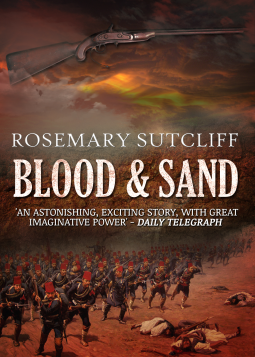
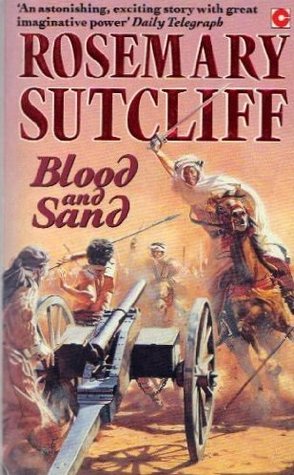
Blood and Sand by Rosemary Sutcliff

Rosemary Sutcliff is probably best known as a children’s author, but she also wrote several novels for adults and Blood and Sand, published in 1987, is one of them.

Blood and Sand is based on the true story of Thomas Keith, a Scottish soldier serving in the British Army during the Napoleonic Wars. Taking part in the Alexandria expedition of 1807 – an operation designed to capture the city of Alexandria in Egypt – Thomas is taken prisoner by Ottoman forces at El Hamed. Most of his fellow captives are sent back to Cairo as prisoners of war, but the Ottoman general in command of El Hamed has other plans for Thomas, who is ‘an extremely personable young soldier who speaks French, knows how to bear pain like a gentleman, and is the best swordsman and shot in his regiment’. Sent to train in the desert with the Bedouin cavalry, Thomas gradually rises through the ranks to enter the service of Tussun Bey, the Viceroy of Egypt’s youngest son, and to become Governor of Medina.

You may be wondering how it was possible for a Christian to reach such heights within the Ottoman Empire, so I should explain that Thomas makes the decision to convert to Islam. He does this partly because he is advised that it is the only way to progress in his military career but also because during his time as a prisoner he reads about and studies the Islamic religion and decides that conversion is something he feels comfortable with. However, it seemed to me that he made this choice a bit too easily and quickly; I would have found it more convincing if he had struggled with it more and if he had thought more often of the life he had left behind in Edinburgh and to which he would now never be able to return.

As far as I can tell – I had never heard of Thomas Keith until reading this book – most of the characters in the novel really did exist and most of the events described really did happen. This certainly seems to be true of the battles and military campaigns, but also two of the novel’s most exciting and memorable scenes: a dramatic duel and a desperate battle for survival on a dark turnpike stair. Of course, it’s Sutcliff’s skill as a writer which brings these scenes to life and fills them with suspense and tension, but it sounds as though the real Thomas Keith must have had a fascinating career and some hair-raising adventures. It’s surprising that he has not been a more popular subject for historical fiction.

In her author’s note Sutcliff says that the only area where she relies completely on her imagination is with the romance she creates for Thomas. This possibly explains why our hero’s love interest doesn’t appear until halfway through the book and only plays a relatively small role in the story. A much more interesting and moving relationship is the one between Thomas and Tussun, the Viceroy’s son – a relationship which develops over the years as Tussun grows from an impulsive, hot-headed teenager into a mature, well-respected leader and although it stops short of actual romantic love, is deeper than a normal friendship.

I enjoyed the first half of the novel very much, but later in the book Thomas and Tussun become embroiled in fighting against the Wahabis of Arabia and the heavy focus on military action was much less interesting to me than the more human story I had been finding so engrossing. That’s just my personal taste, though, and the battle scenes will probably appeal to other readers more than they did to me. I didn’t love this book quite as much as I’d thought I was going to at first, then, but I will certainly be reading more by Rosemary Sutcliff, having enjoyed both this one and The Rider of the White Horse.

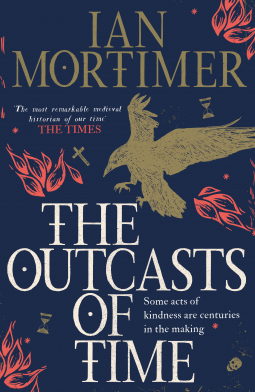
The Outcasts of Time by Ian Mortimer

Historian Ian Mortimer is probably best known for his non-fiction ‘handbooks’, The Time Traveller’s Guide to Medieval England and The Time Traveller’s Guide to Elizabethan England. His latest book, The Outcasts of Time, is a work of fiction but based around a similar concept. It’s a book packed with interesting ideas and intriguing themes, but although I found it an unusual and thought-provoking read, I don’t think it was entirely successful as a novel. I’ll try to explain.

The story begins in December 1348, with England ravaged by the Black Death. Two brothers, John and William, are walking home to their small village near Exeter when they too fall victim to the plague. Wandering into a stone circle in the dark, a mysterious, disembodied voice speaks to them, offering them a choice: they can return home and spend their last six days of life in familiar surroundings, but with the risk of spreading the sickness to the people they love – or they can live each of those six days in a different century, each one ninety-nine years after the one before. If they choose the second option, although they will still die at the end of the six days, all traces of plague will be removed during that period. I’m sure you can guess what they decide to do!

Waking up in the year 1447, the brothers find that the world is a strange and unfamiliar place – and each new dawn after that brings even greater challenges. As the novel’s narrator, John acts as our guide, describing the changes he sees in the English countryside and in the streets of the towns and villages he once knew so well. Some things, it seems never change – for example, in almost every year the brothers visit, a war is taking place – but it’s the great advances in technology and the small details of daily life which surprise John the most. When he reaches that distant age of 1942, he is equally amazed by the ‘flying crosses’ he sees in the sky and by the mysteries of an indoor bathroom!

With his background in history, Ian Mortimer has obviously taken great care to recreate each period his characters visit as accurately as possible, down to the tiniest details, showing the changes in architecture, fashions, food and drink, place names, and even the fact that people are growing taller over the centuries. However, although some characters do remark on the brothers’ unusual way of speaking, I’m not convinced that they would have been able to make themselves understood at all, bearing in mind how much the English language has changed since the 14th century (the time of Geoffrey Chaucer). Also, while I did like the different and unusual approach to time travel in the novel, it often felt more like the framework for a series of history lessons rather than the compelling story I would have preferred.

Religion played an important part in medieval life, and John and William, as they move forward through time, have the chance to see how Christianity, the church and the ways in which people worship have evolved over the years. The religious element of the book is very strong – too strong for me at times – but led to some interesting discussions between the brothers and the other characters they meet. Themes of faith, morality and redemption are always at the heart of the novel, and in each of the periods he visits, John attempts to carry out good deeds in the hope of earning his place in heaven. And as well as seeing some of the worst evils human beings are capable of, he also witnesses some acts of kindness and humanity.

The Outcasts of Time is a fascinating novel but I found it difficult to become fully engaged with it. With only one chapter devoted to each time period, there wasn’t really time to become attached to any of the characters apart from John and his brother. It wasn’t completely satisfying as a story, then, but I would still recommend it to anyone who loves the idea of time travel as much as I do!

Thanks to Simon and Schuster for providing a copy of this book for review via NetGalley.

Death in Bordeaux by Allan Massie

As some of you may know, I am currently working my way through all of the titles shortlisted for the Walter Scott Prize for Historical Fiction since the prize began in 2010. Allan Massie’s End Games in Bordeaux appeared on the 2016 list, but on discovering that it was the final book in a series of four, I was faced with a dilemma: should I just read the book that I needed to read for the prize or should I do as I usually prefer to do and start from the beginning of the series? In the end I decided to at least try the first book, Death in Bordeaux, in the hope that I would enjoy it enough to want to read the other three anyway.

The novel opens in Bordeaux in March 1940, with Superintendent Jean Lannes investigating the death of an old friend, Gaston Chambolley, whose mutilated body has been found in a street near the railway station. Gaston was homosexual and Lannes’s superiors are happy to assume that this was some sort of sex crime, but Lannes himself is sure there must be another explanation. The dead man’s sister-in-law has gone missing after becoming caught up in the political intrigue surrounding the Spanish Civil War, but as soon as Lannes suggests that her disappearance could be linked in some way with Gaston’s murder, he is ordered to drop his investigations immediately. Lannes, however, knows that he won’t be able to rest until he finds out who killed his friend and why.

In a seemingly unrelated case, he is also called in to help the elderly Comte de Grimaud identify the sender of some threatening letters he has received. As he gets to know the various members of the Comte’s dysfunctional family, Lannes begins to uncover some links with the other case he is working on – and that is all I will say about the plot, as it quickly becomes quite complex and I couldn’t go any further without spoiling the story.

All of this unfolds during the early stages of World War II – a period in which, at first, very little seems to be happening despite France having declared war on Germany. Soon, though, France becomes occupied, refugees from Paris begin to arrive in Bordeaux, and Lannes and his wife become increasingly afraid for their eldest son, Dominique, who is at the Front. While the author does provide a lot of historical detail, describing the major events and political decisions, and setting the story in its context, the focus is always on how the war is affecting the lives of our main characters: Lannes’ wife, Marguerite, writes letters to Dominique which she knows she’ll never send; their younger children, Alain and Clothilde, try to decide how they feel about the occupation of their country; and Alain’s new Jewish friend, Léon, wonders for how much longer he will be safe in France.

By the end of the novel, the war is still in progress and the personal stories of the characters mentioned above (and many others) have not been resolved. I believe that in the next book in the series, Dark Summer in Bordeaux, we rejoin some of the characters introduced in this one, so for that reason I’m glad I decided to start at the beginning. I can’t say that I loved this book – I found it slow and a bit too drawn out in places and it didn’t really work for me as a murder mystery. As a portrayal of life in Occupied France, though, it is an interesting, quietly atmospheric read. I liked it enough to want to continue with the second novel – and hopefully then the third and the fourth.

This is Book #3 for the R.I.P. XII challenge.