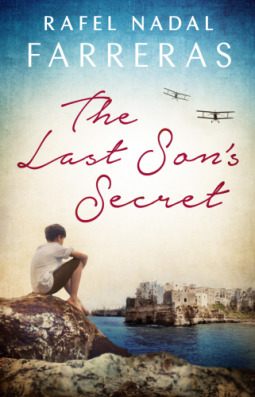
The Last Son’s Secret by Rafel Nadal Farreras

This novel by Catalan author Rafel Nadal Farreras apparently enjoyed a lot of success when published in its original language in 2015 and is now available for the first time in an English translation by Mara Faye Lethem.

The story is set in the Puglia region of Italy where, in the small town of Bellorotondo, the names of twenty-one members of the Palmisano family are engraved on a memorial to the First World War. Vito Oronzo, the last Palmisano man to die in the war, leaves behind a pregnant wife, Donata. When the child – a boy whom she names Vitantonio – is born, Donata is so afraid that her son will succumb to the curse of the Palmisanos that she takes desperate measures to secure his safety.

The Last Son’s Secret follows little Vitantonio through his idyllic childhood in rural Italy, growing up alongside Giovanna Convertini, the daughter of his father’s best friend who was also killed on the same day in 1918.

They took dips in the stone laundry trough, caught crickets in the garden, ran through the fields as the farmers cleared the dead leaves from the olive trees, and they ate dinner together at the kitchen table. In the evenings everyone gathered on the threshing floor and sat in the cool air: the grown-ups sang and told stories and the children played hide-and-seek until they were so worn out they fell asleep on their aunt’s lap.

Elsewhere in Puglia, however, life is not so pleasant. A neighbour’s six-year-old son is sold into child labour, while in the nearby cave houses of Matera families live in extreme poverty. Further afield, Mussolini is rising to power and Europe is on the brink of war once more. Eventually, Vitantonio, Giovanna and their friends will be forced to take sides. Will the Palmisano curse strike again or has Donata done enough to protect her son from his father’s fate?

I enjoyed The Last Son’s Secret; despite it being set during the two world wars, it’s not as depressing as it might sound – the likeable main character and the messages of hope and optimism are enough to counteract the darker aspects of the plot. The depiction of life in Italy between the wars is beautiful and I could easily imagine I was there in Bellorotondo, harvesting olives, picking cherries and planting flowers in the garden of the Convertini palazzo. I particularly liked the descriptions of Matera, where Vitantonio hides out for a while at the beginning of the war.

The Second World War chapters are also interesting to read, and I couldn’t help thinking how rarely I have read anything that looks at the war from an Italian perspective. This is certainly the first time I have read a fictional portrayal of the chemical disaster caused by the release of mustard gas during the sinking of the American ship John Harvey in the port of Bari.

The Last Son’s Secret is a surprisingly quick read, but it did take me a few chapters to really get into the story. This is probably because it begins with a long chronicle of the deaths of the Palmisano men, which I expect was intended to be a quirky and unusual opening to the novel but didn’t quite work for me. Also, while Vitantonio’s story was moving at times, I don’t really think I would describe it as the sweeping, heartbreaking epic promised by the blurb. Maybe some of the emotion was lost in translation – although in general I did think the translation flowed well and I had no real complaints about it. If any other books by Rafel Nadal Farreras become available in English I would be happy to read them.

This is Book 3/20 for my 20 Books of Summer Challenge.

Thanks to the publisher for providing a copy for review via NetGalley.
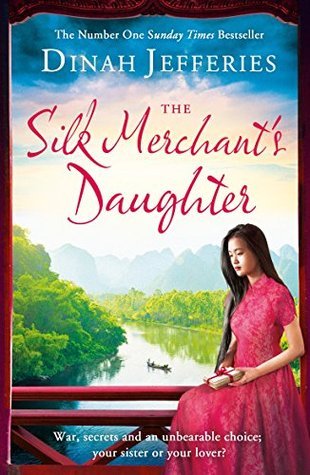
The Silk Merchant’s Daughter by Dinah Jefferies

After reading and loving Dinah Jefferies’ The Tea Planter’s Wife last month, I immediately added another of her books, The Silk Merchant’s Daughter, to my 20 Books of Summer list, hoping for another great read.

The Silk Merchant’s Daughter is set in French Indochina, the name formerly given to the group of French colonial territories which included Vietnam, Cambodia and Laos. The title character – and our heroine – is Nicole Duval, the eighteen-year-old daughter of a French silk merchant based in Hanoi, the capital city. The period during which the story takes place is a turbulent time in the history of the region and Jefferies provides a useful timeline at the front of the book for those of us who need some help in understanding the sequence of events.

As the novel opens in 1952, Nicole learns that her father is planning to hand over the running of the entire silk business to her older sister, Sylvie, leaving Nicole with only one small, neglected silk shop in the Vietnamese quarter of the city. Nicole is disappointed and resentful; her relationship with Sylvie has been difficult from childhood and yet again, Nicole has been made to feel inferior. To make matters worse, the man she loves – Mark, an American trader who is in Hanoi on mysterious government business – has previously been in a relationship with her sister, and Nicole is not at all sure that he and Sylvie no longer have feelings for each other.

Determined to make the best of things, Nicole opens up the little silk shop and it is here, living and working among the Vietnamese people, that she begins to understand their discontent with French rule. With the help of Tran, a militant with the revolutionary group the Viet Minh, Nicole’s mind is opened to new ideas and views. Being half Vietnamese herself – she has inherited her looks from her late Vietnamese mother, whereas Sylvie resembles their French father – Nicole has a certain amount of sympathy for Tran and his friends. But Mark and the Duvals will be on the opposite site of the coming conflict, so Nicole needs to decide where and with whom her loyalties lie.

The Silk Merchant’s Daughter is another enjoyable and engaging novel from Dinah Jefferies, bringing to life the history of a place about which I previously knew very little. Having learned about the Malayan Emergency in The Separation and 1920s Ceylon in The Tea Planter’s Wife, it was good to have the opportunity this time to add to my knowledge of Vietnam. I haven’t read much about the Vietnam War and nothing at all – until now – about the years immediately preceding it, encompassing the rise of the Viet Minh and the First Indochina War. It was also interesting to read about French colonialism, which made a change from reading about British colonialism!

Writing the novel from the perspective of Nicole was a good decision by Jefferies, as she is in the unusual position of being both French and Vietnamese. However, I never really felt that she was truly torn between the two and it seemed fairly obvious to me which side, and which man, she would eventually choose, and that took some of the tension and emotion out of the story. There are some wonderful descriptions of Vietnam, from the sights, sounds and smells of the streets of Hanoi to the colours and textures of Nicole’s silks, but on the whole I found this book slightly disappointing after the very high standards set by The Tea Planter’s Wife.

Although this is not my favourite Dinah Jefferies book, I am still looking forward to reading Before the Rains, her new novel set in India.

This is book 2/20 for my 20 Books of Summer challenge.

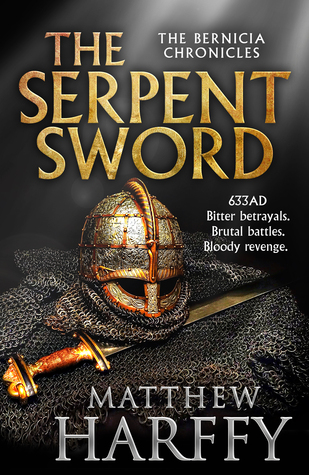
The Serpent Sword by Matthew Harffy

Much as I enjoy reading historical fiction set in other countries, it’s also nice to have the opportunity to learn about the history of my own little corner of the world. This novel by Matthew Harffy, the first of a series, is set in the same time and place as Edoardo Albert’s Northumbrian Thrones trilogy, but as soon as I started to read The Serpent Sword I could tell it was going to be a very different type of book – not necessarily better or worse; just different.

The Serpent Sword opens in the year 633, when Britain is still made up of a collection of warring kingdoms. It begins with murder – the murder of Octa, a favoured warrior of King Edwin, and his lover, a woman called Elda. We don’t know the killer’s identity, but we see him lurking in the shadows of the fortress of Bebbanburg and we learn that there are two motives for what he is about to do. The first is that he has been rejected by Elda, who has chosen Octa instead, and the second, he is unhappy that Edwin has gifted the magnificent sword known as Hrunting to Octa rather than himself.

It was a sword fit for a king. The blades forged from twisted rods of iron. The metal shone with the pattern of rippling water, or the slick skin of a snake. The hilt was inlaid with fine bone and intricate carvings. All who had seen the weapon coveted it.

Too late to be of assistance, Octa’s younger brother Beobrand arrives from Cantware in the south, keen to join the service of a great lord, only to be met with the devastating news of Octa’s death. On a happier note, despite Beobrand’s lack of experience, he impresses Edwin enough to be given a place in the king’s army for his upcoming battle against Penda of Mercia and the Waelisc king, Cadwallon of Gwynedd. However, the battle ends in disaster for Edwin and he and many of his men are killed.

Beobrand, one of the few survivors, is taken to a nearby monastery to recover and this proves to be another turning point in his life. Having formed some new but important friendships at the monastery, he sets off again in search of another lord to serve. He will learn some important lessons on his journey as he grows and develops as a person, acquires new skills and has the chance to fall in love – but he never loses sight of his mission to take revenge upon the man who killed Octa and recover his brother’s sword.

The Serpent Sword is a well-researched work of historical fiction and those readers who like their novels fast-paced and action-packed with plenty of scenes involving battles, weapons and fighting will find a lot to enjoy here. Matthew Harffy’s books have been receiving excellent reviews, many drawing comparisons with Bernard Cornwell, which is clearly high praise if that’s where your tastes lie. However, although I can understand the appeal of this book, the overall feel and style of Edoardo Albert’s novels works better for me with their fantasy-like atmosphere and deeper exploration of the political and religious changes taking place during that period.

Still, it was good to have the opportunity to add to my limited knowledge of Northumbrian history. The focus of Harffy’s novel (and the series, the Bernicia Chronicles) is on the history of Bernicia, the northern half of Northumbria, rather than the southern part, Deira. Bebbanburg with its coastal fort, for example, is modern-day Bamburgh, where an impressive castle still stands, and Hadrian’s Wall, the famous wall built by the Romans, is also referenced, although the characters in the book don’t seem to have a name for it. In some ways, the region described in the book seems almost like a completely different world from the area I know today, but in others it’s strangely familiar.

Despite not really loving The Serpent Sword, I did still find it an interesting read, touching on many different aspects of 7th century life. It is a satisfying novel in itself, but it also feels like the first book in a series, following our hero Beobrand’s transformation from an inexperienced young man to a brave warrior skilled with sword and shield. On reaching the end, there’s the sense that there are many more adventures to come for Beobrand – and yes, there are now another four books that make up the Bernicia Chronicles. Will I be reading them? At the moment I’m not sure, but I could possibly be tempted.

I do have a copy of Bernard Cornwell’s The Last Kingdom which I will get to eventually, although I want to wait a while as I think it could be quite similar to this book – and I suspect it may not be entirely to my taste either. I’m more intrigued by the sound of Cornwell’s new Elizabethan novel, Fools and Mortals, coming later this year.

Thanks to the publisher Head of Zeus for providing a review copy of this book via NetGalley.

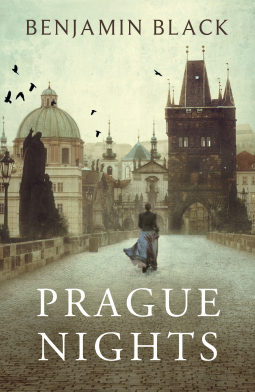
Prague Nights by Benjamin Black

I had never heard of Benjamin Black until I spotted his new novel available on NetGalley, but I quickly discovered that it is a pseudonym of the Irish author better known as John Banville. Not having read anything by Banville either, I had no idea what to expect from Prague Nights, but the title was enough to make me interested in reading it (note: the US title is Wolf on a String) – Prague is a beautiful city and one I would recommend visiting, if you haven’t already. To experience Prague as it is in this novel, however, you would need a time machine as the action takes place more than four hundred years ago, at the end of the sixteenth century.

It’s 1599 and Christian Stern, a young doctor from Regensburg, has just arrived in Prague. On his first night in the city he stumbles across the dead body of a young woman half buried in snow. He reports his discovery and expects that to be the end of the matter, so he is shocked when he is accused of killing the girl himself. Her identity is given as Magdalena Kroll, mistress of the Holy Roman Emperor Rudolf II and daughter of his ‘chief wizard’ Ulrich Kroll. Stern knows he is in serious trouble, but fortunately for him, the emperor – a superstitious man with a strong belief in the occult – believes him to be a messenger whose arrival in Prague had been predicted in a prophecy.

Freed of suspicion now, Stern is given the task of discovering who really did kill Magdalena Kroll. It is a mission which will bring him into conflict with some of the most powerful men in Prague, embroil him in a love affair with another of the emperor’s mistresses, Caterina Sardo, and send him to the town of Most in search of the English occultist Edward Kelley, who it is believed may hold the key to the mystery.

Prague Nights is one of those books that sounds as though it should be much better than it actually is. That’s not to say that I didn’t like it at all, because there were some aspects that I enjoyed, which I’ll return to shortly, but it definitely wasn’t the atmospheric, exciting historical mystery novel I had hoped it would be. I was disappointed that it wasn’t really much of a mystery; yes, there is a murder at the beginning and we find out who was responsible for it at the end, but in between, our narrator, Christian Stern, makes very little effort to actually investigate. Things happen around him but he takes no active part and by the time I reached the end of the book, I found that I no longer really cared how Magdalena Kroll had died and why.

The writing style is descriptive and detailed with a formal feel which suits the time period and the descriptions of Prague’s buildings, bridges and cobbled streets and squares are nicely done:

I had often tried to imagine Prague and its glories, but the reality of it was grander and more gracious than anything I could have dreamed of. Past the castle, we stopped on the height there to look out over the city. The sky was white and the air was draped with a freezing mist, pierced by many spires, all of them appearing black in that pervasive icy miasma. Despite the wintry murk, I could see the river and its bridges and, beyond, the clock tower in the Old Town Square.

This wasn’t enough to make me love the book, however. To be able to love a book I need to at least feel something for the characters and unfortunately I felt very little for Christian Stern or any of the other people who play a part in the novel. That’s particularly frustrating because, in real life, Rudolf II and the members of his court sound fascinating, especially his son, Don Julius Caesar. In his author’s note, Benjamin Black talks about the historical figures on which his characters are based, explaining where he sticks to factual information and where he uses his imagination. As I previously knew nothing about 16th century Prague or Rudolf’s court, it was good to have the opportunity to learn something new, even if the story itself didn’t really succeed in holding my attention.

Have you read anything by Benjamin Black/John Banville? And do you have any other books set in Prague to recommend?

The Wonder by Emma Donoghue

Despite enjoying two of Emma Donoghue’s previous books – Room and Frog Music – this latest novel about a girl in 19th century Ireland who stops eating didn’t appeal to me when it was published last year. It was only when I picked it up in the library a few weeks ago that I thought ‘actually, this does sound good’ – and with such a beautiful cover, how could I resist? And as it turned out, this is my favourite of the three Donoghue books I’ve read so far.

The Wonder is set in a small community in rural Ireland during just two weeks in 1859. Lib Wright, an English nurse who worked with Florence Nightingale in the Crimean War, arrives in the village to start a new job, knowing nothing about the position she has accepted except that her services will only be required for fourteen days. She is surprised to discover that her patient is an eleven-year-old girl, Anna O’Donnell, and that her task is not to nurse but to watch and observe.

Anna’s parents insist that their daughter has eaten nothing at all since her birthday four months ago and exists purely on prayer and faith. Lib is sceptical, but it seems that most people in the O’Donnells’ village – including the local priest and Anna’s elderly doctor – are happy to believe the claims. News of the girl’s amazing achievement has spread far and wide and visitors are arriving from all over Ireland to see ‘the Wonder’ for themselves. To prove whether or not Anna is a fraud, Lib and another woman – Sister Michael, a nun – have been appointed by a committee to take turns watching over Anna all day and night for the next two weeks.

Lib expects to get to the bottom of this mystery very quickly. Anna looks so healthy and full of life, it seems obvious that someone must be providing her with secret supplies of food – all Lib needs to do is keep her wits about her and ensure that she and Sister Michael never let the girl out of their sight. After a few days, however, she’s not so sure. Is Anna really the saint the villagers believe her to be? Is it all an elaborate hoax? Or could something more sinister be going on – and if Lib decides Anna is in danger, at what point should she try to intervene?

Like The Good People by Hannah Kent, another book set in 19th century Ireland, this is a fascinating exploration of the harm that can be done, often unintentionally, by superstition and a lack of understanding and the basic knowledge we take for granted today. In addition to this, there’s the hugely influential role of the Catholic Church, such a large part of everyday life for many Irish people in the 1850s, which Lib Wright – as an Englishwoman who has had her own faith driven out of her by her experiences in the Crimea – finds very frustrating; it seems incomprehensible to her that so many people are ready to accept that Anna O’Donnell is a living miracle when science suggests that there must be a more logical explanation. Anna’s situation is often quite sad and harrowing to read about and I desperately hoped her story would have a happy ending.

I was curious to know whether The Wonder was based on a true story, as the other Emma Donoghue books I’ve read were, but on reading the author’s note at the end it seems that although it is inspired by tales of Victorian ‘fasting girls’, it is not based on one particular case and is a fictional story.

The mystery element of the novel is very strong and at first the reader is as confused as Lib. Anna doesn’t appear to be a starving child, so she must be getting food from somewhere – but who is giving it to her and how? As the novel progresses and we learn more about the O’Donnell family and the community in which they live, other questions are raised. I was able to put enough of the clues and hints together to form a theory as to what was happening, but I was still completely gripped, waiting for Lib to uncover the truth. I thought The Wonder was…well, wonderful. Highly recommended!

This is Book 1/20 for my 20 Books of Summer challenge.

I, Claudius by Robert Graves

When I decided, a few years ago, to include I, Claudius on my list of books to read for the Classics Club I didn’t really expect to enjoy it. It was a book that I felt I should read, due to its status as a work of classic historical fiction, rather than one that I actually wanted to read. The reason I didn’t particularly want to read it was because Ancient Rome was not a setting I found very appealing. That has slowly begun to change since reading Robert Harris’ excellent Cicero trilogy in 2015 and then Margaret George’s The Confessions of Young Nero earlier this year. It’s probably a good thing, then, that I, Claudius has lingered on my Classics Club list until almost the end – it meant that when I did finally pick it up last month, I was much more receptive to it than I would have been a while ago.

I, Claudius, as you would expect, is narrated by Claudius, the fourth Roman emperor. It takes the form of a fictional autobiography:

I, Tiberius Claudius Drusus Nero Germanicus This-that-and-the-other (for I shall not trouble you yet with all my titles) who was once, and not so long ago either, known to my friends and relatives and associates as “Claudius the Idiot”, or “That Claudius”, or “Claudius the Stammerer”, or “Clau-Clau-Claudius” or at best as “Poor Uncle Claudius”, am now about to write this strange history of my life; starting from my earliest childhood and continuing year by year until I reach the fateful point of change where, some eight years ago, at the age of fifty-one, I suddenly found myself caught in what I may call the “golden predicament” from which I have never since become disentangled.

Claudius doesn’t actually tell us about his time as emperor in this novel – that will come later, in the sequel Claudius the God – but instead he gives us a very detailed account of his family background, his childhood and what it was like to live through the reigns of his three predecessors, Augustus, Tiberius and Caligula, who seemed to become progressively more corrupt, unstable and dangerous. However, it is obvious that the real power in Rome is wielded by Livia, the wife of Augustus (and Claudius’ grandmother) who systematically removes various rivals to the throne to ensure the succession of her own line. The ambitious, manipulative Livia is a great character and a constant presence throughout the novel as she works to control and shape the future of the Empire.

Of course, life for someone part of the imperial family as Claudius is comes with its own set of dangers. With his stammering, his twitching and his limp, he is regarded as an embarrassment, kept in the background and not taken seriously as a possible contender for the throne. There are hints and omens from the beginning – including one memorable scene which takes place early in the novel involving a poetic prophecy spoken by a Sibyl – but otherwise the very qualities that appear to make Claudius unsuitable as an emperor seem to keep him safe as those around him are methodically poisoned, exiled or assassinated. This might not be entirely down to luck, though, as Graves has the historian Asinius Pollio advising Claudius to exaggerate these qualities as they could be his only means of survival.

Although I did enjoy I, Claudius, it was a bit of a challenging read for me at times – but that was mainly due to the fact that I haven’t read a lot of fiction (or non-fiction, for that matter) about the Roman Empire so I only have a basic familiarity with the important events and people of the period. I wouldn’t say that it’s necessary to have any prior knowledge before starting this book, but it would certainly help! A piece of advice for future readers: you may find it useful to draw a family tree as you read, if your edition doesn’t already include one. The relationships between the characters quickly become very complicated, especially as so many of them marry and divorce several times, with children from each marriage (as well as adopted children) – but with a little bit of effort and attention, keeping track of the major players in the story isn’t too difficult.

If I have a criticism of this book it would be that as Claudius spends most of his time telling us about events that happened before his birth, elsewhere in the Empire or in which he had no personal involvement, this occasionally takes away the sense of drama and immediacy that there could have been had our narrator always been at the heart of the action. It’s still quite gripping in places – such as the sequence of events leading up to the death of his cousin Postumus, or the ‘haunting’ of his brother Germanicus (two of the few people to actually show Claudius any kindness) – but it’s probably worth being aware that this is not just a book about Claudius himself but also the history of the Roman Empire in general (the real Claudius was a writer and historian so Graves’ decision to have him tell the story in this way feels authentic).

I can’t comment on the accuracy of this novel, the sources Graves has used or the way he has chosen to interpret the characters, because I simply don’t know enough about the subject, but I do know that I found it much more enjoyable than I’d expected – and that I’m glad I decided to read it, despite my ambivalent feelings about Roman history. I’ll look forward to continuing the story soon with Claudius the God.

Song of the Sea Maid by Rebecca Mascull

Having had such a good experience with my first Rebecca Mascull book, The Wild Air, I knew I would have to read her previous two novels as well – and I was delighted to see Song of the Sea Maid on the shelf on a recent visit to the library. I hoped I would love it as much as The Wild Air…and I did. In fact, I thought this one was even better.

Song of the Sea Maid begins with a little girl living on the streets of London with only one aim in life: to do whatever it takes to survive from one day to the next. When her sole friend and companion, an older boy who may or may not be her brother, is taken by a press gang, she finds herself all alone. Caught attempting to commit a desperate act – stealing from a gentleman – she expects to be punished, but instead she is taken to an orphanage where she is given food, shelter and the name Dawnay Price.

Dawnay is an intelligent child with a natural curiosity for the world around her. As she grows older and teaches herself to read and write, her thirst for knowledge becomes apparent and she is chosen by a generous benefactor to receive a full education. It is not at all common at this time for a girl to be educated beyond the absolute basics, so Dawnay is determined to make the most of the opportunities she has been given. Eager for new experiences and the chance to use her skills, she travels to Portugal and the Berlengas islands where her studies of the flora and fauna lead her to come up with some very controversial theories. It seems the 18th century world is not quite ready for Dawnay and her ideas!

Song of the Sea Maid is a wonderful exploration of what it was like to be a woman trying to forge a career in science in a period when it was not considered normal or socially acceptable to do so. Dawnay has a lot of good luck which enables her to indulge her passion for study and travel, but she also faces many obstacles in both carrying out her work and in making her findings known, and by the end of the novel it becomes clear that she really is, as Rebecca Mascull states in her author’s note, just the wrong person in the wrong place at the wrong time. It made me wonder about all the other people – women in particular, but men as well – throughout history who may have had innovative ideas or developed advanced theories but were dismissed and silenced so that their names and their views have been entirely forgotten today.

I also enjoyed reading about the various places Dawnay visits on her travels; her time spent alone on the Berlengas Islands is particularly interesting – I think I would have felt too isolated and lonely, but Dawnay finds peace and harmony there, coming to think of the rocks and caves as her own. Still, she is unable to completely escape from world events; she is in Lisbon for the Great Earthquake of 1755 (which I have previously read about in Linda Holeman’s The Devil on Her Tongue) and in Minorca a year later when the island is captured by the French. The Seven Years’ War forms an important backdrop to the novel and from time to time Dawnay is brought into contact with the crew of a Royal Navy ship, initially during her voyage to Portugal. I found all the ship-based scenes surprisingly enjoyable – I think my recent forays into Patrick O’Brian’s Aubrey/Maturin series have really helped me in this respect!

I haven’t mentioned yet that Dawnay also falls in love; I found it quite predictable – as soon as one particular character appeared in Dawnay’s life I knew that they were going to be the love interest – but it was still a beautifully written romance which developed slowly throughout the novel. There’s really nothing negative I can say about Song of the Sea Maid; even the use of first person present tense, which I often dislike, didn’t bother me – in fact, I barely noticed it because I found Dawnay’s voice so strong and real.

This is a lovely novel and now I really must read Rebecca Mascull’s first book, The Visitors!