At the Edge of the Orchard by Tracy Chevalier

It’s been some time since I last read a Tracy Chevalier novel, but having enjoyed some of her books in the past, I was pleased to have the opportunity to read her latest one, At the Edge of the Orchard.

The story begins in 1838 in the Black Swamp of Ohio, where James and Sadie Goodenough are attempting to make a living from the harsh, inhospitable earth on which they have settled. With the help of their five children, James is working hard to establish an orchard with enough apple trees to satisfy the requirements to legally claim their piece of land. Sadie, who does not share her husband’s ambition, longs to move on and start again somewhere else – somewhere more comfortable and welcoming. Finding solace in the strong cider and applejack produced from the fruits of the orchard, Sadie’s is a miserable existence from which there seems to be no escape.

Time passes and we jump forward to the 1850s where the youngest Goodenough son, Robert, has made his way alone to California. What happened to the rest of the family? Why does Robert never get a reply to the letters he sends home to his brothers and sisters? We’ll have to wait until later in the book for these questions to be answered, but in the meantime we read about Robert’s work with the plant collector William Lobb, gathering seeds and plants to sell to gardeners in England. Having grown up surrounded by trees, this is the sort of job that interests Robert – yet there is still something missing from his life, and when he is finally given a chance of happiness, he will have to decide whether to take it.

I enjoyed At the Edge of the Orchard and found it a surprisingly compelling read. I say ‘surprisingly’ because, despite the title and the picture on the cover, which should have been clues, I wasn’t fully prepared for so much information on trees: in the orchard sections, we learn about different types of apple tree – the qualities of ‘eaters’ versus ‘spitters’; the taste of James’ favourite Golden Pippins; and the methods used to graft one tree onto another – and in the California sections we are given a wealth of information on the giant sequoia trees of Calaveras Grove. I have to admit, although I do appreciate the beauty and importance of trees, I have very little interest in them. I’m impressed that Tracy Chevalier managed to hold my attention from the first page to the last; I was never bored and would never have expected a book about trees to be so engaging!

Of course, this is not just a book about trees – it’s also a book about human beings, following the stories of several very different characters. At first, the Goodenoughs don’t seem to be a very pleasant set of people. James is decent enough, but with a tendency to be violent when things annoy him and a frustrating single-mindedness when it comes to growing and nurturing his precious apple trees. His wife, Sadie, is a deeply unhappy woman but any sympathy I may have had for her was destroyed by her bitter, spiteful nature and needlessly cruel actions. It wasn’t until later in the novel that I found some characters I could like and care about. In fact, a series of letters written by two of these characters broke my heart…the sense of loneliness and desperation they each felt came across so strongly.

The novel is carefully structured, moving backwards and forwards in time to ensure that certain things are kept hidden until it becomes necessary for us to know them. A mixture of styles are used to tell the story too, from the letters I’ve mentioned above to conventional third party narration and several passages narrated by Sadie in a very distinctive voice of her own. Although the story of the Goodenoughs is fictional, we also meet several real historical figures: the legendary Johnny Appleseed is one you may have heard of, but the English tree collector William Lobb was also a real person. There are so many different elements to At the Edge of the Orchard and they all come together to form one fascinating, enjoyable and very moving novel.

I’ve now read four Tracy Chevalier novels and so far they have all been very different, covering such diverse subjects as the Dutch art world (Girl with a Pearl Earring), fossil collecting on the south coast of England (Remarkable Creatures), religious conflict in 16th century France (The Virgin Blue) and now the trees and orchards of 19th century America. I’m looking forward to reading the rest of her books now that I’ve been reminded of them!

Thanks to HarperCollins for providing a review copy of this book via NetGalley.

The Witchfinder’s Sister by Beth Underdown

The Witchfinder’s Sister is Beth Underdown’s first novel. I was drawn to it first by the title and the cover, but the subject – the English witch trials of the 1640s – appealed to me too.

The title character is Alice Hopkins, a fictional sister of Matthew Hopkins, the self-styled Witchfinder General who was believed to be responsible for the deaths of hundreds of women in England over a period of several years in the middle of the 17th century. At the beginning of the novel, following the death of her husband in London, Alice is returning to Manningtree, Essex, where her brother still lives. The two have not been on good terms ever since Alice married the son of a servant, Bridget, whom Matthew blames for the childhood accident which has left his face scarred. Now, though, she hopes they can put the past behind them and move on.

Moving into her brother’s lodgings at the Thorn Inn, Alice is relieved to find that he is willing to let her stay with him – but she quickly discovers that the years have changed Matthew and that he is not the same man she left behind. She hears disturbing rumours about him in the town, linking him with accusations of witchcraft against local women, and when she discovers that he is making lists and collecting evidence, Alice must decide whether or not to intervene.

The novel gets off to a slow start as characters are introduced and background information is provided, with lots of flashbacks to earlier events in Alice’s and Matthew’s lives, but after a few chapters the pace begins to pick up. Not knowing much about the real Matthew Hopkins, I found Underdown’s portrayal of him very intriguing. The lack of known facts relating to his early days gives her the freedom to create a convincing backstory for him, and I appreciated the way she delves into his personal history, revealing family secrets and trying to show how incidents from his childhood may have helped to shape the man he will become. Only seeing him through Alice’s eyes – the novel is written in the first person – makes it difficult to penetrate below the surface and really understand him, but that just makes him all the more chilling and unnerving.

I thought Alice was a less interesting character, maybe because her main role as narrator is to tell the story of Matthew and the women accused of witchcraft rather than taking an active part in events herself. I found her slightly bland – although I did have some sympathy as she was forced to stand by and watch as her brother carried out his terrible deeds, not knowing what she could say or do to help his victims. It would have been nice to have had the opportunity to get to know some of the so-called witches in more depth; most of them were little more than names on the page, and I think if I had been able to care about their fates on an emotional level that would have added an extra layer to the novel. Having said that, I was fascinated by the descriptions of Hopkins’ methods of identifying witches, particularly the one referred to as ‘watching’ – I had heard about that before, but hadn’t fully appreciated the discomfort and torment involved in it.

The book ends in a way that is slightly difficult to believe, but I liked it and thought it added a good twist! Based on this novel, I think Beth Underdown can look forward to a successful writing career; there were things that I liked about it and others that I didn’t like as much, but on the whole I enjoyed it and would certainly be interested in reading more by this author.

Thanks to the publisher for providing a copy of this book for review via NetGalley.

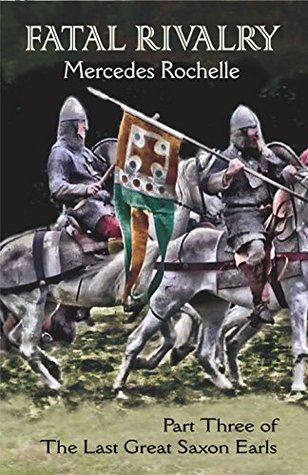
Fatal Rivalry by Mercedes Rochelle

fatal-rivalry-mercedes-rochelle This is the third and final novel in Mercedes Rochelle’s Last Great Saxon Earls trilogy, completing the story begun in Godwine Kingmaker and The Sons of Godwine. Set in 11th century England, just before the Norman Conquest, Godwine Kingmaker told the story of Godwine, the powerful Earl of Wessex, while in The Sons of Godwine the focus switched to the Earl’s children – sons Harold, Tostig, Gyrth, Leofwine and Wulfnoth, and daughter Editha. Fatal Rivalry picks up where that book left off, describing the events leading up to the Battle of Hastings in 1066.

As the novel opens in 1064, Edward the Confessor, Editha’s husband, is still on the throne of England, but the question of his successor is on everybody’s minds. Editha’s brother Harold, who has inherited his father’s earldom of Wessex, has recently returned from Normandy, where he was made to swear an oath to support the claim of Duke William – not an oath Harold intends to keep, because he believes there is a better candidate for the throne: himself. History tells us that Harold will become king in 1066, only to be defeated by William at Hastings later that same year. Fatal Rivalry explores one theory as to why things went so disastrously wrong.

In The Sons of Godwine, we saw how Harold and his younger brother Tostig had been rivals since they were children; in this book the rivalry intensifies. As Earl of Northumbria, Tostig has become very unpopular with his people, particularly after attempting to raise taxes on Harold’s orders. When Tostig’s Northumbrian thegns rebel against him, King Edward sends Harold to negotiate with them. Seeing that the situation is hopeless, Harold agrees to their demands and Tostig is sent into exile. Unable to forgive his brother for siding against him, Tostig searches for new alliances overseas, finally joining forces with the Norwegian king, Harald Hardrada, and setting in motion a chain of events which contribute to Harold’s downfall.

Like the previous novel, this one is presented as the memoirs of the Godwineson brothers, with each one given a chance to narrate his own parts of the story. Leofwine and Gyrth have smaller roles to play, while Wulfnoth, held hostage at Duke William’s court in Normandy, makes only a few appearances – until the end, when he takes on the very important job of concluding his brothers’ stories. Understandably, it’s Harold and Tostig who get most of the attention. I’ve never read about Tostig in this much detail before and I did have some sympathy for him. I’m sure Harold was doing what he thought was in the best interests of the country, but to Tostig it must have seemed like an unforgivable betrayal, particularly when he learned that Harold had married the sister of Morcar, his replacement as Earl of Northumbria.

Fatal Rivalry is an interesting read and probably my favourite of the three books in this trilogy. Because the novel covers a relatively short period of time, it allows the author to go into a lot of detail in exploring the relationship between Harold and Tostig, the motivation behind their actions and how their rivalry could have been the reason why Harold was fighting a battle in the north of the country when William invaded from the south. I am not really a lover of battle scenes, but although there are two major battles which take place in this book – Stamford Bridge and then Senlac Hill (Hastings) – this is only one aspect of the novel and plenty of time is also spent on the more personal lives of the characters, such as Tostig’s relationship with his wife, Judith, and Harold’s marriages to Edith Swanneck and Ealdgyth of Mercia.

I think the Norman Conquest is fascinating to read about and, like many periods of history, there is so much left open to interpretation and debate. I will continue to look for more fiction set in this period and will also be interested to see what Mercedes Rochelle writes about next.

Thanks to the author for providing a copy of this book for review.

The Good People by Hannah Kent

the-good-people The Good People is the second novel from Australian author Hannah Kent, following her 2013 debut Burial Rites. I liked Burial Rites – the story of a woman found guilty of murder in 19th century Iceland – but I didn’t love it the way so many other readers did and I was curious to see what I would think of this new one. Now that I’ve read it, I can say that this is definitely my favourite of the two.

The Good People is set in rural Ireland in the 1820s. Nóra Leahy is going through a difficult time, having lost both her daughter and her husband in the space of a year. She has been left to take care of her four-year-old grandson, Micheál, who should be a blessing to her – but to Nóra he is nothing but a worry. She remembers seeing him as a healthy, happy baby, yet the little boy her son-in-law has brought to live with her is entirely different: he is thin and sickly, has lost the use of his legs, can’t understand what is being said to him and communicates through uncontrollable screaming. Nóra knows something is badly wrong with him and, unable to cope on her own, she hires a girl, Mary Clifford, to help her look after him.

Mary is shocked by Micheál’s condition, but does her best for him with the limited knowledge she has, aware that Nóra is starting to view the child with fear and revulsion. In this isolated community, neither the village priest nor the doctor are able to offer any useful advice or explanations, so Nóra seeks the help of the healer and wise woman Nance Roche. Nance knows all about the world of the fairies, or the Good People, as she calls them, and tells Nóra that Micheál is not her grandson at all, but a changeling. Together, Nóra, Nance and Mary set about trying to drive the fairy out of the child’s body in the hope that the real Micheál will be restored.

As you can imagine, The Good People is not exactly the happiest or most uplifting of books – but then, not everything that happens in life is happy or uplifting either, and, like Burial Rites, this novel is based on a true event from history. Poor Micheál’s story is a tragic one, all the more so because of the treatment he receives from the very people he should be able to rely on for love and affection. The worst of it is, these people really seem to believe in fairies and convince themselves that Micheál really is a changeling, because then there is a chance that he can be cured. Through a mixture of ignorance and superstition, they think they are doing the right thing.

Hannah Kent writes beautifully and from the very first page the reader is pulled into a bygone world, a remote community in which the people, despite living in a Christian society, are still holding on to their ancient beliefs and traditions. This is not a fantasy novel or a fairy tale, yet the unseen fairies are a very strong presence throughout the story: we are told that the Good People live in their ringfort, Piper’s Grave, in a lonely part of the valley where lights dance around the ghostly whitethorn tree, and that their powers are strongest at the place where three rivers meet. Everyone seems to know of at least one person who has been ‘swept’ away by the fairies and they just accept these things as part of their everyday lives.

Because of the overwhelming sadness of the story and the suffering of little Micheál, I know this isn’t a book that will appeal to everyone, but I was very impressed by it. I loved it for the quality of the writing, the intensity of the atmosphere and the insights into life in a less enlightened time and place.

Thanks to Pan Macmillan for providing a copy of this book for review via NetGalley.

A Gentleman in Moscow by Amor Towles

a-gentleman-in-moscowIn 1922, Count Alexander Ilyich Rostov is brought before a Bolshevik tribunal and found guilty of the crime of being an ‘unrepentant aristocrat’.  Once a recipient of the Order of Saint Andrew, member of the Jockey Club and Master of the Hunt, the Count is now considered a Former Person and is sentenced to live out the rest of his days under house arrest in his current place of residence, Moscow’s Metropol Hotel.  Forced to leave his luxury suite and move his possessions to a tiny room in the attic, the Count refuses to let his spirit be broken and decides to make the best of his situation, continuing with his daily routines as far as he is able without leaving the building.

With the help of Nina, a nine-year-old girl in a yellow dress, the Count explores the hidden corridors, rooms and staircases of this magnificent old building, and later he finds some fulfilment in working as a waiter at the hotel’s grandest restaurant, the Boyarsky.  Although it’s never nice to lose one’s freedom, there are certainly worse places to be held prisoner than the Metropol Hotel.  But what truly sustains the Count as the years and decades go by are the friendships he forms with the other hotel employees, guests and visitors.

The Count develops a close bond with Emile and Andrey, the two men who work alongside him in the restaurant, he embarks on a romance with a glamorous actress, comes to value the help and advice of the hotel seamstress, and debates politics, poetry and philosophy with friends old and new.  But the most moving of his relationships, in my opinion, is the one with Sofia, who comes to the Metropol as a child and grows to think of the Count as a father.  The Count is an educated, cultured, intelligent man, but he also has a good imagination and a playful sense of humour and I loved watching as he and Sofia devised their own games to entertain themselves and help pass the time.

Spending most of his adult life under house arrest, the Count is largely insulated from whatever is happening in the outside world, but through the people who pass in and out of his life he is able to keep up with current affairs.  This allows the author to provide the reader with some commentary on Soviet-era Russia and to put the Count’s story into historical context.  The balance between the political and the personal is about right and despite the length of the book, I was never bored.

I had been looking forward to reading A Gentleman in Moscow since seeing it appear on several people’s best-of-year lists at the end of 2016.  Now that I’ve had the chance to read it for myself, I can understand all the praise that has been bestowed on it and although I don’t think I would describe it as an absolute favourite, I did find it a lovely, enjoyable story.  I loved getting to know the Count and I’m sure that if you choose to read this book you’ll love him too.

The Walter Scott Prize longlist 2017

I’ve mentioned before that I am attempting to read all of the books shortlisted for the Walter Scott Prize for Historical Fiction since the prize began in 2010. I am always looking for quality historical fiction and I have found the books nominated for this particular prize to be of a consistently high standard. You can see the progress I’ve made with this project here – Kay of What Me Read has also joined in and if anyone else wants to take part you’re very welcome!

The longlist for this year’s prize has just been announced and includes lots of intriguing titles. I’m not planning on trying to read the entire longlist – I’m waiting until the shortlist is announced – but I might still dip into this list from time to time.

Here are the thirteen books on the 2017 longlist.  As you can see, I’ve only read one so far.

days-without-endA Country Road, A Tree by Jo Baker
The Noise of Time by Julian Barnes
Days Without End by Sebastian Barry
Crane Pond by Richard Francis
The Dark Circle by Linda Grant
The Vanishing Futurist by Charlotte Hobson
The Good People by Hannah Kent
Minds of Winter by Ed O’Loughlin
The Essex Serpent by Sarah Perry
The Last Painting of Sara de Vos by Dominic Smith
Golden Hill by Francis Spufford
Mothering Sunday by Graham Swift
The Gustav Sonata by Rose Tremain

It doesn’t surprise me that Days Without End is on the list and it wouldn’t surprise me if it ends up as the winner. I didn’t enjoy it as much as the other Sebastian Barry books I’ve read, but it’s the sort of book that usually does very well as far as prizes are concerned. I’m delighted to see The Good People on the list as I read it recently and loved it (review coming soon) and also Golden Hill, which I just started reading yesterday.

Of the rest, I was already interested in reading The Gustav Sonata and The Essex Serpent, but I know little or nothing about most of the others.

Have you read any of the books on this year’s longlist? Which ones do you think deserve to be on the shortlist?

For the first time this year, the Walter Scott Prize Academy has also put together an additional list of twenty recommended novels. I won’t post the complete list here (you can see it on the Walter Scott Prize website) but I’m pleased to see mentions of Orphans of the Carnival and The Ashes of London, as well as several other novels I’ve read or am interested in. Lots of great ideas for future reading there!

Frenchman’s Creek by Daphne du Maurier

frenchmans-creek Daphne du Maurier’s Rebecca has been one of my favourite books since I first read it as a teenager, but it’s only relatively recently that I started to explore the rest of her work. Since 2010, I have now read several of her short story collections and one of her non-fiction books, as well as working through almost all of her novels, saving Frenchman’s Creek until near the end (as it sounded like one that I would particularly enjoy and I wanted to have something to look forward to).

Set in the 17th century, Frenchman’s Creek is the story of Dona St Columb who, at the beginning of the novel, is growing disillusioned with her marriage and bored with life in London. To alleviate her boredom, she has been joining her husband Harry and his friends in some increasingly wild escapades, but as the mother of two young children she has started to feel ashamed of her behaviour. Unable to bear it any longer, she decides that what she needs is to spend some time away from her husband and London society – and so she takes the children and heads for Navron, Harry’s estate in Cornwall.

On arriving at the house, Dona is surprised to find that only one servant is present; his name is William, a quiet but perceptive man with whom Dona forms an immediate bond. Despite signs that suggest someone has been sleeping in her bedroom while the house stood empty, she soon begins to feel relaxed and refreshed in the peaceful surroundings of Navron. Her new neighbours, however, seem to be less at ease and it’s not long before Dona hears tales of a French pirate who is said to be terrorising the coast of Cornwall. On a walk through the woods one day, she discovers a ship resting in a creek and suddenly everything makes sense.

The Frenchman (who, you will have guessed, is the owner of the ship), dispels all of Dona’s – and probably the reader’s – preconceived ideas of what a pirate should be. Polite, cultured and intelligent, he couldn’t be more different from Harry and his friends, and it’s no surprise that Dona falls in love with him. I couldn’t quite believe that a man like the Frenchman would have chosen to be a pirate (the reasons he gives for his way of life didn’t seem very convincing) but I thought he was an intriguing character and I enjoyed watching Dona’s relationship with him develop. And yet I didn’t become fully engaged with the story until halfway through, when Dona and the Frenchman embark on an adventure together and the consequences of this threaten to bring their happiness to an end. From this point on, I found the book unputdownable, right through to its poignant ending.

Du Maurier’s writing is beautifully atmospheric and evocative, more so than almost any other author I can think of. The description of Dona’s first walk along the banks of the creek, where it widens into a pool and she comes upon the pirate ship for the first time, is so vivid I could nearly see the scene laid out in front of me. The whole book has a dreamy, almost hypnotic feel. Although we are told once or twice that our hero’s name is Jean-Benoit Aubéry, he is referred to throughout the novel as simply the Frenchman – it’s little things like these which really add to the air of mystery and haziness.

Although I did enjoy this book very much, particularly the second half, it couldn’t quite equal my top four du Mauriers, Rebecca, My Cousin Rachel, The Scapegoat and The House on the Strand. I’m planning a re-read of Rebecca soon and then I would like to read Castle Dor, the only du Maurier novel I still haven’t read.