Ten-Second Staircase by Christopher Fowler

What a wonderful imagination Christopher Fowler has! This fourth novel in the Bryant and May mystery series involves the bizarre deaths of several minor celebrities, a mysterious highwayman complete with horse, cape and tricorn hat, gangs of feuding schoolchildren and a possible link to the Knights Templar. It’s just the sort of case the Peculiar Crimes Unit was created to deal with, and this is one of the most peculiar yet.
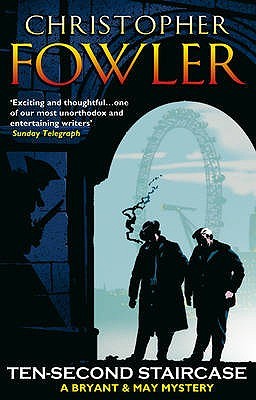
Ten Second Staircase As the novel opens, we learn that yet again the PCU is facing the threat of closure, with Bryant and May’s outdated methods of detection coming under attack. Bryant and May – Arthur and John – are the two elderly detectives around whom the rest of the unit revolves. John May is logical, methodical and more open to modern technology, but his partner prefers to rely on his tried-and-tested network of historians, clairvoyants, witches and psychics. Their different personalities and different approaches to crime-solving are the reasons why the two of them have had so much success over the years, right from the very first case they worked on together during the Second World War (described in Full Dark House). Among the successes, however, there has been one failure: the identity of the serial killer known as the Leicester Square Vampire, which has remained unknown since the 1970s.

Bryant and May’s latest mystery begins when a controversial modern artist is drowned in the display case of one of her own art installations. The only witness is Luke Tripp, a twelve-year-boy from nearby St Crispin’s Boys’ School, who claims to have seen a figure resembling Dick Turpin ride into the gallery on horseback and throw the artist into the tank. No sooner have the detectives begun to investigate than the Highwayman strikes again, his second murder as strange and inexplicable as the first. As Bryant and May dig deeper, they uncover some similarities between the Highwayman and the Vampire; if only they can find a way to solve both mysteries at once, the future of the PCU could be secured.

I enjoyed Ten-Second Staircase as I’ve enjoyed all of the previous books in this series, but this is probably my least favourite of the four. The Peculiar Crimes Unit seems to have been facing closure in every book so far and that aspect of the story is starting to feel repetitive, especially as with another nine (at least) books to follow, it was obvious that it would be allowed to stay open. I also couldn’t help feeling that the author was using Bryant and May in this book to voice his own views and opinions on society; this meant that the dialogue sometimes felt more like a lecture rather than a natural conversation between friends.

The things that I did love in this book were the same things I loved in the first three: the unusual and imaginative mystery (which, as usual, I failed to solve), Arthur’s unorthodox detection methods, and the fascinating historical facts and pieces of trivia which are incorporated into the plot. The real attraction of this series, of course, is the partnership of Bryant and May themselves, but we do get to know other members of the PCU as well and some of these characters are developed further in this novel, particularly May’s agoraphobic granddaughter, April, who I’m sure we’ll see more of in future books.

I’ll be continuing soon with book number five, White Corridor!

Death in Berlin by M.M. Kaye

Death in Berlin Almost exactly a year ago I read Death in Kashmir, the first in M.M. Kaye’s series of mystery novels. I loved it – in fact, it was one of my favourite books of the year – and last week I decided it was time to try another of her Death in… novels. I chose Death in Berlin because it’s the second in the series (although the books all have different settings and characters and all stand alone).

Death in Berlin, published in 1955, is set in a Berlin struggling to recover from the devastating effects of World War II. The city is divided into zones – American, British, French and Russian – and there are ruined buildings and piles of rubble everywhere. At the beginning of the novel we meet Miranda Brand, who is on her way to Berlin with her cousin Robert and his wife Stella. Robert, an army officer, is taking up a new post there and Miranda has decided to come along for a month’s holiday, keen to have a chance to see post-war Germany. During the journey to Berlin, they and a group of other military families listen to Brigadier Brindley tell a story involving a set of diamonds stolen by the Nazis during the war – a story which has special significance for Miranda. Later that night, the Brigadier is found dead in his train compartment and when a murder investigation begins, Miranda discovers that she herself could be a suspect.

This novel has many of the same elements as Death in Kashmir – a young heroine in danger far from home, a romance with a man she’s not sure she can trust, an eerie and atmospheric setting – but this book didn’t impress me as much as the first one. It doesn’t have the stunning opening chapter that Death in Kashmir has and the characters feel less developed, to the point where I had trouble telling some of them apart. I also thought there was a lack of chemistry between Miranda and her love interest, whom I found very bland.

What I did like was the portrayal of a ruined Berlin in the aftermath of war. M.M. Kaye herself spent some time in Berlin when her husband’s regiment was stationed there, so she could draw on her own knowledge of the city while writing this novel. While it isn’t the exotic setting that 1940s Kashmir is, it does provide a great backdrop for a story of murder and mystery. Kaye really excels at creating a sense of unease and writing spine-tingling descriptions of what it feels like to be alone and vulnerable in dark, lonely surroundings – to be the only person awake in the sleeper carriage of an overnight train or to be sitting downstairs in a large, empty house and hear noises coming from upstairs.

I didn’t guess the solution to the mystery, but I did have my suspicions about various characters. I don’t think it would have been possible to work out everything, though, because a lot of information is withheld from us until the final chapters of the book. This information is provided by one of the characters who, in one very long scene near the end, sums everything up for Miranda and the reader. This is something that works well in an Agatha Christie novel, but feels a bit unnatural here.

While I didn’t like this book as much as Death in Kashmir, it hasn’t put me off wanting to read the rest of the Death in… mysteries. Death in Cyprus will probably be the next one I read, but I also have a copy of Kaye’s historical novel, Shadow of the Moon, which I’m looking forward to reading (and should really have read before now as The Far Pavilions is one of my favourite books).

Have you read any of the Death in… books? Which do you think is the best?

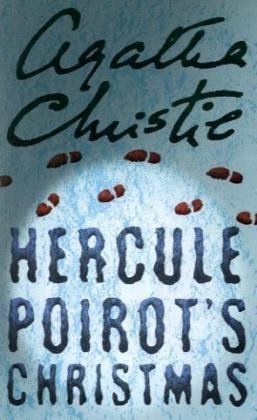
Hercule Poirot’s Christmas by Agatha Christie

Hercule Poirots Christmas I hope you’ve all had a good Christmas! Mine hasn’t been great, unfortunately. My grandfather, who is eighty-five, fell and broke his shoulder last week and has been in hospital over Christmas. Because of his age and poor general health, the doctors haven’t been able to say whether he will make a full recovery or when he might be able to go home. My grandmother, who also has health problems, can’t be left on her own so we are all helping out with taking care of her until we know what long-term arrangements will need to be made. As you can probably imagine, it’s been quite a stressful time and not conducive to writing good book reviews, so this is just a short post to record some thoughts on a recent Christmas-themed read.

Hercule Poirot’s Christmas is a classic locked-room murder mystery which begins with an elderly millionaire, Simeon Lee, inviting various members of his family to spend Christmas with him at his home, Gorston Hall. The family are surprised and suspicious – they are not all on speaking terms and as they begin to gather at Simeon’s house tensions are running high. When the old man is found dead in a pool of blood in his locked bedroom on Christmas Eve, there is no shortage of suspects.

Who could the killer be? Could it be one of Simeon’s sons – the money-obsessed George, maybe, or Harry, who has been estranged from the rest of the family for many years – or one of their wives? What about Pilar Estravados, Simeon’s granddaughter, newly arrived from Spain? Or Stephen Farr, son of Simeon’s former business partner, who has come unexpectedly from South Africa? Hercule Poirot is called in to investigate and as he begins to piece together what happened on the night of the murder, some family secrets are brought to light.

This is not very high on my list of favourite Agatha Christie novels, but I did enjoy it. As usual, I failed to solve the mystery before Poirot did and although there were a few times when I thought I’d figured it out, I never even came close to being correct! Despite the title, it’s not a particularly Christmassy book (Christmas Day passes almost without mention) but I found it fun, entertaining and quick to read, which is just what I was in the mood for. I was reminded of Envious Casca by Georgette Heyer, which is also set at Christmas and has a similar storyline.

With plenty of other unread Christie novels still to look forward to, I’m sure I’ll be reading more Poirot in 2016.

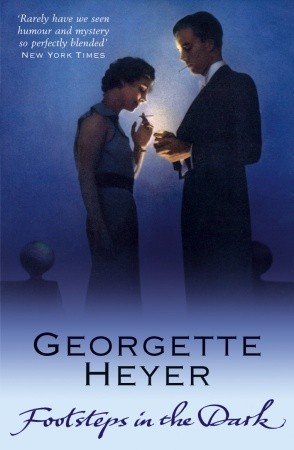
Footsteps in the Dark by Georgette Heyer

Footsteps in the Dark Georgette Heyer is more famous for her Regency romances, but she also wrote twelve mystery novels. Until now, the only one I had read was Envious Casca, but I decided to try another one for this year’s R.I.P. event. Footsteps in the Dark, published in 1932, turned out to be a good choice. More of a haunted house story than a traditional mystery, there are secret tunnels, underground passages, ghostly happenings and noises in the night. A perfect October read!

Celia Malcolm and her brother and sister, Peter and Margaret Fortescue, have inherited an old Priory from their uncle. When their solicitor warns them that the estate is said to be haunted, the three are intrigued and decide to live in the house together for a while so they can inspect their new property and plan some refurbishments.

Accompanied by their aunt, Mrs Bosanquet, and Celia’s husband, Charles, they move into the Priory and almost immediately hear tales from the neighbours of a mysterious Monk who wanders the grounds at night. At first the family are unconcerned, but it’s not long before they witness the Monk for themselves and are forced to accept that something strange is going on at the Priory. Is their new home really haunted or is someone trying to scare them away?

Footsteps in the Dark was Heyer’s first mystery and while I did enjoy it, I also thought there were one or two weaknesses. The characters felt very wooden – I found the two men almost indistinguishable and Celia and Margaret unbelievably silly (in different ways) – and while I did enjoy any scene featuring Mrs Bosanquet, the dialogue didn’t feel as sparkling and witty as I have come to expect from Heyer. The plot wasn’t particularly complex either and it was too easy to identify the villain. There is a murder, if you’re wondering, but it doesn’t take place until later in the novel so I wouldn’t describe this as a murder mystery like Envious Casca.

It was a lot of fun to read, though! With a plot based around a group of young people exploring a haunted house, I was frequently reminded of Scooby Doo – or maybe one of the Famous Five or Nancy Drew stories I used to love as a child. This is not a book to be taken too seriously, but Heyer does create an atmosphere which is genuinely eerie at times, especially if you’re reading when you’re on your own late at night! I probably won’t want to re-read this one, but I do look forward to reading the rest of Heyer’s mysteries.

The Queen’s Man by Sharon Penman

The Queens Man Having read and loved three of Sharon Penman’s historical fiction novels – The Sunne in Splendour, Here Be Dragons and Falls the Shadow – I’ve been interested in trying her series of historical mysteries set in medieval England. I downloaded the first in the series, The Queen’s Man, when it was offered as the Kindle Daily Deal on Amazon a while ago and have been waiting for the right time to read it.

The Queen’s Man introduces us to Justin de Quincy who, as the novel begins in December 1192, has just discovered that he is the illegitimate son of the Bishop of Chester. Furious that his father will not acknowledge their relationship, Justin sets out on a journey to London where he hopes to start a new life. Before he reaches London, however, he witnesses a murder on a snowy road just outside Winchester. As the killers flee the scene, the dying man – a goldsmith called Gervase Fitz Randolph – gives Justin a letter and makes him promise to deliver it to Queen Eleanor in London.

Eleanor of Aquitaine, widow of Henry II, is anxiously awaiting news of her son, King Richard I, who has disappeared while on crusade. As the weeks go by with no word of the missing king, it’s starting to look likely that he is dead and Eleanor’s youngest son, John, Count of Mortain, is getting ready to claim the throne for himself. Justin de Quincy’s arrival at court in possession of a bloodstained letter gives the Queen a clue as to Richard’s fate – but she still wants to know more.

As Justin was the only witness to the murder and the only person able to identify the killers, the Queen commissions him to investigate. Who was responsible for Gervase’s death? Was it a member of the goldsmith’s own family who wanted him dead or could it have been John who paid the murderers to steal the letter before it could reach Eleanor?

I enjoyed The Queen’s Man; it doesn’t compare with Penman’s straight historical novels – it lacks the depth and the emotional impact – but I didn’t mind that as I knew from the beginning that this would be a different type of book. While the plot and characters (with some obvious exceptions) are fictional, the historical background is as accurate and detailed as you would expect from Penman, with lots of interesting snippets of information that bring the 12th century to life: a visit to both a lazar house (hospital for lepers) and a medieval horse fair are incorporated, for example, and there’s a fascinating description of ‘trial by ordeal’ using hot cauldrons.

As a murder mystery, the plot is quite complex with plenty of suspects and some red herrings – although it’s slightly disappointing that some important information is withheld from the reader until near the end, so it would have been difficult to have guessed the solution before it was revealed.

The Queen’s Man has an interesting variety of supporting characters, ranging from innkeeper’s widow, Nell, and the under-sheriff of Winchester, Luke de Marston, to one of Queen Eleanor’s ladies, the beautiful Claudine. My only concern is that I found Justin de Quincy himself very bland. Based on this first novel, I wouldn’t have thought he was a strong enough character to build a whole series around. I could be wrong about him, though, and I’m still interested enough to want to read the next book, Cruel as the Grave, at some point to see how his story continues.

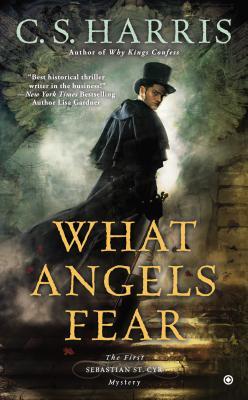
What Angels Fear by CS Harris

What Angels Fear When I made my list for this year’s RIP challenge, I decided to give priority to books I’ve been wanting to read for a while rather than search out new titles. What Angels Fear, the first in CS Harris’ Sebastian St. Cyr mystery series, is one of those books. I can’t remember where I first heard about this series but I know it has been recommended to me several times over the last few years and did sound like something I would enjoy. There are now ten books in the series, which is slightly overwhelming, especially as I’m already in the middle of so many other series, but I thought it was time I at least gave the first one a try.

What Angels Fear is set in London in 1811. With King George III suffering from mental illness, the Prince of Wales is preparing to start his period as Regent and members of the two main political parties, the Whigs and the Tories – who are strongly divided over issues such as Britain’s role in the Napoleonic Wars – are hoping to gain positions of power and influence in the newly-established Regency.

At the beginning of the novel, Sebastian St. Cyr, Viscount Devlin, returns from fighting a duel to discover that he has become a suspect in a murder investigation. A beautiful young actress, Rachel York, has been found dead on the steps of a church altar and evidence found at the scene has implicated Sebastian. Determined to clear his name, Sebastian decides to investigate the murder himself. As he delves deeper into the circumstances surrounding Rachel’s death, more and more people are drawn into the mystery, including a French spy, an Italian artist and a London street urchin, as well as some of the country’s top politicians and even members of Sebastian’s own family.

I’m pleased to say that I enjoyed What Angels Fear enough to want to read the next book in the series. I didn’t love it, but I found it very entertaining with a good mixture of mystery, political intrigue and romance (Sebastian’s love interest in this book is an actress whose stage name is Kat Boleyn). Harris captures the atmosphere of the Regency period very well, although I occasionally came across a choice of word that didn’t feel quite right. It was probably a mistake to read this book immediately after finishing April Lady as there are few authors who bring the Regency to life as convincingly as Georgette Heyer!

I haven’t really warmed to Sebastian yet, but I’m hoping that will eventually happen if I continue with the series. He is certainly an intriguing character: Harris gives him an interesting past, with five years spent in the army, some family secrets which are only hinted at in this book, and some unusual abilities (he has quick reflexes and very acute eyesight and hearing, which according to the author’s note are signs of Bithil Syndrome, although I couldn’t seem to find out whether this is a real condition or not). Because so many things are left unresolved at the end of this first novel, I’m sure there’s still a lot more to learn about Sebastian and I’m curious to see how his character develops.

What Angels Fear was a good start not only to my reading for the RIP challenge, but also to a new series. Now I’m looking forward to the second Sebastian St. Cyr novel, When Gods Die.

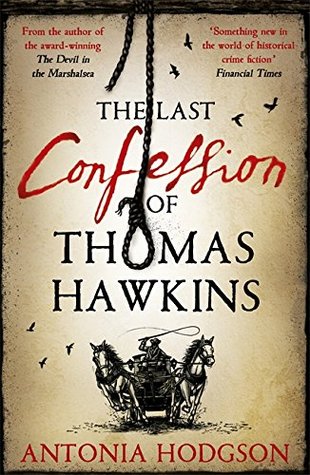
The Last Confession of Thomas Hawkins by Antonia Hodgson

The Last Confession of Thomas Hawkins It’s 1728 and Thomas Hawkins is being escorted through the streets of London towards the gallows at Tyburn. Although he has been found guilty of murder and sentenced to hang, Tom has been promised a pardon and is sure he will be freed. But as he gets closer and closer to the gallows and the pardon doesn’t come, he begins to lose hope. Could this be the end for Thomas Hawkins?

Antonia Hodgson’s debut novel The Devil in the Marshalsea was one of my favourite books of last year. I loved the setting (an eighteenth century debtors’ prison), I loved the entertaining plot, and I loved learning about life in Georgian London, so I was pleased to find that there was going to be a sequel. If you haven’t read the first book, though, that shouldn’t be a problem because The Last Confession of Thomas Hawkins can be read as a ‘standalone historical mystery’, as stated on the book cover. I would still recommend reading the two books in order as there are some minor spoilers in the second one, but it isn’t really necessary.

If you have read The Devil in the Marshalsea you will already have met Thomas Hawkins and will know what he experienced during his time in the notorious Marshalsea Prison. Sadly, as the sequel begins, it seems that Tom has forgotten the lessons he learned in the Marshalsea. He has started to build a new life for himself with Kitty Sparks, bookseller and print shop owner, but this is not enough for Tom and he has returned to his old habits of drinking, gambling and looking for adventure.

It’s not long before things start to spiral out of control again and this time Tom finds himself embroiled in the affairs of Queen Caroline and the king’s mistress, Henrietta Howard, as well as becoming a suspect in a murder investigation. Alternating between Tom’s journey to the gallows and the events leading up to his death sentence, Tom’s story – his ‘last confession’ – gradually unfolds.

This is another great book from Antonia Hodgson and I enjoyed it almost as much as the first. I say ‘almost’ because the fact that The Devil in the Marshalsea was set almost entirely within a debtors’ prison gave the first book a feeling of novelty and originality that this second one doesn’t have. That doesn’t mean I didn’t like the setting of this book too, of course. Hodgson’s portrayal of 1720s London is wonderful: a cockfight in a crowded tavern; a gang leader’s lair in a crumbling slum building; the beautifully furnished rooms of St James’s Palace – all of these are described in vivid detail.

Tom Hawkins, as our narrator, is the perfect character to guide us through Georgian London. His lifestyle means he is familiar with the darker side of society, but his family background makes him a gentleman and it is this combination that brings him to the attention of those who hope to use him for their own ends…including the clever, scheming Queen Caroline (a historical figure I’ve never read about until now). Tom is frustrating, flawed and a bit of a rogue, but he’s also a person you can’t help but like. I’m obviously not going to tell you whether or not he does escape the hangman’s noose, but what I will say is that Antonia Hodgson keeps us in suspense until the end. The final chapter gave me hope that there could be a third book in this series – but if you want to know whether Thomas Hawkins will survive that long, you’ll have to read The Last Confession to find out!