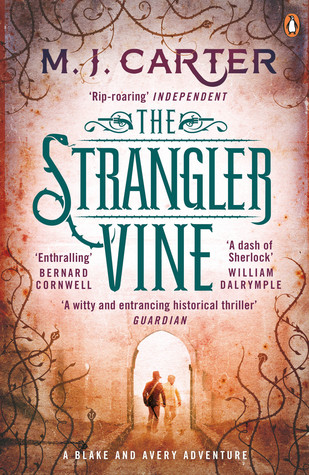
The Strangler Vine by MJ Carter

the-strangler-vine I love a good historical mystery and when this one was recommended to me recently (thank you, Pam!) I remembered that I already had a copy on my Kindle and couldn’t leave it to languish there any longer. Having read it, I wish I’d found time for it earlier – it’s an excellent book – but on the positive side, there are now two more in the series which I can read sooner rather than later.

The Strangler Vine is set in India in 1837, when large areas of the country were ruled by the British East India Company. Our narrator is William Avery, a young officer with the Company’s army. Originally from Devon, he has grown up reading the work of Xavier Mountstuart, a fictional author and poet whose writings sound similar to Rudyard Kipling’s and which have given him a romanticised view of India. Having spent nine months in Calcutta, however, he is starting to feel disillusioned with “the monstrous climate, the casual barbarities of the native population and the stiff unfriendliness of the European society”.

Disappointed that he still hasn’t been summoned to join his cavalry regiment in North Bengal, Avery is growing frustrated and bored – until the day he is asked to accompany an older officer, Jeremiah Blake, on a special mission. It seems that his literary hero, Mountstuart, has gone missing while carrying out research for a new poem and Avery and Blake have been given the task of finding him.

The Strangler Vine is a wonderful, fascinating novel; there are so many things I enjoyed about it that I’m not sure where to start! First of all, there’s the relationship between the two main characters, Avery and Blake, who, like all good mystery-solving duos, are two very different people who complement each other perfectly. Young, naïve and loyal to the Company, Avery is more instantly likeable and although he can be slow to pick up on clues, the fact that he never seems to know any more than the reader does makes him the perfect character to guide us through the novel. There’s a sense that where Indian culture, politics and history are concerned, Avery is learning as he goes along, which means background information tends to be given in large chunks rather than being lightly woven into the story. This style won’t appeal to every reader, but I found it all so interesting that it didn’t bother me.

Jeremiah Blake is a more unusual and intriguing character; although he still has connections to the East India Company, he no longer actively works for them – his knowledge of Indian languages and marriage to an Indian woman have aroused the distrust of the other officers who consider him to have ‘gone native’. His attitude towards Avery is abrupt, rude and dismissive and because we only see him through Avery’s eyes, he is a complete enigma at first. Eventually his true character starts to be revealed, but I was still left with the feeling that we have more to discover about Blake.

The mystery element of the novel is quite complex and what seems to Avery at first to be a straightforward search for a missing man soon develops into something with much deeper implications. It all revolves around the cult of Thuggee – organised gangs of thieves and murderers who worship the Goddess Kali and who are causing widespread fear and panic amongst the British in India. Mountstuart is thought to have been researching the Thugs at the time of his disappearance and so Avery and Blake, following his trail, also become drawn into the mystery and controversy surrounding the cult.

I loved The Strangler Vine; apart from the aspects of the novel I’ve already mentioned, I also really liked MJ Carter’s writing; it’s intelligent and detailed, she brings the setting vividly to life and, while I can hardly claim to be an expert on the India of the 1830s, if there were any inaccuracies or anachronisms I didn’t notice them. I can’t wait to join Avery and Blake for another adventure in The Printer’s Coffin.

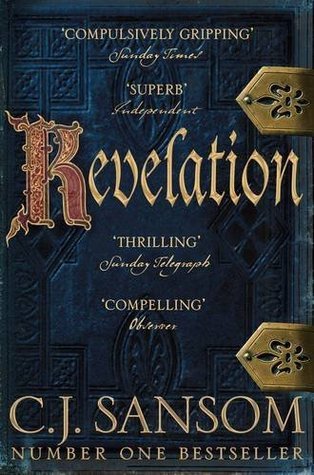
Revelation by CJ Sansom

revelation After reading Sovereign recently, I was desperate to continue with the next of CJ Sansom’s Shardlake mysteries – and luckily for me, I managed to find a copy of Revelation in the library the next day. I had said that Sovereign was my favourite in the series so far, so I was curious to see whether Revelation could possibly be as good. Well, it is; it’s even better! Before I continue, though, just a quick warning: although I’ve done my best to avoid spoilers here, this is the fourth book in the series and the appearance of certain characters in it will mean you can rule them out as suspects in the previous ones. My recommendation would be to start with book number one, Dissolution, and work through them in order.

Revelation is set in 1543, the year in which Katherine Parr becomes the sixth and final wife of Henry VIII, and after their adventures in York (described in Sovereign), lawyer Matthew Shardlake and his assistant Jack Barak are back in London. Shardlake has no desire to become embroiled in any more mysteries, but when a friend is found dead with his throat cut and his blood turning the water of a fountain red, it seems he will have no choice.

The dead man’s widow, Dorothy, is an old love interest of Shardlake’s, and he promises to help bring her husband’s killer to justice. However, it soon emerges that this is just the latest in a series of bizarre murders and, at the request of Archbishop Cranmer, Shardlake agrees to investigate. His involvement will bring him into contact with a circle of powerful men, including Edward and Thomas Seymour, brothers of the late Queen Jane, who have their own reasons for wanting the killer caught. Meanwhile, Shardlake has also taken on another intriguing case, one which involves a young man whose obsessive praying has resulted in imprisonment in the asylum known as Bedlam and could lead to him being arrested as a heretic.

As a murder mystery, I thought Revelation was excellent. There are plenty of suspects and although my guess turned out to be completely wrong, looking back I think we were given enough clues to at least have a chance of solving the mystery. I loved the way the murders corresponded to passages in the Book of Revelation from the Bible. The deaths are quite gruesome, but I didn’t find the book excessively graphic – although it depends on how high your tolerance is for that kind of thing, I suppose.

Four books into the series, I feel that I’m getting to know Shardlake well and I’m able to settle into his narration from the very first page. I think one of the reasons I find him such an engaging character is that, while he’s generally likeable, he does have flaws and he does make mistakes and lose his temper from time to time. He doesn’t seem to have much luck with women and I wondered if he would find love with Dorothy this time. I won’t tell you whether he does or not, of course! Barak isn’t faring much better in the relationship stakes either. I was quite fond of him in the previous novels and I still am, I think, but his treatment of Tamasin in this book really frustrated me.

Barak is by Shardlake’s side, as ever, as he investigates each murder, but I was pleased to see that another of Shardlake’s old friends, Guy Malton, also has a big part to play in the story. Guy, the former monk from Scarnsea Monastery in Dissolution, is now working as a physician in London and his medical skills prove to be very useful in establishing the causes of the deaths and also in offering assistance to the boy locked in the Bedlam. However, Guy has taken on a new apprentice whom Shardlake dislikes and distrusts from their first meeting, and this puts a big strain on their friendship.

In addition to all of this, we are treated to the usual vivid portrayal of Tudor life I’ve come to expect from Sansom, drawing us into the political and religious debates that marked this stage of Henry’s reign. I found it all fascinating and am looking forward to reading Heartstone, which I hope I’m going to enjoy even more than this one.

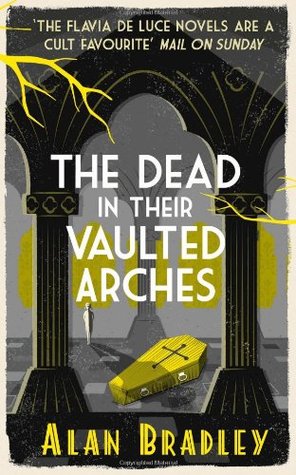
The Dead in Their Vaulted Arches by Alan Bradley

the-dead-in-their-vaulted-arches I love Alan Bradley’s Flavia de Luce series. I love the 1950s setting, I love getting to know the inhabitants of Buckshaw – the de Luce estate in the little English village of Bishop’s Lacey – and most of all I love Flavia, our eleven-year-old narrator with a talent for solving mysteries and a passion for chemistry and poisons. The Dead in Their Vaulted Arches, though, is probably my least favourite Flavia novel so far. I found it quite disappointing, but I’m hoping it’s just that I was in the wrong mood for it and that things will get back to normal when I pick up the next book in the series.

The first Flavia novel, if you’re like me and prefer to read a series in order, is The Sweetness at the Bottom of the Pie. The Dead in Their Vaulted Arches is book number six and although some of the earlier novels could probably be read as standalones, I wouldn’t recommend reading this particular book until you’ve read the fifth one, Speaking from Among the Bones, because it ended on a cliffhanger – and this one picks up the story from that point.

The de Luce family have been joined by their friends and neighbours on the platform at Buckshaw Halt, waiting for the arrival of the train bringing Flavia’s mother, Harriet, home to Bishop’s Lacey. Flavia has never known her mother – she was just a baby when Harriet went missing (presumed dead), in Tibet ten years earlier. It’s an emotional day for Flavia and her family, then, but it’s also an eventful one in other ways…a stranger at the station begins to give Flavia a cryptic message, but moments later he is found dead beneath the wheels of the train as it leaves. Did someone push him? And could his death be connected with what happened to Harriet?

I think every time I’ve written about this series I’ve said that the mystery-solving is only one small element of each book and that the real charm is in the setting, the characters and Flavia’s narration. In this particular novel the mystery is almost non-existent and Flavia doesn’t get a chance to do the detective work she usually does, searching for clues and making lists of suspects. This gives The Dead in Their Vaulted Arches a different feel from the rest of the series and I think that could be why I didn’t like it as much. It seems that the mystery element was more important to me than I thought it was! That’s not to say, though, that there were no secrets to be uncovered here and no revelations to be made – because there certainly were.

Flavia, who was ten years old when we first met her, is now nearly twelve and I think Alan Bradley is doing a great job of showing the subtle changes in her character from one book to the next as she begins to grow up. Things happen in this book which require a more mature attitude from Flavia and she is forced to make some difficult decisions, but there are also times when she still behaves like the child she is – for example, when she becomes convinced that she will be able to use her chemical skills to reanimate a dead body.

With a storyline based around Harriet’s return, most of the action in this novel takes place in and around Buckshaw which means Flavia spends a lot of time with the other de Luce family members. Her relationships with her father and her sisters, Daffy and Feely (Daphne and Ophelia), are still strained, but some of the information revealed in this book helps us to understand why this is. I’ve been wondering since the beginning of the series why Daffy and Feely had such a problem with Flavia, so I’m pleased that things have finally become a bit clearer!

I’m not sure whether I liked the direction the story went in towards the end of the book but I’m still looking forward to reading As Chimney Sweepers Come to Dust, and hoping I will like it better than this one.

The Moving Toyshop by Edmund Crispin

the-moving-toyshop I can’t remember where or when I first heard about this book, but I’ve been interested in reading it for a long time and was pleased to see that it had been made available through NetGalley. It was worth the wait because it was every bit as much fun to read as I had thought and hoped it would be.

The novel opens with poet Richard Cadogan on his way to Oxford, where he hopes to find some literary inspiration. Arriving in the city just before midnight, he is surprised to find a shop with the door unlocked and goes inside to investigate. Inside he finds nothing but toys – ‘Meccano sets, engines, dolls and dolls’ houses, painted bricks, and lead soldiers’ – but venturing up the stairs at the back of the shop, he stumbles across the dead body of an elderly woman on the floor.

Before Cadogan can react, someone hits him on the head and he wakes up to find himself locked in a tiny room used for storing cleaning products. He manages to escape through a window and wastes no time in informing the police – but when they accompany him to the street the next morning, the toyshop is gone and in its place is a grocer’s which looks as though it has been there all the time. How could a shop possibly disappear overnight? Feeling that the police aren’t taking him seriously, Cadogan calls on his friend, Professor of English Language and Literature at Oxford University, Gervase Fen. Fen has some experience of solving mysteries (there are two previous novels in this series, which I haven’t read – The Case of the Gilded Fly and Holy Disorders) and he agrees to help Cadogan investigate.

With the main characters being a poet and an English professor, the dialogue between them is clever and witty, filled with literary allusions and wordplay. When they need a break from crime solving, they amuse themselves by playing games with titles such as Detestable Characters in Fiction. I’m sure we can all think of plenty of those!

“Got you!” said Fen triumphantly. “You miss your turn. Those vulgar little man-hunting minxes in Pride and Prejudice.”

At this exultant shout the muffled, rabbity man at the nearby table frowned, got unsteadily to his feet, and came over to them.

“Sir,” he said, interrupting Cadogan’s offering of Richard Feverel, “surely I did not hear you speaking disrespectfully of the immortal Jane?”

But the literary references are not always just for fun…they form an important part of the plot too. As a mystery involving wills, inheritances, unscrupulous lawyers and small spotted dogs begins to unfold, Fen and Cadogan discover that a knowledge of Edward Lear’s limericks will be useful in deciphering some of the clues. I loved this aspect of the novel; it was so imaginative and made up for the fact that the mystery itself is not a particularly strong one. The plot relies heavily on coincidences, improbabilities and things which are so far-fetched as to be ridiculous – but none of that really mattered to me. I was left with the impression that the author had as much fun writing this book as I had reading it.

Published in 1946, The Moving Toyshop is the third of Edmund Crispin’s Gervase Fen novels but it stands alone perfectly and I didn’t feel that I was at any disadvantage because of not having read the first two books. I’m sure I’ll be tempted to pick up one of the other books in the series soon!

Magpie Murders by Anthony Horowitz

magpie-murders It’s been nearly a week since I finished reading the wonderful Magpie Murders, but it wasn’t until this morning that I felt able to start writing my review. I loved it – it’s one of my books of the year, without a doubt – but I’ve spent a lot of time staring at a blank screen wondering what I could possibly say about it that would explain exactly why I loved it without spoiling things for future readers in the process. The reason I’ve found this such a difficult book to write about is because it’s a mystery novel which contains not just one mystery, but two – and part of the fun was in not only trying to solve each one, but also in discovering the connections between the two.

The novel opens with Susan Ryeland, editor for Cloverleaf Books, a small, independent publisher, settling down to read the latest manuscript from bestselling author, Alan Conway. Conway has achieved enormous success with his series of Golden-Age-style crime novels featuring the detective Atticus Pünd. Susan has never liked the author but she loves his books and has high hopes for his new one, Magpie Murders.

We are then given the privilege of reading the manuscript of Magpie Murders in – almost, but not quite – its entirety. This story-within-a-story is set in the 1950s in the little English village of Saxby-on-Avon. One of the villagers, Mary Blakiston, has been found dead at the bottom of the stairs in Pye Hall, where she worked as a cleaner, and Pünd has been called in to investigate. The story has everything you would expect from a classic whodunnit – plenty of red herrings, some intriguing clues, a long list of suspects all with secrets to hide, an eccentric detective and his hapless sidekick. It’s a real treat for anyone who enjoys reading Agatha Christie!

Eventually the manuscript comes to an end and we return to the present day, where a second mystery, every bit as perplexing as the one we have just been reading, is beginning to take shape. As Susan tries to draw parallels between the fictional world of Saxby-on-Avon and the private life of its creator, Alan Conway, she finds that Magpie Murders really is one of those life-changing books which, until now, she thought were just a cliché.

This is one of the most compelling mystery novels I’ve read for a long time. Both the fictional story and the ‘real life’ one had me completely gripped, trying to figure out which clues were important and which were designed to mislead us, who had a valid alibi and who didn’t…needless to say, I failed to solve either of the mysteries and fell into most of the traps that had been set for the reader. I didn’t mind, though – I was happy just to watch everything unfold as more information came to light and secrets were revealed.

There were so many other things to enjoy…the insights into the publishing world, the little puzzles and word games woven into the plot, even the chapter titles based on the One for Sorrow nursery rhyme. My only disappointment is that the rest of the Atticus Pünd mysteries referred to in the novel don’t really exist. I loved Alan Conway’s Magpie Murders so much I’m now desperate to read Atticus Pünd Investigates, Atticus Pünd Takes the Case, Gin & Cyanide, and all of the others – apart from maybe Night Comes Calling, but I’m not telling you why!

This is the first of Anthony Horowitz’s adult novels I’ve read, although I do remember, as a child, reading one of his Diamond Brothers detective stories. His recent Sherlock Holmes novels The House of Silk and Moriarty didn’t appeal, but now I’m wondering if I should give them a try. Has anyone read them? And have I convinced you to read Magpie Murders? I hope so!

Thanks to Orion for providing a review copy via NetGalley

The 1947 Club: The Labours of Hercules by Agatha Christie

1947-club-pink This week, Karen (of Kaggsy’s Bookish Ramblings) and Simon (of Stuck in a Book) are hosting a 1947 Club. The idea is that we all read and review books which were published in 1947, forming an overview of the literary world in that particular year. Having enjoyed the books I read for the first two clubs – 1924 and 1938 – I’ve been looking forward to taking part in this one.

First, here are some reviews of 1947 novels previously posted on my blog:

The Blank Wall by Elisabeth Sanxay Holding

Alone in Berlin by Hans Fallada

Prince of Foxes by Samuel Shellabarger

I can highly recommend all three of those – and I also enjoyed the book I chose to read for the club: Agatha Christie’s The Labours of Hercules. I love Christie and as it’s been a while since I read one of her books, I was pleased to find that she’d had one published in 1947!

the-labours-of-hercules The Labours of Hercules begins with a foreword in which we learn that Hercule Poirot is planning to retire from crime-solving and devote himself to the growing of marrows. Before giving up detective work for good, he decides to take on twelve more cases, each inspired by one of the twelve Labours of Hercules from Greek mythology. This is in response to a friend who has pointed out that although Poirot may be Herculean by name, he is hardly Herculean by nature!

The foreword is followed by twelve stories, each one a complete mystery in itself. If you’re familiar with the original Labours of Hercules (Poirot himself admits to having no knowledge of the Classics and has to do some research before beginning his mission), you will know that the first one involves the slaying of the Nemean Lion. The ‘lion’ of Poirot’s first Labour is slightly less terrifying – a Pekinese dog stolen during a walk in the park – but it forms the basis of a case which is much more intriguing than it initially appears. The other stories in the book are also loosely related to the Labours but instead of tackling monsters and wild beasts, Poirot finds himself facing an assortment of thieves, drug dealers, kidnappers and murderers.

Until now, I have only read full-length Poirot novels and have avoided the short story collections as I often find short stories disappointing, lacking the depth and complexity I prefer in longer books. However, this particular collection is surprisingly satisfying; fun to read, nicely varied and with at least one clever twist in each story. I’m not going to discuss all of them here, but a few of my favourites were The Stymphalean Birds, in which Poirot attempts to rescue a British politician from the clutches of a pair of blackmailers, and The Cretan Bull, where a young woman seeks Poirot’s help after her fiancé ends their engagement because he fears he’s going insane. I also enjoyed The Erymanthian Boar, set in a hotel on top of a mountain in Switzerland to which Poirot has travelled in the hope of disturbing a rendezvous arranged by a dangerous Parisian gangster.

Poirot is very much alone throughout most of his adventures in this book. We don’t see anything of Captain Hastings, but other recurring characters from the series do make an appearance in some of the stories, including Chief Inspector Japp, Poirot’s valet, Georges, and his secretary, Miss Lemon (I loved her brief but hilarious role in the final story, The Capture of Cerberus, when Poirot asks her what she would do if a friend wanted to meet her in Hell).

Apart from one or two stories towards the end which I found slightly weaker than the others, I really enjoyed reading this collection. I’m sorry that I’m not going to have time to read anything else this week for the 1947 Club, but I’m pleased that the one book I have read proved to be such a good choice!

Sovereign by CJ Sansom

sovereign-cj-sansom Sovereign is the third in CJ Sansom’s Shardlake mystery series set in Tudor England and I found it every bit as good as the first two. The front cover states that it is “So compulsive that, until you reach its final page, you’ll have to be almost physically prised away from it”. Well, I wouldn’t go quite that far, but it was certainly a gripping story and while I’m not sure that it really needed to be over 600 pages long, I never found myself getting bored.

The novel opens in 1541, as Henry VIII embarks on his Progress to the North, a state visit with the aim of allowing those who rebelled during the recent Pilgrimage of Grace to make their formal apologies to the king. The royal progress is heading for York – and so are lawyer Matthew Shardlake and his assistant, Jack Barak. Officially, Shardlake will be dealing with petitions to the king made by the people of York, but he has also been given another task to carry out. An important prisoner, Sir Edward Broderick, is due to be brought from York to London, and Thomas Cranmer, Archbishop of Canterbury, has asked Shardlake to take responsibility for Broderick’s welfare as he doesn’t want the prisoner to die before he can be questioned in the Tower.

Shortly after arriving in York, the murder of a glazier leaves Shardlake in possession of a chest of documents which, if they fall into the wrong hands, could be used to destroy the king. Shardlake barely has time to look at the documents before they are stolen again, but the little bit of knowledge he has gained puts his own life at risk. To make matters worse, he and Barak stumble upon a liaison between the king’s wife, Catherine Howard, and one of her courtiers, Thomas Culpeper; it seems that danger is closing in on them from all sides.

The first Shardlake novel, Dissolution, was set in a monastery, and the next, Dark Fire, took us into the heart of Tudor London; Sansom did a wonderful job of bringing those settings to life and he does the same here with York, capturing the mood of the people in the aftermath of a failed rebellion – people whose political and religious beliefs are not necessarily in alignment with the king’s. I enjoyed reading about the preparations for the arrival of the Progress and what was involved in providing food, accommodation and other amenities for not just the king and queen, but also their entourage of hundreds of courtiers, attendants and servants.

If you haven’t read the previous two books, I don’t think it’s completely necessary as this one does work as a standalone mystery with a beginning, middle and end, but I think I would still recommend reading them in order. There are some recurring characters in the series and it would be best to get to know them from their first appearance.

Barak came into the series in the second book, Dark Fire, and his relationship with Shardlake continues to develop in this book, but it also becomes strained after he falls in love with Tamasin Reedbourne, a servant in Queen Catherine’s household. There is no woman in Shardlake’s life and it does seem that he is jealous of Barak’s relationship with Tamasin – not because he’s attracted to Tamasin himself but because he resents his friend having another attachment. Shardlake comes across as quite a lonely person, I think, which is understandable as he has spent a lifetime being shunned for having a hunched back. He suffers a lot of cruel jibes and ridicule during his time in York, including a humiliation at the hands of the king, which completes the disillusionment with Henry which has been growing in him since Dissolution.

I have barely mentioned the actual mystery yet, but I can assure you that Shardlake does have a mystery to solve in this novel. It centres around a conspiracy dating back to the days of Edward IV and Richard III and I found this element of the story interesting as it showed the extent to which information relating to the Plantagenets was suppressed and covered up by the Tudors. For me, though, the mystery was secondary to the characters and the vivid Tudor setting.

I think this was probably my favourite of the Shardlake novels so far, but I still have another three to read and am planning to continue soon with the fourth one, Revelation.