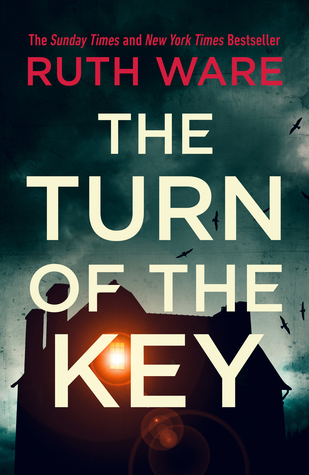
The Turn of the Key by Ruth Ware

Ruth Ware doesn’t write the sort of books I usually choose to read these days, but something drew me to her latest one, The Turn of the Key, and I thoroughly enjoyed reading it courtesy of The Pigeonhole (a website/app which makes new novels available in daily instalments). I’m sure I will be looking for more of Ruth Ware’s books; they would be perfect to put on my list for this year’s RIP Challenge, which I’m hoping will be announced soon.

The novel opens with our narrator, Rowan Caine, in prison awaiting trial for murder. We don’t know exactly what happened, except that a child died while in her care and that suspicion fell on Rowan as the killer. With no one else to turn to for help, Rowan begins to write a letter to her lawyer, Mr Wrexham, in an attempt to explain the sequence of events that led to her imprisonment.

It all starts with a job offer which seems too good to be true: the position of live-in nanny for a rich family based in the Scottish Highlands, caring for four children in return for an unbelievably huge salary. However, it’s not just the money that attracts Rowan…although she doesn’t tell us, or Mr Wrexham, her other reason for applying for the job until much later in the book. In fact, it quickly becomes obvious that Rowan is telling lies about a lot of things; if you enjoy books with unreliable narrators this is definitely the book for you!

Rowan is not the only one with secrets, though, and when she arrives at her new place of work, Heatherbrae House, she becomes aware of some of the mysteries lurking behind its luxurious exterior. Why have the Elincourt children had so many nannies in such a short period of time, some of them lasting no more than a day? What are the eerie sounds Rowan hears during the night? Is Heatherbrae House haunted?

The Turn of the Key, as the title would suggest, draws inspiration from the classic Henry James novel, The Turn of the Screw (which I have to confess I still haven’t read, although I know what it’s about) but Ruth Ware updates the story into a very modern setting. Life at Heatherbrae House is controlled almost entirely by smart technology with cameras in nearly every room and apps to operate lights, heating, showers and music. The sense that Rowan is under constant surveillance with no idea who could be watching her every move creates a sinister and claustrophobic atmosphere which combines with the more traditional gothic elements such as the unexplained noises and other ghostly happenings to make this quite a spooky read.

There were just one or two things that bothered me. First, I thought there were several plot points that felt unconvincing and too convenient; for example, I found it a bit unbelievable that the Elincourts would leave for a week-long conference the day after Rowan’s arrival, leaving the children, including a baby, with someone they had only just met. Also, I felt that in the age of the internet and Google some of the novel’s mysteries could have been solved by the characters much more quickly and needn’t really have been mysteries at all. And then, some of the revelations that came in the final chapters of the book had seemed quite obvious to me and I had already guessed the truth well in advance. Not the ending, though – I hadn’t seen that coming!

I’m looking forward to my next Ruth Ware novel, whichever that turns out to be. I like the sound of The Death of Mrs Westaway and The Woman in Cabin 10, so I think it will probably be one of those.
The Way to the Lantern by Audrey Erskine Lindop

It’s 1793 and Philippe Roberts is in one of the most notorious prisons in Paris awaiting the decision that could send him to the guillotine. The only reason it hasn’t happened already is that nobody seems able to establish his identity. According to the Committee of General Security, he is Philippe-Jean-Baptiste-Raoul, Vicomte de Lambrière, a French aristocrat and therefore a counter-revolutionary. The Committee of Public Safety, however, insist that he is an English gentleman, Anthony Buckland of Sandgate, and that he has been spying on behalf of the British government. Nobody will believe him when he tries to explain that his name is actually Roberts and both de Lambrière and Buckland are fake identities that he has used at various times for reasons entirely unconnected with the French Revolution.

How has Roberts ended up in this ridiculous situation? In his own words:

Some of my more disagreeable friends suggest that in my case there’s no need to look any further for the cause of my present predicament than my own character. I’m inclined to think that’s unjust. After all, there have been thieves, liars, and murderers who have ended up on thrones before now. The fact that I have been all three with less success needn’t necessarily account for my situation.

As Roberts sits in his dungeon and waits, he remembers the events that have led him to this point and shares his memories with the reader. His story begins in England where, as an aspiring young actor, he is taken under the wing of the man he calls Manager Smith (or ‘M.S.’), from whom he learns ‘scraps of history, Latin, astrology, fencing, how to be a gentleman, mathematics, doctoring, geography – everything, in fact, from tips on farming to how to beat the law’. M.S. believes Roberts is destined for a great career on the stage and invests a huge amount of time and effort in his training, but success is slow to come and most of their ‘acting’ is limited to picking pockets and finding creative ways to escape from inns without paying.

Eventually, though, the two acquire their own small theatre, the Little Apollo. Their luck seems about to change – especially when the wealthy and eccentric Lizzie Weldon approaches Roberts after one of his performances and offers to pay him to carry out a simple task. It sounds like an easy way to make money, but Roberts soon regrets saying yes. His involvement with Lizzie and her ludicrous schemes gets him into so much trouble that he and M.S. are forced to flee the country, arriving in France at the worst possible time…the beginning of the Revolution.

The Way to the Lantern was published in 1961 and is the first book I’ve read by Audrey Erskine Lindop. Why it has been allowed to go out of print and fade into obscurity is a mystery to me. I thought it was a wonderful book and I thoroughly enjoyed it from beginning to end! I can’t really say that I loved our narrator – after all, as he admits himself, he is a thief, a liar and a murderer, and his attitude towards women leaves a lot to be desired too – but I did love the way he tells his story, in the style of the picaresque novels of the 18th century, never losing his sense of humour no matter how bad things get. And they do get very bad! It seems that everything that can go wrong does go wrong for Roberts and he spends the entire novel stumbling from one disastrous situation straight into another. Sometimes he only has himself to blame, but often he is simply the victim of bad luck or bad timing.

Roberts’ relationship with M.S. was one of my favourite aspects of the book. From the beginning, M.S. fills the role not just of manager, but of mentor, friend and father figure and this never really changes, even as Roberts grows into a man and their disagreements and differences of opinion become more profound. One way in which they differ is in their political views – M.S. is a royalist while Roberts, whose mother was a French laundress, takes the side of the working classes (the sans-culottes) and the revolutionaries – and another is over Roberts’ romance with the beautiful Marie-Clarice, a woman he meets shortly after they arrive in Paris.

M.S. sees Marie-Clarice as a distraction which could ruin Roberts’ acting career, as well as a danger as Marie-Clarice is a countess (actually a ci-devant, or former, countess, since the nobility have had their titles removed during the Revolution). Roberts knows that she could be denounced at any moment and that he could also fall under suspicion because of his association with her, but he is sure that her true sympathies are with the revolutionaries and so he refuses to abandon her to her fate. At first I was inclined to agree with M.S. about Marie-Clarice, but I warmed to her later in the book; it would have been difficult not to, I think. The real star of the novel for me, though, was Suzon Dupont – or as Roberts nicknames her, the Puce (the flea). We first meet the Puce as a dirty, impoverished urchin of thirteen who proves to be a better pickpocket than Roberts himself, but over the course of the novel we see her blossom into a pretty and intelligent young woman with a fierce loyalty towards M.S. and Roberts.

Loyalty is something to be valued during the Revolution, at a time when there are spies around every corner and you can never be sure who may be about to denounce you as a supporter of the ancien régime. Although all of the major events are covered in the novel, such as the storming of the Bastille, the abolition of the monarchy and the execution of Louis XVI, the focus of the story is on the lives of the ordinary people and I was given a real sense of what it was like to live in Paris during that period. The balance between the historical detail and Roberts’ fictional adventures is perfect; it’s the sort of book where you learn a lot as you go along, while being entertained by a great story at the same time.

I’m sorry for the length of this post, but I did really enjoy The Way to the Lantern and found that I had a lot to say about it! It’s disappointing that none of Audrey Erskine Lindop’s books are in print, but I will definitely try to read some of her others – although they do all sound very different from this one.

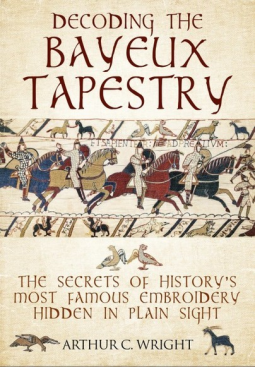
Decoding the Bayeux Tapestry by Arthur C. Wright

You have probably seen The Bayeux Tapestry – if not in real life then in books, on websites or on television – and you may know that it depicts the story of the Norman Conquest of England, but have you ever looked at the pictures that appear in the margins and wondered what they mean? This new book by historian Arthur C. Wright, Decoding the Bayeux Tapestry: The Secrets of History’s Most Famous Embroidery Hidden in Plain Sight, attempts to interpret these often-overlooked images and relate them to the action taking place in the main body of the Tapestry.

At a quick glance, the pictures in the margins look very random and don’t appear to be connected with the larger pictures in the middle, but now that I’ve read this book I know that is not the case. Wright takes us step by step along the whole length of the Tapestry, matching the marginal story to the one in the main panel and this adds to our overall understanding of what the Tapestry is telling us.

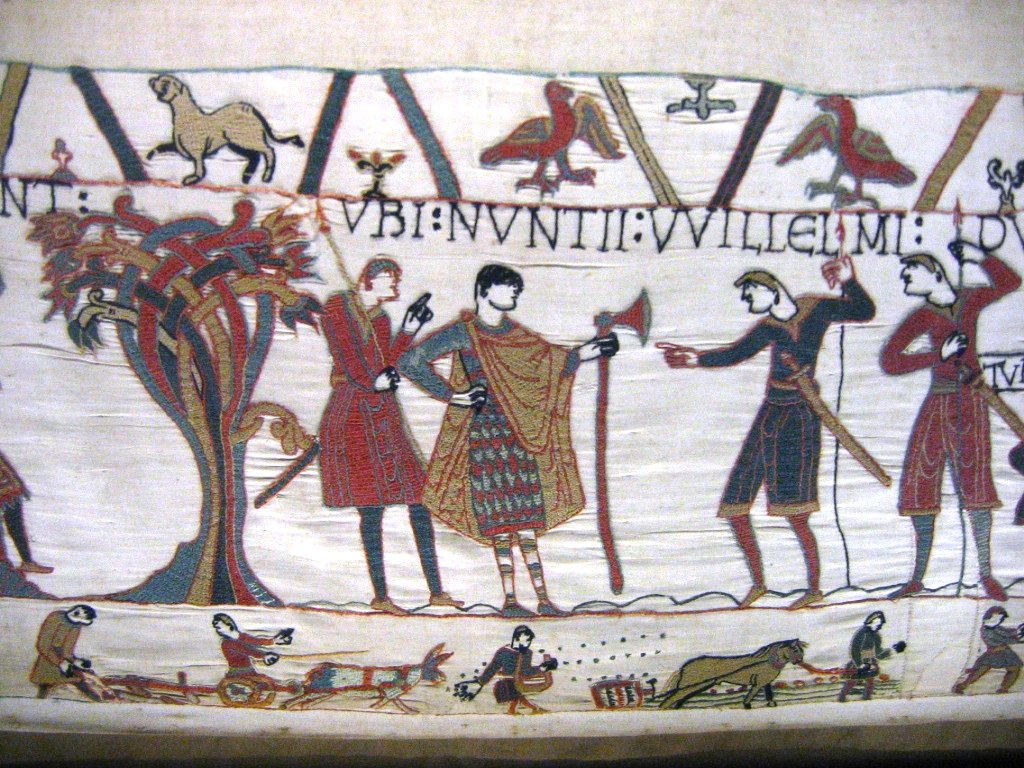
So, what exactly are these marginal illustrations? Well, many of them depict birds and animals such as dogs, lions, ‘pards’ (the name given to large leopard-like cats), crows, foxes, mythological beasts such as dragons – anything that might have appeared in a medieval bestiary. These creatures add extra meaning to the central panels; for example, a dog is shown howling below the picture of Edward the Confessor being taken to his burial. Others display fear, joy, pride, anger or other appropriate emotions at relevant points in the Tapestry. The margins also include illustrations of some of Aesop’s Fables; the story of ‘the Fox and the Crow’ is one of them. In order to understand the significance of the fables and the other messages we are being given in the margins, it helps if we know who embroidered these images, who commissioned the Tapestry in the first place and who the intended audience was, and Wright spends a lot of time discussing these things as well as interpreting the images themselves.

All of this was fascinating, but I did wonder who this book was really aimed at. Even though I do have an interest in the subject and a moderate amount of knowledge of the Norman Conquest (admittedly, gained mainly through historical novels such as Gildenford, Godwine, Kingmaker and 1066: What Fates Impose), I didn’t really feel the need to go into so much detail on the size of the fleet that invaded England or the geographical features of the landscape. There are lengthy appendices exploring both of these topics and I think this sort of information would only really be of interest to an academic reader who wanted to make a very thorough study of the subject. Although the earlier chapters are much more accessible, I’m not sure whether I could recommend the book overall to the general reader, especially not to those who are unfamiliar with this period of history.

I’m still pleased to have had the opportunity to learn a little bit more about the Bayeux Tapestry, though, and to have been made aware that those medieval embroiderers were perhaps telling us more than meets the eye. If anyone else has read this book, or has ever studied the Tapestry, I would love to hear your thoughts.

A scene from the Bayeux Tapestry

Thanks to Pen & Sword for providing a copy of this book for review via NetGalley.

This is book 8/20 of my 20 Books of Summer.

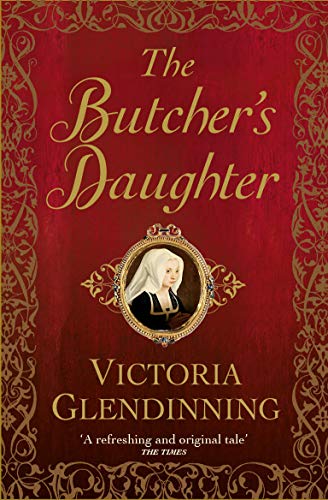
The Butcher’s Daughter by Victoria Glendinning

Today I am taking part in a blog tour for The Butcher’s Daughter, a novel set in Tudor England during and after the Dissolution of the Monasteries. It’s a time period and subject that interests me, so I had high hopes for this book, my first by Victoria Glendinning.

It’s 1535 and Agnes Peppin is the ‘butcher’s daughter’ of the title – a young woman from Bruton in Somerset who, after giving birth to an illegitimate child, has been sent to live with the nuns at Shaftesbury Abbey as a novice. Agnes can read and write, having been taught by the canons at her local church, and these skills make her useful to the abbess, Elizabeth Zouche. Before she has time to take her vows and become a nun herself, however, Shaftesbury Abbey, like other great religious houses across the country, becomes a target of Henry VIII and Thomas Cromwell’s campaign to dissolve the abbeys and monasteries, seizing their assets for the crown and then demolishing the buildings.

The Butcher’s Daughter is narrated by Agnes herself in the form of a memoir as she first describes her life at the abbey and then tells us what happens afterwards as she and her fellow nuns and novices find themselves facing uncertain futures. It’s a slow-paced novel and definitely one which is driven more by character than by plot, but I still found it quite gripping because Agnes pulled me so thoroughly into her world. The chapters set within the abbey are informative and detailed; as a novice, Agnes has a lot to learn, from how to dress herself correctly to studying the Lives of the Saints, as well as getting to know the other women with whom she will be living within the confines of the cloister.

The second half of the book was even more interesting. While the inhabitants of Shaftesbury Abbey have been watching the downfall of other smaller, less profitable houses, telling themselves that ‘in our case, of course, surrender is unthinkable and indeed unthought of’, it eventually becomes evident that they will not be spared and must prepare to suffer the same fate. We see the final days of the abbey through our heroine’s eyes, before following her through a series of adventures as she rejoins the secular world and attempts to find a place for herself in society again. Although Agnes has spent a relatively short time at Shaftesbury, there are others who have known no other sort of life and who find it much more difficult to cope with the changes enforced on them.

Although Agnes is a fictional character and her personal story is invented, Shaftesbury Abbey was real and characters such as Elizabeth Zouche really existed too. Towards the end of the novel, Agnes crosses paths with Sir Thomas Wyatt (son of the poet of the same name), bringing more real historical events and political intrigue into the story, but the focus is always on Agnes herself and the things she experiences during this traumatic and eventful period of religious history. And yet, despite the upheaval Agnes goes through and the challenges she faces, there is still a sense of optimism…a comforting knowledge that, whatever happens, life must go on, “Beans will sprout. Children will be born. There will be butterflies”.

Thanks to Duckworth Books for providing a copy of this novel for review.

The Night Tiger by Yangsze Choo

First of all, this is a quick note to say that I am moving house this week so won’t have much time for blogging for a while – there are just so many other things that need to be done! I have prepared and scheduled some posts in advance, so you probably won’t notice any difference, but I might be slow to respond to comments or to catch up with commenting on your blogs. I’m hoping to get settled in quickly so that things can get back to normal, but meanwhile here is my review of one of last month’s reads, The Night Tiger.

***

The Night Tiger was a surprise. I had been drawn to it mainly by the colourful cover and the fact that it was set in Malaya (now part of Malaysia), a country I know very little about, but I didn’t really expect to like it very much. I hadn’t read Yangsze Choo’s first novel, The Ghost Bride, because the subject didn’t appeal to me, and it sounded as though this book, like that one, would have a very strong magical realism element – and I’m not much of a fan of magical realism. Well, I was wrong about that; although there are times when the story does veer towards the fantastical, most of it is concerned with simply describing the folklore and superstitions of the Chinese people of Malaya and asking us to accept that some of these things may actually be real.

The story is set in the 1930s and is told from two different perspectives. First there’s Ren, an eleven year-old houseboy whose master, Dr MacFarlane, has recently died. While on his deathbed, the doctor asked Ren to carry out a very special task for him: to find his severed finger and bury it in his grave beside his dead body. This must be done within forty-nine days, otherwise Dr MacFarlane’s soul will be condemned to roam the earth forever. In need of new employment, Ren enters the service of another doctor, William Acton, then begins his quest to locate the missing finger.

Our other main character is Ji Lin, a dressmaker’s apprentice who has been secretly working in a dance hall in Ipoh to earn the money to pay off her mother’s gambling debts. While dancing with a salesman one night, she sees a little glass bottle fall from his pocket and, catching it before it hits the ground, she finds that it contains a shrivelled finger. This gruesome discovery leads Ji Lin to cross paths with Ren and when they each begin to have recurring dreams involving a train journey, it seems that their lives are becoming intertwined in other ways as well.

I enjoyed The Night Tiger much more than I thought I would. The setting is fascinating, of course; I have read two other books set in Malaya (The Garden of Evening Mists by Tan Twan Eng and The Separation by Dinah Jefferies) but they are very different types of books and don’t explore Chinese and Malaysian myths and legends the way this one does. The folklore surrounding the legend of the weretiger was particularly intriguing; there are hints that one could be responsible for the unexplained deaths that have been occurring around the town, and we can either believe that this is true or we can just believe that the characters in the story believe it is true, if that makes sense!

Both main viewpoint characters are easy to like; I felt closer to Ji Lin, because her story is told in the first person whereas Ren’s is told in the third, but I did love Ren too. He often seems very mature for his age – probably because he has been forced to grow up quickly due to his personal circumstances – but at other times he behaves more like the child he still is.

I’m still not sure whether I want to read The Ghost Bride, but I will look out for Yangsze Choo’s next book and see if it appeals.

Thanks to Quercus Books for providing a copy of this book for review via NetGalley.

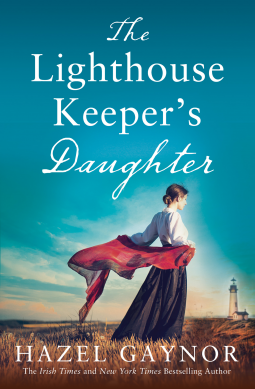
The Lighthouse Keeper’s Daughter by Hazel Gaynor

Being from the North East of England, Grace Darling is something of a local heroine, but although I remember hearing her story at school, I couldn’t really have told you very much about her. Hazel Gaynor is an author I’ve been interested in reading for a while and I already have one of her previous books, The Cottingley Secret, on the TBR, but when I saw that her latest book, The Lighthouse Keeper’s Daughter, was about Grace Darling I thought it might be a better one for me to start with.

The Lighthouse Keeper’s Daughter is divided between two different time periods, but unlike most dual timeline novels where one storyline is set in the past and the other in the present, both periods in this book are historical. One thread begins in 1838 and introduces us to Grace, a young woman whose father runs the lighthouse on Longstone Island, one of the Farne Islands just off the coast of Northumberland. The family live with him at the lighthouse and although it’s an isolated, unconventional lifestyle, Grace loves it and can’t imagine living anywhere else. One night, she helps her father with a rescue when a paddle steamer, the Forfarshire, gets into trouble during a storm and is wrecked on the rocks. News of Grace’s bravery quickly reaches the public and suddenly she finds herself the centre of attention, but all she wants is to continue living a quiet, simple life in her beloved lighthouse…how will she cope with her unexpected fame?

The other storyline is set in America in 1938 and follows Matilda, a young Irish woman who has been sent away from home in disgrace after becoming pregnant. Matilda is staying with an older relative, Harriet, who happens to be a lighthouse keeper in Newport, Rhode Island. At first she finds Harriet unwelcoming and difficult to talk to, but as she gets to know her better she starts to understand what has made Harriet the person she is.

I was interested in both storylines, but although it was the promise of learning more about Grace Darling that drew me to this book, I think I preferred reading about Matilda. To be honest, I didn’t feel that there was much difference between the narrative voices of Grace and Matilda, especially considering that they were living in different centuries, but of the two I felt closer to Matilda and more emotionally invested in her story. I wanted to understand the nature of her relationship with Harriet and I enjoyed watching that aspect of the story unfold, as well as discovering the connections between Matilda and Grace. Grace’s chapters deal mostly with the events of the sea rescue and the unwanted, unlooked for fame she experiences in the aftermath, but the author also imagines a romance for her, which feels believable and is also quite moving and poignant.

There was some added interest for me in that I was familiar with so many of the places which form the setting for Grace’s story, including North Sunderland, Seahouses, Alnwick and Bamburgh. The Matilda sections are more fictional, but do also incorporate some real places and events such as the New England Hurricane of 1938. Although there were one or two small things that stopped me from enjoying this book as much as I would have liked to – particularly the use of present tense, which I almost always find annoying – overall I thought this was a good, interesting read. I’m looking forward to reading more by Hazel Gaynor, starting with The Cottingley Secret.

Thanks to HarperCollins for providing a copy of this book for review via NetGalley.

This is book 7/20 of my 20 Books of Summer.

Murder in the Crooked House by Soji Shimada

A remote, snow covered mansion; a group of people arriving for a Christmas house party; a seemingly impossible locked-room murder; a detective whose methods are unusual and unorthodox. These may sound like the ingredients of a classic British Golden Age mystery, but Murder in the Crooked House is actually a Japanese novel first published in 1982 which Pushkin Vertigo have now made available for the first time in an English translation by Louise Heal Kawai.

I was really looking forward to reading this book as it sounded like just my sort of thing, and it did get off to a great start. The descriptions of the Ice Floe Mansion in northern Japan are fascinating, with its sloping floors and drawbridge leading to a leaning tower (which gives the house its nickname, the Crooked House). Inside, the mansion resembles a fairground fun house with a maze of rooms, unusually positioned staircases, and a room containing a collection of Tengu masks and mechanical dolls, including a life-size Golem which is said to get up and walk around at night.

This weird and wonderful building is the home of retired businessman Kozaburo Hamamoto, who has invited his family and friends to spend the Christmas of 1983 with him. The guests include his daughter Eiko and her two suitors Togai and Sasaki, his great-nephew Yoshihiko, and a former business partner Eikichi Kikuoka, who brings several of his employees along with him. On their first night in the Crooked House, one of the guests is found dead inside a locked room, Kikuoka’s secretary is terrified by a face at her top-floor window, and Golem appears to have thrown himself into a snowdrift outside. The local police are baffled; there seems to be no explanation for any of these incidents and no obvious motive either. It is only after several more murders take place and the brilliant detective Kiyoshi Mitarai arrives on the scene that the truth is finally revealed.

Murder in the Crooked House is a very clever murder mystery. I found the culprit easy to guess – there was only one person it could have been, in my opinion – but what I didn’t know was how they carried out the murders. The solution is certainly very original and although Shimada states in a ‘Challenge to the Reader’ towards the end of the book that he has given us all the clues we need to solve it, I will be impressed if any reader has actually managed to work out the exact method used by the murderer! However, the cleverness of the novel was also one of the things I disliked about it.

The book contains a number of diagrams showing floor plans and layouts of rooms and sadly these weren’t included in the ebook I received for review, which obviously wasn’t the finished version. Although Amazon’s ‘Look Inside’ feature came to my rescue and allowed me to at least see the plan of the house, I think even if I’d been able to study all of the diagrams I would still have found the plot overly complicated. As well as a lot of importance being placed on alibis and who was in which room at what time, there’s also a lot of discussion of distances of windows from floors, positions of ventilation holes in walls and which rooms can be reached from which staircase. I do like mysteries with puzzles to solve, but I felt that this one became too technical – too concerned with the details rather than with the characters and their motivations. As a result, the characters seemed to lack depth and didn’t feel like real people to me, which wasn’t helped by the dialogue which felt a bit stilted, although that could have been due to the translation.

Most of the novel is written in the third person, so I was surprised to find that, when Kiyoshi Mitarai arrives at the Crooked House well into the second half of the book, the perspective switches to the first person (from the point of view of Kazumi Ishioka, Mitarai’s friend who has accompanied him to the house). It seemed unusual to have such a change so far into the book, but I got used to it quickly enough. Although this is the first novel I’ve read by Shimada, I’ve learned that this is one of a series of mysteries featuring the partnership of Mitarai and Ishioka, as a sort of Holmes and Watson. I would possibly try another book in the series – the first one, The Tokyo Zodiac Murders, is also now available in English and presumably some of the others will follow.

Thanks to Pushkin Vertigo for providing a copy of this book for review via NetGalley.

This is book 6/20 of my 20 Books of Summer.