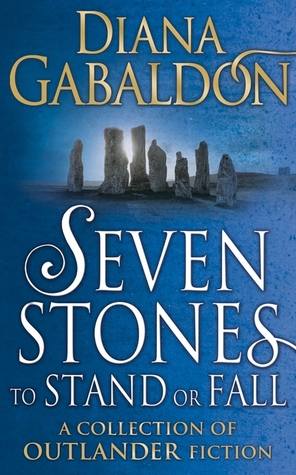
Seven Stones to Stand or Fall by Diana Gabaldon

No, this is not a new novel in Diana Gabaldon’s Outlander series, but a collection of seven stories featuring characters from the series, written over a number of years. The first five have previously appeared in other collections, such as 2013’s A Trail of Fire, or as standalone novellas, but the final two are new ones. I hadn’t really intended to read this book; although I loved the earlier Outlander novels, I’ve been less impressed with the more recent ones, mainly because of the increasing focus on Lord John Grey’s family, and as most of these stories seemed to involve the Lord John characters I wasn’t in any hurry to read them. When I found a copy in the library a few weeks before Christmas, though, I thought I would give it a try in the hope that at least one or two of the stories would interest me – and some of them did, but maybe not the ones I would have expected!

The first story (they are all really novellas rather than ‘short stories’; I don’t think Diana Gabaldon is capable of writing anything that can truly be described as short!) is The Custom of the Army. Lord John gets into trouble at an electric eel party and when he is forced to fight a duel which goes disastrously wrong, he takes the opportunity to escape to Canada to serve as character witness for an officer who is facing a court martial. While he is there he finds himself caught up in the Battle of Quebec of 1759. Despite my general lack of enthusiasm for reading about Lord John, I found the setting interesting and thought this was a good start to the collection.

The next story, The Space Between, is entirely different from the first. It’s set around the time of An Echo in the Bone, I think, and our protagonists this time are Joan MacKimmie (whom readers of the Outlander series will remember as Laoghaire’s daughter) and Michael Murray (one of Jenny and Ian’s sons). Michael is escorting Joan to Paris where she is to become a nun, but on their arrival they become entangled with the sinister Paul Rakoczy, a character who has previously appeared in the series under a different name. I found this story quite enjoyable; it was good to meet some old friends again and also to learn more about the time travel aspects of the series. I think it’s funny that in the first Outlander novel (or Cross Stitch as it used to be called here in the UK), Claire’s ability to time travel seemed to be something unusual, yet by this point in the series almost everyone is doing it!

Now we’re back to Lord John again with Lord John and the Plague of Zombies. This time John is in Jamaica where he has been sent on army business to deal with a slave rebellion in the mountains. When the Governor of Jamaica is found murdered, it seems that a zombie could be responsible for his death…but Lord John knows nothing about zombies so needs to learn quickly. I have to admit, the title of this story was enough to put me off before I’d even read it! These particular ‘zombies’ do have a rational explanation, though, and are only one element of the story. In the overall timeline of the series, this story seems to take place shortly before the events of Voyager, when a certain Mrs Abernathy is still living at Rose Hall…

Next, we have A Leaf on the Wind of All Hallows, which answers the question of what happened to Roger’s father, Jerry MacKenzie, a Spitfire pilot whose plane went down over Northumberland during World War II. This fascinating story, another which involves time travel, gives a different perspective on an episode from Written in My Own Heart’s Blood which we have already read from Roger’s point of view. I enjoyed this one as Roger is one of my favourite Outlander characters and I found it interesting to learn more about his parents.
You may be starting to wonder whether Claire and Jamie appear in any of these stories; sadly, we don’t see anything of Claire (although she is mentioned once or twice), but the next novella, Virgins, does feature a young Jamie Fraser. A straightforward prequel to Outlander, it is set during the period following Jamie’s flogging by Black Jack Randall when he joins his friend Ian Murray in France. This was the biggest disappointment in the collection, for me. It didn’t even feel as though it was written by the same author as the other stories, at least at first, although I can’t put my finger on the reason why. It does pick up halfway through, with a subplot involving the marriage of a young Jewish girl, but I still didn’t like it. I think I’m so used now to an older Jamie that I found it disconcerting to meet him as a nineteen-year-old!

Next comes my favourite story in the book: A Fugitive Green. Set in 1744, this is the story of Lord John Grey’s brother Hal, the Duke of Pardloe, and his future wife, Minnie Rennie. The young Minnie makes a wonderful heroine and I loved this tale of spying, blackmail and family secrets which takes us from Paris to London and back again. Both Hal and Minnie have appeared in other Outlander and Lord John novels, but they are not characters who ever interested me before. This story was a real surprise!

Finally, there’s Besieged, a sort of follow-up to Plague of Zombies. Lord John is still in Jamaica, but has received news that his mother, the Dowager Duchess of Pardloe, is in Havana, which is about to become the centre of a battle between Britain and Spain. Heading for Cuba to rescue her, John finds that he is too late to avoid the British invasion and the siege which follows. Like the other Lord John stories, this is set at an interesting moment in history, but the story itself was not very memorable.

So, they are the seven stories – the ‘seven stones’ of the title. They do all stand alone and it’s not completely necessary to have read anything else by Gabaldon first. However, if you’re new to her work I don’t think this would be a good place to start. I would recommend this book more for existing fans of the Outlander books (in particular, the spin-off Lord John series) who are waiting for the next full-length novel to be published.
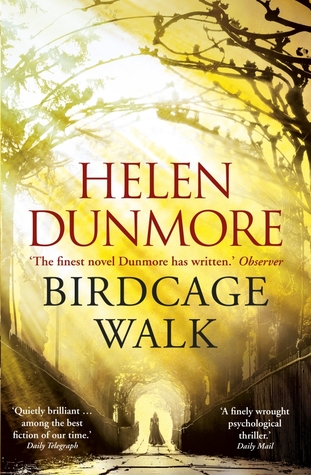
Birdcage Walk by Helen Dunmore

Helen Dunmore’s Exposure was one of my favourite books of 2016, so when I saw that she had a new one coming out last year, I knew I wanted to read it. The early reviews seemed to be very mixed, though, so I didn’t rush to get hold of a copy and it wasn’t until the days between Christmas and New Year that I finally got round to reading it.

I mustn’t have read those reviews very closely because I had the impression that this was a book about the French Revolution – but that’s not really true. The story is set in England and although events taking place across the Channel do have an effect on the lives of our characters, all of this is happening at a distance and is not the focus of the novel. The main theme of Birdcage Walk, according to Helen Dunmore herself and hinted at in the opening chapters, is the temporary nature of human life and the way so many of us leave behind very little evidence of our existence when we die. Dunmore states in her Afterword that she wanted to show that everyone has shaped the future in some way, by influencing those around them, even if they then disappear without trace. This is particularly poignant when you consider that while she was writing this novel she was already seriously ill with the cancer that would soon take her life.

But back to the plot of Birdcage Walk. The main part of the story is set in Bristol in 1792. Lizzie Fawkes’ husband, John Diner Tredevant (known simply as Diner) is a property developer who has started to build a terrace of houses with magnificent views of the Avon Gorge. With war against France on the horizon, however, this is a bad time to be trying to sell houses. Lizzie can see that her husband is troubled but is he just worried about the failure of his building project or is there something else on his mind?

Dunmore’s portrayal of Diner is excellent; he is a jealous, possessive and controlling husband who resents Lizzie having relationships with any other friends or family members apart from himself – but it is clear that something terrible has happened in his past, leaving him unhappy and disturbed. We find out very early in the novel what that something probably is, which takes away part of the suspense, but I think there is still plenty of tension in waiting to see when and how Lizzie will learn the truth.

The characterisation in general is very good; I found Lizzie’s mother, the writer Julia Fawkes and her husband Augustus particularly interesting to read about. Julia’s role in the story is brief, but she is one of the characters Dunmore uses to illustrate her point about a person’s influence living on after their words have faded away. Augustus, with his strong political views but lack of insight when it comes to the everyday things going on around him, also feels believable and real.

As I’ve said, the French Revolution is played out in the background with news reaching our characters mainly in the form of letters and newspaper reports. This means we don’t have the excitement of being thrown directly into the events of the Revolution, but it is still interesting to see things from the perspective of people who were less directly involved. Most of the novel, though, is concerned with more domestic issues: Lizzie’s personal relationship with Diner and her efforts to care for her baby brother Thomas despite Diner’s opposition.

I didn’t like Birdcage Walk quite as much as Exposure, but I still found it atmospheric and beautifully written. It’s so sad that there won’t be any more books from Helen Dunmore, but as I have only read three of them so far (The Lie is the other) I can still look forward to reading her others.

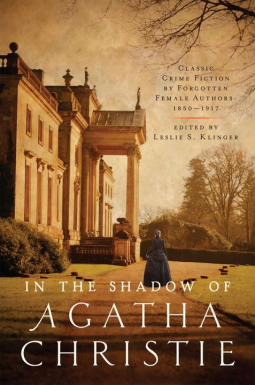
In the Shadow of Agatha Christie, edited by Leslie S. Klinger

Agatha Christie is an author most people have heard of, whether or not they’ve ever read any of her books. Ask someone to think of a female crime writer and she is probably the first name that will come to mind. Christie’s first novel, though, wasn’t published until 1920 – and she was by no means the first woman to write in the crime genre. This new collection of short stories, edited by Leslie S. Klinger, features some of the lesser known women crime writers who came before Agatha and could even have inspired her work.

The book is subtitled Classic Crime Fiction by Forgotten Female Writers: 1850-1917 and although I wouldn’t personally describe all of these authors as ‘forgotten’, there were certainly quite a few whose names were new to me. Of the sixteen stories included in the book, I had already read one of them – A Jury of Her Peers by Susan Glaspell (1917), which shows the different ways in which men and women evaluate the same situation and the different clues they pick up on – but it’s such a good story I was happy to read it again. Other names who may be familiar to many readers are Victorian novelist Elizabeth Gaskell and Scarlet Pimpernel author Baroness Orczy, although the stories included here – The Squire’s Story (1853) and The Regent’s Park Murder (1901) – didn’t particularly stand out to me.

As a fan of Victorian sensation novels, I was intrigued to come across stories by Ellen Wood and Mary Elizabeth Braddon, two authors whose work I’ve loved in the past. The Braddon one, The Winning Sequence (1896), is more of a ghost story than a mystery and I found it disappointingly weak, but Wood’s story, Mrs. Todhetley’s Earrings (1873), was very enjoyable. It is narrated by her young hero, Johnny Ludlow, who is apparently the subject of a whole series of short story collections, although I had never heard of him until now.

Others that I think deserve a special mention include The Statement of Jared Johnson (1899) by Geraldine Bonner, a murder mystery with a twist I’ve come across several times in crime stories recently but which I always find clever, The Ghost of Fountain Lane (1893) by C.L. Pirkis, in which a link emerges between two seemingly unconnected mysteries, and The Case of the Registered Letter by the Austrian author Augusta Groner. There’s also A Point in Morals (1899) by Ellen Glasgow, an unusual story which considers whether murder is always morally wrong, The Blood-Red Cross (1902) by L.T. Meade which features a sinister villain called Madame Sara, and Anna Katherine Green’s Missing: Page Thirteen (1915), an eerie tale of a house with a secret room.

The other authors represented in the book, whose work made less impression on me, are Catherine Crow, Mary Fortune, Harriet Prescott Spofford, Elizabeth Corbett and Carolyn Wells – whose The Adventure of the Clothes-Line (1915) is a parody of a Sherlock Holmes story which I think a lot of readers would enjoy even though I didn’t.

There’s nothing here, in my opinion, which resembles an Agatha Christie story in any way, so the title of this book could be slightly misleading if someone picked it up expecting a selection of Christie-style mysteries. I didn’t find any new authors here that I liked enough to want to explore further, but it was still interesting to read this collection and see how crime fiction has developed over the years.

Thanks to Pegasus Books for providing a copy of this book for review via NetGalley.

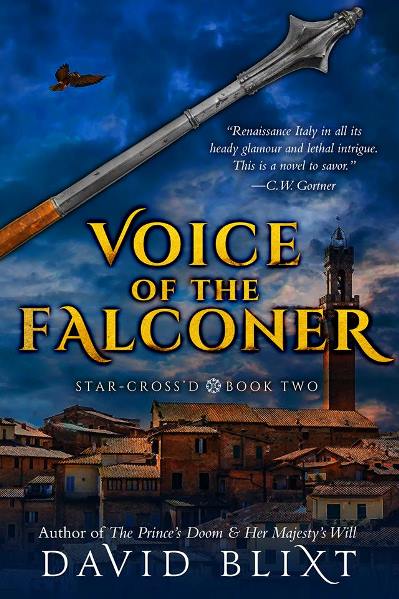
Voice of the Falconer by David Blixt

This is the second volume in David Blixt’s Star Cross’d series, combining the history and politics of 14th century Italy with characters and storylines inspired by Shakespeare. I read the first novel, The Master of Verona, in 2012 and it won a place on my ‘books of the year’ list that year, which gives you an idea of how much I loved it. I really hadn’t meant to let so much time go by before continuing the series, and I worried that I might have trouble picking up the threads of the story again, but as soon as I started to read Voice of the Falconer things fell back into place and I felt as if only five days had passed since reading the first book rather than five years!

Voice of the Falconer opens in 1325, eight years after the events described in The Master of Verona. Pietro Alaghieri, son of the late poet Dante, has been living in exile in Ravenna, entrusted with the guardianship of the illegitimate heir of Cangrande della Scala, the ruler of Verona. The child, Cesco, has already been the target of several assassination attempts so it has been decided that he should be raised in secret, with as few people as possible aware of his location. When news of Cangrande’s death begins to circulate, however, Pietro must hurry back to Verona to ensure that the eleven-year-old Cesco receives his rightful inheritance – but as other members of the della Scala family also have their eyes on the throne of Verona, this won’t be an easy task. And now that Cesco’s existence has been revealed, his life could be in danger again…

Cesco, who was only a baby in the previous novel, has developed into a wonderful character – even if you do need to suspend disbelief to accept that a boy of his age could be so intellectually advanced, quick-witted and talented in every way! I loved the little circle of friends and protectors who surround him, too: Morsicato the doctor, Antonia the nun, Tharwat the Moor and, of course, Pietro himself. The characters in the novel are a mixture of those who are fictitious and those who are based on real historical figures, such as Cangrande and the rest of the Scaligeri family. If you don’t know the history, I would recommend not looking things up until you’ve finished the book; if you just let the story carry you along, there will be one or two surprises in store for you as there were for me.

I won’t say too much more about the plot, then, but I do need to mention another very important aspect of the book…the Shakespearean connection. In The Master of Verona we witnessed the beginnings of a feud between Pietro’s two friends, Mariotto Montecchio and Antonio Capulletto. In this book, we meet Mariotto’s young son Romeo and Antonio’s baby daughter Giulietta (Juliet), as well as Giulietta’s cousin Thibault (Tybalt); obviously there is still a long way to go before the tragedy of the star-cross’d lovers is played out, but the foundations of the story have now been laid. I also had fun spotting other characters from Shakespeare’s plays such as Shalakh (Shylock) from The Merchant of Venice and Petruchio and Kate from The Taming of the Shrew, but if you have no knowledge of Shakespeare I don’t think it would be a problem at all – it’s just another of the novel’s many layers.

In case you can’t tell, I enjoyed this book as much as the first one! I am looking forward to visiting Renaissance Italy again soon with the third in the series, Fortune’s Fool…and certainly won’t be waiting five years this time.

Death Comes for the Archbishop by Willa Cather

This is the first book I’ve read from my new Classics Club list and my third by Willa Cather. I’m grateful to the recent Classics Spin for choosing it for me because although I do like Cather’s writing I seem to need something to push me into picking up her books. This one could have lingered on my list for a long time otherwise, which would have been a shame as once I started reading it I loved it. It’s certainly my favourite of the three I’ve read so far (the others are The Professor’s House and My Ántonia).

Death Comes for the Archbishop is set in the nineteenth century and follows the stories of Bishop Jean Marie Latour and his friend Father Joseph Vaillant, two French missionaries who have been sent into the newly formed diocese of New Mexico – territory which has recently been acquired by America. As they begin their work of spreading their faith to the people of New Mexico, they face a number of challenges. The landscape, although beautiful, is harsh and often inhospitable; the railroad has not yet arrived so travel must be by mule over difficult terrain. When they do eventually reach other settlements, they are disappointed to find that the Catholic priests already established in these communities are, in most cases, not suitable for the job. They are either corrupt, greedy, too powerful, too weak or insufficiently devoted to their religion.

It is the task of Father Latour, with the help of Father Vaillant, to decide how to tackle these problems, while also learning to love his new home and getting to know the people who have lived there for generations. These include not only Americans and Mexicans, but also the Hopi, Navajo and other Native American people, whom Cather writes about with sensitivity and sympathy. Each group have their own customs, traditions, stories, histories and superstitions and as all of these things are new to the Bishop and his friend, the reader is able to learn along with them.

I have never been to New Mexico so as I read I found myself turning to Google for images of the deserts and hills, mesas and pueblos, plants and trees that are mentioned in the novel. After Latour visits the pueblo of Acoma and hears about the legend of the Enchanted Mesa, for example, I wanted to see what it would be like to live in such a harsh and isolated location. Cather writes beautifully about the New Mexico landscape; her use of colour is wonderful, helping to bring her descriptions to life. Here is the moment when Latour arrives at Santa Fé for the first time:

As the wagons went forward and the sun sank lower, a sweep of red carnelian-coloured hills lying at the foot of the mountains came into view; they curved like two arms about a depression in the plain; and in that depression was Santa Fé, at last! A thin, wavering adobe town…a green plaza…at one end a church with two earthen towers that rose high above the flatness. The long main street began at the church, the town seemed to flow from it like a stream from a spring. The church towers, and all the low adobe houses, were rose colour in that light,–a little darker in tone than the amphitheatre of red hills behind; and periodically the plumes of poplars flashed like gracious accent marks,–inclining and recovering themselves in the wind.

My favourite aspect of the novel is the relationship between Bishop Latour and Father Vaillant. The two men have known each other since they were students together at the seminary in France and I found the depiction of their friendship very moving, particularly later in the book when Father Vaillant has the chance to take up a new mission far away; the Bishop, who can’t bear to lose his companionship, must decide whether to keep his friend with him for selfish reasons or to let him go and give him the chance to develop his own career elsewhere and carry out the work which will make him happy. The characters are based on real historical figures – Jean-Baptiste Lamy and Joseph Projectus Machebeuf – but I like the names Cather has chosen for them. Vaillant, meaning ‘valiant’, is perfect for Joseph, who is brave and energetic, warm and friendly, while Latour (‘the tower’) is quieter and more reserved, finding it more difficult to open up and make friends. Their different qualities, different strengths and weaknesses are what make them such a successful partnership.

Death Comes for the Archbishop has no real plot, being more a series of little stories and vignettes spread across a number of years and describing the various experiences Latour and Vaillant have as they travel around the New Mexico diocese. I do prefer novels that strike a balance between the plot-driven and the character-driven, but I still thoroughly enjoyed this book – it got my new Classics Club journey off to a great start! I’m looking forward to reading more Willa Cather and I think the next one I pick up will be either Shadows on the Rock or A Lost Lady.

~

Book 1/50 from my second Classics Club List

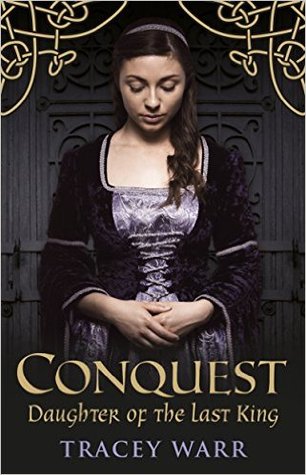
Conquest: Daughter of the Last King by Tracey Warr

One of the things I love about historical fiction is having the opportunity to read about historical figures I previously knew nothing at all about. Nest ferch Rhys, daughter of the last king of Deheubarth in Wales, certainly falls into that category, so when I was offered review copies of the first two books in Tracey Warr’s Conquest trilogy, of course I said yes!

Daughter of the Last King opens in 1093. The twelve-year-old Nest is playing on the beach with her brother when she is captured by Norman invaders who inform her that her father has been killed in battle at Aberhonddu. Taken by her captors to Cardiff Castle, Nest is placed in the household of Sybil de Montgommery, a member of a powerful Norman family who have been granted lands and titles in Wales. Although Nest has every reason to despise the Montgommery family and all they stand for, she quickly finds herself warming towards Sybil, who has been given the job of overseeing her education and training. The plan is that Nest will one day marry Sybil’s brother, Arnulf de Montgommery – but what about her existing betrothal to the Welsh prince, Owain?

Nest’s story takes place during a troubled and eventful time in the histories of England, Wales and Normandy. William the Conqueror has died and his lands have been divided, with his eldest son, Robert Curthose, inheriting Normandy and the throne of England going to a younger son, William Rufus. The two are rivals and the nobility, particularly those with land in both England and Normandy, are forced to choose between them. Sybil’s husband and her Montgommery brothers have each decided where their loyalties lie, but will they have made the right choice?

Although I have read quite a few novels set just before and during the Norman Conquest of 1066, I have read very little about the period following this – the late eleventh and early twelfth centuries. Tracey Warr goes into a lot of detail regarding the politics of the period, the rebellions, the shifting loyalties and betrayals, so that by the time I finished the book I felt that I had learned a lot. There is some overlap with the knowledge I gained from another recent read, Alison Weir’s Queens of the Conquest, but otherwise most of this was new to me. In particular, I found the focus on Welsh history interesting, especially the contrast between the Normans’ relatively quick and successful conquest of England and their attempts to conquer Wales.

Due to my unfamiliarity with so much of the history covered in this novel, I was relieved to see that the author had included some very useful material at the front of the book: genealogies for the Welsh royal families, Anglo-Norman royal family and Montgommerys; maps of eleventh century Wales, England and Normandy; and a plan of Cardiff Castle. I resisted the temptation to look anything up online because, with my complete lack of knowledge of Nest ferch Rhys and her story, I didn’t want to find out too much in advance. There was some suspense involved in waiting to see who – and whether – she would eventually marry, and I didn’t want to spoil the surprise for myself.

The one aspect of the book I’m not sure I liked was the inclusion of journal entries and letters written by a fictitious nun, Sister Benedicta, and her brother, a knight called Haith. These characters do serve a purpose in the novel, providing us with information on events which are unknown to Nest, but personally I found them a bit distracting and would have preferred to focus solely on Nest. She is such an interesting character and, although Tracey Warr points out in her author’s note that there is a limit to how much we know for certain about the real Nest, I did enjoy getting to know her. I’m looking forward to finding out how the story continues in the second part of the trilogy, The Drowned Court.

Thanks to Impress Books for providing a copy of this novel for review.

~

I would like to take this opportunity to wish you all a Merry Christmas! I’ll be back soon with my books of the year, my December Commonplace Book and maybe another review or two before New Year.

Lincoln in the Bardo by George Saunders

It’s February 1862 and an eleven-year-old boy is dying, probably of typhoid fever. After his death, he is interred in a crypt at Oak Hill Cemetery in Georgetown. Unable to accept that he has lost his beloved son, the boy’s father enters the crypt on several occasions to hold the body and grieve. The boy’s name is Willie Lincoln and his father is Abraham, the sixteenth President of the United States.

According to author George Saunders this is a true story, reported in contemporary news accounts at the time, and is what inspired him to write Lincoln in the Bardo, a novel which won the 2017 Man Booker Prize. I don’t always get on well with Booker novels and I wasn’t at all sure whether it was a good idea for me to read this book, but it sounded so unusual and intriguing that when I saw it in the library I couldn’t resist.

The first thing to consider is the meaning of that word in the title – ‘bardo’. In Tibetan Buddhism, bardo is the transitional state between death and rebirth. It is portrayed in Saunders’ novel as a sort of limbo inhabited by the ghosts of people who either aren’t aware that they are dead or won’t admit to it, and for one reason or another have not yet moved on. This is where Willie Lincoln finds himself following his death and is unable to leave because his father is not ready to let go. The other spirits are worried about Willie – they know the bardo is no place for a child to linger – but they also have stories of their own, which slowly begin to unfold as the novel progresses.

The next thing – a very important thing – that I need to mention is the writing style, because Lincoln in the Bardo is not written in conventional prose. Instead, it takes the form of a cacophony of voices, all speaking up, giving their opinions, interrupting each other and completing each other’s sentences. It looks a bit daunting on the page, with short fragments of dialogue accompanied by the speaker’s name, but approaching it as if I were reading a play made it feel easier to follow. I don’t usually listen to audiobooks, but I think this particular novel would be a good one to listen to. Apparently the audio version has 166 narrators!

As well as the conversations taking place in the bardo, there are also some chapters made up of quotations from a selection of primary and secondary sources including letters, memoirs and academic accounts. These provide us with some background information on Abraham Lincoln and the period before and after Willie’s death. The sources looked authentic, but I later discovered that although some of them are real, others are fictional – and there is no easy way to tell which ones are which. This bothered me slightly, but probably won’t bother everyone! What I did like was the way Saunders uses these quotations to illustrate the unreliability of sources and the importance of looking at more than one account of the same event. For example, a chapter describing Lincoln’s appearance gives one source saying that his eyes are “gray-brown”, followed by another stating that they are “bluish-brown” and another simply “blue”.

I would say this was a love it or hate it type of book – except that for me it was a bit of both! There is no doubt that it’s wonderfully creative, imaginative and original, with a lot to admire and enjoy, but my initial feeling that this wasn’t really a book for me proved to be correct. I have never been much of a fan of experimental styles and structures; I find that I get distracted from the story and am unable to become fully absorbed in the way that I prefer. Maybe for that reason, I didn’t find the book as emotional as I would have expected given the subject – although other readers have described it as moving and heartbreaking, so it’s probably just me. I’m glad I read it though, as I would have been curious about it forever otherwise! If you’ve read it too, I would love to hear what you thought.