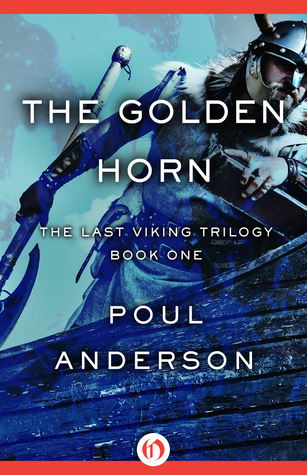
 Poul Anderson (1926-2001) was an American author of fantasy and science fiction, but he also wrote a trilogy of historical novels, known as The Last Viking, which tells the story of Harald Hardrada, who was King of Norway from 1046 to 1066. I have read about Harald before, but only as a minor character or in relation to the Norman Conquest of 1066 and the role he played in trying to claim the throne of England, so I was looking forward to reading The Golden Horn and learning more about his life.
Harald Sigurdharson (the name Hardrada or Hardrede, meaning “hard ruler”, will follow later) is the younger half-brother of Olaf II of Norway. Harald is only fifteen years old when he fights alongside Olaf at the Battle of Stiklastadh (Stiklestad) in an attempt to restore his brother to the Norwegian throne, which has been lost to King Canute of Denmark. Olaf is killed during the battle, his forces are defeated and Harald manages to escape. The Golden Horn, the first book in the trilogy, follows Harald throughout his time in exile as he waits for his chance to come home to Norway and reclaim the throne.
After recovering from being badly wounded at Stiklastadh, Harald flees to Russia with the help of Rognvald Brusason of Orkney. In Kiev, he meets the Grand Prince Yaroslav who makes him a captain in his army. Later, Harald continues south to Constantinople, capital of the Byzantine Empire, where he becomes commander of the Varangian Guard. The next few years are spent on various military campaigns in and around Constantinople and the Mediterranean. During this time Harald amasses great wealth, makes a name for himself as a warrior, and enters into marriage with Princess Ellisif (Elisaveta) of Kiev.
The Golden Horn was not quite what I was expecting: not being very familiar with Harald’s story, I hadn’t realised so much of the novel would be set in Constantinople rather than Scandinavia (although the title should have been a clue; the golden horn was the name of the horn-shaped harbour of Constantinople). I didn’t mind, though, as I loved this setting and enjoyed following the intrigue surrounding the Byzantine Empress Zoe Porphyrogenita, her husband Michael IV, and her sister Theodora. Harald is back in Norway by the end of the novel, so I imagine the next two books in the trilogy will be the ‘Viking’ stories I had expected.
What I liked less were the battle scenes and the focus on Harald’s military career with the Varangian Guard, which seemed to come at the expense of character development and the emotional connections which are so important to me in fiction. I never felt that I got to dig beneath the surface and really get to know Harald – or any of the other characters in the book – and that was disappointing. Still, it was good to have the chance to learn a little bit about Harald’s life, even if I sometimes felt overwhelmed by the sheer quantity of historical facts, which I felt could have been woven more smoothly into the fabric of the story.
The Golden Horn is followed by The Road of the Sea Horse and The Sign of the Raven. All three novels were originally published in 1980. I don’t think I’ll be reading the other two as this book just wasn’t really for me, but I would have no hesitation in recommending the trilogy to readers who are interested in this period and who look for different things in historical fiction than I do.
Thanks to Open Road Integrated Media for providing a review copy via NetGalley.