The Ballad of Jacquotte Delahaye by Briony Cameron

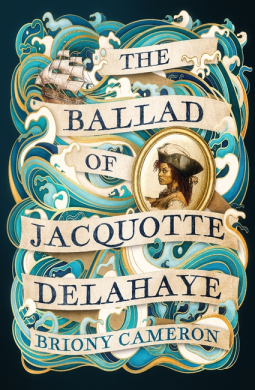
The Ballad of Jacquotte Delahaye is an unusual novel because it’s based on the ‘true story’ of someone who may or may not have actually existed! One of a very small number of 17th century female pirates, Jacquotte Delahaye is not mentioned in any contemporary sources and appears in writing, possibly for the first time, in the 1940s in stories by Léon Treich, a French fiction writer. However, she has become part of pirate folklore and although her existence hasn’t been proved, it hasn’t been disproved either. In this new novel, Briony Cameron has taken the few ‘facts’ about Jacquotte that have found their way into the legends – such as her place of birth and the colour of her hair (red, leading to the nickname Back from the Dead Red) – and imagined a story around them.

At the beginning of the book, twenty-year-old Jacquotte is living in the town of Yáquimo, Santo Domingo, in 1655. As the daughter of a Frenchman exiled to the Caribbean for treason, all Jacquotte knows about her mother is that she was a free black woman who died after giving birth to her younger brother. When her father is implicated in another treasonous plot, Jacquotte’s world falls apart and she is forced to flee the island. Her life of piracy begins when she is captured by the brutal Captain Blackhand and finds herself an indentured servant aboard his ship, but eventually Jacquotte will become a pirate captain in her own right, with her own ship and crew to command.

There’s also a romantic element to the novel, with Jacquotte falling in love with Teresa, wife of the Governor of Yáquimo, but this was one of my least favourite aspects of the book. They seemed to rush into things very quickly, with no time for the reader to see their feelings for each other developing and I felt that the relationship lacked emotional depth. In fact, apart from Jacquotte herself, I thought all of the characters in the book lacked depth – the good characters were very good and the bad ones were very bad, with little in between. I would describe this as much more of a plot-driven book. Although it takes a while to get started, once Jacquotte is at sea there’s lots of action, with sea battles, fight scenes and all the swashbuckling adventure you would expect from a pirate novel.

Sadly, despite the fascinating protagonist, I wasn’t very impressed with this book. I did enjoy the first section, which describes Jacquotte’s life in Yáquimo and the events that lead to her becoming a pirate, but as I read on I felt I was reading the author’s fantasy of how she would have liked 17th century society to have been, rather than how it actually was. I don’t think many people in the 1650s had such progressive ideas on race, gender and sexuality, however nice it is to imagine that they did! If you’re not too bothered about historical accuracy and just want to read an entertaining story, then you’ll probably enjoy The Ballad of Jacquotte Delahaye, but it wasn’t really for me. On a more positive note, I liked the descriptions of the various ports Jacquotte and her crew visit as they sail around Hispaniola, Jamaica and Tortuga, which is the closest I’ll get to visiting the Caribbean this summer!

Thanks to Piatkus for providing a copy of this book for review via NetGalley.

Book 20/50 for the Historical Fiction Reading Challenge 2024

This is book 2/20 of my 20 Books of Summer 2024.

The Noh Mask Murder by Akimitsu Takagi

Translated by Jesse Kirkwood

My 20 Books of Summer reading is off to a good start with this 1949 Japanese locked room mystery, now available from Pushkin Press in a new English translation. Thanks to Pushkin, I’ve been able to try several Japanese classic crime authors over the last few years, including Seishi Yokomizo, Yukito Ayatsuji and Soji Shimada. The Noh Mask Murder is the first book I’ve read by Akimitsu Takagi and I thoroughly enjoyed it.

The novel opens with a discussion between Koichi Yanagi, a chemist who has recently returned to Japan after serving in Burma during the war, and his old school friend, Akimitsu Takagi (yes, the author himself, who appears as a character in his own novel – just like Anthony Horowitz in his Horowitz and Hawthorne series). Akimitsu explains to Koichi that he wants to write a new kind of detective novel, one based on a mystery he has solved for himself in real life:

‘I’d tackle some fiendish real-life mystery, then set down precisely how I solved it in the form of a novel. My readers would be provided with the exact same evidence as the author. They’d be able to follow the detective-narrator’s train of thought, assess the appropriateness of his actions – and even come up with their own alternatives. But I don’t imagine an opportunity like that will ever present itself…’

His opportunity comes sooner than he had imagined when Koichi stumbles upon a mystery at the Chizui family mansion, where he has been staying since returning from the war. The head of the household, Professor Chizui, who was once a friend of Koichi’s, died ten years earlier and the house is now inhabited by his two children and the family of his younger brother, Tajiro. The first sign that something is wrong within the Chizui mansion comes when an eerie figure wearing a sinister Noh mask is seen at one of the windows. Soon after this, Tajiro is found dead inside a locked room, with a smell of jasmine in the air and a Noh mask lying on the floor beside him. Akimitsu Takagi joins Koichi at the house to investigate the murder, but when they discover that someone has called the undertaker to order three coffins, it seems that there’s going to be more than just one murder to investigate!

The mystery is a fascinating one and although some time is spent discussing the mechanisms of how the locked room murder took place, the story never becomes too bogged down by the puzzle aspect; the focus is on the characters, their relationships and their motives. I did find the structure slightly confusing at times as we know we’re reading a book within a book written by Akimitsu Takagi (as both character and author), but within that there’s a journal written by Koichi and a long letter written by Hiroyuki Ishikari, the public prosecutor, so the narrative is sometimes three layers deep. There are some clever twists towards the end, however, which might not have worked if it had been structured differently.

Apart from the mystery, I found it interesting to learn about the different types of mask used in Japanese theatre and how although the Noh mask, which represents a demon, cannot change expression the actors can still use it to show various emotions by tilting the mask up and down and by the clever use of lighting. With the story being set in the post-war period, it’s also interesting to hear the characters reflect on the irony of being so concerned with the death of one person after living through a war in which millions died. If you kill a man in peacetime you’re considered a murderer, says Tajiro’s son, Rintaro, but if you kill a man on the battlefield you’re given a medal.

I really enjoyed The Noh Mask Murder, then, but be warned – in the prologue, where Takagi is discussing his plans for a detective novel, he casually spoils the solution of Agatha Christie’s The Murder of Roger Ackroyd. Not a problem for me as I’ve already read it, but I wish authors wouldn’t do that!

Thanks to Pushkin Vertigo for providing a copy of this book for review via NetGalley.

This is book 1/20 of my 20 Books of Summer 2024.
Spitting Gold by Carmella Lowkis

In Charles Perrault’s fairy tale about two sisters, Diamonds and Toads, a fairy rewards the good sister with the ability to spit gold and punishes the bad sister with the curse of spitting toads. This is the premise at the heart of Carmella Lowkis’ new novel, Spitting Gold, a tale of two very different sisters living in 19th century Paris.

It’s 1866 and Baroness Sylvie Devereux has settled into a respectable married life, but a visit from her younger sister, Charlotte Mothe, threatens to ruin both her marriage and her reputation. For several years, Sylvie and Charlotte had worked together as spiritualists, conning grieving victims out of large sums of money, but Sylvie has promised her husband that those days are behind her and her sister is no longer part of her life. Now, though, Charlotte is begging Sylvie to join her for one last job and Sylvie finds it impossible to refuse, knowing that Charlotte needs the money to pay their father’s medical bills.

Several members of the wealthy de Jacquinot family believe they are being haunted by the spirit of a great-aunt, who was brutally murdered during the French Revolution, leaving behind a hidden treasure. The Mothe sisters agree to help lay the ghost to rest and begin to use every trick and deception at their disposal to convince the family that they are making contact with the spirit. Everything seems to be going well, until the ghost appears to start targeting the sisters themselves. Is the de Jacquinot house really haunted or is there another explanation for what is happening?

There seems to be a current trend for historical novels about mediums and séances; I can think of several I’ve read just in the last year or so, including Lucy Barker’s The Other Side of Mrs Wood and Ambrose Parry’s Voices of the Dead. What makes this one different is the structure and the idea of using two sisters to give alternate views of the same story – the first half of the book is narrated by Sylvie and the second half by Charlotte. I’m not sure how well this worked for me; it was interesting to see things from two such different perspectives, but by the time Charlotte’s narrative began I had become so absorbed in Sylvie’s story I struggled to adjust to a change of narrator.

Apart from the references to the French Revolution, I felt that the book lacked the strong sense of time and place I prefer and at times I even forgot that I was reading a story set in 19th century Paris and not Victorian London. I did love the good sister/bad sister theme, though – while at first it seems obvious that Sylvie is the good one and Charlotte the bad, as the novel continues we learn that things are not that simple and that we shouldn’t rely on just one point of view to give us the full picture. As a debut novel it was quite entertaining, with some interesting twists; I’m not sure whether I’ll read more books by Carmella Lowkis, but I could be tempted!

Thanks to Doubleday for providing a copy of this book for review via NetGalley.

Book 19/50 for the Historical Fiction Reading Challenge 2024

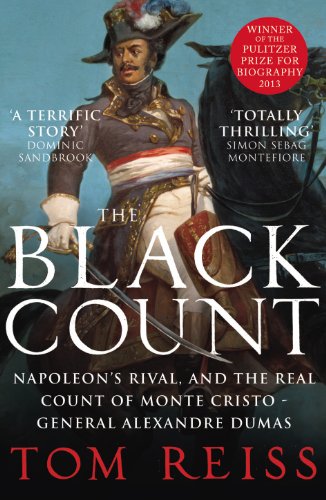
The Black Count by Tom Reiss

My second non-fiction review this month, The Black Count is a biography of General Thomas-Alexandre Dumas, father of the French author Alexandre Dumas. I’ve always loved Dumas’ novels (he’s most famous for The Three Musketeers and The Count of Monte Cristo, one of my all-time favourite books), so The Black Count appealed to me as soon as I heard about it on its publication in 2012. I’ve no idea why it has taken me so long to actually pick it up and read it!

Thomas-Alexandre Dumas, usually referred to in the book as Alex, was born in 1762 in the French colony of Saint-Domingue (now Haiti) in the Caribbean. He was the son of a French aristocrat, the Marquis Alexandre Antoine Davy de la Pailleterie, and a freed slave woman, Marie-Cesette Dumas. After the death of his mother, the young Alex, along with his three siblings, was temporarily sold into slavery by his father in order to pay their passage back to France. Eventually the Marquis bought Alex back (but not the other three children, who remained in slavery and are lost to history) and took him home to France where he was educated in fencing, horse riding and all the other skills befitting the son of a nobleman.

When the Marquis remarried, however, Alex was left to fend for himself and he joined the French military, taking his mother’s surname of Dumas. Playing an important role in the French Revolutionary Wars, he quickly rose through the ranks and by the age of thirty-two was General-in-Chief of the French Army of the Alps, commanding 53,000 men. Later, on a campaign to Egypt, Alex clashed with another powerful general, Napoleon Bonaparte, and from there his career took a downward spiral. Today, Napoleon remains one of the most well known historical figures of all time, but Alex Dumas has been largely forgotten. The Black Count is an attempt to give Dumas the attention he deserves and make his story known to a modern audience.

General Alex Dumas was clearly a fascinating man, yet I have to be completely honest and say that I was slightly disappointed by this book. It was described as a thrilling real life adventure story, as exciting as one of Dumas’ novels, which I think raised my expectations too high. For me, there was too much focus on military history, with details of campaigns, battles and tactics, along with lots of general information on the French Revolution, with Alex Dumas himself being pushed into the background for large sections of the book. Of course, other readers will find this much more interesting than I did, but military life is never going to be one of my personal favourite subjects to read about and I have read about the Revolution many times before. I did quite enjoy the chapter about the Army of the Alps, though, where Alex and his men scaled the icy cliffs of Mont Cenis to capture a mountain pass; as Reiss points out, the cold must have come as a shock to a man who grew up in the Caribbean!

All of Alex Dumas’ achievements are very impressive, but most impressive of all is the fact that he was able to rise as high as he did as a person of colour in the 18th century. In some ways it was the perfect time and place for him to succeed because it was a surprisingly tolerant period in French history; a century later racial prejudices and the removal of rights for black people would have prevented him from reaching the same heights. At the time of Alex’s arrival in France, however, a decree known as the Code Noir was in place which gave freed slaves the same rights and privileges as white people. Add to that Alex’s renowned strength, courage and leadership skills and it’s easy to see how he was able to accomplish so much and even rival Napoleon for a while.

Tom Reiss occasionally tells us about his visits to museums and archives where he saw documents and paintings which informed his writing of the book. He also draws on a large number of other sources, which are listed at the end in a bibliography, the most notable being the writings of Alexandre Dumas (the author), who wrote about his father in his memoirs and several of his other non-fiction books. Reiss also suggests that some famous scenes from Dumas’ novels were based on his father’s adventures – for example, in 1799 Alex was captured and thrown into a dungeon in the Kingdom of Naples for two years, something which surely inspired the imprisonment of Edmond Dantès in The Count of Monte Cristo.

Although I expected to love The Black Count more than I did, I do feel that I’ve learned a lot from it, both about France in the second half of the 18th century and about Alex Dumas himself. He was an amazing man and deserves to be better known; I’m sure this book, in the twelve years since it was published, will have gone some way towards achieving that.

Hungry Ghosts by Kevin Jared Hosein

This is a book I would probably never have chosen to read if it hadn’t been nominated for this year’s Walter Scott Prize, but although I didn’t love it, for reasons I’ll explain below, it’s a book I’m glad I’ve read. For a start, it’s set in Trinidad and I’ve only ever read one other novel set there – Fortune by Amanda Smyth, which was also shortlisted for the same prize a few years ago – and it was good to have the opportunity to learn more about the history and culture of that country.

The story takes place in the 1940s in and around Bell Village in central Trinidad. Thirteen-year-old Krishna Saroop lives with his parents in a sugarcane estate barrack, a ramshackle building with a leaking roof that is home to four other families. On a hill above the village is the Changoor farm where Dalton Changoor and his wife Marlee live in comparative luxury and where Krishna’s father, Hansraj – known as Hans – works on the land. When Dalton disappears without explanation one day, Marlee feels uneasy about being alone and asks Hans to stay on the estate overnight as a night watchman – and Hans agrees, grateful for the extra money she offers him in return. But as the days go by with no sign of Dalton coming home, Hans finds himself becoming increasingly attracted to Marlee and spending less and less time with his own wife and son.

Kevin Jared Hosein uses the disappearance of Dalton Changoor to explore the stories of Hans and Marlee and also Krishna and his mother Shweta, left behind in their squalid home while Hans spends his nights on the farm. Shweta is dreaming of a better life and at first is happy for Hans to take Marlee’s money in the hope that they can use it to buy a house of their own, but she changes her mind as she discovers that her husband is slipping away from her. However, Marlee is only one part of the problem; the relationship between Shweta and Hans has already been strained by the death of their first child, the ‘hungry ghost’ of the title.

If you think this sounds like a bleak novel, that’s because it is. I found it relentlessly miserable. Everyone has had an unhappy childhood, an unhappy marriage or both. We see people being abused, assaulted, blackmailed, murdered…even the animals don’t escape unscathed; there are some very graphic descriptions of the death of Dalton Changoor’s abandoned dogs, so be warned. I don’t usually have a problem reading books that tackle uncomfortable or challenging subjects, but I do like there to be at least a glimmer of hope and optimism and this particular book didn’t seem to have any. I don’t think there was a single character in the book that I actually liked.

Although I struggled to cope with the misery and sadness, obviously other people have enjoyed this book much more than I did and I would agree that it’s beautifully written. Kevin Jared Hosein was born in Trinidad and brings his island to life through his descriptions of the landscape, the birds and animals, the food, clothing and housing. He also captures the language and the speech patterns of the Trinidadian people and through the story of the Saroop family, who are of Indian descent, he explores the differences between the Hindu and Christian communities on the island. I can understand why it was shortlisted for the Walter Scott Prize and the fact that I didn’t like it probably means it’s going to win!

Book 18/50 for the Historical Fiction Reading Challenge 2024

Earth by John Boyne

Earth is the second in John Boyne’s new quartet of novellas named after the four elements. I enjoyed the first book, Water, so I was looking forward to this one and it didn’t disappoint. Although the two books (and presumably Fire and Air as well) are loosely linked, they are completely separate stories and you don’t need to read them in order. If you have already read Water, you may remember Evan Keogh, the teenage boy we last saw leaving his home on a small Irish island in search of a new life in England. Earth is Evan’s story.

Evan has had a talent for football from an early age, but his true passion is for painting and on his arrival in London he hopes to pursue a career as an artist. After a series of rejections he is forced to accept that he’s unlikely to achieve his dream and with his money running out he reluctantly decides that he will have to use his football skills after all. The book begins with Evan, now twenty-two and a famous footballer, preparing to stand trial for sexual assault. Robbie, his friend and teammate, is accused of rape and Evan has been charged as an accessory for filming the incident on his phone.

For such a short book (under 200 pages), Boyne manages to create a multi-layered story covering a range of important – and often uncomfortable – topics. Much of Evan’s story is told in flashbacks as he remembers his childhood, his strained relationship with his father and his growing awareness of his sexuality (Evan is gay, which can make life difficult both in his small Irish community and in the world of professional football). When he arrives in London he is taken advantage of by an older man who pushes him into work as a male escort, which has disastrous results for Evan. This is what leads to Evan’s decision to become a footballer, despite his dislike of the sport – and again I thought it was interesting to see how Boyne explores the idea of someone achieving huge success in a profession that they don’t enjoy and don’t respect, as well as the various ways in which young men cope with suddenly attaining a level of fame that they’re not really prepared for.

The trial is also a main focus of the book and I found it increasingly frustrating and infuriating to see how the victim was treated in court. I hoped Evan would do the right thing and not just try to protect his friend, but Boyne keeps us doubting him throughout the novel and I’m not going to tell you whether I got the outcome I wanted. Obviously there have been many real life cases of women making allegations of sexual assault against famous people and the courtroom scenes are all the more disturbing because you can easily imagine them happening.

Like ‘water’ in the previous book, Boyne works the element of earth into the story in several different ways, from the soil of Evan’s island home to the ground beneath his feet that is so important to his sport. Of the two, I think I preferred Water but both are powerful books and I’m now looking forward to Fire, coming in November of this year.

Thanks to Doubleday for providing a copy of this book for review via NetGalley.

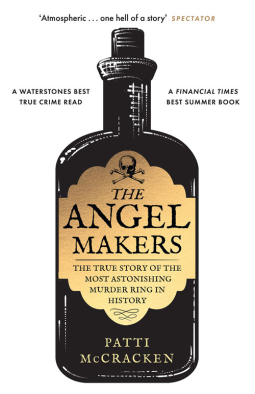
The Angel Makers by Patti McCracken

I don’t read a lot of true crime, but the title, cover and blurb of this one all intrigued me. Subtitled The True Story of the Most Astonishing Murder Ring in History, the book narrates in dramatic detail the tale of a group of serial killers in a Hungarian village who murdered over a hundred men during a fifteen year period. The killers were all women and their ringleader was a midwife known as Auntie Suzy.

The village of Nagyrév, a farming community in central Hungary, may seem an unlikely centre of crime, but actually it’s easy to understand why the events described in the book happened where and when they did. The murders took place between 1914 and 1929, a time when Hungary was in a state of political turmoil and preoccupied with war and its aftermath. The government didn’t have the money or resources to look into reports of suspicious deaths in a small rural village. Not only did Nagyrév have no police presence, but also no doctor, meaning that Auntie Suzy, with her limited medical knowledge, was the person to whom everyone turned for help with their own and their family members’ health problems. This put Suzy in a position of power, made stronger by the fact that she was the one who dictated to the clerk the causes of death to be put on the death certificates.

Auntie Suzy’s method was poisoning; she would soak sheets of flypaper in water to leave a residue of arsenic which could then be fed to the victim in small doses until they eventually became ill and died. Women came to buy bottles of Suzy’s potion for all sorts of reasons: maybe they had an abusive husband, an unwanted child they couldn’t feed or an elderly father they’d become tired of and wanted dead. Suzy herself would sometimes have reasons for wanting the murder to take place – if a wealthy woman was widowed, for example, she would then be free to marry Suzy’s own son, or perhaps a house would become vacant that Suzy could take for herself.

In The Angel Makers, Patti McCracken tells the story of Auntie Suzy and the other female poisoners of Nagyrév in a style that is as easy to read as fiction. In fact, the whole book feels much more like a novel than a work of non-fiction; I liked this as it made it easy to get to know the characters and follow what was happening, but it wasn’t what I’d expected and it may not appeal to readers who prefer their non-fiction to be more formal and academic. There’s a section of notes at the end of the book and a bibliography, but apart from occasional extracts from newspaper articles or other documents, McCracken doesn’t interrupt the flow of the story to provide any commentary of her own. She has also anglicised the names of most of the people in the book – Auntie Suzy’s real name was Zsuzsanna Fazekas.

One thing that struck me about this case was how easily the crimes could have been stopped and the culprits brought to justice, yet they were allowed to continue for many years because the authorities either didn’t have the resources to investigate or just didn’t seem interested. The poisonings were an open secret in Nagyrév and Suzy and the other women grew more and more confident over time, hardly bothering to cover up their actions. You can feel sorry for some of the women, pushed into arranged marriages at a time when divorce was not an option, but others were committing murder for cruel or petty reasons. Suzy, as the ringleader, was particularly complacent and unrepentant about the deaths she was causing and her behaviour is quite chilling to read about. However, McCracken seemed to have an obsession with Suzy’s weight; the constant descriptions of her chubby hands, fat feet and waddling walk quickly became very repetitive and unnecessary.

The Angel Makers is a fascinating story and I would probably recommend it to people who have enjoyed Kate Summerscale’s books such as The Suspicions of Mr Whicher, although the informal style won’t be to everyone’s taste. Despite some flaws I found it entertaining and informative and feel that I’ve not only gained some knowledge of a very unusual ring of criminals but also some insights into life in Hungary between the wars and the various elements that enabled crimes like these to take place.

Thanks to Mudlark for providing a copy of this book for review via NetGalley.