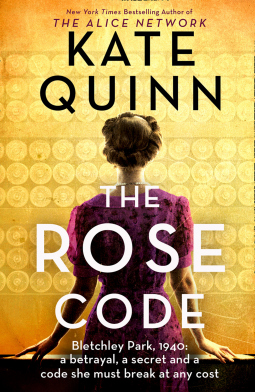
The Rose Code by Kate Quinn

I loved this! I’ve never read Kate Quinn before, although she has been recommended to me several times, so I’m pleased that my first experience of her work has been such a good one. The Rose Code wasn’t a perfect book, but the few flaws that I noted were quickly outweighed by the gripping plot, strong characters and interesting historical setting.

The story takes place in and around Bletchley Park, the English country house which became the home of Britain’s World War II codebreakers, and follows three of the young women who work there. Two of them, Osla Kendall and Mab Churt, meet on the train in 1940 as they travel to Bletchley Park, unsure as to what their new jobs will involve but determined to do their best to help the war effort. Osla, a beautiful, wealthy young socialite, is desperate to prove that she is more than just a ‘silly debutante’; the outspoken and fiercely independent Mab is a working class girl from the East End of London who, having escaped from a life of poverty, wants to make a better future for herself. At Bletchley Park, both will find the opportunities they need to change their lives – and so does a third young woman, Beth Finch. Beth has grown up under the thumb of her domineering mother and looks set to remain a spinster all her life, but when Osla and Mab notice her special gift for crosswords and puzzles, they encourage her to overcome her shyness and join them at Bletchley.

Although most of the novel is set during the war years, we occasionally jump forward in time to 1947. On the eve of the royal wedding between Princess Elizabeth and Prince Philip, two of the three Bletchley Park women have received a summons for help from the third, who has been confined to an asylum. However, the friendship between the three of them broke down before the war ended and the two women who are free aren’t sure if they really want to help the one who is imprisoned. What happened to destroy their friendship? Was there really a traitor within Bletchley Park? And will the mysterious Rose Code ever be solved?

The Rose Code is a long novel, but was quicker to read than I’d expected because I became so engrossed in the stories of Osla, Mab and Beth. Their work at Bletchley Park is fascinating to read about, particularly Beth’s as a cryptanalyst, working with the legendary Dilly Knox. Although it all sounds very complicated – and I’m pleased the Allies didn’t have to rely on me to break the Enigma codes – Kate Quinn does a good job of explaining how the various machines were used and what the different decryption methods involved. She also explores the psychological impact of carrying out such highly confidential work; all of the codebreakers sign up to the Official Secrets Act and are banned from discussing their work with friends and family or even with people from different departments within Bletchley Park itself. This raises the interesting question of whether it’s ever acceptable to break your oath of secrecy – and if not, what sort of strain will that put on your relationships with other people?

Several real historical figures appear in The Rose Code. I have already mentioned Dilly Knox, but we also briefly meet Alan Turing, Winston Churchill…and Prince Philip, who is romantically involved with Osla before his marriage to Princess Elizabeth (the future Queen). This isn’t as far-fetched as it might seem, as Kate Quinn apparently based the character of Osla Kendall on the real life Osla Benning, who really was a Canadian debutante who worked at Bletchley Park and was Prince Philip’s girlfriend – but I don’t personally feel comfortable reading fictional portrayals of people who are still alive and this whole storyline felt unnecessary to me. I couldn’t imagine the real Philip saying some of the things he says in the book either; in fact, although I did appreciate the author’s attempts to use the slang of the time, the language in general didn’t always feel quite right to me – and there are a few annoying references to England when it should be Britain.

Still, even the Philip storyline didn’t stop me from enjoying this book because the rest of it was so interesting and compelling. There was even one scene that made me cry and I think that’s always a sign that the author has done something right! I’m sure I will be reading more books by Kate Quinn.

Thanks to HarperCollins UK for providing a copy of this book for review via NetGalley
Book 13/50 read for the 2021 Historical Fiction Reading Challenge.
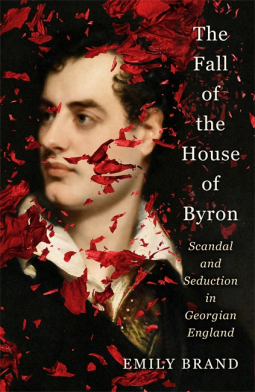
The Fall of the House of Byron by Emily Brand

The poet Lord Byron was famously described by Lady Caroline Lamb as ‘mad, bad and dangerous to know’. This recent biography by Emily Brand shows that he is not the only member of his family to whom this description could apply! Subtitled Scandal and Seduction in Georgian England, the book takes the Byron ancestral home, Newstead Abbey in Nottinghamshire, as its starting point and shows how this once grand house falls into ruin over the years, mirroring the downfall of the Byron family.

George Gordon Byron, 6th Baron Byron, the Romantic poet, is obviously the best known Byron; a lot has already been written about his life and work, so he is not really the focus of this book. He does appear from time to time, but the majority of the book is devoted to the stories of his parents and grandparents, great-aunts, great-uncles and their children. As was common in that era, the same names tended to be passed down from father to son and mother to daughter, so there are lots of Johns, Williams and Georges, Isabellas, Elizabeths and Sophias. The family tree at the beginning of the book is useful, but it’s still easy to get confused! However, some of the family members are given more attention than others and these include:

* William Byron, 5th Baron Byron – Known as ‘the Wicked Lord’, William Byron is rumoured to have tried to abduct an actress at the same time as negotiating his marriage to an heiress. He is also tried for murder after killing a friend in a duel. In later life (after his son elopes with his own cousin), William finds himself in financial difficulties, selling off parts of the family estates and unable to keep Newstead Abbey in good repair.

* Vice Admiral John Byron – Nicknamed ‘Foul-Weather Jack’, John Byron is a Royal Navy officer and explorer. The book describes his adventures at sea, including a shipwreck off the coast of Chile, his role in claiming the Falkland Islands for Britain, and the battles he fought in during the American Revolution. Towards the end of a career which had once seemed so impressive, John returns home under the shadow of failure and suffering from ill health.

* Isabella Howard, Countess of Carlisle – William and John’s sister marries the Earl of Carlisle and lives with him at his estate of Castle Howard in Yorkshire until she is widowed in 1758. Her second marriage, to a much younger man, makes her the subject of gossip, and after separating from him several years later, she travels Europe in the company of a German soldier, writing poetry, throwing parties and falling into debt.

* Captain John Byron – Later known as ‘Mad Jack Byron’, he is Foul-Weather Jack’s son and George Gordon’s father. In 1785, he marries a Scottish heiress, Catherine Gordon, for her money and proceeds to waste her fortune on ‘gambling, pretty women, thoughtless spending on clothes, alcohol and horses’.

Although all of these people were individually fascinating to read about (I was most interested in Isabella, an independent and unconventional woman who is often unfairly judged by the standards of the time), I found the structure of the book quite disjointed and difficult to follow at times. In the first half of the book, each of the main characters has a chapter devoted mainly to them, but by the second half their stories overlap so much that I was struggling to keep them all straight in my mind. Having said that, I’m not sure how else the book could have been structured as the actions of one family member obviously have an impact on the lives of all of the others and it would have probably been impossible to continue writing about each of them separately.

As well as exploring the downfall of the Byron family, the book also offers lots of interesting insights into Georgian life; I particularly enjoyed the descriptions of the fashionable society of Bath and the friendship between Sophia Byron (Mad Jack’s mother) and the authors Fanny Burney and Hester Thrale. Emily Brand has obviously carried out a huge amount of research for this book; I can’t comment on the accuracy as I’ve never read any other non-fiction about the Byrons, but she does quote from a large number of primary sources and everything is clearly referenced at the end of the book. Although at times I found it all slightly overwhelming and felt that I was being given so much information I couldn’t digest it all properly, I still very much enjoyed reading this book and getting to know the members of this scandalous family!

Mini-reviews: Ashes; A Net for Small Fishes; The Lost Diary of Venice

Although I usually devote an entire post on my blog to every book I read, sometimes I find that I have very little to say. That’s not always necessarily a reflection on the quality of the book or how much I enjoyed it, but more an inability to put into words my thoughts about a particular book and an awareness that if I don’t just write something soon I will never get round to reviewing it at all! Three of my recent reads fall into that category, so here are a few paragraphs about each of them:

The first is Ashes by Christopher de Vinck, a novel set in Belgium during World War II. Simone Lyon, the daughter of a major general in the Belgian army, meets Hava Daniels while volunteering with the Red Cross in 1939 and despite their different backgrounds – Hava’s family are Jews from Poland – the two become close friends. In those innocent days at the beginning of the war, the girls believe their country will remain safe and neutral, untouched by the horrors starting to sweep across the rest of Europe. Less than a year later, Brussels is under German occupation and Hava and Simone become caught up in everything they’d hoped to avoid.

I found this a moving portrayal of friendship and loyalty, although I struggled to believe that Simone and Hava were really supposed to be eighteen years old as they felt a lot younger than that to me – in fact, I thought the whole story and the way in which it was written felt more like YA fiction than adult. Not a problem, but not what I’d expected! It was interesting to read about the Holocaust from a Belgian perspective and the quotes from politicians, news articles and Nazi propaganda which begin every chapter help to put everything into historical context, but the story was not quite as harrowing as books on this topic usually are. Maybe that was due to the pacing, as a lot more time is spent on building up Hava and Simone’s friendship than on describing the events that follow the Nazi invasion. Overall, this was a worthwhile read, but just didn’t have the sort of depth I prefer in a novel.

A Net for Small Fishes by Lucy Jago is set much earlier, in Jacobean England, and tells the story of the real life Thomas Overbury Scandal from the perspective of Anne Turner, one of the people involved in the crime. Anne, the wife of a London physician, is also a businesswoman in her own right, holding the patent for yellow starch for collars and ruffs. Early in the novel, she becomes dresser and companion to Frances Howard, the young Countess of Essex – and when Frances falls in love with Robert Carr, the king’s favourite, it is Anne to whom she turns for help. Frances wants to marry Robert, but his friend Sir Thomas Overbury stands in their way; if only she and Anne could somehow get rid of him!

I think I would probably have enjoyed this book more if I hadn’t already read several other versions of the Overbury story, most recently EC Fremantle’s The Poison Bed and Rafael Sabatini’s The Minion. Being familiar with the story in advance took away the suspense and what was left wasn’t really enough to hold my attention. The choice of Anne as narrator, while interesting from the point of view of showing us how an ordinary citizen of the time might have viewed royalty and courtiers, took us further from the action, often leaving a sense that all the excitement was happening elsewhere. I also found Anne’s habit of referring to Frances as ‘Frankie’ very irritating as I didn’t think that name was in common use in the early 17th century. This book just wasn’t for me, but most of the other reviews I’ve seen are much more positive than mine! I do like the title, which is a reference to ‘small fishes’ being caught in the net of justice while the larger fish swim away.

The Lost Diary of Venice by Margaux DeRoux is a dual timeline novel; the present day narrative follows Rose, an expert in book restoration from Connecticut, and the historical one is set in Renaissance Italy. The connection between the two comes when William, an artist, brings a 16th century manuscript into Rose’s bookshop. Rose quickly discovers that the document is a palimpsest, where one set of words has been written over another which has been scraped away. On the surface it is a treatise on art by the great Italian painter Giovanni Lomazzo, but it’s the hidden diary entries and sketches underneath that really intrigue Rose and William.

It’s often the case that when a novel is set in two time periods, I like one much more than the other; with this novel, however, I didn’t find either of them very compelling. The book is well written, with some beautiful descriptions of Venice in the historical sections, but I didn’t feel any emotional connection to any of the characters. Rose’s relationship with the married William didn’t interest me and I was unmoved by Giovanni’s romance with the courtesan Chiara too (although I did have some sympathy for Giovanni as he discovered that he was losing his sight, a terrible thing for an artist to have to come to terms with). I also loved the glimpses we are given of the political situation in Venice at that time, the conflict between the Venetians and the Ottoman Empire, and the events taking place in Cyprus ahead of the Battle of Lepanto. I wished more time had been spent on all of this, as every time I started to become gripped by what was happening, the chapter ended and we switched back to the modern day story. This is not a book I can say I particularly enjoyed, but I’m pleased I was at least able to learn something from it.

Have you read any of these? If so, let me know what you thought.

Book 10, 11 and 12/50 read for the 2021 Historical Fiction Reading Challenge.
The Soul Thief by Cecelia Holland

Cecelia Holland is an American historical novelist who has been writing since the 1960s and whose books cover a huge range of different time periods and geographical settings. To give an example of the variety of her work, I have previously read three of her novels and one was set in Borgia-ruled Rome, one in medieval England and one in 16th century Hungary! The Soul Thief, the first in a six-volume series published between 2002 and 2010, takes us back to Ireland in the 10th century, beginning on the eve of a Viking raid…

Corban Loosestrife has argued with his father and, having been threatened with banishment, has gone off to sleep outdoors in the hope that he will be forgiven the next day. However, when the sun rises in the morning and he heads back home, he finds the family farm burning to the ground, his parents’ dead bodies amongst the ruins and no sign at all of his twin sister, Mav. Making his way to the Viking settlement at Dubh Linn (Dublin), Corban learns that Mav may have been transported across the sea to Jorvik with the other healthy young women to be sold as slaves. Determined to do whatever is necessary to bring her home, Corban sets out on his sister’s trail – a trail that will take him first to Jorvik and then further afield to the Danish trading post of Hedeby.

I know from my earlier experience of Cecelia Holland’s novels that her ‘heroes’ are usually not particularly heroic – and in fact are often very unlikeable. Corban is easier to like than, for example, János Rákossy or Fulk, Earl of Stafford, but he is also another imperfect character. He makes mistakes, he lacks courage at times, and he is often easily distracted from his quest. There’s a lot of scope for character development, yet I felt that there was very little in this book; maybe as this is only the first of six novels we will see Corban grow and change as a person later in the series, although at this point I’m not sure whether I will be continuing. I enjoyed parts of Corban’s story, but this novel had neither the depth nor the level of emotional engagement I prefer and I don’t think I really liked it enough to want to commit to another five books.

I did find Mav’s story intriguing: after being captured during the Viking raid, she falls into the hands of the mysterious Lady of Hedeby, a sort of witch or sorceress who decides to use Mav’s psychic connection with her twin Corban for her own purposes. With this storyline, the novel begins to cross from straight historical fiction into the realms of historical fantasy – although the supernatural elements are really quite subtle and not fully explained (again, maybe this is developed further later in the series). Mav and the Lady interested me much more than Corban did and I would have preferred to have had more of the novel devoted to them.

My knowledge of this period of history is very limited, so I can’t really comment on the historical accuracy of anything that is described in the book. The focus is mainly on the fictional characters, but Corban does cross paths with some of the historical figures of the time, particularly in Jorvik (York), where he is drawn into the court of the Viking king, Eric Bloodaxe, and his wife, Gunnhild. Meanwhile, the Lady of Hedeby plots and schemes with another king, Harald Bluetooth (yes, the one Bluetooth technology is named after). I didn’t feel that I learned a lot about these historical men and women, although they have important roles in the plot, but as this is very much Corban’s story – the series is called The Life and Times of Corban Loosestrife – it’s understandable that he is given most of the attention.

As I’ve said, I’m probably not going to read the second Corban book, but I will continue to read Cecelia Holland’s standalone novels. So far I have read Rákossy, Hammer for Princes and City of God, and am looking forward to reading more.

Book 9/50 read for the Historical Fiction Reading Challenge.
Daughters of Night by Laura Shepherd-Robinson

It’s 1782 and Caroline Corsham – known to her friends as Caro – is waiting for her husband, Captain Harry Corsham, to return to London from France where he has been sent on diplomatic work. Visiting the Vauxhall Pleasure Gardens one evening, Caro is horrified when she comes across the body of her friend, Lady Lucia, an Italian noblewoman, who has been stabbed and left to die. The London authorities seem to have no intention of investigating the murder, which confuses Caro until she discovers that her friend was not who she claimed to be: she was actually a prostitute known as Lucy Loveless. As the police are no longer interested, Caro knows that she will have to avenge Lucy’s death herself – so with the help of thief taker Peregrine Child, she sets out to begin an investigation of her own.

Daughters of Night is a sequel to Laura Shepherd-Robinson’s previous novel, Blood & Sugar, but both books work as self-contained mysteries and I don’t think it will matter if you read them out of order. Those of you who have read Blood & Sugar will remember that it follows Harry Corsham as he investigates the death of an abolitionist friend and uncovers the horrors of the slave trade. Caro was only a minor character in that book, but now, with Harry absent in France, this is Caro’s turn to take centre stage with her own mystery to solve – and again, there is a very dark topic at the heart of the story, in this case prostitution and the treatment of women in 18th century society.

I mentioned in my review of the first book that I found the characters too thinly drawn and not memorable enough, but that was not a problem at all with this second novel. Daughters of Night is written partly from Caro’s perspective and partly from Peregrine Child’s; I liked them both and thought they complemented each other very well. Child’s previous experience as a magistrate means he knows what sort of questions to ask and what clues to look out for, and while he has some personal problems of his own he is a decent and honourable man. Caro is new to crime solving but there are things she understands that Child does not and together they make a perfect team. I certainly had no idea who the murderer was; there were several suspects who all seemed equally likely to me, so I enjoyed following the twists and turns of the plot until the truth is revealed.

Although the Georgian world that has been created here is not always very pleasant, it’s always fascinating to read about and feels thoroughly researched, ranging from larger themes such as the roles of art and classical mythology to the tiniest pieces of arcane knowledge that add colour and intrigue to the story. Laura Shepherd-Robinson has said that her next book will be a standalone but that she might return to this world again for a future novel – and I hope she does, as I would love to find out what else life has in store for Caro and Harry!

Thanks to Mantle for providing a copy of this book for review via NetGalley.

Book 8/50 read for the Historical Fiction Reading Challenge.
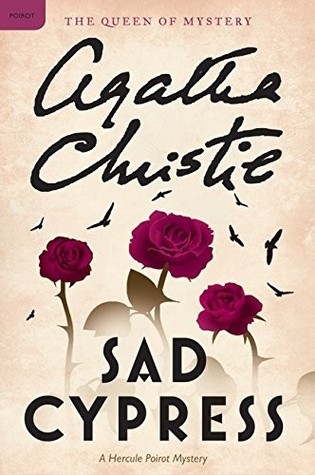
Sad Cypress by Agatha Christie

The February prompt for Read Christie 2021 was ‘a story featuring love’; as usual there were several books I could have chosen to fit this theme, but I decided on Sad Cypress, a Poirot title from 1940.

The novel begins with Elinor Carlisle on trial for the murder of Mary Gerrard. All the evidence points to her being guilty – not only was Mary her rival in love, Elinor was also in the right place at the right time to have carried out the murder. Only the village doctor, Peter Lord, believes Elinor didn’t do it and he calls in Hercule Poirot to find proof of her innocence. As Poirot begins to investigate, he discovers that almost everyone connected with the case is telling lies – but Poirot knows that where crimes are concerned, a detective can learn as much from a lie as he can from the truth.

Sad Cypress has not become a favourite Christie novel, but it’s still one that I enjoyed and one that stands out to me as feeling slightly different from most of the other Poirots I’ve read. In fact, Poirot himself doesn’t appear until almost halfway through the book and although he plays his usual vital role in solving the crime, I think the story could have been just as strong without him (apparently this was Christie’s own view as well, when she reflected on the novel after it was published). A large part of the story is written from Elinor’s perspective which gives it an emotional, intimate feel; I particularly liked the sections at the beginning and end of the book which become almost dreamlike as Elinor stands in court ‘as though imprisoned in a thick mist’, waiting to hear the decision of the jury.

As for the mystery itself, I think the plot is perhaps simpler than a lot of Christie’s others, but cleverly constructed and tightly focused. There are really only two or three likely suspects and for once I did correctly guess how the murder had been carried out and therefore who must have been responsible, but I wasn’t completely sure and had to wait for Poirot to provide the evidence. I didn’t manage to solve the mystery entirely, though – there were still lots of things that confused me, including the motive, and the twists towards the end of the book took me by surprise! Finally, in case you’re wondering, the unusual title comes from Shakespeare’s Twelfth Night: “Come away, come away, death, And in sad cypress let me be laid.”

The Read Christie theme for March is ‘a story featuring a society figure’. I’m torn between Lord Edgware Dies and Sparkling Cyanide; if you’ve read either of them, maybe you can help me decide!

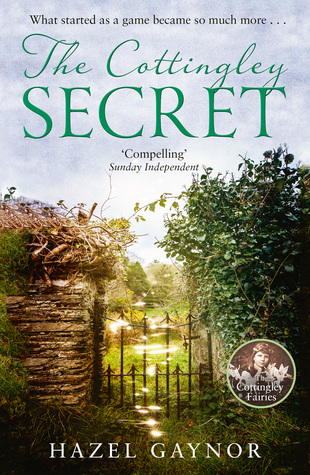
The Cottingley Secret by Hazel Gaynor

I was already aware of the Cottingley Fairies before reading this book; I remember watching a documentary years ago, as well as the 1997 film Fairy Tale. I knew that, early in the 20th century, a series of photographs appeared, taken by two young girls and allegedly showing fairies playing in the garden. Were the photographs real? Well, the girls managed to convince half the world that they were, including the famous author Sir Arthur Conan Doyle! In The Cottingley Secret, Hazel Gaynor gives a fictional account of the story of one of the girls, Frances Griffiths, and through her eyes we see how and why they take the photographs and the effect the incident has on the rest of their lives.

Frances’ story begins to unfold in 1917, when she and her mother return to England from South Africa because her father has gone to fight in the war. Arriving in the Yorkshire village of Cottingley, where they will stay with family, nine-year-old Frances gets to know her cousin, Elsie Wright, who is sixteen, and the two quickly become close friends. When Frances insists that she has seen fairies playing by the beck, or stream, at the bottom of their garden, she and Elsie decide to take photographs to prove that they exist. However, they are completely unprepared for the sensation they cause when the pictures are eventually made public.

One hundred years later, in 2017, Olivia Kavanagh is in Ireland where she has inherited her grandfather’s bookshop. Sorting through his things, she comes across an old manuscript and is fascinated by what it contains: the true story of the Cottingley Fairies, written by Frances Griffiths herself. As Olivia delves into Frances’ story, she discovers her own family connection to the village of Cottingley and begins to understand the appeal of believing in fairies!

I’ve mentioned in the past that I often have problems with dual timeframe novels, particularly where one period is much more interesting to read about than the other, but I’m pleased to say that I think The Cottingley Secret is one of the better examples of this type of book. Although I did find Frances’ narrative slightly more compelling, I liked Olivia too and enjoyed watching her discover the story of the fairies while also trying to bring new life to the ‘Something Old’ bookshop, coming to terms with her grandmother’s dementia and making some important decisions about her future.

I can’t talk too much about how Hazel Gaynor approaches the subject of the fairies and whether or not Frances’ sightings of them are genuine, because that would spoil the novel, but I do think she creates a convincing explanation for how the girls come to take the photographs while leaving just enough mystery in the story to raise some intriguing possibilities. You may also be wondering how so many people, ranging from photography experts to the author of Sherlock Holmes, were so ready to believe that the fairies were real, but remember that the photographs were published at a time when the world was just emerging from four years of war and it’s easier to see why people were desperate for some magic in their lives.

I have now read two of Hazel Gaynor’s books – this one and The Lighthouse Keeper’s Daughter, about Grace Darling – and have enjoyed both. I’m looking forward to reading more!

Book 7/50 read for the Historical Fiction Reading Challenge.