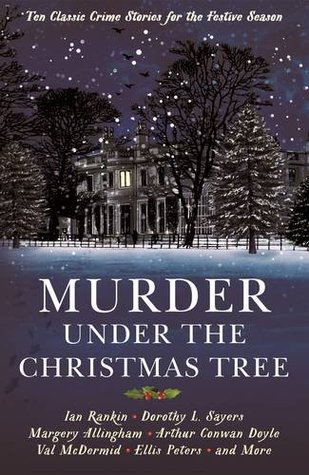
Murder Under the Christmas Tree, edited by Cecily Gayford

Murder Under the Christmas Tree contains ten stories by a variety of crime authors, all with a Christmas theme or set during the festive period. I don’t often choose to read short story collections (although I seem to have read more of them this year than ever before, so maybe that is beginning to change) but I picked this one up in the library a few weeks ago because I was intrigued by the mixture of authors – some modern, some classic, some that I was familiar with and some that I wasn’t.

I’m never sure of the best way to write about books like this, but as there are only ten stories I think I should be able to give all of them a brief mention. The book opens with The Necklace of Pearls, a Lord Peter Wimsey mystery by Dorothy L. Sayers, one of the five authors in the collection I had read before. The story involves a search for a valuable pearl necklace which goes missing as a party of guests gather to celebrate Christmas. I always like Sayers’ writing, but this particular story is not very strong and not a great start to the book, in my opinion. It is followed by The Name on the Window by Edmund Crispin, a locked room mystery set in winter and featuring his detective Gervase Fen. Crispin is another author I have previously read – I highly recommend The Moving Toyshop if you haven’t read it yet – and again, this story is not the best example of his work but it’s still enjoyable and I didn’t guess the solution.

Now we come to one of the authors who were new to me: Val McDermid. Yes, there are some huge gaps in my reading when it comes to more recent crime fiction! A Traditional Christmas is a short and simple murder mystery with a nice twist at the end. I really liked this one, although it felt odd coming straight after Sayers and Crispin – especially as the next story is an even older one: The Adventure of the Blue Carbuncle by Arthur Conan Doyle. This is a classic Sherlock Holmes mystery involving a Christmas goose and a precious jewel. I feel sure I must have read it before, but I couldn’t remember it at all!

The Invisible Man is next: a Father Brown mystery by GK Chesterton. I first encountered Father Brown in a British Library Crime Classics anthology I read earlier this year (Miraculous Mysteries), but I enjoyed this story much more than that one. It made me think about the things we never notice and the things that we do! This is followed by another modern story, Cinders by Ian Rankin. During rehearsals for a performance of Cinderella, the Fairy Godmother is found dead and Rankin’s detective Rebus is called in to investigate. I have never read anything by Ian Rankin before and although there was nothing wrong with this story, I don’t think he’s an author for me.

The next two stories are my favourites. The first, Death on the Air by Ngaio Marsh, is a fascinating story set during the early days of radio. On Christmas morning, ‘Septimus Tonks was found dead beside his wireless set’, presumably having been electrocuted – but was it an accident or was it murder? This is my first introduction to Marsh’s work, but I would love to read more. The next story, Persons or Things Unknown, is by Carter Dickson, a pseudonym of John Dickson Carr. A host entertains his house guests with an atmospheric tale of murder set in the 17th century. I loved it – and again, I will be looking for more by this author.

The penultimate story in the book is Margery Allingham’s The Case is Altered. It’s an Albert Campion mystery and while I had hoped it would be one of the highlights of the book, I found it quite forgettable. The last story, The Price of Light by Ellis Peters, was good but felt out of place in this collection, being a Brother Cadfael mystery set in 1135. I’ve never read anything by Peters before and I liked this enough to want to try one of her full-length Cadfael novels.

This is an uneven collection, then, and I don’t think the mixture of Golden Age, historical and contemporary mysteries really worked. I’m pleased I read it, though, if only because it has given me my first taste of Ngaio Marsh, John Dickson Carr and Ellis Peters. Another book in this series, Murder on Christmas Eve, also edited by Cecily Gayford, has just been published and seems to include many of the same authors.

A Halloween Treat: Six stories by Edgar Allan Poe

It’s been a while since I last read anything by Edgar Allan Poe so I decided to pull my Complete Tales and Poems off the shelf this weekend to re-read a few of his stories. With Halloween on its way, I thought I would concentrate on some of his spooky, unsettling or gothic stories rather than the mysteries, science fiction, essays and other genres which are also included in the collection. Maybe I will write about some of those in a future post, but for now, here are my thoughts on the six stories I’ve managed to re-read over the weekend:

~

Ligeia – This has always been one of my favourite Poe stories. It begins with the narrator describing his beautiful, talented, intelligent wife Ligeia, whom he met in a ‘large, old, decaying city near the Rhine’. When Ligeia dies, the heartbroken narrator retreats to England where he buys and restores an ancient abbey. Marrying again, he brings his new wife, the Lady Rowena, to live with him at the abbey where he prepares for her a chamber which sounds wonderfully sinister and eerie. The rays of the sun and moon fall ‘with a ghastly lustre on the objects within’, in each corner stands ‘a gigantic sarcophagus of black granite’ and an artificial current of wind behind the tapestries gives a ‘hideous and uneasy animation to the whole’.

The story is notable for the unreliability of the narrator and for the inclusion of one of Poe’s poems, The Conqueror Worm.

– 5 Ravens

~

The Masque of the Red Death – This is a story I’ve always found slightly confusing. A prince and a thousand friends (could anyone really have a thousand friends?) lock themselves away in a castle while a terrible plague devastates the rest of the country. The moral of the story seems clear enough to me, but I’m not sure I’ve ever understood all of the symbolism, such as why the prince has seven chambers each decorated in a different colour – That at the eastern extremity was hung, for example in blue — and vividly blue were its windows. That’s maybe why this one has never been a favourite.

– 3 Ravens

~

Metzengerstein – In this story, set in what I assume is medieval Germany, the young Baron Metzengerstein witnesses a horse in a tapestry take on human characteristics: The eyes, before invisible, now wore an energetic and human expression, while they gleamed with a fiery and unusual red; and the distended lips of the apparently enraged horse left in full view his sepulchral and disgusting teeth. Moments later a strange horse appears in his stables outside. Is it just an innocent animal or is it something more sinister? Again, this is not a favourite, but it’s an interesting story with lots of gothic elements.

– 3 Ravens

~

The Oblong Box – I found this the weakest of the stories I’ve read this weekend. The narrator takes passage on a ship from Charleston to New York City and meets an old friend aboard. The friend is accompanied by his wife, his two sisters…and an oblong-shaped box made of pine. I thought it was quite obvious what must be inside the box – and I guessed correctly. The most interesting thing about the story is that the narrator comes to entirely the wrong conclusion!

– 2 Ravens

~

Silence: A Fable – This is a very short story (three pages long in my edition) but one that I’ve always loved, mainly for the language Poe uses to create atmosphere. The story is narrated by a Demon, who is describing a region of Libya where giant water lilies ‘stretch towards the heaven their long ghastly necks’, the river ‘palpitates forever and forever beneath the red eye of the sun’ and ‘strange poisonous flowers lie writhing in perturbed slumber’. With its rhythm and repetition it has the feel of a poem in prose. It was night, and the rain fell; and, falling, it was rain, but, having fallen, it was blood.

As it’s so short, I don’t want to spoil the plot (not that there’s much plot to spoil). Without going into details, I think there are different ways you could interpret this story, but I see it as meaning that while humans may not necessarily be afraid of chaos, noise and destruction, what they fear most of all is complete and utter silence.

5 Ravens

~

The Oval Portrait – Another very short story, at two and a half pages long. Our narrator becomes injured during a journey and takes refuge in a château, a place of ‘gloom and grandeur’. A portrait of a young woman in an oval frame opposite his bed catches his eye and he is fascinated when he learns the tragic story behind it. The similarities between The Oval Portrait and Oscar Wilde’s The Picture of Dorian Gray – and what they each have to say about art and artists – are striking.

– 4 Ravens

~

Have you read any of these? What are your favourite Poe stories?

If I’ve got you in the mood for more Poe, here are some of my older Poe-related posts which you may find interesting:

Mrs Poe by Lynn Cullen

Dragonwyck by Anya Seton (Poe makes a few brief appearances in this one)

The American Boy by Andrew Taylor (the title character is the ten-year-old Poe)

Ulalume: A Poem for Halloween

Small and Spooky (a short story anthology including Poe’s Morella)

Snowdrift and Other Stories by Georgette Heyer

I always love spending time in Georgette Heyer’s world; with duels, masked balls, elopements, high-stakes card games and lively period slang, her novels provide perfect escapism – and based on this collection, so do her short stories. Originally published as Pistols for Two in 1960, Snowdrift and Other Stories contains eleven of Heyer’s tales of Regency romance and adventure plus three additional stories not included in the earlier book.

I found these stories so enjoyable and so much fun, it was tempting to read them all at once, but instead I decided to just dip in and out, reading one or two at a time over the course of a few weeks. This was probably a good idea as many of the stories in the book are very similar, so better in smaller doses, I think! In particular, there are several that deal with young couples eloping with various family members in pursuit and a series of misunderstandings ensuing along the way – and also several involving duels, fought with either pistols or swords, and never quite going according to plan. Most of the stories have a twist or two, which are usually easy for the reader to predict, but come as a complete surprise to the characters!

I don’t want to discuss all fourteen stories here, but I can honestly say that I liked all of them – some more than others, of course. Some of my favourites included Bath Miss, in which a gentleman agrees to escort the daughter of a family friend home from school in Bath, but finds that the girl is not quite what he’d expected; The Duel, which follows a young lady who goes in search of the disreputable Lord Rotherfield to beg him not to shoot her brother; and Hazard, where a nobleman ‘wins’ a friend’s sister in a drunken game of dice and is horrified when he wakes up the next day and finds himself on the way to Gretna Green. Another which stood out, although it wasn’t one I particularly loved, was Night at the Inn. Unlike the others, which are all romances of various types, this one is more of a suspense story in which three guests arrive at a lonely inn one dark, foggy night.

As for the three extra stories – Pursuit, Runaway Match and Incident on the Bath Road (all from the 1930s, I think) – they are very entertaining too, although they suffered slightly from being placed at the end. Speaking as someone who is not usually a fan of short stories, I did really enjoy this book. I prefer her full length novels but, as I’ve said, if you just want a small dose of Heyer – or maybe if you’ve never read her before and don’t want to commit to anything longer – I would recommend giving Snowdrift a try.

Thanks to Sourcebooks for providing a copy of this book for review via NetGalley.
Hemmed In edited by M.R. Nelson

This is another collection of classic short stories edited by M.R. Nelson. I have previously read two of her others – Love and Other Happy Endings and Small and Spooky – and enjoyed them both, so I was looking forward to finding out what was in store this time! Nelson calls her collections ‘taster flights’ because they give us a taste of each author’s writing; this particular book contains only one author (Willa Cather) whose work I have previously read – the other five were new to me. Although the stories are very different, they are all linked by a common theme. The title, Hemmed In, should be a clue as to what that theme is!

The opening story is A Jury of Her Peers (1917) by Susan Glaspell, in which a sheriff and a witness are accompanied by their wives on a visit to a house where, it appears, a woman has murdered her husband. This is a cleverly written story, showing how men and women can perceive the same situation differently. The two wives in the story pick up on things that their husbands would never have noticed and are able to use their own knowledge and experience to understand the misery and oppression that may have led the accused woman to commit murder. I have never read anything by Susan Glaspell before but I’m aware that two of her novels have been published by Persephone and now I’ll have to consider reading them.

Kate Chopin’s A Pair of Silk Stockings (1897) appears next and follows the story of Mrs Sommers, who unexpectedly finds herself in possession of fifteen dollars and the luxury of deciding what to spend the money on. She knows she should be sensible and buy things for her children, but when a pair of beautiful silk stockings catches her eye, she finds it hard to resist. Despite being so short, this is a powerful story about how a woman reacts when given the chance to escape her responsibilities and have just one day to herself.

The next story – probably the most famous of the six – is one that I’ve wanted to read for a while and I’m pleased that I’ve finally had the opportunity. It’s The Yellow Wallpaper (1892) by Charlotte Perkins Gilman, in which a woman is prescribed a rest cure for a ‘nervous complaint’. Spending hour after hour alone in a room at the top of the house, the narrator becomes obsessed with the patterns on the yellow wallpaper because she has nothing else to stimulate her mind. This is a disturbing and unsettling story, but also a fascinating one and I can see why it is considered a feminist classic.

In Little Selves (1916) by Mary Lerner we meet Margaret O’Brien, an elderly woman who is dying and looking back on her earlier life. Not having had any children, she thinks instead about the little girls who were her own younger selves and laments the fact that ‘there’s all those poor dear lasses there’s nobody but me left to remember, and soon there’ll not even be that’. This is an interesting and unusual story by an author I’ve never come across before.

Edna Ferber is yet another author I’ve never read until now and although her story The Leading Lady (1912) is probably my least favourite in this collection, I did still enjoy it. The main character is an actress on tour with a small company and suffering from loneliness and boredom. Like the woman in Kate Chopin’s story, she jumps at the chance to break out and do something different for the day.

Finally, we have a story by Willa Cather, The Bohemian Girl (1912). This one feels slightly different from the previous five as it features a male protagonist, Nils Ericson, who is returning to his hometown after an absence of many years. However, once his sister-in-law Clara Vavrika arrives on the scene and we learn a little bit about her life, I could see why this story had been included along with the others. It’s the longest and most developed story in the book – more of a novella, I would say – and I found it very reminiscent of My Ántonia.

I loved reading Hemmed In. It contains a great selection of stories, all six of which could be considered important works of feminist literature. Of course, I could have read them at any time as they have all been published in other books or are in the public domain and available online, but I wouldn’t have read them all together and that’s what makes M.R. Nelson’s anthologies so good. It’s always interesting to read her thoughts at the back of the book on why she chose each particular story and how it fits with the overall theme. Best of all, I have now been introduced to five new authors, all of whom I would like to explore further!

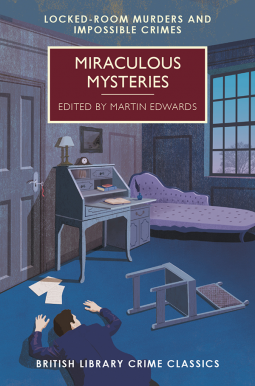
Miraculous Mysteries edited by Martin Edwards

A train that disappears without trace. A haunted chapel containing a dagger with a mind of its own. An entire crime scene which vanishes overnight. A series of unexplained deaths in a museum. A house suddenly abandoned like the Mary Celeste. These are just a few of the puzzles to be solved in Miraculous Mysteries, the latest of the British Library Crime Classics anthologies edited by Martin Edwards.

There are sixteen stories in the collection and they each deal with a different locked room murder or ‘impossible crime’. These are often my favourite types of mysteries – crimes which at first appear to have no rational explanation but with solutions which are either completely ingenious or so simple the reader is left wondering how they could possibly have been fooled! For that reason, I’m not going to discuss the individual stories in any detail but will just give each one a brief mention.

Many of the authors whose stories are featured in Miraculous Mysteries were new to me (although some of them may already be familiar to those of you who have read other books from the Crime Classics series) and I appreciated the biographical information Martin Edwards provides before every story. I was particularly impressed by Christopher St John Sprigg’s Death at 8:30 in which the exact time of a man’s death is predicted, and Nicholas Olde’s The Invisible Weapon, a short but perfectly paced mystery which I felt that I should have been able to solve, but didn’t quite manage it!

Although many of the stories in the book feature a crime committed in an actual locked room (Too Clever by Half by husband and wife team G.D.H. and Margaret Cole, Locked In by E. Charles Vivian and The Aluminium Dagger by R. Austin Freeman are three examples), there are others which don’t. Arthur Conan Doyle’s The Lost Special is the disappearing train story I mentioned in my opening paragraph – it’s not a Sherlock Holmes mystery, but it does include a letter written by an anonymous person I would like to think might be Holmes! The Sands of Thyme by Michael Innes – the first time I’ve had the pleasure of reading Innes – is set outside in the open air but the principles are the same as in a locked room mystery, with the crime taking place in a seemingly impossible location.

The Music Room by Sapper (better known for his series of Bulldog Drummond crime thrillers) is another good one. By the time I came to this story I was halfway through the book and took a moment to reflect on how rarely, when it comes to stories like these, we are given access to the detective’s own thought processes. The authors included in this collection find a variety of different approaches to take – the detective entertaining a friend with an account of an old case; a passive narrator observing the actions of his detective companion; anything to make the mystery more difficult to solve and to keep ‘obvious’ clues obscured from the reader until the end of the story.

What else is there? Well, there’s The Thing Invisible, a gothic, ghostly mystery by William Hope Hodgson, The Diary of Death by Marten Cumberland, about a killer who appears to be using a diary for inspiration, and The Broadcast Murder by Grenville Robbins, which is set in a radio studio. We also meet detectives ranging from the obscure – such as Sax Rohmer’s Moris Klaw, who investigates The Case of the Tragedies in the Greek Room – to the better known, such as G.K. Chesterton’s Father Brown, who appears in The Miracle of Moon Crescent. And it was good to be reacquainted with Gervase Fen, Oxford Professor of English Language and Literature, in Beware of the Trains by Edmund Crispin. I was hoping for something more fun and quirky from Crispin (remembering The Moving Toyshop, which I read last year), but still, this was quite an enjoyable story about a missing train driver.

Two of my favourite stories, though, were The Haunted Policeman by Dorothy L. Sayers, a Lord Peter Wimsey story which offers an intriguing twist on the locked room mystery, and The Villa Marie Celeste by Margery Allingham, in which a family disappear from their home – but have they been murdered or is something else going on? This last story is an Albert Campion mystery and I think I actually enjoyed it more than the full-length Campion novel I read last year!

Although the quality varied from story to story, none of them disappointed me, and on the whole I thought this book was a great read. I’ll definitely consider reading more of Martin Edwards’ British Library Crime Classics anthologies.

I received a review copy from the publisher via NetGalley.

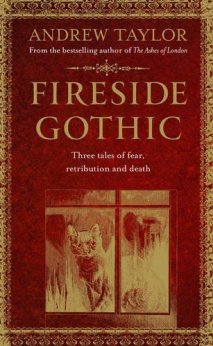
Fireside Gothic by Andrew Taylor

fireside-gothic Having read and enjoyed some of Andrew Taylor’s historical crime novels, I was immediately intrigued when I heard about Fireside Gothic, a hardback collection of three novellas which had originally been published separately in ebook form as ‘Kindle Singles’.  The stories are all quite different but, as Taylor says in his author’s note, they do share some common themes.

Broken Voices, the first of the three, has the feel of a classic Christmas ghost story. Set in an English cathedral city just before the First World War, it follows the adventures of two schoolboys whose circumstances mean they have to stay at school in the care of a retired teacher over the Christmas holidays. After listening to the teacher’s tales of mysterious happenings in the nearby cathedral, one of the boys begins to hear ghostly music and persuades his friend to sneak into the cathedral with him late one night to investigate.

Broken Voices gets the collection off to a good start.  Although I would describe it as an eerie story rather than a scary one, with its haunting atmosphere, winter setting and vivid descriptions of the deserted cathedral, this is the most obviously ‘gothic’ of the stories in the book.

The second story, The Leper House, is my favourite. Set in the modern day this time, our narrator is driving home from his sister’s funeral when his car breaks down on a lonely country road near the Suffolk coast. Setting off through the rain and wind in search of help, he manages to find shelter for the night and during his stay he has a brief but unforgettable encounter with a woman who lives in a neighbouring cottage. In the morning, he discovers that both the woman and the cottage have disappeared – and becomes obsessed with finding an explanation for his strange experience.

I can’t say too much, but the story then goes in a direction which was completely unexpected and which I loved. It raises a lot of fascinating questions and some of them are still unanswered at the end. There are some ideas here which I would have liked to have seen developed further; this story has all the ingredients of a full-length novel and I was sorry it had to come to an end so soon!

The collection finishes with The Scratch, another contemporary story. Unlike the first two, this one is narrated by a woman. Her name is Clare and she lives in the Forest of Dean with her husband, Gerald, and their pet cat. At the beginning of the story, their orphaned nephew, Jack, comes to stay with them on his return from fighting in Afghanistan. Jack’s time in the army has left him with a fear of cats, a dislike of enclosed spaces and a scratch on his arm which won’t seem to heal.

This is an interesting story, but the focus is mainly on the complicated relationships between Clare, Gerald and Jack, so the supernatural elements are much more subtle than in the other novellas. This is my least favourite of the three, although there are some clever little twists at the end which took me by surprise!

Fireside Gothic is an entertaining and unusual collection. The title and cover had led me to expect something slightly different – something spookier and, well, more gothic – but I did still enjoy these three novellas, particularly the middle one.  While it’s still winter, this would be an ideal time to get yourself a copy of this book and spend a cold, dark evening reading it by the fire.

Thanks to HarperCollins for providing a review copy of Fireside Gothic.

Small and Spooky, edited by M.R. Nelson

small-and-spooky As it’s Halloween on Monday, I thought today would be a good time to tell you about the wonderful collection of classic ghost stories I’ve just had the pleasure of reading. It’s called Small and Spooky and the six stories it contains were selected by M.R. Nelson, editor of two other short story collections (she refers to them as ‘taster flights’), one of which – Love and Other Happy Endings – I read and enjoyed earlier in the year.

Three of the stories in this collection are by authors I already know and love, while the other three are by authors who were new to me. All six share a common theme – they all feature a child or the ghost of a child – but otherwise they’re all quite different. It’s difficult to know how much you can say about short stories without spoiling them, so I’m just going to give a brief overview of each one.

The first is The Marble Child (1918) by E. Nesbit, a favourite childhood author of mine. I remember loving her children’s novels The Railway Children and The Phoenix and the Carpet, but had no idea until recently that she had also written ghost stories. This story about a little boy who is fascinated by the marble child he sees in the church gets the collection off to a good start. Part of the story is written from the boy’s perspective and part from an adult’s which, as the editor points out in her notes, makes this story a sort of bridge between children’s and adult fiction.

The next story is a great one: The Wind in the Rose-Bush (1903) by Mary E. Wilkins Freeman, an American author I had never heard of until now. The story follows Rebecca Flint as she travels to a small, remote town hoping to see her young niece, who has been living with her stepmother since her parents died. From the moment Rebecca arrives and sees a rosebush moving when there’s no wind, she knows something is wrong. I found it easy to guess what was going on in this story, but Rebecca didn’t know and I could really feel her growing sense of unease and confusion as the truth began to unfold.

Next is Their Dear Little Ghost (1890) by Elia Wilkinson Peattie (also another new author for me), which as you might guess from the title is not a scary ghost story at all. It’s actually quite a sweet and moving little story about a child who dies just before Christmas and her godmother’s love for her even in death. I found this one of the weakest stories in the book, but I still liked it and thought it made a nice contrast to the previous one, which was quite creepy!

The following story, Morella (1835), is by Edgar Allan Poe. Poe is another author I love and I was already familiar with Morella (I think I read nearly all of his short stories and poems years ago when I was given his complete works as a Christmas present). This tale of reincarnation is not one of his scariest and I don’t think it’s one of his best either, but I can see why it was chosen for this collection as it does fit the theme.

The fifth story is another strong one: The Old Nurse’s Story (1852) by Elizabeth Gaskell. I was convinced I had read this one before – it appears in Gaskell’s Gothic Tales which I borrowed from the library a few years ago – but when I started to read, I didn’t remember it at all. In this atmospheric story set in winter, a ghostly child haunts the Northumberland countryside. I love Gaskell’s writing and this is an excellent example of a Victorian ghost story.

Finally, we have The Doll’s Ghost (1911) by F. Marion Crawford, another author I’ve never read before. This is an unusual story about a child’s doll which is broken and given to a dolls’ hospital to repair. Although I found this story a bit eerie, the ghost was a nice ghost, which meant the collection finished on an uplifting note! I would be happy to read more by this author.

These are six very enjoyable stories and perfect for those readers who, like me, prefer their ghost stories to be spooky but not terrifying! It was good to revisit Nesbit, Gaskell and Poe – and also to be introduced to three new authors, all of whom I’m now interested in exploring further.

Thanks to M.R. Nelson for providing a copy of Small and Spooky for review.