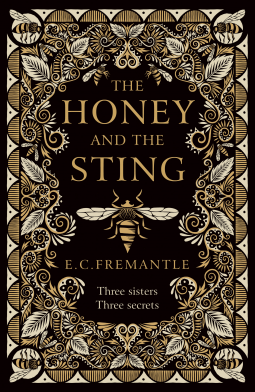
 After 2018’s The Poison Bed, a Jacobean thriller based on a real life murder scandal, EC Fremantle has returned to the same period – the early seventeenth century – with another historical thriller, this time one which is only partly inspired by a true story.
Hester, Melis and Hope are three sisters who live together in a cottage in Iffley, Oxfordshire. With no male relative in the household, apart from Hester’s little boy Rafe, their living arrangements are unusual for the time – not quite respectable, some would say. Yet all three women have their reasons for avoiding outsiders and keeping themselves to themselves. Hester’s secret is perhaps the most scandalous: the father of her son is George Villiers, the powerful Duke of Buckingham and the King’s favourite. The beautiful, eccentric Melis experiences visions and premonitions which have an unsettling habit of coming true. And Hope’s African heritage makes her stand out from the other girls in Iffley, while also making her the target of unwelcome attention from men.
When we first meet the sisters, they are leading quiet lives at Orchard Cottage, filling their days with cooking, gardening, needlework and tending the bees in their hives. This will all change when George Villiers decides that the time has come to claim his son – something Hester refuses to contemplate as the Duke had cruelly cast her aside and left her to raise Rafe alone. In order to keep Rafe out of his hands, the three women are forced to go on the run, fleeing to an isolated house in the woods. But even here it seems there’s no guarantee of safety and they must decide who can and cannot be trusted.
Hester and her sisters are fictional, but their story is entwined with a sequence of real historical events involving George Villiers, Duke of Buckingham. I won’t say too much here, but if you know anything about Buckingham then as soon as a certain character appears in the novel you will be able to guess what is ultimately going to happen. Knowing this didn’t spoil the story for me, though; I found this particular character and the motivations for their actions very intriguing and their inclusion made the book much more compelling than it would otherwise have been.
The novel is written in present tense, never my favourite but I didn’t find it as annoying as I often do because it somehow suited the pace of the story and gave it a sense of urgency and danger. Some of the chapters are told from Hester’s perspective and these are written in the first person, but others are from Hope’s perspective, in the third person. I didn’t really understand the reason for this and would have preferred one style or the other. We don’t hear from Melis at all, only seeing her through the eyes of the other characters, but this is quite effective and adds to the aura of mystery that surrounds her. I think she was probably the sister I found most interesting; Hester and Hope both frustrated me with the number of poor decisions they made!
The only other thing that bothered me slightly was the way Hester refers to Buckingham throughout the novel as ‘George’. I felt that, as she had been a servant in Buckingham’s household when he seduced her, she would have spoken of him as ‘the Duke’ or ‘Buckingham’ or ‘His Grace’. A servant calling a nobleman by his first name in the seventeenth century just didn’t seem right to me, but maybe I’m just being pedantic. Overall, this was an enjoyable novel, even if it wasn’t one of my favourites by Fremantle.
Thanks to Penguin Michael Joseph for providing a copy of this book for review via NetGalley
This is book 10/20 of my 20 Books of Summer.



 She Reads Novels