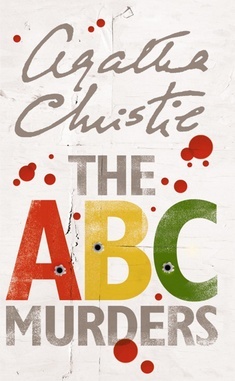
 When I read about the Read Christie 2019 Challenge hosted at www.agathachristie.com – the idea being to tick off twelve books from twelve different categories over the course of the year – I was immediately tempted to join in. I didn’t want to think of it as a challenge as such, or make a definite commitment, but I thought I could use the monthly prompts to get through some of the many Christies I still haven’t read. This month’s category is “a recent TV adaptation” and the suggested book is The ABC Murders. I had started to watch the new BBC adaptation of The ABC Murders which was shown at Christmas, but struggled to get into it, so I thought I would try the book instead. And what a great book it is!
The murder of Alice Ascher in her small tobacconist shop in the town of Andover seems as though it should be an easy one to solve. There is an obvious culprit – the woman’s drunken husband – and he would certainly have been the prime suspect, if not for a mysterious coincidence which happened just days before the murder. Hercule Poirot had received a typewritten letter signed simply A.B.C. and warning of a crime to be committed in Andover on that particular date – and beside the body of the dead woman was a copy of the ABC Railway Guide.
But this will not be the only murder to take place:
‘I admit,’ I said, ‘that a second murder in a book often cheers things up. If the murder happens in the first chapter, and you have to follow up everybody’s alibi until the last page but one – well, it does get a bit tedious.’
When a similar letter arrives soon afterwards giving advance warning of a second murder which will happen in Bexhill, it doesn’t come as a surprise to Poirot when the second victim has a name beginning with B and when another ABC Guide is found next to the body. Convinced now that the killer is following an alphabetical pattern, Poirot must uncover his or her identity before they get all the way to Z.
This is one of several Poirot novels narrated by Captain Hastings (although there are a few chapters written from the perspective of other characters). I always seem to enjoy the ones with Hastings, partly because he, like the reader, is often in the dark and needs Poirot to explain things to him, but also because I think Poirot having a friend to discuss things with gives these books a different dynamic to the ones where he is working entirely on his own amongst strangers. Sometimes Hastings can make an observation or suggestion which proves to be useful later on, as he does once or twice in this book. Inspector Crome is investigating too, and a ‘legion’ of the victims’ families and friends is also formed to see whether they can shed any light on the situation.
What makes this book so intriguing is that each of the murders which takes place seems unrelated to the others, apart from the ABC theme and the letters sent to Poirot. They each have a separate set of suspects, all with their own motives, but what Poirot needs to do is find something which links them all to one man or woman – the mysterious A.B.C. I found this a particularly clever Christie novel and didn’t come close to solving it. I allowed myself to be sent in completely the wrong direction by the red herrings and took everything at face value; in fact, for a long time I thought I was reading a different sort of mystery entirely.
I loved this one and I think I did the right thing in reading it before trying to watch the adaptation again. I’m planning to read another Christie novel in February, although I don’t know what it will be yet – I’m waiting to see what the chosen category will be for the next stage of the challenge.








 She Reads Novels