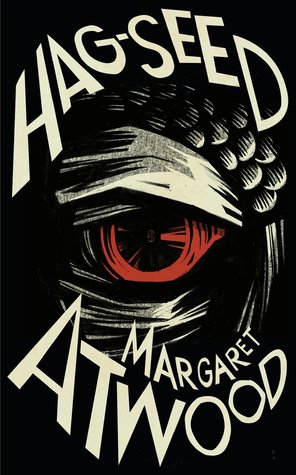
 This month I’ve been taking part in Nonfiction November, but it’s also Margaret Atwood Reading Month hosted by Naomi at Consumed by Ink and Marcie at BuriedInPrint. I was planning to read one of her longer books – The Blind Assassin or possibly Cat’s Eye, but I found myself running out of time towards the end of the month, so I decided on the much shorter Hag-Seed instead. This book is part of the Hogarth Shakespeare series of retellings of Shakespeare’s plays by modern authors.
Felix Phillips had a successful career as Artistic Director of the Makeshiweg Theatre Festival until his assistant, Tony, betrayed him and took his job. Forced to abandon his plans to stage a contemporary version of The Tempest – a play close to his heart, having recently lost his three-year-old daughter Miranda (who shared her name with Shakespeare’s heroine) – Felix drops out of public life and begins to plot his revenge. Under the name of Mr Duke, he applies for a position at Fletcher Correctional, helping to improve the literacy of the prisoners. Here he will have his chance to direct The Tempest after all, while making his enemies pay for what they have done.
The Tempest is a play that I know quite well, although I wish I’d found time to re-read it before starting Hag-Seed. I’m tempted to do that now, but I think reading them in the opposite order would have been more helpful! I enjoyed watching the prisoners as they study the play for the first time and try to interpret it in their own unique way (could Ariel have been an alien rather than a fairy? Would Shakepeare’s songs be improved by rewriting them as rap?) Personally, when it comes to adaptations of books and plays, I don’t usually like to see things being modernised or given ‘contemporary twists’, but even so it was good to see the Fletcher Correctional Players having so much fun and being so inventive.
Felix plays Prospero, the magician and rightful Duke of Milan, in the prisoners’ production, but he also fills the role of Prospero in the framing narrative. The prison represents the magical island to which Prospero is exiled, while Tony is clearly the equivalent of Prospero’s usurping brother, Antonio. Events in Felix’s life mirror events from The Tempest, coincidentally at the beginning, but then intentionally as he begins to orchestrate his plan for revenge. And of course, even as Felix controls and manipulates the other characters, we know that he is also a character and a prisoner, caught between the pages of Margaret Atwood’s novel, controlled and manipulated by Atwood herself.
Having some familiarity with the play does make it easier to understand and unravel the many layers of Hag-Seed, but if you’re not familiar with it, that shouldn’t be a problem as the whole story is told at various points in the novel, in various different ways (including a full summary at the end of the book). We can learn along with the prisoners as they try to identify the nine types of prison portrayed in the play and as they write an analysis of their chosen character and imagine how his or her story might continue after the play comes to an end. I particularly enjoyed the contributions made by Anne-Marie Greenland, the actress and dancer Felix brings in to play the part of Miranda.
As for the real Miranda – Felix’s daughter who died as a child – the novel is as much about Felix’s feelings for her and his inability to let things go and move on as it is about anything else. Without saying too much, I really liked the way that part of the story was resolved and the way the novel ended.
I must read some of those longer Atwood novels soon – and I would like to try another of the Hogarth Shakespeare books too.












 She Reads Novels