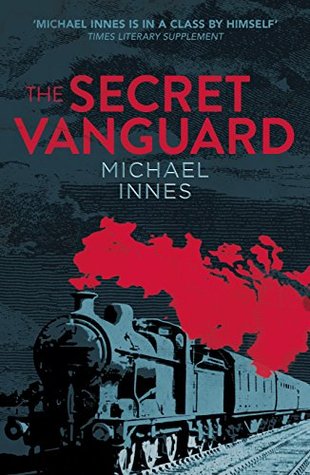
 I don’t think you could accuse Michael Innes of being formulaic – each book of his that I’ve read has been entirely different from the last! I’ve read two recently (The Secret Vanguard and The Daffodil Affair) and thought I would write about both of them in this post.
The first one, The Secret Vanguard, was published in 1940 and is the fifth in the Inspector Appleby series. It is set just before the beginning of World War II and is much more of a spy thriller than a detective novel. Our heroine, Sheila Grant, is on her way to Scotland to visit family when she overhears a conversation between some fellow passengers on the train, one of whom is reciting a poem by Swinburne. Sheila, who happens to be familiar with the poem, knows that it has been misquoted and can’t resist saying so – but when she is captured and held prisoner after disembarking from the train, she wishes she had said nothing. It seems that the misquoted poem contained a secret message and that Sheila is now in possession of information which could make her a threat to some very dangerous enemies.
It’s not long before Inspector John Appleby gets involved and begins to link Sheila’s abduction with the recent murder of a minor poet, Philip Ploss, and the disappearance of a scientist who has been working on a secret formula which could help the war effort. There are lots of twists and turns as Appleby tries to track Sheila and the missing chemist through the Scottish Highlands and Sheila tries to escape from her kidnappers, unsure of who she can and can’t trust. Although it’s all very melodramatic and unlikely, I did find it quite a fun, fast-paced read. However, the constant chase scenes, last-minute escapes and cases of mistaken identity became a bit tedious after a while. A good entry in the series, but not a great one.
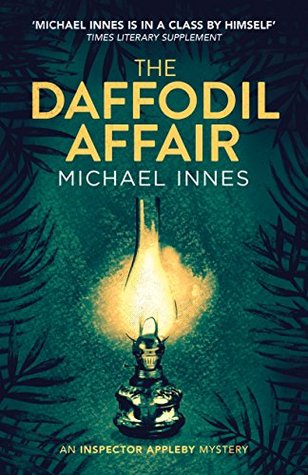 The Daffodil Affair isn’t a typical detective novel either. Published two years after The Secret Vanguard, in 1942, the war is an influence on this novel too, but I won’t say much more about that as I would be risking giving away too much of the plot.
In The Daffodil Affair, Appleby and his colleague Hudspith are investigating three separate mysteries, none of which are the sort of thing you would expect two Scotland Yard detectives to become involved in. First, there is the theft of Daffodil, an extraordinary horse who seems able to count and to read minds. Next, there’s the disappearance of Lucy Rideout, a vulnerable young girl who appears to have been lured away from home by promises of a trip to the island of Capri. Finally, and strangest of all, an entire house has vanished from a street in London – a house which is said to have been haunted.
These three strange occurrences may seem at first to be unconnected, but links soon start to emerge and an adventure begins which sends Appleby and Hudspith on a voyage to South America in the company of the sinister Mr Wine. All sorts of paranormal phenomena are incorporated into the story, including telepathy, séances, witchcraft, hauntings and possession by demons. Some of the situations in which our detectives find themselves are quite surreal and implausible, but there are darker undertones too, which is where the war influence comes in. I think Mr Wine’s schemes and actions would have been frighteningly relevant to readers in the 1940s.
Again this is an entertaining novel, but I found it too bizarre to be truly enjoyable. On the plus side, we do see a lot of Appleby, who has a much bigger role to play than he does in some of the other books in the series. Of these two novels, I preferred The Secret Vanguard, but I don’t think I would recommend either of these as a first introduction to Innes. I would start with Hamlet, Revenge! for a good literary murder mystery or Lament for a Maker if you’re in the mood for a novel in the style of Robert Louis Stevenson with multiple narrators and plenty of Scottish dialect. Those are my two favourites so far.







 She Reads Novels