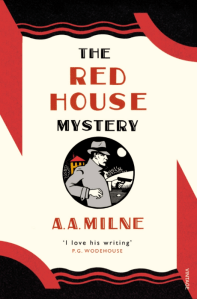
 I don’t think I would have ever read The Red House Mystery if it hadn’t been for seeing other bloggers reading and reviewing it. I had always thought of A.A. Milne solely as the author of the Winnie the Pooh stories and it had never occurred to me to wonder what else he had written. It turns out that The Red House Mystery, originally published in 1922, was his first and only detective novel – which is a shame, because it’s excellent.
The novel opens on a beautiful summer’s day with Mark Ablett entertaining guests from London at his home, the Red House. Earlier that morning, Mark had announced to his friends that his brother, Robert, was on his way home from Australia, having been absent for fifteen years. The guests are surprised to hear this, as Mark had never mentioned a brother before, and unfortunately – or perhaps fortunately, given the descriptions of Robert’s character – they don’t get a chance to meet him, because almost as soon as Robert arrives at the Red House he is shot dead.
Antony Gillingham, a latecomer to the party at the Red House, is one of the first on the scene, along with Mr Cayley, the Abletts’ cousin. Seeing Robert’s dead body on the office floor and no sign of Mark, who appears to have run away, it seems quite obvious what has happened…but Antony is not so sure. Joining forces with his friend and fellow house guest, Bill Beverley, he begins to search for clues in an attempt to solve the mystery.
I loved this book; being such an early example of a detective novel, it contains many of the elements of a classic ‘locked room mystery’ which would still have felt fresh and new in the 1920s: a country house, secret passages, ghostly figures, midnight adventures, red herrings etc. I also think Milne is very fair to the reader, providing enough hints for us to at least guess at the solution, while not making it too easy to work out.
Antony and Bill make a great detecting team, falling perfectly into the roles of Sherlock Holmes and Dr Watson (they even refer to themselves as Holmes and Watson several times throughout the novel). They are both very likeable characters and I would have been happy to read a whole series of Gillingham/Beverley mysteries.
Most of all, though, I loved the writing style, which is light and lively, with plenty of humour and witty dialogue. Here, for example, is a conversation between two of the Red House servants:
“I was never the one to pretend to be what I wasn’t. If I’m fifty-five, I’m fifty-five – that’s what I say.”
“Fifty-eight, isn’t it, auntie?”
“I was just giving that as an example,” said Mrs. Stevens with great dignity.
And here we learn what Antony’s father thinks of his son:
Old Gillingham returned to his paper. Antony was a younger son, and, on the whole, not so interesting to his father as the cadets of certain other families; Champion Birket’s, for instance. But, then, Champion Birket was the best Hereford bull he had ever bred.
The Red House Mystery was great fun to read. Having enjoyed it so much, I’m disappointed that there aren’t more mysteries to read by A.A. Milne, but if you think I might like any of his other books I would love to hear your recommendations.
 Having read and enjoyed some of Andrew Taylor’s historical crime novels, I was immediately intrigued when I heard about Fireside Gothic, a hardback collection of three novellas which had originally been published separately in ebook form as ‘Kindle Singles’. The stories are all quite different but, as Taylor says in his author’s note, they do share some common themes.
 My first introduction to Margery Sharp’s work came this time last year when I read
  The Flowering Thorn introduces us to Lesley Frewen, a twenty-eight-year-old socialite living in London. Lesley’s days and nights are a whirl of bridge parties, lunch engagements, shopping trips, hair appointments and visits to matinees and art exhibitions. Despite all of this, there’s still something missing from her life: love. Having discovered that the one man she really wants appears to be the one man she can’t have, Lesley is still in low spirits when she joins her aunt for afternoon tea the next day. This could explain why, when her aunt introduces her to Patrick, the orphaned child of a servant who has recently died, Lesley finds herself volunteering to adopt the boy.
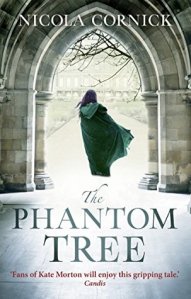 I have always found the concept of time-travel fascinating – and equally fascinating are the number of ways in which various authors choose to approach the subject when writing time-travel fiction. The Phantom Tree is one of many dual time period time-slip novels I have read over the last few years, but I found it refreshingly different in that it deals not with the usual idea of a modern day character going back in time but a woman from the past coming forward to the present time.
 Well, it may be only January but I think I already know one book which will be appearing on my books of the year list this December! Having read and enjoyed all of Alexandre Dumas’ d’Artagnan novels over the last few years (beginning with a re-read of
 She Reads Novels