Charity Girl by Georgette Heyer

charity-girl Continuing to work through my library’s selection of Heyer novels, I came home last Saturday with both her earliest book and one of her last. The first one I decided to read was Charity Girl, which was published in 1970, towards the end of Heyer’s career. It doesn’t seem to be one of her more popular Regency romances; I’ve seen other readers describe it as a recycling of Sprig Muslin and The Foundling, but that wasn’t a problem for me as I haven’t read either of those yet. While I did find a lot to enjoy, though, I would agree that this isn’t one of her best.

The hero of Charity Girl is Viscount Desford who, as the novel opens, is being berated by his father for not marrying his childhood friend, Henrietta Silverdale, and providing him with grandchildren. Desford and Hetta have been insisting for years that, although they are the best of friends, they are not in love – and nothing has changed now that they are both in their late twenties. Following this uncomfortable interview with his father, Desford goes to visit family and ends up attending a party at which he meets a vulnerable young girl called Charity – or Cherry – Steane.

Cherry’s mother is dead and her father has abandoned her, leaving her at the mercy of an aunt and cousins who treat her like a servant. The next day, Desford encounters Cherry walking along the road to London with a suitcase, determined that she is running away from her aunt. Unable to persuade her to go back, Desford accompanies her to London to find her grandfather, Lord Nettlecombe. However, the old man is away from home, so Desford turns to Hetta Silverdale for help. Cherry goes to stay with the Silverdales while he continues to look for her grandfather and absent father, but people soon begin to talk – why is Desford so concerned for Cherry’s welfare? Has he fallen in love at last?

I found Charity Girl an entertaining read, as have been all of the Heyer novels I’ve read, with plenty of the witty dialogue, peppered with Regency slang, which I love in her work. There are some funny scenes too, especially whenever one of Cherry’s disreputable family members makes an appearance. Despite this, though, Charity Girl has not become a favourite Heyer. I liked Desford, but he isn’t a particularly strong or memorable hero, and instead of having so much focus on his search for Cherry’s family, I would have preferred more time spent on his interactions with Cherry and Hetta. I couldn’t tell, at first, which of them was going to be his love interest and, when it eventually became clear, I didn’t feel that I’d seen enough of them on the page together.

Still, I didn’t think this was a bad book at all, so I don’t want to sound too negative about it. I have just started to read the other Heyer novel on my library pile – The Black Moth – and am so far finding it very different from this one!
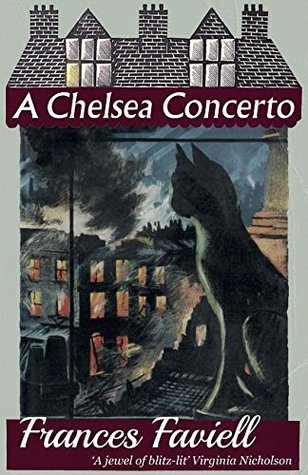
A Chelsea Concerto by Frances Faviell

a-chelsea-concerto I had a nice surprise a few months ago when I unexpectedly received two ebooks from Dean Street Press who were launching their new imprint, Furrowed Middlebrow (in conjunction with Scott from the Furrowed Middlebrow blog). The first one I chose to read was A Chelsea Concerto, a Second World War memoir originally published in 1959.

Frances Faviell lived at 33 Cheyne Place in Chelsea – one of the most heavily bombed areas of London during the war due to its location, close to the Royal Hospital and to several bridges over the River Thames. Her memoir opens in the early days of the war, a period known as the Phoney War because it seemed as though very little was actually happening. During this time, as well as continuing her work as an artist, Frances becomes a Red Cross volunteer, taking part in air-raid drills and trying to ensure that the people of Chelsea are as fully prepared as they can possibly be for whatever may follow.

What follows, of course, is the Blitz, which Faviell describes in vivid detail. Night after night, people living in Chelsea are subjected to one bombing raid after another, emerging from the shelters each morning in fear of what they might find: their home destroyed; a friend or neighbour dead; the roads blocked; an unexploded bomb in the street. With her work as a volunteer, Frances is often at the centre of the action, experiencing and witnessing the most horrifying things, while throughout it all, the Green Cat – her most treasured possession – sits in her window as a symbol of safety and prosperity.

Serene and aloof he sat in the window in the sunlight, surveying with contempt the activities in the street. Everyone begged me to put him down in the cellar with some of the paintings which I had stored there now. But I would not move him. Was he not the Guardian of the Home? He must be treated with respect.

Before the war, Frances had travelled widely and learned to speak several languages, something which enables her to offer help and support to the refugees who have fled to Britain as the Nazis sweep across Europe. There are some real characters amongst the refugees – in particular ‘The Giant’, a large and outspoken Belgian fisherman – and some funny moments, such as the story of Monsieur D, who is suspected of being a spy when mysterious lights show from his window during a blackout. Many of these people, though, are frightened and traumatised and look to Frances for advice and protection. She becomes particularly close to Ruth, a Jewish refugee from Germany, who attempts to kill herself, leaving her young daughter in need of Frances’ care. Nineteen-year-old Catherine, who arrives in London pregnant and unmarried, is another troubled young woman whom Frances finds herself taking under her wing.

Despite the terrible things going on around her – and the terrible things she experiences herself – Frances keeps her sense of humour and often manages to see the funny side (when she remembers a government information leaflet on what to do if German parachutists land, for example, or when she talks about her dachshund, Vicki, known as Miss Hitler).

The wording of the pamphlet which we knew was designed to try and avoid the same panic flight as in Belgium and France caused such hilarity everywhere that every current show included some skit on the arrival of parachutists. In the FAP we went about chivvying one another with the words of the clauses about seeing anything suspicious and “Be calm, be quick, be exact” became a joke in every place of work or exercise which we had to carry out with the Civil Defence.

Most of her memories are quite harrowing, though, such as when she describes the horrors of trying to reassemble pieces of bodies blown apart by bombs and the time she was lowered headfirst into a hole in a collapsed building to assist an injured man. But the most vivid and dramatic episode of all comes near the end when Faviell’s own home is bombed – and although we know that Frances must have survived to be able to write this book, the tension and the sense of danger come across so strongly in her writing that we worry for her anyway.

I haven’t read many wartime memoirs and I couldn’t help comparing this one to the few that I have read. It didn’t have quite the emotional impact that Vera Brittain’s Testament of Youth had on me, for example, but I still found it a fascinating and moving read. Frances Faviell wrote several other books which are also available from Dean Street Press; has anyone read any of them, and if so, which would you recommend?

The Shogun’s Queen by Lesley Downer

the-shoguns-queen Japan, as I discussed in my recent Historical Musings post, is a country whose history I know very little about. Lesley Downer has written several books about Japan, including a quartet of novels set in the 19th century; I remember reading about one of the others on The Idle Woman’s blog a few months ago, so I was pleased to have the opportunity to read Downer’s latest book, The Shogun’s Queen. This is the final book in the quartet to be published, but it’s the first chronologically so even though I haven’t read the other three I didn’t expect to be at any disadvantage.

After a brief prologue, the novel opens in 1853 with Japan on the cusp of change. Until now, the country has been largely insulated from the outside world and apart from some limited contact with Dutch traders, Japanese ports have been closed to the west. The sight of barbarian ships approaching, then, causes panic, fear and confusion. What do the barbarians (westerners) want and what will they do if Japan refuses to agree to their demands?

It’s during this turbulent period that our heroine, Okatsu, is adopted by the ambitious Lord Nariakira of Satsuma and taken into his household, where she is renamed Atsu. Adoption, in Japan at this time, is a way of raising a woman’s rank and improving her marriage prospects, so a few years later Nariakira arranges for Atsu to be adopted again, this time by his brother-in-law Prince Konoe. His ultimate aim is to marry Atsu to Iesada, the 13th Tokugawa Shogun, and in 1856 this aim is achieved. Nariakira hopes Atsu can use her position as Iesada’s wife to influence the Shogun’s choice of a successor – but as Atsu gets to know her new husband she discovers how difficult that task will be.

The approach of western ships means Japan is facing a new set of threats, dangers and opportunities, so strong leadership is desperately needed. I’m not going to say too much about the character of Iesada, but as soon as he appears on the page it is obvious that he can’t possibly be that strong leader. Poor Atsu; although she does begin to feel affection and even love, of a sort, for the Shogun, it is not a normal or happy marriage and it would be difficult not to have sympathy for her. Iesada’s mother is a cruel, manipulative woman who resents having to relinquish any of her control over her son, and this makes it almost impossible for Atsu to carry out the instructions she has been given by Nariakira.

As if Atsu’s situation wasn’t already bad enough, she has been forced to separate from the man she truly loves, Kaneshige, and doesn’t expect to see him again, knowing that once she enters Edo Castle as the Shogun’s wife she will never be allowed to leave. As I’ve said, I knew nothing about this period of Japanese history before I started reading, and I was fascinated by the descriptions of Atsu’s life, both before her marriage, when she lived in the Satsuma domain, and later, in the confines of the Women’s Palace in Edo (the former name for Tokyo). It was also fascinating to read about the ‘barbarians’ – Americans and Europeans – and how they and their culture appeared when seen through Japanese eyes.

I would have no hesitation in recommending The Shogun’s Queen to readers who, like myself, are looking for an accessible introduction to the history of 19th century Japan. A lack of familiarity with the period is not a problem as Lesley Downer makes everything easy to follow and understand; the book also includes a map, a list of characters and a detailed afterword in which the author provides more information on the historical background and gives us an idea of which parts of the novel are based on fact and which are largely fictional (such as the relationship between Atsu and Kaneshige). First and foremost, though, this is a gripping and entertaining story with characters to love and characters to hate. I enjoyed it and will be exploring Lesley Downer’s other books, as well as continuing to look out for more novels set in Japan.

I received a copy of The Shogun’s Queen from the publisher for review.

Lady on the Coin by Margaret Campbell Barnes

lady-on-the-coin One of the many things I enjoy about reading historical fiction is seeing how different authors choose to interpret the same historical events and people. This is the second novel I’ve read about Frances Stuart, one of the prominent figures at the court of Charles II, and as I remembered being disappointed in Marci Jefferson’s Girl on the Golden Coin, I was curious to find out how Margaret Campbell Barnes had approached the same subject in this novel from 1963.

Lady on the Coin opens with Frances Stuart (or Stewart, but I have gone with the spelling used by Barnes) and her family in exile in Paris where they have been living since the Royalists were defeated in England’s recent civil war. In 1660, the monarchy is finally restored and Charles II, to whom Frances is distantly related, takes the throne. After saying goodbye to her close friend, Henrietta – Charles’ beloved sister, ‘Minette’ – who has married the brother of Louis XIV of France, Frances returns to England to join the household of the new queen, Catherine of Braganza.

With her appealing combination of beauty, enthusiasm and youthful innocence, Frances soon finds herself with many friends and admirers at court, and Charles himself is one of them. Although she enjoys the attention, Frances has no desire to hurt Catherine, so she does her best to resist the King’s attempts to make her his mistress. As she comes under more and more pressure to agree to his demands, a rumour begins to circulate that he is planning to make her his wife should anything happen to Catherine. A chance of escape arrives when she falls in love with the King’s cousin, the Duke of Richmond and Lennox, but there will be more obstacles to overcome before they can find happiness together.

I found this book better written and more satisfying than Marci Jefferson’s. Although the two are very similar in terms of plot (I suppose there’s a limit as to how much could be written about Frances Stuart, after all), I felt that Margaret Campbell Barnes did a much better job of forming a compelling story from the material available and giving her characters depth. Frances is portrayed as frivolous and immature, but she also has a kind heart and I couldn’t help liking her, as did most of the people around her. I say ‘most’ because her popularity at court earns Frances some enemies as well as friends and puts her at the mercy of those who wish to manipulate her for their own ends, such as Barbara Palmer, Lady Castlemaine, the King’s mistress of many years.

Later in the novel, when Frances’ relationship with Lennox begins to develop and she has some important decisions to make, we see a stronger, more serious side to her character. I don’t know enough about the real Frances or Lennox to be able to say whether their relationship has been romanticised here, but I expect it probably has; he is described, by his own admission, as a gambler and heavy drinker, but these problems seem to be brushed aside very easily once he and Frances get together. I did find their romance quite moving, though, and much more interesting to read about than the King and his mistresses!

Frances Stuart’s story is played out during an eventful period of history, but important events such as the plague, the Great Fire of London and the Anglo-Dutch Wars seem to pass by in the background without having much of an effect on the life of our heroine. It’s probably true that Frances would have been very insulated from the outside world by her position at court, but I would still have liked a better balance between her personal story and the wider history of the period in general.

Now, you may be wondering why the title of the book refers to the ‘lady on the coin’. Well, one of Frances Stuart’s claims to fame is that she was apparently the model for Britannia, appearing on a commemorative medal produced after the war with the Dutch and then on various British coins until as recently as 2006.

Lady on the Coin is the second book I’ve read by Margaret Campbell Barnes; the first was Mary of Carisbrooke, which told the story of Charles I’s imprisonment in Carisbrooke Castle on the Isle of Wight. I’m sure I’ll be reading more of her books and the next logical choice is With All My Heart, her novel about Catherine of Braganza.

I received a copy of this book via NetGalley for review.

The Mill on the Floss by George Eliot

the-mill-on-the-floss Whenever I think about my favourite Victorian authors, George Eliot never seems to be a name that comes to mind – and yet I’ve liked everything I’ve read by her…Middlemarch, Romola and, years ago, Silas Marner. The Mill on the Floss is another one I can now add to this list; it was one of the titles on my Classics Club list I had been putting off reading and I really don’t know why. I didn’t love it as much as Middlemarch but I did enjoy it. It’s a beautifully written novel, though I wouldn’t expect anything less from George Eliot.

The Mill on the Floss was published in 1860, but set several decades earlier, beginning before the Reform Act of 1832. The story takes place in the fictional English town of St Ogg’s and at Dorlcote Mill which stands on the banks of the River Floss. The mill is owned by Mr Tulliver who lives there with his wife and two children, Tom and Maggie. He is keen for his son to receive a good education, so Tom is sent to school, but it’s nine-year-old Maggie who shows the most interest and aptitude for books and learning.

Remembering how much I loved reading myself when I was Maggie’s age and how much I value my 20th century education, I had a lot of sympathy for her when Tom’s tutor tells her that girls have a “great deal of superficial cleverness, but couldn’t go far into anything; they’re quick and shallow” or when she finds herself having a conversation like this one with her brother:

“Why, you couldn’t read one of ’em,” said Tom, triumphantly. “They’re all Latin.”

“No, they aren’t,” said Maggie. “I can read the back of this, – ‘History of the Decline and Fall of the Roman Empire.'”

“Well, what does that mean? You don’t know,” said Tom, wagging his head.

“But I could soon find out,” said Maggie, scornfully.

“Why, how?”

“I should look inside, and see what it was about.”

Although they don’t always see eye to eye (and despite Tom’s sense of superiority) Maggie and Tom do care about each other and their relationship is quite a strong one – until the day Philip Wakem, a lawyer’s son, joins Tom at Mr Stelling’s school. Tom dislikes Philip from the start, but Maggie grows very close to him and as the years go by they begin to have feelings for each other. Unfortunately for Maggie and Philip, their fathers have become sworn enemies following a lawsuit which has resulted in Mr Tulliver losing Dorlcote Mill. Maggie is forbidden to see any more of Philip, but when Tom discovers that they are still meeting in secret, she is forced to choose between her family and the man she is beginning to love.

There’s more to the story than this – a second love interest appears later in the novel and we also get to know several of Maggie’s aunts, uncles and cousins – but I’m not going to describe the plot in any more detail. I do want to mention the ending, though. It’s one of those endings which, when you first read it, is shocking, unexpected and not very satisfactory – but after you’ve had time to think about it, you decide it was perfect after all. That’s how I felt about it, anyway; I imagine other readers would have had a different reaction.

I don’t know very much about George Eliot as a person, but she writes so convincingly about Maggie’s childhood and about the ups and downs of sibling relationships that I wonder how much of it was autobiographical. These were my favourite sections of the book, but I liked, and had some sympathy for, the older Maggie too.

The Mill on the Floss is not a fast-paced novel and not a short one either, so it’s not the sort of book you can read quickly. I took my time with it, enjoying the beautiful writing, the descriptions of the town, the mill and the river, and the insights into life. And now I’m looking forward to reading the rest of Eliot’s books; I think Daniel Deronda will probably be next.

Revelation by CJ Sansom

revelation After reading Sovereign recently, I was desperate to continue with the next of CJ Sansom’s Shardlake mysteries – and luckily for me, I managed to find a copy of Revelation in the library the next day. I had said that Sovereign was my favourite in the series so far, so I was curious to see whether Revelation could possibly be as good. Well, it is; it’s even better! Before I continue, though, just a quick warning: although I’ve done my best to avoid spoilers here, this is the fourth book in the series and the appearance of certain characters in it will mean you can rule them out as suspects in the previous ones. My recommendation would be to start with book number one, Dissolution, and work through them in order.

Revelation is set in 1543, the year in which Katherine Parr becomes the sixth and final wife of Henry VIII, and after their adventures in York (described in Sovereign), lawyer Matthew Shardlake and his assistant Jack Barak are back in London. Shardlake has no desire to become embroiled in any more mysteries, but when a friend is found dead with his throat cut and his blood turning the water of a fountain red, it seems he will have no choice.

The dead man’s widow, Dorothy, is an old love interest of Shardlake’s, and he promises to help bring her husband’s killer to justice. However, it soon emerges that this is just the latest in a series of bizarre murders and, at the request of Archbishop Cranmer, Shardlake agrees to investigate. His involvement will bring him into contact with a circle of powerful men, including Edward and Thomas Seymour, brothers of the late Queen Jane, who have their own reasons for wanting the killer caught. Meanwhile, Shardlake has also taken on another intriguing case, one which involves a young man whose obsessive praying has resulted in imprisonment in the asylum known as Bedlam and could lead to him being arrested as a heretic.

As a murder mystery, I thought Revelation was excellent. There are plenty of suspects and although my guess turned out to be completely wrong, looking back I think we were given enough clues to at least have a chance of solving the mystery. I loved the way the murders corresponded to passages in the Book of Revelation from the Bible. The deaths are quite gruesome, but I didn’t find the book excessively graphic – although it depends on how high your tolerance is for that kind of thing, I suppose.

Four books into the series, I feel that I’m getting to know Shardlake well and I’m able to settle into his narration from the very first page. I think one of the reasons I find him such an engaging character is that, while he’s generally likeable, he does have flaws and he does make mistakes and lose his temper from time to time. He doesn’t seem to have much luck with women and I wondered if he would find love with Dorothy this time. I won’t tell you whether he does or not, of course! Barak isn’t faring much better in the relationship stakes either. I was quite fond of him in the previous novels and I still am, I think, but his treatment of Tamasin in this book really frustrated me.

Barak is by Shardlake’s side, as ever, as he investigates each murder, but I was pleased to see that another of Shardlake’s old friends, Guy Malton, also has a big part to play in the story. Guy, the former monk from Scarnsea Monastery in Dissolution, is now working as a physician in London and his medical skills prove to be very useful in establishing the causes of the deaths and also in offering assistance to the boy locked in the Bedlam. However, Guy has taken on a new apprentice whom Shardlake dislikes and distrusts from their first meeting, and this puts a big strain on their friendship.

In addition to all of this, we are treated to the usual vivid portrayal of Tudor life I’ve come to expect from Sansom, drawing us into the political and religious debates that marked this stage of Henry’s reign. I found it all fascinating and am looking forward to reading Heartstone, which I hope I’m going to enjoy even more than this one.

Historical Musings #20: Exploring Japan

Historical Musings In previous Historical Musings posts, I’ve confessed to a lack of knowledge of the histories of certain African and European countries and was pleased to receive so many intriguing suggestions for future reading. This month’s post is on a similar topic, but much more specific as this time I’m asking about just one particular country rather than a whole continent!

shogun I’ve recently finished reading Lesley Downer’s The Shogun’s Queen, one of a quartet of novels set in nineteenth century Japan. The book tells the story of Atsu, the wife of Iesada, the 13th Tokugawa Shogun. I have yet to post my full thoughts, but for now I can say that I found it all fascinating; everything that happened in the novel was completely new to me and as I read, I couldn’t stop thinking about how little knowledge I have of Japan’s history. In fact, the only other historical novel I can think of that I’ve read set in Japan is Shogun by James Clavell (set much earlier than the Lesley Downer book, in 17th century feudal Japan).

Hotel on the Corner of Bitter and Sweet I read Shogun a few years before I started blogging in 2009, and I was convinced that, surely, I must have read something else set in Japan since then! A search through my blog archives, however, shows that I haven’t – although I have read some books that touch on various aspects of Japanese history and culture. For example, the gardener Aritomo in Tan Twan Eng’s The Garden of Evening Mists is Japanese and the story is set partly during Japan’s occupation of Malaya. China Dolls by Lisa See and Hotel on the Corner of Bitter and Sweet by Jamie Ford both explore the fate of Japanese Americans during World War II, while Ghostwritten by Isabel Wolff features the story of a character who was interned in a Japanese camp in Java. Other than these few books, Japan doesn’t seem to have featured in my reading at all in recent years.

So, my question this month is:

Which books would you recommend to someone who knows almost nothing about Japan’s history? Fiction, non-fiction and classics…any suggestions are welcome!