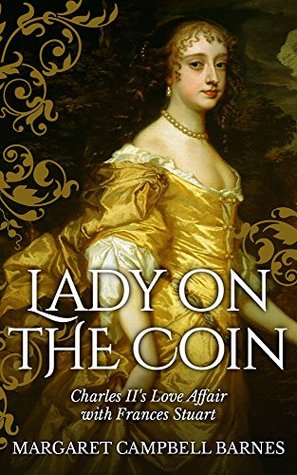
Lady on the Coin by Margaret Campbell Barnes

lady-on-the-coin One of the many things I enjoy about reading historical fiction is seeing how different authors choose to interpret the same historical events and people. This is the second novel I’ve read about Frances Stuart, one of the prominent figures at the court of Charles II, and as I remembered being disappointed in Marci Jefferson’s Girl on the Golden Coin, I was curious to find out how Margaret Campbell Barnes had approached the same subject in this novel from 1963.

Lady on the Coin opens with Frances Stuart (or Stewart, but I have gone with the spelling used by Barnes) and her family in exile in Paris where they have been living since the Royalists were defeated in England’s recent civil war. In 1660, the monarchy is finally restored and Charles II, to whom Frances is distantly related, takes the throne. After saying goodbye to her close friend, Henrietta – Charles’ beloved sister, ‘Minette’ – who has married the brother of Louis XIV of France, Frances returns to England to join the household of the new queen, Catherine of Braganza.

With her appealing combination of beauty, enthusiasm and youthful innocence, Frances soon finds herself with many friends and admirers at court, and Charles himself is one of them. Although she enjoys the attention, Frances has no desire to hurt Catherine, so she does her best to resist the King’s attempts to make her his mistress. As she comes under more and more pressure to agree to his demands, a rumour begins to circulate that he is planning to make her his wife should anything happen to Catherine. A chance of escape arrives when she falls in love with the King’s cousin, the Duke of Richmond and Lennox, but there will be more obstacles to overcome before they can find happiness together.

I found this book better written and more satisfying than Marci Jefferson’s. Although the two are very similar in terms of plot (I suppose there’s a limit as to how much could be written about Frances Stuart, after all), I felt that Margaret Campbell Barnes did a much better job of forming a compelling story from the material available and giving her characters depth. Frances is portrayed as frivolous and immature, but she also has a kind heart and I couldn’t help liking her, as did most of the people around her. I say ‘most’ because her popularity at court earns Frances some enemies as well as friends and puts her at the mercy of those who wish to manipulate her for their own ends, such as Barbara Palmer, Lady Castlemaine, the King’s mistress of many years.

Later in the novel, when Frances’ relationship with Lennox begins to develop and she has some important decisions to make, we see a stronger, more serious side to her character. I don’t know enough about the real Frances or Lennox to be able to say whether their relationship has been romanticised here, but I expect it probably has; he is described, by his own admission, as a gambler and heavy drinker, but these problems seem to be brushed aside very easily once he and Frances get together. I did find their romance quite moving, though, and much more interesting to read about than the King and his mistresses!

Frances Stuart’s story is played out during an eventful period of history, but important events such as the plague, the Great Fire of London and the Anglo-Dutch Wars seem to pass by in the background without having much of an effect on the life of our heroine. It’s probably true that Frances would have been very insulated from the outside world by her position at court, but I would still have liked a better balance between her personal story and the wider history of the period in general.

Now, you may be wondering why the title of the book refers to the ‘lady on the coin’. Well, one of Frances Stuart’s claims to fame is that she was apparently the model for Britannia, appearing on a commemorative medal produced after the war with the Dutch and then on various British coins until as recently as 2006.

Lady on the Coin is the second book I’ve read by Margaret Campbell Barnes; the first was Mary of Carisbrooke, which told the story of Charles I’s imprisonment in Carisbrooke Castle on the Isle of Wight. I’m sure I’ll be reading more of her books and the next logical choice is With All My Heart, her novel about Catherine of Braganza.

I received a copy of this book via NetGalley for review.

The Mill on the Floss by George Eliot

the-mill-on-the-floss Whenever I think about my favourite Victorian authors, George Eliot never seems to be a name that comes to mind – and yet I’ve liked everything I’ve read by her…Middlemarch, Romola and, years ago, Silas Marner. The Mill on the Floss is another one I can now add to this list; it was one of the titles on my Classics Club list I had been putting off reading and I really don’t know why. I didn’t love it as much as Middlemarch but I did enjoy it. It’s a beautifully written novel, though I wouldn’t expect anything less from George Eliot.

The Mill on the Floss was published in 1860, but set several decades earlier, beginning before the Reform Act of 1832. The story takes place in the fictional English town of St Ogg’s and at Dorlcote Mill which stands on the banks of the River Floss. The mill is owned by Mr Tulliver who lives there with his wife and two children, Tom and Maggie. He is keen for his son to receive a good education, so Tom is sent to school, but it’s nine-year-old Maggie who shows the most interest and aptitude for books and learning.

Remembering how much I loved reading myself when I was Maggie’s age and how much I value my 20th century education, I had a lot of sympathy for her when Tom’s tutor tells her that girls have a “great deal of superficial cleverness, but couldn’t go far into anything; they’re quick and shallow” or when she finds herself having a conversation like this one with her brother:

“Why, you couldn’t read one of ’em,” said Tom, triumphantly. “They’re all Latin.”

“No, they aren’t,” said Maggie. “I can read the back of this, – ‘History of the Decline and Fall of the Roman Empire.'”

“Well, what does that mean? You don’t know,” said Tom, wagging his head.

“But I could soon find out,” said Maggie, scornfully.

“Why, how?”

“I should look inside, and see what it was about.”

Although they don’t always see eye to eye (and despite Tom’s sense of superiority) Maggie and Tom do care about each other and their relationship is quite a strong one – until the day Philip Wakem, a lawyer’s son, joins Tom at Mr Stelling’s school. Tom dislikes Philip from the start, but Maggie grows very close to him and as the years go by they begin to have feelings for each other. Unfortunately for Maggie and Philip, their fathers have become sworn enemies following a lawsuit which has resulted in Mr Tulliver losing Dorlcote Mill. Maggie is forbidden to see any more of Philip, but when Tom discovers that they are still meeting in secret, she is forced to choose between her family and the man she is beginning to love.

There’s more to the story than this – a second love interest appears later in the novel and we also get to know several of Maggie’s aunts, uncles and cousins – but I’m not going to describe the plot in any more detail. I do want to mention the ending, though. It’s one of those endings which, when you first read it, is shocking, unexpected and not very satisfactory – but after you’ve had time to think about it, you decide it was perfect after all. That’s how I felt about it, anyway; I imagine other readers would have had a different reaction.

I don’t know very much about George Eliot as a person, but she writes so convincingly about Maggie’s childhood and about the ups and downs of sibling relationships that I wonder how much of it was autobiographical. These were my favourite sections of the book, but I liked, and had some sympathy for, the older Maggie too.

The Mill on the Floss is not a fast-paced novel and not a short one either, so it’s not the sort of book you can read quickly. I took my time with it, enjoying the beautiful writing, the descriptions of the town, the mill and the river, and the insights into life. And now I’m looking forward to reading the rest of Eliot’s books; I think Daniel Deronda will probably be next.

Revelation by CJ Sansom

revelation After reading Sovereign recently, I was desperate to continue with the next of CJ Sansom’s Shardlake mysteries – and luckily for me, I managed to find a copy of Revelation in the library the next day. I had said that Sovereign was my favourite in the series so far, so I was curious to see whether Revelation could possibly be as good. Well, it is; it’s even better! Before I continue, though, just a quick warning: although I’ve done my best to avoid spoilers here, this is the fourth book in the series and the appearance of certain characters in it will mean you can rule them out as suspects in the previous ones. My recommendation would be to start with book number one, Dissolution, and work through them in order.

Revelation is set in 1543, the year in which Katherine Parr becomes the sixth and final wife of Henry VIII, and after their adventures in York (described in Sovereign), lawyer Matthew Shardlake and his assistant Jack Barak are back in London. Shardlake has no desire to become embroiled in any more mysteries, but when a friend is found dead with his throat cut and his blood turning the water of a fountain red, it seems he will have no choice.

The dead man’s widow, Dorothy, is an old love interest of Shardlake’s, and he promises to help bring her husband’s killer to justice. However, it soon emerges that this is just the latest in a series of bizarre murders and, at the request of Archbishop Cranmer, Shardlake agrees to investigate. His involvement will bring him into contact with a circle of powerful men, including Edward and Thomas Seymour, brothers of the late Queen Jane, who have their own reasons for wanting the killer caught. Meanwhile, Shardlake has also taken on another intriguing case, one which involves a young man whose obsessive praying has resulted in imprisonment in the asylum known as Bedlam and could lead to him being arrested as a heretic.

As a murder mystery, I thought Revelation was excellent. There are plenty of suspects and although my guess turned out to be completely wrong, looking back I think we were given enough clues to at least have a chance of solving the mystery. I loved the way the murders corresponded to passages in the Book of Revelation from the Bible. The deaths are quite gruesome, but I didn’t find the book excessively graphic – although it depends on how high your tolerance is for that kind of thing, I suppose.

Four books into the series, I feel that I’m getting to know Shardlake well and I’m able to settle into his narration from the very first page. I think one of the reasons I find him such an engaging character is that, while he’s generally likeable, he does have flaws and he does make mistakes and lose his temper from time to time. He doesn’t seem to have much luck with women and I wondered if he would find love with Dorothy this time. I won’t tell you whether he does or not, of course! Barak isn’t faring much better in the relationship stakes either. I was quite fond of him in the previous novels and I still am, I think, but his treatment of Tamasin in this book really frustrated me.

Barak is by Shardlake’s side, as ever, as he investigates each murder, but I was pleased to see that another of Shardlake’s old friends, Guy Malton, also has a big part to play in the story. Guy, the former monk from Scarnsea Monastery in Dissolution, is now working as a physician in London and his medical skills prove to be very useful in establishing the causes of the deaths and also in offering assistance to the boy locked in the Bedlam. However, Guy has taken on a new apprentice whom Shardlake dislikes and distrusts from their first meeting, and this puts a big strain on their friendship.

In addition to all of this, we are treated to the usual vivid portrayal of Tudor life I’ve come to expect from Sansom, drawing us into the political and religious debates that marked this stage of Henry’s reign. I found it all fascinating and am looking forward to reading Heartstone, which I hope I’m going to enjoy even more than this one.

Historical Musings #20: Exploring Japan

Historical Musings In previous Historical Musings posts, I’ve confessed to a lack of knowledge of the histories of certain African and European countries and was pleased to receive so many intriguing suggestions for future reading. This month’s post is on a similar topic, but much more specific as this time I’m asking about just one particular country rather than a whole continent!

shogun I’ve recently finished reading Lesley Downer’s The Shogun’s Queen, one of a quartet of novels set in nineteenth century Japan. The book tells the story of Atsu, the wife of Iesada, the 13th Tokugawa Shogun. I have yet to post my full thoughts, but for now I can say that I found it all fascinating; everything that happened in the novel was completely new to me and as I read, I couldn’t stop thinking about how little knowledge I have of Japan’s history. In fact, the only other historical novel I can think of that I’ve read set in Japan is Shogun by James Clavell (set much earlier than the Lesley Downer book, in 17th century feudal Japan).

Hotel on the Corner of Bitter and Sweet I read Shogun a few years before I started blogging in 2009, and I was convinced that, surely, I must have read something else set in Japan since then! A search through my blog archives, however, shows that I haven’t – although I have read some books that touch on various aspects of Japanese history and culture. For example, the gardener Aritomo in Tan Twan Eng’s The Garden of Evening Mists is Japanese and the story is set partly during Japan’s occupation of Malaya. China Dolls by Lisa See and Hotel on the Corner of Bitter and Sweet by Jamie Ford both explore the fate of Japanese Americans during World War II, while Ghostwritten by Isabel Wolff features the story of a character who was interned in a Japanese camp in Java. Other than these few books, Japan doesn’t seem to have featured in my reading at all in recent years.

So, my question this month is:

Which books would you recommend to someone who knows almost nothing about Japan’s history? Fiction, non-fiction and classics…any suggestions are welcome!

The Romance of the Forest by Ann Radcliffe

the-romance-of-the-forest If you were going to write a Gothic novel, what sort of things would you include? Dark forests? Ruined abbeys? Stormy weather? Wicked noblemen? Secret manuscripts? Skeletons? Well, you’ll find all of those and more in Ann Radcliffe’s 1791 classic, The Romance of the Forest. Radcliffe was one of the earliest pioneers of the Gothic novel and, while I can see that her books won’t appeal to everyone, I’ve now read four of them and enjoyed them all – although this one is not her best.

The story is set in 17th century France and opens with Pierre de la Motte, who has found himself in debt, fleeing Paris with his wife and servants, hoping to get as far away from his creditors as possible. Losing their way in the dark, they see lights shining from a house in the distance and Pierre knocks on the door to ask for help. He gets more than he bargained for, however, when the man who answers the door pushes a beautiful young lady towards him and begs Pierre to take her away with him. Pierre agrees and the family, with the addition of the girl, whose name is Adeline, continue on their way.

They find refuge in an old, deserted abbey and decide to settle there for a while, safe in the knowledge that their pursuers are unlikely to find them in such a remote and gloomy place. Inside the abbey, though, there are new terrors to face. The discovery of a skeleton, a rusty dagger and a faded manuscript point to a murder in the abbey’s history – and when the sinister Marquis de Montalt arrives on the scene, Adeline senses that her own life could also be in danger.

Ann Radcliffe is not known for her strong heroines and Adeline is no exception, so be prepared for some fainting and swooning and lots of melodrama. Having said that, she does have strong principles, and tries, in her own way, to fight for what she wants and believes in. Like Emily St Aubert in The Mysteries of Udolpho, she also has a habit of picking up her lute and breaking into song from time to time (giving Radcliffe an opportunity to insert her own poems into the text).

I didn’t find this book quite as atmospheric as her others (certain sections of The Italian, in particular, have a darkness and an eeriness that are never matched in this book), but her descriptive writing is still beautiful:

Dark woods, intermingled with bold projections of rock, sometimes barren, and sometimes covered with the purple bloom of wild flowers, impended over the lake, and were seen in the clear mirror of its waters. The wild and alpine heights which rose above were either crowned with perpetual snows, or exhibited tremendous crags and masses of solid rock, whose appearance was continually changing as the rays of light were variously reflected on their surface, and whose summits were often wrapt in impenetrable mists.

I also enjoyed seeing the plot unfold in the final third of the novel, with revelation following upon revelation. There are some coincidences which are too convenient or too ridiculous to be believed and any big holes in the plot are explained away as ‘fate’ or ‘destiny’. These are things that would bother me in any other type of novel, but in an 18th century Gothic novel, they’re exactly what I would expect and so I was able to suspend my disbelief without any problems!

This is a weaker Radcliffe novel, in my opinion, so if you’ve never read any of her books before I would probably recommend beginning with a different one. The Italian, The Mysteries of Udolpho and A Sicilian Romance are the others I’ve read and any of those might be a better starting point.

Burning Sappho by Martha Rofheart

burning-sappho There are some historical women whose lives have been written about in fiction many times but I think it’s safe to say that Sappho, the Greek lyric poet, doesn’t seem to be one of them. This novel, first published in 1974, is the first I’ve come across that tells her story and much as I do enjoy reading about Tudor queens and medieval princesses, it’s always refreshing to have the opportunity to read about somebody different!

Very little is known for certain about Sappho’s life. We do know that she was born on the Greek island of Lesbos, possibly between 630 and 612BC, and grew up in the port town of Mitylene. We know the probable names of some of her family members and we know that she was exiled from Mitylene twice. Beyond this, most of the information we have about Sappho is unreliable or based on the remaining fragments of her poetry, which may or may not have been autobiographical. It’s enough to build a novel around, though, and in Burning Sappho Martha Rofheart uses the known facts as a starting point to give a possible interpretation of what Sappho’s life could have been like.

We don’t have much factual information about the other characters who appear in the novel either – and I have to admit, I hadn’t even heard of most of them and didn’t know whether they were real or fictional, so Google proved very useful there! Some of the most notable characters include Gorgo, a girl from Sparta who angers Sappho by befriending Andromeda, the Nubian slave purchased by Sappho’s father; Alkaios, a fellow poet and the man Sappho loves; Pittakos, who rules Mitylene after the downfall of the Tyrant, Melanchros; and the famous courtesan Doricha, known as Rhodopis. I was also pleased to see Aesop make a few appearances – one character I had at least heard of!

The novel is divided into five sections; there are two narrated by Sappho herself and one each from the points of view of Alkaios, Doricha/Rhodopis and the sea trader, Kerkylas of Andros. There’s not a lot of difference between the voices of the narrators so it took a while to adjust to each change of perspective, but otherwise I thought the structure worked well. I preferred Sappho’s own narration, but hearing from other people who were close to her helped me to form a more balanced view of her as a person. There seems to be a lot of debate surrounding Sappho’s sexuality (the word lesbian is derived from the name of Sappho’s home, Lesbos), but Rofheart portrays her as having relationships with both men and women. In particular, she is shown to be in love with a girl called Atthis, whose name is mentioned in some of her love poetry.

I always admire people who write fiction set in ancient periods; I think it must be very difficult, when we have such limited knowledge of how people lived in those times. On reading Martha Rofheart’s Author’s Note and list of acknowledgments at the end of the book, I can appreciate the efforts she went to in researching her novel – for example, she states that as the geographical landscape has changed so much over the centuries, she has based her descriptions of the Greek islands on how they appeared in ancient writings rather than modern day ones. However, I still felt that there was something a little bit too ‘modern’ about this book – maybe it was the attitudes of some of the characters and the language they used. It wasn’t a huge problem, but the best way I can explain it is that I was always conscious that I was reading a story written in the 1970s, rather than being completely swept away to another time and place.

Still, I thought this was a fascinating novel and an educational one too. I knew absolutely nothing about this period before I started to read so I don’t feel qualified to comment on the historical accuracy or the choices Rofheart makes, but even if not everything happened as she describes it, I feel that I’ve learned a lot about the history of Lesbos. Although the focus is usually on Sappho and her music, she lived through a time of political turmoil; one of the most memorable scenes in the book describes the overthrow of Melanchros the Tyrant (which is sparked, in Rofheart’s version of events, by Sappho’s performance of a song she has written in protest against the custom of child sacrifice).

Burning Sappho (also published as My Name is Sappho) was an enjoyable read. Although it wasn’t quite as immersive as I would have liked, I thought it was much better than Lionheart, the other Martha Rofheart book I’ve read. She has written several other historical novels, all set in different periods, and I’m looking forward to working my way through them. As for Sappho, I can only find details of one or two other novels about her, but there seems to be plenty of non-fiction, including collections of her surviving writings. Now that I’ve been introduced to this fascinating woman, I’m interested in reading more about her!

Note: The spellings of names and places used in this review are as they appear in the novel and may vary between different sources.

I received a review copy of this book from the publisher via NetGalley.

Top Ten Tuesday: Ten books I’ve added to my TBR list lately

Top Ten Tuesday

This week’s Top Ten Tuesday topic (hosted by The Broke and the Bookish) is Ten Books I’ve Added To My To-Be-Read List Lately. This seemed like a good one to participate in, as it gives me a chance to highlight some of the books I’ve acquired recently but don’t know when I’ll get round to reading.

All blurbs are taken from Goodreads.

~

1. Sandokan: The Tigers of Mompracem by Emilio Salgari

I hadn’t heard of this book but was tempted when I was offered a review copy as it’s a classic Italian adventure novel, first published in 1900.

sandokan “Malaysia, 1849. The Tigers of Mompracem are a band of rebel pirates fighting for the defense of tiny native kingdoms against the colonial powers of the Dutch and British empires. They are led by Sandokan, the indomitable “Tiger of Malaysia”, and his loyal friend Yanez De Gomera, a Portuguese wanderer and adventurer. Orphaned when the British murdered his family and stole his throne, Sandokan has been mercilessly leading his men in vengeance. But when the pirate learns of the extraordinary “Pearl of Labuan” his fortunes begin to change…”

~

2. The Phantom Tree by Nicola Cornick

I’ve never read anything by this author but I spotted this book on NetGalley and thought it sounded interesting.

the-phantom-tree “Browsing antiques shops in Wiltshire, Alison Bannister stumbles across a delicate old portrait – supposedly of Anne Boleyn. Except Alison knows better… The woman is Mary Seymour, the daughter of Katherine Parr who was taken to Wolf Hall in 1557 as an unwanted orphan and presumed dead after going missing as a child.

The painting is more than just a beautiful object for Alison – it holds the key to a past life, the unlocking of the mystery surrounding Mary’s disappearance, and the enigma of Alison’s son. But Alison’s quest soon takes a dark and foreboding turn, as a meeting place called the Phantom Tree harbours secrets in its shadows…”

~

3. The Witchfinder’s Sister by Beth Underdown

Another one from NetGalley. A few weeks ago I was looking for recommendations of historical novels about witches, so this is quite appropriate!

the-witchfinders-sister “1645. When Alice Hopkins’ husband dies in a tragic accident, she has no choice but to return to the small Essex town of Manningtree, where her brother Matthew still lives.

But home is no longer a place of safety. Matthew has changed, and there are rumours spreading through the town: whispers of witches, and of a great book, in which her brother is gathering women’s names. To what lengths will her brother’s obsession drive him? And what choice will Alice make, when she finds herself at the very heart of his plan?”

~

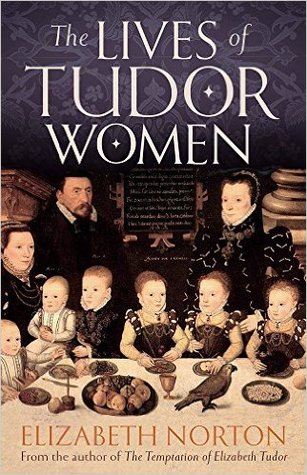
4. The Lives of Tudor Women by Elizabeth Norton

I don’t read a lot of non-fiction books but I think I might find this one interesting.

the-lives-of-tudor-women “The turbulent Tudor age never fails to capture the imagination. But what was it actually like to be a woman during this period? This was a time when death in infancy or during childbirth was rife; when marriage was usually a legal contract, not a matter for love, and the education of women was minimal at best. Yet the Tudor century was also dominated by powerful and characterful women in a way that no era had been before.

Elizabeth Norton explores the seven ages of the Tudor woman, from childhood to old age, through the diverging examples of women such as Elizabeth Tudor, Henry VIII’s sister who died in infancy; Cecily Burbage, Elizabeth’s wet nurse; Mary Howard, widowed but influential at court; Elizabeth Boleyn, mother of a controversial queen; and Elizabeth Barton, a peasant girl who would be lauded as a prophetess.”

~

5. The Printer’s Coffin by M.J. Carter

I’ve just finished reading the first book in this series and enjoyed it so much I couldn’t wait to order the second one! This was originally published as The Infidel Stain.

the-printers-coffin “It’s 1841, and three years after we left them at the close of The Strangler Vine, Blake and Avery are reunited in very different circumstances in London.

There has been a series of dreadful murders in the slums of the printing district, which the police mysteriously refuse to investigate, and Blake and Avery must find the culprit before he kills again.”

~

6. Redgauntlet by Sir Walter Scott

It’s been a while since I’ve read anything by Scott and I liked the sound of this one.

redgauntlet “Arguably Scott’s finest novel, and the last of his major Scottish novels, Redgauntlet centers around a third, fictitious, Jacobite rebellion set in the summer of 1765. The novel’s hero, young Darsie Latimer, is kidnapped by Edward Hugh Redgauntlet, a fanatical supporter of the Stewart cause, and finds himself caught up in the plot to install the exiled Bonnie Prince Charlie on the British throne.

First published in 1824, this is perhaps Scott’s most complex statement about the relation between history and fiction.”

~

7. Oswiu: King of Kings by Edoardo Albert

I enjoyed the first two books in this trilogy, so I’m looking forward to reading the third.

oswiu “In the third entry chronicling the rise of Christian kings in Britain, Oswald dies and the great pagan king Penda becomes overlord in his place. To stand against the increasingly powerful Penda, Oswiu, king of Bernicia, tries to unite the smaller neighboring kingdoms by marrying a daughter of Deira. But the struggle for power leads Oswiu to order the assassination of the king of Deira. He wins the throne but loses the approval of the people. In atonement, he establishes a monastery at the site of the slaying. What will happen when Oswiu and High King Penda at last meet in battle? Though the kingdom may become politically one, both the Celtic and Roman strands of Christian faith vie for supremacy, mirroring the king’s own struggle for power.”

~

8. A Gentleman in Moscow by Amor Towles

I’m curious about this book as I’ve been hearing a lot about it recently.

a-gentleman-in-moscow “On 21 June 1922 Count Alexander Rostov – recipient of the Order of Saint Andrew, member of the Jockey Club, Master of the Hunt – is escorted out of the Kremlin, across Red Square and through the elegant revolving doors of the Hotel Metropol. But instead of being taken to his usual suite, he is led to an attic room with a window the size of a chessboard. Deemed an unrepentant aristocrat by a Bolshevik tribunal, the Count has been sentenced to house arrest indefinitely.

While Russia undergoes decades of tumultuous upheaval, the Count, stripped of the trappings that defined his life, is forced to question what makes us who we are. And with the assistance of a glamorous actress, a cantankerous chef and a very serious child, Rostov unexpectedly discovers a new understanding of both pleasure and purpose.”

~

9. The Bear and the Nightingale by Katherine Arden

This appeals to me as I love books based on fairy tales. The cover is beautiful too.

the-bear-and-the-nightingale “A young woman’s family is threatened by forces both real and fantastical in this debut novel inspired by Russian fairy tales.

In a village at the edge of the wilderness of northern Russia, where the winds blow cold and the snow falls many months of the year, a stranger with piercing blue eyes presents a new father with a gift – a precious jewel on a delicate chain, intended for his young daughter. Uncertain of its meaning, Pytor hides the gift away and Vasya grows up a wild, wilful girl, to the chagrin of her family. But when mysterious forces threaten the happiness of their village, Vasya discovers that, armed only with the necklace, she may be the only one who can keep the darkness at bay.”

~

10. The Norman Pretender by Valerie Anand

I loved Valerie Anand’s Gildenford and it’s time I continued with the next book in the series.

the-norman-pretenderThe Norman Pretender continues the story of the great Godwin family, Earls of Wessex, and the most powerful faction in England. The book opens in 1052 and takes us in a series of brilliantly constructed episodes up to its climax at the Battle of Hastings and its tragic aftermath. Much of the action takes place in Normandy, where Harold Godwinson is rescued by Duke William from captivity, only to be tricked later into swearing an oath securing William’s succession to the English throne.”

~

Have you read any of these or are there any you would be interested in reading? What have you added to your own TBR lately?