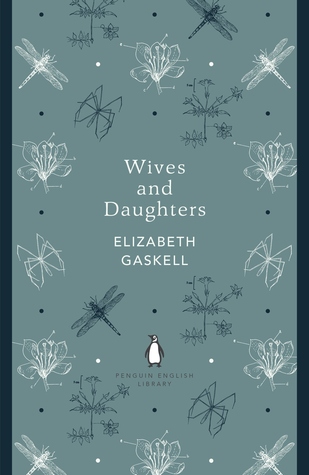
 Now that I’m starting to come towards the end of my Classics Club list, I’m having to tackle some of the books I’ve been putting off reading since I put the list together in 2012. I’m really not sure why I haven’t picked up Wives and Daughters until now; I’ve enjoyed everything else I’ve read by Gaskell (North and South, Sylvia’s Lovers, The Moorland Cottage, Cranford and Mr Harrison’s Confessions) so it seemed likely that I would enjoy this one too. And did I? Yes, of course I did!
Wives and Daughters is set in a village in England in the 1830s, a world similar to the one Gaskell created in Cranford, where everyone knows everyone else’s business. Molly Gibson, our heroine, is the daughter of the village doctor; her mother is dead and, as an only child, Molly is very close to her father. The two have a strong relationship built around love and trust, but the harmony of their little household is disrupted when Mr Gibson decides to marry again. His new wife is the beautiful widow, Hyacinth Kirkpatrick, former governess to the Duke of Cumnor’s children, and he hopes she will provide the seventeen-year-old Molly with the motherly guidance he is unable to give. Unfortunately, Hyacinth proves to be a selfish, manipulative woman and she and Molly don’t always see eye to eye.
As well as a new stepmother, Molly also has a new stepsister – Cynthia. Although she and Cynthia have very different personalities, the two girls become good friends – and it is this friendship which will get Molly into trouble when she tries to help Cynthia find a way out of her tangled love affairs. Meanwhile, there’s a romance for Molly too but it’s quite a subtle one and also quite one-sided, as the man she loves appears to be in love with someone else, so poor Molly has to keep her feelings to herself.
Wives and Daughters is a very long novel, with more than 700 pages, and there were times when it seemed to be going on forever, but I didn’t really mind because once I’d been pulled into Molly’s world I didn’t want to leave it again. I didn’t want to leave the characters behind either – they were drawn with so much care and in so much depth. I loved Molly for her honesty, intelligence and kind heart, and Cynthia, with all her charms, flaws and vulnerabilities, was also an interesting character. But I particularly enjoyed reading about the family at nearby Hamley Hall: the old country squire, his invalid wife, and their two sons, Osborne and Roger.
First published as a serial between 1864 and 1866, this was Elizabeth Gaskell’s last novel, sadly left unfinished at the time of her death. I was aware that it was unfinished before I started to read, so I was prepared to be left feeling frustrated (as I was when I read Dickens’ The Mystery of Edwin Drood) but luckily this wasn’t the case. At the point where the novel finished I could see the direction in which the plot was heading and I was satisfied that, if the story had continued, things would have worked out in the way that I’d hoped.
Gaskell has a style all of her own, but I think this particular book would appeal to readers of Jane Austen; I could see some similarities in the characterisation, the dialogue and the shape of the plot. So far all of the books I’ve read by Gaskell have been quite different from each other. Wives and Daughters is probably my favourite so far, but I’m looking forward to reading the other two novels I haven’t read yet – Ruth and Mary Barton.

 She Reads Novels