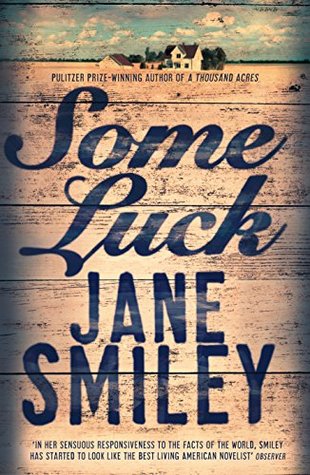
Some Luck by Jane Smiley

Some Luck This is the first volume of a trilogy following the lives of the Langdon family across a period of a century. Beginning in 1920 and ending in 2020 (although Some Luck only takes us up to 1953), we will get to know several generations of the family over the course of the three novels, watching as the children grow up, get married and have children of their own, sharing their hopes and dreams, and accompanying them through some of the events which shaped the last one hundred years of American history.

At the heart of the story are Walter and Rosanna Langdon, a young married couple who, as the novel opens, are settling into life on the farm they have recently bought in Iowa. Rosanna has just given birth to their first child, Frank, and in the first few chapters, not only do we see things through the eyes of the two adults, but also through the baby’s, to whom everything in the world is new and strange. As the years go by, four more sons and daughters follow: quiet, gentle, animal-loving Joey; the sweet and angelic Lillian; Henry, who loves reading; and Claire, the youngest and her father’s favourite. Frank himself is handsome, clever and adventurous – and the contrast between his personality and Joey’s adds an interesting angle to the dynamics of the Langdon family.

The novel is carefully structured so that each chapter is devoted to one year and this keeps the story moving forward at a steady pace. However, it also gives the book an episodic feel; each time a new chapter begins and we find that we’ve jumped straight into the following year, there’s a sense that there are some gaps in the story and that things may have changed without our knowledge in a way that wouldn’t happen with a more fluent narrative. Also, as is true in all of our lives, some years are more eventful than others, which means that some chapters are more interesting than others.

Really, though, this is not a book you would choose to pick up if you were looking for a thrilling, action-packed read. Some Luck is a quiet, low-key story about ordinary people leading ordinary lives. Much of the novel is concerned with farming and all it involves: planting and harvesting crops, shearing sheep, trying to cope with summer droughts and winter snowdrifts. It reminded me in this respect of other farm-based novels I’ve read – Willa Cather’s My Antonia and, of course, Little House on the Prairie.

There are some dramas in the lives of the Langdons, but they are relatively small ones – the sort of things that could happen to any of us. Historical events are experienced mainly as the effects filter through to their remote Iowa farm – advances in farming methods, such as the replacement of horses with tractors, cause a lot of excitement and controversy – but occasionally a family member decides to leave the farm and see more of the world. Frank enlists in the army during the Second World War and is sent to North Africa, Rosanna’s sister Eloise moves to Chicago and marries a communist, and Lillian…well, I won’t say too much about what Lillian does except that it’s the one thing I found hard to believe.

Some Luck is the first book I have read by Jane Smiley. I’m aware that A Thousand Acres was her Pulitzer Prize-winning novel and might have been a better choice for me to start with, but I did still enjoy this one and am planning to continue with the trilogy soon. I have the next two books – Early Warning and Golden Age – ready to read.
Classics Spin #12: The Result!

Last week I decided to take part in the Classics Spin. The idea of the Spin was to list twenty books from my Classics Club list, number them 1 to 20, and the number announced today (Monday) represents the book I have to read before 2nd May 2016.

The number that has been selected by the Classics Club this time is #8, which means the book I’ll be reading is:

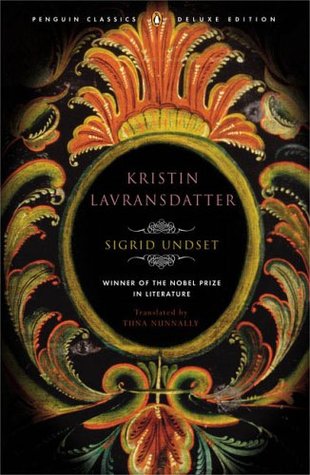
Kristin Lavransdatter

Kristin Lavransdatter by Sigrid Undset

I have to admit, this is not one of the books I was hoping for – although I’m still quite happy with this result. I do think I’ll enjoy it, but having just finished Vanity Fair today I would really have liked something shorter and lighter. This is the longest book left on my Classics Club list so trying to read it by the May deadline might be too ambitious, but I should at least have time for the first volume, The Wreath.

Have you read Kristin Lavransdatter? What did you think? And if you took part in the spin too, what will you be reading?

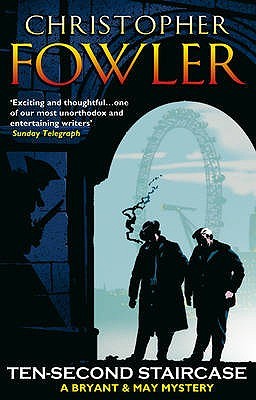
Ten-Second Staircase by Christopher Fowler

What a wonderful imagination Christopher Fowler has! This fourth novel in the Bryant and May mystery series involves the bizarre deaths of several minor celebrities, a mysterious highwayman complete with horse, cape and tricorn hat, gangs of feuding schoolchildren and a possible link to the Knights Templar. It’s just the sort of case the Peculiar Crimes Unit was created to deal with, and this is one of the most peculiar yet.

Ten Second Staircase As the novel opens, we learn that yet again the PCU is facing the threat of closure, with Bryant and May’s outdated methods of detection coming under attack. Bryant and May – Arthur and John – are the two elderly detectives around whom the rest of the unit revolves. John May is logical, methodical and more open to modern technology, but his partner prefers to rely on his tried-and-tested network of historians, clairvoyants, witches and psychics. Their different personalities and different approaches to crime-solving are the reasons why the two of them have had so much success over the years, right from the very first case they worked on together during the Second World War (described in Full Dark House). Among the successes, however, there has been one failure: the identity of the serial killer known as the Leicester Square Vampire, which has remained unknown since the 1970s.

Bryant and May’s latest mystery begins when a controversial modern artist is drowned in the display case of one of her own art installations. The only witness is Luke Tripp, a twelve-year-boy from nearby St Crispin’s Boys’ School, who claims to have seen a figure resembling Dick Turpin ride into the gallery on horseback and throw the artist into the tank. No sooner have the detectives begun to investigate than the Highwayman strikes again, his second murder as strange and inexplicable as the first. As Bryant and May dig deeper, they uncover some similarities between the Highwayman and the Vampire; if only they can find a way to solve both mysteries at once, the future of the PCU could be secured.

I enjoyed Ten-Second Staircase as I’ve enjoyed all of the previous books in this series, but this is probably my least favourite of the four. The Peculiar Crimes Unit seems to have been facing closure in every book so far and that aspect of the story is starting to feel repetitive, especially as with another nine (at least) books to follow, it was obvious that it would be allowed to stay open. I also couldn’t help feeling that the author was using Bryant and May in this book to voice his own views and opinions on society; this meant that the dialogue sometimes felt more like a lecture rather than a natural conversation between friends.

The things that I did love in this book were the same things I loved in the first three: the unusual and imaginative mystery (which, as usual, I failed to solve), Arthur’s unorthodox detection methods, and the fascinating historical facts and pieces of trivia which are incorporated into the plot. The real attraction of this series, of course, is the partnership of Bryant and May themselves, but we do get to know other members of the PCU as well and some of these characters are developed further in this novel, particularly May’s agoraphobic granddaughter, April, who I’m sure we’ll see more of in future books.

I’ll be continuing soon with book number five, White Corridor!

Classics Spin #12: My list

The Classics Club

The Classics Club have announced another of their Classics Spins today; I wasn’t sure whether to take part as I’m already reading two classics (Mauprat by George Sand and Vanity Fair by William Makepeace Thackeray) but I’m more than halfway through both so I’m sure I’ll have time to read one more before the spin deadline!

Here is a reminder of the Spin rules:

* List any twenty books you have left to read from your Classics Club list.
* Number them from 1 to 20.
* On Monday the Classics Club will announce a number.
* This is the book you need to read by 2nd May 2016

And here is my list:

1. The Woodlanders by Thomas Hardy
2. Louise de la Vallière by Alexandre Dumas
3. Mary Anne by Daphne du Maurier
4. The Mill on the Floss by George Eliot
5. Crime and Punishment by Fyodor Dostoevsky
6. I, Claudius by Robert Graves
7. Howards End by E.M. Forster
8. Kristin Lavransdatter by Sigrid Undset
9. The Heir of Redclyffe by Charlotte M. Yonge
10. The Leopard by Giuseppe Tomasi di Lampedusa
11. Shirley by Charlotte Brontë
12. Excellent Women by Barbara Pym
13. The Red House Mystery by A.A. Milne
14. Around the World in Eighty Days by Jules Verne
15. Wuthering Heights by Emily Brontë (re-read)
16. The Day of the Triffids by John Wyndham
17. Prince of Foxes by Samuel Shellabarger
18. Frenchman’s Creek by Daphne du Maurier
19. Wives and Daughters by Elizabeth Gaskell
20. East of Eden by John Steinbeck

It was easy to put this selection together because I only have 25 books left on my Classics Club list now. At this stage, I really don’t mind which one I get, but I’m particularly hoping for number 2, 3, 10, 12 or 17.

Have you read any of these books? If you’re a member of the Classics Club, will you be joining in with this spin?

The Lion and the Cross by Joan Lesley Hamilton

The Lion and the Cross If you’re looking for the perfect book to read as St Patrick’s Day approaches, this could be it. Originally published in 1979, The Lion and the Cross: A Novel of Saint Patrick and Ancient Ireland has recently been made available as an ebook by Open Road Media. Narrated by Patrick himself, it is a fictional account of the life of the man who would become Ireland’s patron saint.

The story takes place in the 5th century, a time of unrest and uncertainty as the period of Roman rule in Britain has come to an end, leaving the country vulnerable to attacks from raiders. As the novel opens in the year 410, Magonus Sucatus Patricius, son of wealthy Romano-Britons, is sixteen years old. Despite being the grandson of Potitus the priest, Magonus himself has no intention of devoting his life to religion, but this is something which will slowly change. The first big turning point in Magonus’s life comes when he is captured by barbarian raiders who take him across the sea to Ireland where he is sold into slavery.

Now known as Padraic, or Patrick, he spends the next few years herding sheep in the Irish countryside and – after catching the attention of the Ri and Rigan (king and queen) – trying to survive the intrigues and machinations of the court. During this time his faith strengthens and when he eventually manages to escape from his captivity and from Ireland, Patrick must make the decision whether to one day return and convert the people to Christianity.

In The Lion and the Cross, Joan Lesley Hamilton has drawn on a variety of sources including The Confession of St Patrick, Irish mythology and historical fact to recreate the story of Patrick’s life. As she states in her author’s note, this period of history is ‘obscured by the roiling, silent fog of centuries’ and there are many things we don’t know about Patrick and his world; however, I think Hamilton does a good job of working with what little information is available and finding the right balance between fact and fiction.

The praise at the front of this book compares it to Mary Stewart’s Merlin trilogy, which I have read and loved. Although they are very different stories, I can understand the comparison; like Stewart’s The Crystal Cave, The Lion and the Cross is set shortly after the decline of the Roman Empire, it is narrated by a young male protagonist and it has a slightly magical feel (the first chapter deals with Patrick’s meeting with the Morrighan, a legendary Celtic goddess). The writing is quite beautiful and poetic at times, but let down by the dialogue – some of the characters speak with Irish accents which, to me, don’t sound at all right.

Patrick himself is not the easiest of characters to like. He is a stubborn, arrogant and defiant young man and because of this, despite the ordeals he goes through, I sometimes found him difficult to connect with. Patrick’s personality, though, is an important part of the story; it’s the reason he’s able to survive and to accomplish what he does, and it explains his internal struggles with God and the doubts he has to overcome. I did enjoy learning about Patrick and his life, but the religious element of the novel is very strong (as you would expect from a book about a saint) and I think the ideal reader for this book would be someone with a particular interest in religious history.

Thanks to the publisher for providing a copy of this book for review.

My commonplace book: February 2016

commonplace book
Definition:
noun
a notebook in which quotations, poems, remarks, etc, that catch the owner’s attention are entered

Collins English Dictionary

~

A summary of this month’s reading, in words and pictures.

~

Every sound of the quiet evening came clearly to her ears with an unnatural distinctness; but now each one possessed a different and terrifying meaning. The muffled shouts and laughter of the few remaining bathers from the indoor swimming bath were the cries of fleeing, panic-stricken people. The whisper of the breeze through the pine needles was a frightened man whispering orders in the shadow of fog-shrouded whin bushes. A passing car was the drone of an enemy bomber and the faint lap of water against the sea-green tiles at the far side of the wide pool was the lap of waves against a pebble beach.

Death in Berlin by M. M. Kaye (1955)

~

“The promise of the day!” said Visconti, dreamily and sadly. “Hath it never struck thee how that promise never is fulfilled? Day after day, since the world began, something in the mystery of the dawn is promised – something the sunset smiles to see unfulfilled – something men have ever been cheated of – something men will never know – the promise of the dawn!”

The Viper of Milan by Marjorie Bowen (1906)

~

Louis X

Uncertain health, a clever but overbearing father whose authority had crushed him, an unfaithful wife who had scoffed at him, an empty treasury, impatient vassals always ready to rebel, a famine in the first winter of his reign, a storm which threatened the life of his second wife – beneath what disastrous conjunction of the planets, which the astrologers had not dared reveal to him, must he have been born, that he should meet with adversity in every decision, every enterprise, and end by being conquered, not even nobly in battle, but by the water and mud in which he had engulfed his army?

The Poisoned Crown by Maurice Druon (1956)

~

She looked up as the train passed, and I was almost near enough to catch her eye. She had a round pale face, the usual exhausted face of the slum girl who is twenty-five and looks forty, thanks to miscarriages and drudgery; and it wore, for the second in which I saw it, the most desolate, hopeless expression I have ever-seen. It struck me then that we are mistaken when we say that ‘It isn’t the same for them as it would be for us,’ and that people bred in the slums can imagine nothing but the slums. For what I saw in her face was not the ignorant suffering of an animal. She knew well enough what was happening to her — understood as well as I did how dreadful a destiny it was to be kneeling there in the bitter cold, on the slimy stones of a slum backyard, poking a stick up a foul drain-pipe.”

The Road to Wigan Pier by George Orwell (1937)

~

Flag of Iowa

After all no fledgling had it easy, farmer or crow. Hadn’t he known since he was a boy the way the fledglings had to fall out of the nest and walk about, cheeping and crying, until they grew out their feathers and learned to fly on their own? Their helpless parents flew above them, and maybe dropped them a bit of food, but flying or succumbing belonged to them alone.

Some Luck by Jane Smiley (2014) – review to follow

~

“I must insist upon it,” she continued, “that you shall take me now as I really am — as your dearest friend, your sister, your mother, if you will. I know what I am. Were my husband not still living it would be the same. I should never under any circumstances marry again. I have passed the period of a woman’s life when as a woman she is loved; but I have not outlived the power of loving.”

Phineas Redux by Anthony Trollope (1873)

~

“There is no other way, Robert,” James said quietly, watching the emotions shift across his face. “If Balliol returns you lose everything. At least this way you have a chance to make sure you and your family are protected. Our best hope is that Edward will be able to keep Balliol from the throne. If he succeeds, God willing, you may one day still claim it.”

Renegade by Robyn Young (2012)

~

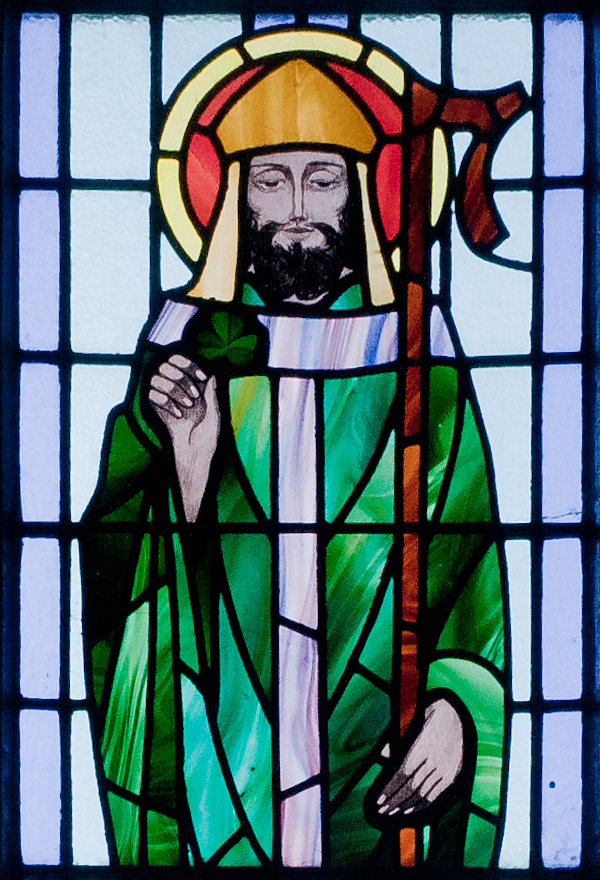
St Patrick

And so it came to be that they carried me away into bondage, slung over the shoulder of the black-beard while the girl walked, roped behind. I cannot tell you of the voyage, nor of the faces of the many who were taken into captivity with us. I can only say that on that day “…the Lord brought over us the wrath of His anger and scattered us among many nations, even unto the utmost part of the earth, where now my littleness is placed among strangers” in the land known as Eire.

The Lion and the Cross by Joan Lesley Hamilton (1979) – review to follow

~

Everybody was bowing, sliding on to one knee as Henry came into the chamber, leaning on his staff and smiling…Here comes the King, and with the coming of the King, all life must stop, the very air must thicken as if congealed in awe of this gross man who hobbled painfully on his tall staff, nodding and smiling, blinking every second.

Here Comes the King by Philip Lindsay (1933)

~

In a country where so many desire status and wealth, petty annoyances can spark disproportionately violent behaviour. We become frustrated because we feel powerless, invisible, unheard. We crave celebrity, but that’s not easy to come by, so we settle for notoriety. Envy and bitterness drive a new breed of lawbreakers, replacing the old motives of poverty and the need for escape. But how do you solve crimes which no longer have traditional motives?

Ten-Second Staircase by Christopher Fowler (2006) – review to follow

~

Favourite books this month: Phineas Redux and The Viper of Milan

The Butcher’s Hook by Janet Ellis

The Butchers Hook Life is not easy for Anne Jaccob, the young protagonist (more anti-heroine than heroine) of The Butcher’s Hook. Her mother is an invalid, her father is cold and distant, and she is struggling to warm to her new baby sister, who will never, ever take the place of the beloved little brother who died. The one bright spot in Anne’s life is her secret romance with Fub, the butcher’s apprentice, but even this is threatened when her father announces that he is arranging a marriage for her with the vile Simeon Onions. It seems that Anne is going to have to take matters into her own hands…

The Butcher’s Hook is the debut novel of Janet Ellis, who is probably best known for presenting the BBC’s long-running children’s show Blue Peter in the 1980s. It’s an unusual and imaginative story set in a Georgian London populated with colourful, larger-than-life characters. Many of them feel as though they could have stepped out of the pages of a Charles Dickens novel. There’s Titus Levener, the grotesquely fat butcher, and Dr Edwards, the sinister tutor who gives the young Anne an education she’ll never forget. There’s Angus, the Scottish soldier defeated in the recent Jacobite rising, who wanders the streets of London hungry, ragged and cold. And then, of course, there’s Anne.

From the beginning I was drawn into Anne’s world – the world of a lonely, confused young woman who has difficulty fitting in with the people around her. As the story progresses, Anne decides to take control of her life and shape her own destiny despite the obstacles which have been placed in her way. From this point on, things become very dark and twisted! I don’t want to say too much, but you need to be aware that you’ll be spending a lot of time in the company of a character who is seriously flawed and capable of the most horrifying things.

The Butcher’s Hook is an unsettling and atmospheric novel, with a plot that took me by surprise several times with its unexpected changes of direction. Based on this first effort, I’m sure Janet Ellis can look forward to a successful new career as a writer. To think that I nearly didn’t read it because I’m a vegetarian and found the title off-putting! My only disappointment was that I thought the ending felt slightly unfinished, as if there was more of Anne’s story still to be told; I don’t know whether there will be a sequel, but if not I’ll be interested to see what Janet Ellis writes next.

I had the opportunity to read this book just before Christmas, but have been waiting to post my review here until after the UK release date – which was yesterday. Thanks to Lovereading for the review copy.