A clan of murderous outlaws, a dashing highwayman, stolen jewels, family feuds, political intrigue, lots of beautiful scenery and a tender love story: R.D. Blackmore’s 1869 classic, Lorna Doone: A Romance of Exmoor, has all of these things and more. Set in the south west of England in the seventeenth century, it tells the story of John Ridd, a yeoman farmer, and his love for the beautiful Lorna Doone.
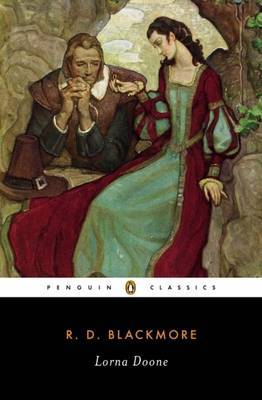 John is twelve years old when his father is attacked and killed by a gang of Doones, a once noble family who fell out of favour at court and fled to an isolated Exmoor valley where they have since been leading wild and lawless lives. Being a child, there is no immediate action John can take, so he puts his desire for revenge aside and settles back into life at Plover’s Barrows farm with his mother and two younger sisters, Annie and Lizzie.
At fourteen, John has his first encounter with the eight-year-old Lorna after climbing a hill behind a steep waterfall and unexpectedly finding himself in the Doone Valley. Several years later they meet again as adults and fall in love, but there are many obstacles which must be overcome before they can have any chance of happiness. First there are John’s own feelings towards the Doones, and the fact that as granddaughter of Sir Ensor Doone, head of the family, Lorna’s social status is much higher than that of a humble farmer like John. To complicate things further, the brutal and violent Carver Doone intends to marry Lorna himself and will let nothing stand in his way.
I could tell from the beginning that I was going to enjoy Lorna Doone. It’s just the sort of classic I love! I suppose this could technically be classed as a re-read as I did own an abridged version of the book as a child, but I can barely remember reading it and huge chunks of the original must have been missing anyway (the full, unabridged version has more than 700 pages). I can only regret that it has taken me so long to decide to try it again as an adult.
Lorna Doone takes place during the final years of the reign of Charles II, the Monmouth Rebellion of 1685 and the Bloody Assizes which followed. If you don’t know much about this period of history it might be worth briefly reading up on it first, to gain an understanding of the novel’s historical context, but don’t worry – it’s easy enough to follow the story of John and Lorna even without this knowledge. As our narrator, John is the character we get to know best, following him as he grows from a child into a man. His narrative voice is honest, down-to-earth and often humorous. Lorna, though, is a typical Victorian heroine – beautiful, delicate, gentle, passive, and with a tendency to faint and swoon. I didn’t dislike her, but I preferred John’s two sisters: Annie, who has a romance of her own with the highwayman Tom Faggus (who is based on a real person, and whose horse, Winnie, is a great character in her own right), and the intelligent, sharp-tongued Lizzie.
There are lots of other characters, of course, all of whom play an important role in the story. These include Reuben Huckaback and his granddaughter, Ruth, who wants John to marry her; Lorna’s maid Gwenny Carfax, daughter of a Cornish miner; Counsellor Doone, the clever, scheming father of Carver; and Jeremy Stickles, the King’s messenger, who provides a link with London and the court. I should warn you that some of the characters speak in a strong dialect (for example, “there be a dale of faighting avore thee. Best wai to begin gude taime laike. Wull the geatman latt me in, to zee as thee hast vair plai, lad?”) but this is restricted mainly to one or two of the Ridds’ servants – as in many Victorian novels, dialect is used as an indication of class.
Blackmore devotes a lot of time to telling us about daily life at Plover’s Barrows and the things that are important to John and to his family, such as bringing in the harvest, fishing for loaches in the river and surviving a bad winter. I couldn’t help being reminded of Thomas Hardy – another author with a lot of affection for the countryside and country life. Doing a bit of research online, I was interested to discover that Hardy had read Lorna Doone in 1875 and wrote a letter to Blackmore, mentioning “the kindred sentiment between us in so many things”. Lorna Doone is set in Somerset and Devon and there are lots of vivid descriptions of the beautiful landscapes. I particularly loved reading about John Ridd’s adventures in the secluded, hidden valley of the Doones; every time he enters it in search of Lorna, whether through the waterfall or the forbidding Doone Gate, it’s almost as if the reader is being pulled into another world.
I thoroughly enjoyed reading Lorna Doone and now I’m curious as to why it seems to be the only one of Blackmore’s many novels that has stood the test of time and is still in print. His others are available as ebooks and on Project Gutenberg, but before I investigate further I would love to know if any of you have read them and if so, did you find them worth reading?



 She Reads Novels