Once Upon a Time IX

Once Upon a Time
(Art by Kimberly Kincaid)

Spring is here at last – and so is the start of this year’s Once Upon a Time reading challenge, hosted by Carl of Stainless Steel Droppings. The challenge is in its ninth year but this is the first time I’ve decided to take part.

The event runs from 21st March (today) to 21st June and involves reading books (or watching films or playing games) that encompass four categories: Fairy Tale, Folklore, Fantasy and Mythology. There are different levels of participation and as this is my first year – and these are not genres I read very often – I’m signing up for The Journey level. This is perfect for me because it means I don’t need to commit to any specific number of books, as long as I read at least one.

I already own several books that would count towards this challenge, including these:

Ship of Magic by Robin Hobb
Uprooted by Naomi Novik
Throne of Jade by Naomi Novik
Under Heaven by Guy Gavriel Kay
River of Stars by Guy Gavriel Kay
Tooth and Claw by Jo Walton
Stardust by Neil Gaiman
The Book of Life by Deborah Harkness
The Lies of Locke Lamora by Scott Lynch

Have you read any of these books?

Will you be taking part in Once Upon a Time?

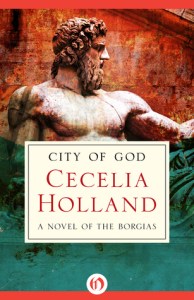
City of God by Cecelia Holland

City of God Since 1966 Cecelia Holland has written over thirty novels, most of them historical fiction, and some are now being re-released in ebook format by Open Road Integrated Media. As I’ve never read any of her work before, I was pleased to receive a copy of her 1979 novel, City of God, via NetGalley.

City of God is set in Rome at the beginning of the sixteenth century and, as the subtitle suggests, it is A Novel of the Borgias. With the former Rodrigo Borgia now Pope Alexander VI, the Borgia family already wield a large amount of influence in Rome, but the Pope’s illegitimate son, the condottiero Cesare Borgia, is now turning his attention to conquering the rest of the Italian city states. Cesare, known as Duke Valentino, has a reputation for being cruel and ruthless and even as he plots and schemes his way to power, his enemies are conspiring against him.

We see all of this through the eyes of Nicholas Dawson, secretary to the Florentine ambassador to Rome. Raised at a Spanish monastery after his English parents died in Pamplona, Nicholas is a man who seems to have no real connection or loyalty to any particular country or city. This makes him an ideal target for Valentino, who has his eye on Florence and needs a spy within the Florentine embassy. Nicholas has already been secretly rewriting the ambassador’s dispatches to suit his own political views – will betraying Florence to the Borgias be the next step?

As this is the first Cecelia Holland novel I’ve read I didn’t know what to expect – and I was quite surprised. This is a book with a very dark and claustrophobic atmosphere and the writing is completely unromantic, focusing firmly on the political machinations of Nicholas and the Borgias and the intrigue of the Papal Court.

I didn’t find this an easy book to read, but that’s because I’m not very familiar with the Borgias or the history of Rome in this period and Holland does seem to assume that the reader has some previous knowledge. She doesn’t spend much time explaining the negotiations, alliances and conflicts between Spain, France and the various Italian city states, but expects us to already understand the politics involved. I do like historical fiction that makes me think and that encourages me to look things up for myself so I can learn about the period, but I did wish I had known more about the subject before I started!

The characters in City of God are very unlikeable. The book doesn’t challenge the popular view of the Borgias as scheming and corrupt – Alexander is a Pope who gambles and who has mistresses and children, while Cesare is brutal and unscrupulous and Lucrezia, his sister, is the subject of gossip and suspicion – and the people around them are not much better. I found nobody to sympathise with or to admire, not even Nicholas. This wasn’t a big problem, though, as I can often still enjoy a book without liking the characters – and at least they were interesting.

Nicholas himself is a fascinating, complex character but it’s never obvious where his loyalties lie or if he even has any at all. He appears to be motivated by self-interest, ambition and the desire for power, and he enjoys using his brains to give advice to the Borgias and to act independently of the Ambassador. I’m not sure I ever fully understood what Nicholas was trying to do, but something that happens right at the end of the book made me think again about what he was hoping to achieve. Nicholas is also a gay man living in a time when it is dangerous to be openly homosexual and this adds another layer to the novel. His relationship with a young man called Stefano is an important aspect of the plot (though don’t expect a great love story, as even this part of the novel is free of romance and sentiment).

City of God was an interesting and unusual read; I didn’t love it but I do want to try another of Cecelia Holland’s books as I think I might prefer one with a different setting. Now that more of her books are being made available again I’ll have plenty to choose from!

I’m counting this book towards Week 3 of the Forgotten Histories Reading Challenge – Read a book with an LGBT protagonist.

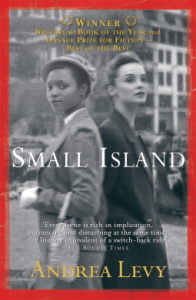
Small Island by Andrea Levy

Small Island Last year I read The Long Song, Andrea Levy’s novel about life on a sugar plantation in 19th century Jamaica. Small Island is a very different book and didn’t initially sound as appealing to me, but now that I’ve read both, this is definitely my favourite of the two.

Set in London in 1948 but with flashbacks to other times and places, Small Island follows the story of two couples, one British (Queenie and Bernard) and one Jamaican (Hortense and Gilbert). After a brief prologue, the first character we get to know is Hortense. Having been raised by her father’s rich relatives, Hortense is a well-mannered and well-educated young Jamaican woman. With Jamaica still a British colony (it wouldn’t gain independence until 1962), Hortense is desperate to see the ‘mother country’ she has heard so much about and when she marries Gilbert Joseph she has a chance to do just that.

Gilbert, who had volunteered with the RAF during World War II, has found it difficult to settle back into life in Jamaica and is planning to return to Britain where he believes there will be more opportunities. Arriving in London, he rents a room in a house belonging to Queenie Bligh, a white Englishwoman he previously met during the war, and Hortense joins him there a few months later. Queenie’s husband, Bernard, also in the RAF, has still not returned from the war, and Queenie has been taking in lodgers to help pay the bills. But when Bernard finally does come home, he is not at all pleased to find black people living in his house.

Through the eyes of these four very different men and women we watch the stories of life on two ‘small islands’ unfold – Britain and Jamaica. From the perspectives of Hortense and Gilbert we share the disappointment and bewilderment of two immigrants discovering that their new country is not quite what they had expected and facing a level of prejudice and discrimination they were unprepared for. In Bernard and Queenie we see how the attitudes of the white British people towards black immigrants range from overt racism and intolerance in Bernard’s case to a more open-minded attitude in Queenie’s (sadly most of the people Hortense and Gilbert meet tend to share Bernard’s views rather than Queenie’s). While things have changed a lot since the 1940s, these are obviously issues that are still important and relevant today, and it was interesting to read four such different points of view.

I was impressed by the way Levy manages to give each character a distinctive voice of his or her own (though I shouldn’t have been surprised after reading The Long Song, which also has a protagonist with a very strong narrative voice). The book is structured so that each of the four has a chance to narrate their part of the story, going back into the past to talk about their childhood and their experiences before and during the war. My favourite character was Gilbert, though I did enjoy the sections narrated by Queenie and Hortense too. I found Bernard’s section the least interesting, not just because I didn’t like him, but also because the story of his wartime experiences in India didn’t feel very relevant to the rest of the novel.

Apart from being bored with Bernard’s story, my only other problem was the ending, which I thought relied too heavily on coincidences to bring the novel to its conclusion. Other than that, I loved this book! I know Andrea Levy has written three other novels as well as Small Island and The Long Song, and although I haven’t heard much about any of them I do want to investigate at some point.

Thanks to the publisher for providing a review copy via NetGalley.

Romola by George Eliot

Romola I’ll admit that I didn’t feel very enthusiastic about starting to read Romola. I had added it to my Classics Club list because I loved Middlemarch and because the Italian Renaissance setting sounded appealing to me. Then I came across some reviews that said it was very difficult to read, overly detailed and boring, and I began to wonder what I had let myself in for. Luckily, now that I’ve read the book, I can say that none of these things were big problems for me. Yes, it was challenging, and yes, the amount of historical and political detail was overwhelming, but none of that mattered because I was so caught up in the story and the lives of the characters.

Romola is set in Florence in the final years of the 15th century and I wonder if this could be one of the reasons it’s not more widely read as it isn’t what you would typically expect from a Victorian novel. There’s no doubt that Eliot must have thoroughly researched the setting and the historical background, although it sometimes seemed that she had been determined to include every little fact and detail she uncovered during that research. Apparently Anthony Trollope wrote to Eliot after reading the first instalment and praised her for her descriptions of Florence, ‘wonderful in their energy and in their accuracy’, but warned her not to ‘fire too much over the heads of your readers’. Well, a lot of it did go over my head, and although I loved the book overall I won’t pretend that I understood everything I read.

The title character, Romola, is the daughter of an elderly scholar, Bardo de’ Bardi. Romola’s brother has left home to join the church and Romola is doing her best to take his place in helping their father with his classical studies. This work does not really interest Romola, however, so when they are introduced to a young man called Tito Melema who agrees to become Bardi’s assistant, this seems to be the perfect solution.

Tito, a Greek scholar, has just arrived in Florence after surviving a shipwreck and is looking forward to building a new life and career for himself. When he learns that his adoptive father, Baldassarre, has been sold into slavery in Antioch and needs his assistance, Tito must decide whether to put his own comfort above his duty to his father. Meanwhile Romola is beginning to fall in love with Tito, but knows nothing of his relationship with Baldassarre – or of his entanglement with a pretty young Florentine girl called Tessa.

The story of Romola and Tito unfolds against the backdrop of a very important period in Florentine history. Piero de’ Medici has been driven from Florence as the French prepare to invade and religious fervour is sweeping through the city under the leadership of the Dominican preacher, Girolamo Savonarola. Savonarola is an important character in Romola – along with Niccolò Machiavelli he is one of several real historical figures to appear in the novel – and is portrayed here as a complex human being with both good points and bad.

The fictional characters are even more interesting than the historical ones; the villain in this novel is the equal of almost any in Victorian fiction. He is particularly fascinating because when we first meet him he doesn’t appear to be villainous at all; his character undergoes a slow descent into deceit and treachery so that I went from liking him to loathing him. Romola sometimes feels more like a typical virtuous and dutiful Victorian heroine than a 15th century one (she reminded me of Dorothea Brooke from Middlemarch) but I liked her and enjoyed watching her character develop.

I think how much you take away from Romola depends on how much effort you put in. You can look up every reference if you want to, or you can just be swept along by the story – like a lot of classics it works on more than one level. I certainly didn’t understand it all and I got very confused by the political intrigue towards the end of the book but as long as I could keep track of who was on which side, who was being betrayed and who was doing the betraying I was happy.

This hasn’t become a favourite classic but it’s one of the best I’ve read for a while. I was gripped by the plot, fascinated by the characters and loved the portrayal of Florence, its buildings, its art and culture and its people. Having only read Middlemarch, Silas Marner and now Romola so far, I’m looking forward to reading George Eliot’s other novels!

Sea of Poppies by Amitav Ghosh

Sea of Poppies Sea of Poppies is the first book in the Ibis Trilogy by Amitav Ghosh and introduces us to a large and diverse cast of memorable characters who are thrown together on a voyage from India to Mauritius aboard a former slaving ship, the Ibis. Set in the 1830s just before the First Opium War, this is a long, detailed novel (and also quite a challenging one due to the various styles of dialogue and language Ghosh uses) but once I became familiar with the characters and their stories I found myself enjoying it more and more.

Each of the novel’s main characters comes from a different background and a different set of circumstances has led to each one being on board the Ibis, whether as a migrant, a prisoner or a member of the crew. Inevitably I found some of the characters more interesting than others; I was particularly intrigued by Neel Rattan Halder, the Raja of Raskhali, who is arrested for forgery and dispossessed of his lands, by Deeti, widowed after her husband succumbs to his opium addiction, and by Paulette Lambert, the orphaned daughter of a French botanist. These three people and many others are brought into the story one by one, but eventually their paths meet as the Ibis prepares to set sail for Mauritius.

I’m not really a big fan of novels set on ships (Patrick O’Brian’s Aubrey-Maturin series is one of the few exceptions) so I was pleased to find that there are plenty of land-based sections in this one too. The descriptions of India are colourful and vivid throughout the novel, but the scene that sticks most in my mind is one from the beginning of the book which describes Deeti’s visit to the opium factory where her husband works. The author doesn’t shy away from showing us the horrors of opium addiction and withdrawal, as well as the health problems suffered by those who had to work with the drug and the trouble caused by so much land having to be devoted to poppy growth rather than other crops which could be eaten as food.

I’ve already mentioned that Amitav Ghosh uses language in some unusual ways in this novel, so I’ll try to explain what I mean. As well as Bengali and Hindi words being scattered throughout the pages, the Indian sailors (known as Lascars) have their own terminology, one of them (Serang Ali) speaks a form of pidgin English to communicate with the American second mate, Zachary Reid, while the European characters also draw on a stock of words and slang terms taken from various different languages. As you can imagine, when characters from different cultures are speaking to each other, things often become very complicated! A glossary would have made reading this book a lot easier, but unfortunately there wasn’t one (at least not in the edition that I read) so I just had to struggle along and console myself with the knowledge that sometimes the characters in the book were just as confused as I was!

Sea of Poppies was a fascinating read, but I was left with the feeling that it wasn’t a complete novel in itself – it finishes on a cliffhanger and with so many loose ends that reading the second book in the trilogy really is essential if you want to know what happens to the characters you’ve come to know and care about. I started River of Smoke immediately after finishing this one!

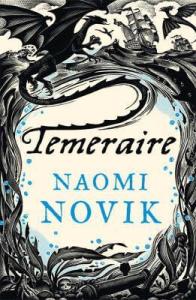
Temeraire by Naomi Novik

Temeraire Temeraire (also published as His Majesty’s Dragon) is the first in a series of nine books and is set during an alternate version of the Napoleonic Wars. This alternate world is exactly like our own in almost every detail, but with one very important difference – the existence of dragons. These dragons are intelligent creatures, capable of human speech and independent thought, and are used by both the British and French to provide aerial support to their navies. This first novel explores the beginning of a very special relationship between Captain Will Laurence and his dragon, Temeraire.

When we first meet Laurence he is a Captain in the Royal Navy and has just captured a French ship which happens to be carrying an unhatched dragon egg. The egg is very close to hatching and Laurence knows that if the dragon is to be tamed (and therefore of use to Britain’s Aerial Corps) it’s essential that it is harnessed and made to accept a human handler as soon as possible. The thought of becoming an aviator is not something that appeals to Laurence – as well as requiring total dedication, leaving little time for a family life, aviators are treated with scorn and contempt by the rest of the military. Unfortunately, the newly-hatched dragon refuses to accept any other handler so Laurence, after naming him Temeraire, reluctantly resigns himself to his new career and new way of life.

The rest of the novel follows the adventures of Laurence and Temeraire as they begin their training with the Aerial Corps in Scotland, learning all the flying manoeuvres and formations they will need to know before being called into service. This does feel very much like the first in a series and although Laurence and Temeraire do have the opportunity to take part in some action towards the end of the novel, the main purpose of the book seems to be to set the scene and introduce us to the concept of dragon warfare. This doesn’t mean that I thought the book was boring, though – quite the opposite: I found all the details of dragon training fascinating and now that I know how things work in the world of Temeraire I’m looking forward to continuing with the series.

I particularly enjoyed meeting all the other aviators and dragons who form the Aerial Corps including Captain Harcourt and her Longwing dragon, Lily (the presence of female aviators is something Laurence has to adapt to, having been used to the male-dominated Navy), Berkley and his Regal Copper, Maximus, and the training master, Celeritas, who is himself a dragon. One of my favourites was Levitas, a little dragon who has been neglected by his selfish captain and is desperate for some love and affection.

Most of all, I loved watching the relationship develop between Temeraire and Laurence as they come to trust and understand each other. There are some intriguing revelations about Temeraire at the end of the novel that make me want to pick up the second book in the series, Throne of Jade, as soon as possible!

I read Temeraire for Week 1 of the Forgotten Histories Reading Challenge.

Ross Poldark by Winston Graham

Ross PoldarkI’ve often thought about reading the Poldark novels but there was always some reason why I didn’t; it never felt like the right time to start a twelve volume series or I could only find copies of the later books and not the first one. I had been aware that the BBC were making a new adaptation to be shown this year but I had forgotten about it until seeing a trailer a few weeks ago. That left me with a dilemma as the first episode is being shown on Sunday and obviously I wouldn’t have time to read the whole series by then. But I could at least read the first book and that is what I’ve done.

Ross Poldark is set in 18th century Cornwall (in fact, it is subtitled A Novel of Cornwall 1783-1787). At the beginning of the novel, Ross Poldark returns home from fighting in America to discover that things have changed in his absence. His father has died, leaving his estate, Nampara, to Ross – and Elizabeth, the woman he loves, has just become engaged to his cousin, Francis. With his heart broken, Ross devotes his time to restoring Nampara, which has fallen into disrepair having been left in the hands of the servants, and investigating the possibility of opening a new copper mine.

Life is not easy for Ross – as well as managing his father’s lazy, drunken servants, Jud and Prudie, and dealing with the problems of the tenants and workers who live on the estate, he also has to cope with seeing Francis and Elizabeth together at family gatherings. Then one day, Ross rescues fourteen-year-old Demelza Carne from a brawl at the fair and brings her home to work in his kitchen. With an age difference of ten years, the relationship between Ross and Demelza is at first one of master and servant, but as time goes by a friendship forms and Ross will eventually discover whether or not he is able to love again.

When I began to read Ross Poldark last weekend I thought I might have started it too late to finish by Sunday, but I needn’t have worried; I found it so easy to get into and the story so compelling that it turned out to be a very quick read. I loved the Cornish setting; I won’t comment on the accuracy of the descriptions or the dialect, not being from Cornwall myself, but I thought the overall sense of time and place was very strong. Although they’re quite different stories, the setting and the mining element made me think of another book I enjoyed: Penmarric by Susan Howatch.

As the title character, this is very much Ross Poldark’s story (and Ross is the sort of hero I could immediately like and care about, right from the moment he arrives home to find that the woman to whom he was planning to propose is marrying his cousin) but I found Demelza an even more intriguing character. She changes quite a lot over the four or five years the novel covers and she does slowly grow in confidence, yet never quite shakes off her insecurities and her feeling that the Poldarks are looking down on her because of her background. She is still just in her teens when the novel ends and I’m sure there will be more development to come in the second book. I also liked Verity, Ross’s cousin, and found her personal storyline as interesting as Ross and Demelza’s.

As well as the main characters, there are also lots of memorable secondary characters representing all different levels of society, from the Poldarks and their friends to the farmers and miners who work for them. Quite a lot of time is devoted to the servants Jud and Prudie, and also to one of Ross’s young tenants, Jinny Martin, and two rivals for her love, farm boy Jim Carter and the villainous Reuben Clemmow. Whenever the focus switches to these characters, it provides a diversion from the main plot, sometimes funny, sometimes moving, as well as showing us how Ross handles the problems on his estate and interacts with the people around him.

At the end of this book there are still a lot of unresolved storylines and loose ends and I’m looking forward to continuing the series with the second book, Demelza.