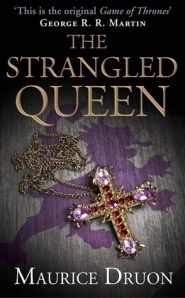
The Strangled Queen by Maurice Druon

The Strangled Queen This is the second book in Maurice Druon’s Accursed Kings series (Les Rois Maudits in French). There are seven novels in the series, all published between 1955 and 1977, telling the story of the monarchs of medieval France. The front covers of these new HarperCollins editions tell us that The Accursed Kings inspired George R.R. Martin’s A Game of Thrones, but be aware that this is not a fantasy series!

In the first book, The Iron King, we saw how Philip IV the Fair of France brought about the destruction of the Knights Templar. Before being sent to burn at the stake, the Grand Master, Jacques de Molay, cursed Philip and his descendants to ‘the thirteenth generation’. Philip was the first victim of the curse, but now he is dead and in The Strangled Queen we see how his son, Louis, becomes the next to suffer. Unlike his father, the newly crowned Louis X proves to be a very weak king and allows himself to be manipulated by his uncle, the Count of Valois, who is engaged in a power struggle with Enguerrand de Marigny, the former king’s chief minister.

Louis’ personal life is also a disaster – his wife, Marguerite of Burgundy, has been imprisoned for adultery following the Tour de Nesle Affair (described in the previous book) and as there is currently no Pope, he is unable to obtain a divorce so that he can find a new queen. Valois is hoping to arrange a marriage between his niece, Clemence of Hungary, and Louis, but first a new Pope will have to be chosen. However, Enguerrand de Marigny has other ideas and will do whatever it takes to thwart Valois’ plans.

I enjoyed The Strangled Queen, though not as much as The Iron King which I read more than a year ago and loved. I wished I hadn’t let so much time go by between reading the first book and the second as this really does seem to be a series that needs to be read in order with each book following on directly from the one before. Storylines that were begun in The Iron King were picked up again and continued in this book and I found myself struggling to remember exactly what had happened previously. I had forgotten all about Tolomei, the Lombard banker and his nephew Guccio, for example, but I was very pleased to see Guccio again as he is one of the few likeable characters in the series.

My only real complaint with this book is that, as someone who doesn’t know much about this period of French history, the title is a very big spoiler in itself. Knowing that the queen was going to be strangled took away some of the suspense! Luckily, though, the queen’s fate only forms a part of the story. Most of the novel is actually devoted to the rivalry between Charles of Valois and Enguerrand de Marigny…so you can expect lots of plotting, scheming and intrigue! And these are not the only plotting, scheming characters – there’s also Robert of Artois, still hoping to find a way of reclaiming his lands from his detested Aunt Mahaut.

I think the element of the book I found most interesting, though, is the portrayal of a young man (Louis X) who is unexpectedly forced to accept responsibilities that he is not ready for and not able to deal with. While I certainly didn’t like Louis (I find it difficult to have sympathy for someone whose idea of fun is shooting doves in an enclosed barn), I could understand his fears and insecurities and could see why it was so easy for the people around him to take control.

The third book in the series is called The Poisoned Crown so it sounds as if there’s still more trouble ahead for the sons of Philip the Fair!
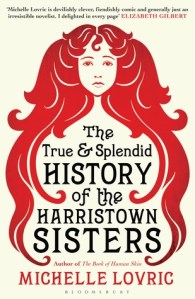
The True and Splendid History of the Harristown Sisters by Michelle Lovric

Harristown Sisters Manticory Swiney and her six sisters are born into poverty in rural 19th century Ireland and brought up by their mother, a laundress. They have never known their father (he visits once a year in the middle of the night) but from him they have inherited some very special gifts: their wonderful names and the abundance of long, thick hair which proves to be their route to fame and fortune. Bullied by the eldest sister, Darcy, into performing on the stage, the girls entertain their audiences by singing, dancing and, as a finale, unleashing their luxuriant cascades of ankle-length hair.

Approached by Augustus Rainfleury and Tristan Stoker, both of whom can see the money-making potential of seven long-haired sisters, the ‘Swiney Godivas’ leave their impoverished Harristown lives behind to find success in first Dublin then Venice. But for black-haired, sharp-tongued Darcy, the rival twins Berenice and Enda, quiet Pertilly, gentle, blonde Oona, wild Idolatry and our narrator, red-haired Manticory, fame doesn’t necessarily bring happiness.

I loved this book, the first I’ve read by Michelle Lovric, and I would agree that it really is a ‘splendid history’. It’s not quite a true one – Manticory and her sisters are fictional – but it was inspired by the story of the real-life Sutherland Sisters, an American family who really did become celebrities due to their long hair. If you have trouble imagining what seven sisters all with floor-length hair would look like, lots of pictures of the Seven Sutherland Sisters can be found online.

With so many Swineys to get to know, I was pleased to find that each sister is given a strong and distinctive personality of her own. I liked some of the girls and disliked others, but they were all great to read about, particularly the fierce, devilish Darcy who takes control of every scene in which she appears. One of my favourite characters, though, was not a Swiney sister at all, but their childhood enemy, Eileen O’Reilly (or the Eileen O’Reilly as she is always described) who enjoys exchanging very imaginative insults with Darcy – and who claims to hate the Swineys yet can’t seem to stay away from them.

Manticory herself has a wonderful narrative voice: strong, poetic and unmistakably ‘Irish’. She manages to bring a lot of humour into her ‘true and splendid history’ but it’s really a very dark story. There’s a vulnerability about the sisters, even Darcy, in that they are manipulated and taken advantage of by ruthless businessmen and men who are…well, attracted to girls with long hair. The Swineys are betrayed and exploited by the very people they have placed their trust in and what makes this even more tragic is that the reader can see this from the beginning while the sisters can’t.

Finally, I want to mention the excellent descriptive writing in this book. Every time Manticory thinks of her childhood in Harristown, County Kildare, she remembers the ‘turf stoves, thin geese and slow crows’ until Harristown becomes almost a character in itself. Later in the book, the descriptions of Venice are particularly beautiful…

The palazzi and churches let their fretted stones hang down into our faces like beautiful, insitent ghosts. Beckoning lanterns hung at arched water-gates. Inside their houses, equisitely dressed Venetians displayed themselves in glowing tableaux so that each palace seemed to host a puppet theatre performing just for us. The city was mystical and barbaric all at once, a floating fortress so delicate that the fairies would hesitate to place the weight of their wings on it.

I also loved the images of the girls hanging their hair from the windows of the bell tower of San Vidal like seven Rapunzels and each of them standing in the bow of a gondola with her hair trailing into the boat behind. I could tell this book was written by someone who knows and loves Venice!

The True and Splendid History of the Harristown Sisters is one of my favourite books of the year so far and I’m now looking forward to investigating Michelle Lovric’s previous novels.

I received a copy of this book from NetGalley for review.

The Classics Club Spin number is…

The Classics Club

Number 17

Last week I decided to take part in the Classics Club Spin. The rules were simple – list twenty books from your Classics Club list, number them 1 to 20, and the number announced today (Monday) represents the book you have to read before 6th October 2014.

The number that has been selected is 17, which means the book I’ll be reading is:

The Idiot

The Idiot by Fyodor Dostoevsky

I have to admit this is not one of the titles on my list that I was hoping for, but I’m prepared to give it a try! I had a failed attempt at reading Crime and Punishment a few years ago, so I’m hoping I might have more luck with a different book.

If you took part in the spin are you happy with your result?

After the Sunday Papers #16

newspaper-clip-art-4 What a difference twenty-four hours can make! Yesterday I was walking in the sunshine at Fountains Abbey in North Yorkshire; today has seen the return of heavy rain and miserable grey skies. At least the disappointing weather has given me time to sit down and write one of my Sunday posts which were originally intended to be weekly but have become more and more sporadic. It also means I’ve had a chance to work on my Journey Through Time, which some of you may already have noticed in the menu at the top of my blog. This is really just a way for me to arrange my historical fiction reviews by period, but I’m hoping it will also eventually act as a guide for other readers who are looking for recommendations. Please have a look and let me know if this is something you find useful! So far I have put two pages together: The Wars of the Roses and The Tudors: Part 2. It may seem strange that I’ve posted Part 2 before Part 1, but Part 1 is proving to involve a lot more work so will take me a bit longer to finish.

I received some lovely new books this week courtesy of Bookbridgr. I’ve started one of them, Smiler’s Fair, and I’m looking forward to the other two.

New books Aug 2014

Smiler’s Fair by Rebecca Levene
The Vanishing Witch by Karen Maitland
Gutenberg’s Apprentice by Alix Christie

Have you read or will you be reading any of these?

Like many of you I’m waiting for the announcement of the Classics Club Spin result which will determine what my next classic read will be. There are one or two numbers that I’m particularly hoping for, but there are no books on my list that I’m actually dreading so I honestly don’t really mind which number comes up. All will be revealed tomorrow! For now, I’ll leave you with some pictures from my visit to Fountains Abbey yesterday:

Fountains Abbey 1

Fountains Abbey 2

Fountains Abbey 3

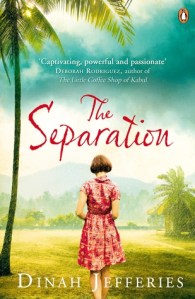
The Separation by Dinah Jefferies

The Separation Imagine that you’ve returned home from visiting a friend to find that your house is empty – your husband and children have disappeared, the servants have vanished and when you pick up the phone the line is dead. You set out in search of your family, determined to find them no matter what, but it’s not going to be an easy task because this is Malaya in 1955: a country at war.

This is what happens to Lydia Cartwright in this wonderful debut novel by Dinah Jefferies. As Lydia leaves the family home in Malacca and heads north to Ipoh believing that her husband (who works for the British Administration) may have been posted there, we discover that Alec and the two girls – Emma, aged eleven, and Fleur, eight – have gone somewhere else entirely. Will Lydia ever see her daughters again?

The Separation is divided into two distinct storylines told in alternating chapters. In one we follow Lydia as she makes the discovery that her children are missing. As she embarks on her nightmarish journey through the dangerous Malayan jungle, she faces terrorist attacks, gunfire and overcrowded buses and trains, as well as the possibility that she has been betrayed and deceived. In the other thread of the story we join Emma as she and Fleur try to settle into their new lives while coming to terms with the loss of their mother. Things are not easy for Emma and she too is forced to go through some terrible ordeals, all the while clinging to the hope that her mother is still alive and one day they will be reunited.

I thought the structure of the novel worked well; I enjoyed reading both Lydia’s chapters and Emma’s and never felt that we were spending too much time on one character at the expense of the other. Lydia’s story is more dramatic (and full of beautiful, exotic descriptions of Malaya) but of the two I think I preferred Emma’s. That could just be due to the fact that I felt closer to Emma as she narrates in the first person while Lydia’s chapters are written in the third person – or maybe it’s because although I’m not a mother I am a daughter so it was easier for me to identify with Emma. I did like and sympathise with both main characters, though, and desperately wanted them to be together again. Of course, I’m not going to tell you whether that happens or not!

I have never read anything about the history of Malaya (as it was still known in the 1950s before becoming Malaysia) so that was another aspect of the book I found interesting. The story isn’t weighed down with too much historical detail but by the time I’d finished the book I felt that I’d learned a little bit about The Emergency (the name given to the war) and what it was like to be a woman and a European living in Malaya during that period. I was interested to read that Dinah Jefferies was born in Malaya and lived there until the age of nine, which means she was able to draw on some of her own experiences and memories.

This was a very impressive first novel and I’m already looking forward to the second book from Dinah Jefferies, The Tea Planter’s Wife, which is going to be set in Sri Lanka.

Thanks to the author for sending me a copy of this book for review.

The Devil in the Marshalsea by Antonia Hodgson

The Devil in the Marshalsea This is a murder mystery with a difference, being set almost entirely within the confines of an eighteenth century debtors’ prison. Our narrator, Tom Hawkins, is a young man who has rebelled against his clergyman father’s plans for his future and is enjoying himself in London, spending all his money on drinking and gambling. After a big win at the card tables one night, Tom is attacked on his way home and his winnings are stolen, leaving him unable to pay his debts. Taken to the notorious Marshalsea Prison, he is horrified to discover that the last occupant of his cell, Captain Roberts, was murdered. The killer has never been caught, but Tom’s new roommate, the charismatic and mysterious Samuel Fleet, is the man most people believe to be the murderer.

The Marshalea is privately run for profit, so it’s not surprising that the prison governors want the killer identified as quickly as possible to avoid any further scandal. Told that his only chance of being released depends on whether or not he can solve the mystery of Roberts’ death, Tom agrees to investigate. Unsure who can be trusted and beginning to wonder whether such things as truth and justice even exist in a place as corrupt as the Marshalsea, Tom eventually uncovers a web of betrayal and deception on a scale he could never have imagined.

Other authors have written about the Marshalsea, most famously Charles Dickens in Little Dorrit, but Dickens’ Marshalsea was a newer building on a site further down the road; set in 1727, Antonia Hodgson’s novel refers to the original prison. Not knowing anything at all about the Marshalsea, this was quite an eye-opening book for me. I was aware that prisoners were often able to offer bribes in return for better living conditions and privileges, but I hadn’t realised there was such a great disparity between the fate of those who could afford to pay and those who couldn’t.

The prison was divided into two sections. The prisoners who had some money to spend or who had influential friends, lived on the Master’s Side, which was almost like a complete town in itself, with coffee houses, bars, restaurants and even a barber. They had the freedom to move around and in some cases were even given permission to go out into London during the day. For the poor people on the Common Side, things were much worse. Crammed into tiny cells and suffering from starvation, disease and overcrowding, they died at a rate of up to twelve a day. Tom Hawkins, whose best friend happens to work for Sir Philip Meadows, Knight Marshal of the Marshalsea, is lucky enough to find himself on the Master’s Side but with the knowledge that if his luck should run out, he could find himself thrown into the Common Side to meet his death with the others.

This is not a book for the faint-hearted as there are some horrible descriptions of sickness, torture and brutality, not to mention the dirty, squalid conditions the unfortunate inmates of the Common Side were forced to endure. Knowing that this was an experience many people really did have to go through makes it even more horrific. Despite this, I found The Devil in the Marshalsea very entertaining and fun to read. The book is filled with larger than life characters and I was surprised to find, when I read the notes at the end of the book, that many of these people really existed and were mentioned in the diary of John Grano, a debtor who spent a year in the prison from 1728-1729.

As a mystery novel, The Devil in the Marshalsea kept me guessing right until the end. I did not work out who the murderer was and even after the truth was revealed there were still more plot twists and revelations to come. As a work of historical fiction it’s equally impressive; I loved the portrayal of eighteenth century London both inside and outside the Marshalsea. I was so pleased to find that there’s going to be a sequel to this book and I’m already looking forward to meeting Tom Hawkins again!

I received a copy of this book from the publisher for review

The Classics Club Spin #7

The Classics Club

It’s time for another Classics Club Spin. I was hoping there would be one this month! As always, here are the rules:

* List any twenty books you have left to read from your Classics Club list.
* Number them from 1 to 20.
* Next Monday (August 11th) the Classics Club will announce a number.
* This is the book you need to read during August and September.

And this is my list:

1. Shirley by Charlotte Brontë
2. The Return of the Native by Thomas Hardy
3. Excellent Women by Barbara Pym
4. A Country Doctor’s Notebook by Mikhail Bulgakov
5. The Vicomte de Bragelonne by Alexandre Dumas
6. The Age of Innocence by Edith Wharton
7. The Hunchback of Notre Dame by Victor Hugo
8. The Cloister and the Hearth by Charles Reade
9. Vanity Fair by William Makepeace Thackeray
10. Germinal by Emile Zola
11. David Copperfield by Charles Dickens
12. The Heir of Redclyffe by Charlotte M. Yonge
13. The Mill on the Floss by George Eliot
14. The Heart of Midlothian by Sir Walter Scott
15. The Glass-Blowers by Daphne du Maurier
16. The Leopard by Giuseppe Tomasi di Lampedusa
17. The Idiot by Fyodor Dostoevsky
18. East of Eden by John Steinbeck
19. Lorna Doone by R.D. Blackmore
20. Around the World in Eighty Days by Jules Verne

I’m not dividing these into categories as I had enough trouble just deciding on my twenty books, but I’ve tried to include a mixture of books that I’m looking forward to reading and books that I feel more hesitant about.

Now I have to wait until next Monday to see what I’ll be reading. Which numbers do you think I should be hoping for?