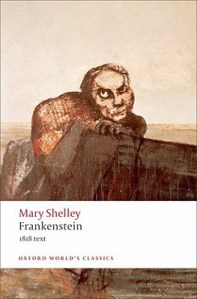
 I’ve had this book on my list for the RIP challenge for the last four years and finally, this year, I found time to read it! This was technically a re-read for me as I know I read it in when I was in my teens, but I had almost completely forgotten the story so it did feel as though I was reading it for the first time again. I also think I was maybe a bit too young to fully appreciate it the first time (I remember skipping through the ‘boring’ parts at the beginning to get to the parts with the monster).
Frankenstein, or the Modern Prometheus was written while Mary Shelley and her husband, the poet Percy Bysshe Shelley, were staying at Lake Geneva with Lord Byron and John Polidori in the summer of 1816. Shelley’s novel is said to have come about as a result of a challenge from Byron that also led to Polidori’s The Vampyre (a story that influenced Bram Stoker’s Dracula) and the beginnings of Byron’s own unfinished vampire story.
Frankenstein begins with some letters written by Arctic explorer Robert Walton to his sister in which he describes his voyage to the North Pole and how he saw a huge figure crossing the ice in a sledge pulled by dogs. Soon after this, Walton and his companions rescue another man, who is frozen and exhausted. His name is Victor Frankenstein and he tells Walton that he was trying to catch up with the giant figure they saw earlier. What follows is Victor’s story, beginning with his childhood in Geneva and his early interest in chemistry and other sciences. At university, his study of science continues and he secretly begins the construction of a human-like being which he plans to bring to life.
Victor’s experiment is a success, but after his creature is brought to life he panics and runs away, leaving the monster alone to fend for itself. The rest of the book follows Frankenstein’s nameless monster, abandoned and rejected by his creator, as he searches for acceptance and friendship. Meanwhile, Victor is convinced that he has unleashed a terrible evil upon the world and that he will have to destroy the monster before it destroys him.
Like Dracula, Frankenstein has become a part of popular culture, but most film versions of Frankenstein have very little in common with this book, so it’s still worth reading even if you think you already know the story. We probably all have an image in our mind of what Frankenstein’s monster looks like (green skin, bolt through the neck etc) but in the book, there are only a few descriptions of the monster’s physical appearance. We are told that he’s hideously ugly and much bigger than ordinary men, but he is also agile, intelligent and sensitive. The monster is also never given a name (his name is not Frankenstein, which is another common misconception) and Shelley refers to him most often as ‘the wretch’.
It’s the chapters that are told from the monster’s perspective that are the most interesting and also the most moving. Despite some of the horrific acts the monster commits, it would be difficult not to feel sympathy for him and anger towards Victor, who has created a living being and then abandoned it. The clear message of the book is that we need to think before we act and be prepared to accept responsibility for our actions. I think another thing Shelley is trying to show us is that rather than being born a monster we can become a monster because of the way we are treated by others. When we first meet Victor’s creature he is gentle and compassionate but after he is repeatedly rejected by society he begins to carry out violent, monstrous actions.
To the modern day reader there are some aspects of Frankenstein that are maybe not very satisfying or believable, such as the way the monster teaches himself to speak and to read. I would also have liked more details of the scientific methods Victor uses to create the monster and bring him to life, but I suppose that would have been beyond the scope of someone writing in the 1800s. As an early nineteenth century gothic novel, though, this is a true classic and I’m glad I took the time to re-read it.


 She Reads Novels