The Spring of the Ram by Dorothy Dunnett

This is the second book in the eight-volume House of Niccolò series. In the first book, Niccolò Rising, we saw how Nicholas, a young dyer’s apprentice, rose in the world to become head of the Charetty trading company. In The Spring of the Ram, Nicholas and the other men of the Charetty company – including the doctor Tobias, notary Julius, priest Godscalc, engineer John le Grant and mercenary leader Astorre – journey to the Black Sea port of Trebizond to establish a trading post. With them every step of the way is Pagano Doria, a sea adventurer who has married Nicholas’s thirteen-year-old stepdaughter, Catherine de Charetty, and is now in a position where he may be able to seize control of the company through his marriage.

One of the things I love about Dorothy Dunnett’s books is that they give me an opportunity to learn about people and places I might never have known anything about otherwise. Dunnett’s novels open up whole new worlds, focusing on periods of history and geographical locations that are usually ignored in historical fiction. This is the first book I’ve read about Trebizond, a final outpost of the Byzantine Empire which at the time the story is set (1461) is under threat of falling to the Turkish army at any moment, and I thought it was a fascinating setting. I loved all of the beautiful descriptions of Trebizond and the other places Nicholas and his companions pass through on their journey to and from the Black Sea coast. This, for example, is the moment when the two ships belonging to Doria and Nicholas finally arrive at Trebizond:

So there came to the poisonous honey of Trebizond the two vessels from barbarian Europe, the four months of their travelling over, and winter turned into spring. One after the other, they crossed the wide, irregular bay towards the green amphitheatre which lined it. In its midst, the classical City gleamed on its tableland, alight with marble and gold against the dark mountain forests behind. There stood the fabled City, treasure-house of the East.

I enjoyed The Spring of the Ram much more than the first book, Niccolò Rising, possibly because I’m more familiar with the characters now and so found it easier to get straight into the story. And of course when I first started to read Niccolò Rising it was inevitable that I was going to compare it with Dunnett’s other series, the Lymond Chronicles, however hard I tried not to, and although I liked Nicholas and Marian de Charetty, most of the other characters seemed to me to be less interesting than the ones in the Lymond Chronicles. It seems that I just needed to give myself time to get used to them though, because now that I’ve read two Niccolo books I feel that I’m starting to get to know and understand some of the characters better. Nicholas himself continues to amaze me with his complex machinations and intricate trading deals, but despite the amount of time we spend inside his head in this book (which is more than we were ever allowed to spend inside Lymond’s) his character and motivations still remain a bit of an enigma to me. Most of what we learn about him is through the observations of the people around him – Tobie, Godscalc and the others – but we have to remember that none of them truly understand Nicholas either and have a tendency to misinterpret his actions.

All of Dunnett’s books are clever, complex and intricately plotted; this one, I thought, was particularly complicated because there seemed to be so much happening behind the scenes, so many different forces and factions all vying against each other, pulling in different directions and trying to turn things to their own advantage. The main trading powers – Venice, Florence and Genoa – are all rivals with conflicting business interests, then there are the various rulers and leaders – Emperor David of Trebizond, Uzum Hasan of the White Sheep Tribe, Sultan Mehmet II of the Ottoman Empire, and others. Members of Nicholas’s family also seem to have agendas of their own, and finally there are Violante of Naxos and the mysterious Greek with the wooden leg, both of whom are also trying to control Nicholas’s actions. With so much going on, I won’t pretend that I fully understood everything that was happening in the book because I certainly didn’t, but as with all of Dunnett’s novels I’m looking forward to reading this one again!

It has taken Niccolo a bit longer to win me over than it took Lymond but I’ve been pulled into his world now and have already started the third in the series, Race of Scorpions.

Wolf Hall Readalong: Week 1

During August and September I am taking part in a readalong of Wolf Hall, Hilary Mantel’s Booker Prize-winning novel about Thomas Cromwell. The readalong is hosted by Michelle of The True Book Addict and Kai of Fiction State of Mind. This week we have been reading Part One, which consists of three chapters.

Here are my answers to this week’s discussion questions:

1) What prompted you to join this read-a-long?

As an avid reader of historical fiction I should probably have read this book before now, but for some reason, despite its success and popularity, I never got around to reading it. Now that the sequel, Bring Up the Bodies, has been released and getting so much praise and attention too, it seemed like the perfect time to finally read Wolf Hall, and when I saw that there was going to be a readalong it helped motivate me to actually pick the book up and start reading. I also like the way this readalong is structured and hopefully I won’t have any problems keeping up with the schedule!

2) What do you think of Thomas so far?

I don’t feel that I know Thomas Cromwell very well yet, but as I’ve still only read the first three chapters I’m sure I’ll get to know and understand him better as I read on. However, each of these first three chapters has given us an insight into a different side of Thomas’s character. In the first, we get a glimpse of what appears to have been a very unhappy childhood, living with a cruel and abusive father. In the second, we meet Thomas again as an adult and we are shown his public persona, the part he is playing in the politics of the country, and his interactions with other important historical figures such as Stephen Gardiner and Cardinal Wolsey. And in the third we see Thomas in his role as a husband and father.

3) What do you think about Thomas’s feelings towards his son Gregory? Do you think he is too indulgent? Do you think his treatment of Gregory now will affect Gregory’s future?

I think it’s a good thing that Thomas is trying to avoid treating Gregory the way his own father treated him. This quote gives us a good idea of his feelings on this subject:

Bawling, strong, one hour old, plucked from the cradle: he kissed the infant’s fluffy skull and said, I shall be as tender to you as my father was not to me. For what’s the point of breeding children, if each generation does not improve on what went before?

I don’t think Thomas is being too indulgent, but it’s too early to say at this point in the novel what effect his treatment of Gregory will have on Gregory’s future.

See Kai’s post for other participants’ thoughts on Part 1 of Wolf Hall.

Classics Club August Meme – A Favourite Classic


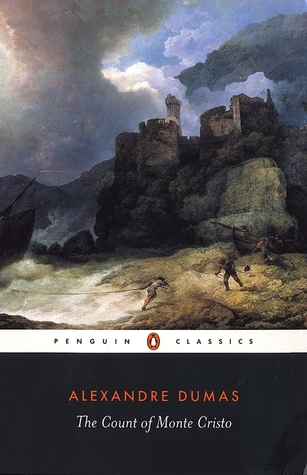
The Classics Club are now hosting a new monthly meme and this month we are asked to write about our favourite classic. Like most of the other Classics Club members who have been participating in this meme I find it difficult to pick just one book. There are so many that I love and on a different day and in a different mood I might have chosen to write about Wuthering Heights, Jane Eyre, To Kill a Mockingbird, The Woman in White, Gone with the Wind or even a children’s classic, like my beloved Watership Down. But if I have to name one classic as my all-time favourite, it would have to be The Count of Monte Cristo by Alexandre Dumas.

I’ll admit that other classics might offer deeper insights into life, more beautifully-written descriptive passages and more fully-developed characters, but this is the one I enjoy reading the most and that’s why it’s my favourite. It has such an exciting, entertaining plot (and lots of fascinating subplots), so much action and adventure – and one of my favourite fictional characters, Edmond Dantes.

I’m sure most of us have experienced some form of injustice at some point in our lives and can remember how it made us feel. The hero/anti-hero of The Count of Monte Cristo, Edmond Dantes, is the victim of an injustice so great that it completely destroys his life. Determined to punish his enemies for what they have done, he transforms himself into the Count of Monte Cristo and sets into motion an intricate plan for revenge.

I read The Count of Monte Cristo for the first time in 2006 and knew from the very first chapter that I was going to enjoy it. It’s a very long book – over 1,000 pages in the edition I read – but if you’ve never read it, please don’t let the length put you off. The story moves along at such a fast pace I remember being surprised to find it was a much quicker read than I’d expected. Don’t be tempted to read an abridged edition either because you would be missing out on so much. The plot is so complex I can’t imagine how anything could successfully be left out without spoiling the whole structure of the story.

I’ve also read two other Dumas novels – The Black Tulip and The Three Musketeers – and I loved them both, but not quite as much as I love this one. I’ve now read it twice and it’s on my list to re-read again soon for The Classics Club!

What is your favourite classic?

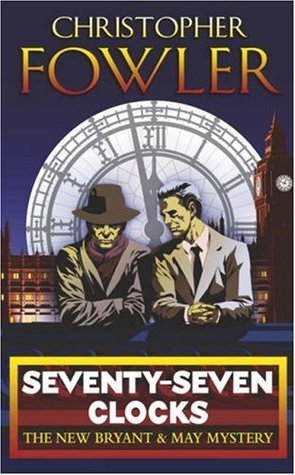
Seventy-Seven Clocks by Christopher Fowler

This is the third book in Christopher Fowler’s Bryant and May series following the investigations of two elderly detectives, Arthur Bryant and John May, who work for London’s “Peculiar Crimes Unit”. The first in the series, Full Dark House, looked back at their first mystery in the unit’s early days during World War II, while the second, The Water Room, was a fascinating mystery set in the present day and involving London’s system of underground rivers. This third instalment takes us back to 1973, when Britain was facing a winter of strikes and blackouts.

Seventy-Seven Clocks begins with two unusual incidents. The first is the death of a lawyer in the lobby of the Savoy Hotel, believed to be caused by a snake bite, and the second involves a man dressed in Edwardian clothing who runs into the National Gallery and damages a valuable painting. When more bizarre murders, accidents and abductions follow, Bryant and May discover that most of the victims are members of a large, rich family, the Whitstables. As they begin to investigate, the two detectives uncover a connection between the family and a Victorian secret society. Meanwhile, the receptionist at the Savoy Hotel, a seventeen-year-old girl called Jerry Gates decides to do some detective work of her own – but it seems that Jerry might have reasons of her own for disliking the Whitstables.

The solution to the mystery is both ingenious and completely ridiculous, but that has been the case with all three of the Bryant and May mysteries I’ve read and I’ve found that it doesn’t matter to me. In fact, the unusual and implausible plots are one of the reasons this series is so much fun to read and so different from anything else I’ve read. The other reason, of course, is that Bryant and May themselves are such wonderful characters. I find myself liking the character of Arthur Bryant more and more with every book. I love the way he refuses to leave no stone unturned or discount any possible theory, however unlikely it might seem. John May, being Bryant’s opposite in so many ways, is his perfect complement. One of the big differences between the two detectives is that May is willing to move forward and embrace new technology, while Bryant in many ways is still living in the past. As May says, “You find comfort in darkness. I prefer the world brightly lit; there’s so much more to see”.

The role of darkness and light is one of the themes explored during the story, but there were so many other things involved in this book I was slightly overwhelmed by it all! Pre-Raphaelite art, Gilbert and Sullivan societies, Victorian guilds (the Worshipful Company of Watchmakers), the British class system, the invention of electric light, and lots of other interesting topics and pieces of trivia. Christopher Fowler’s knowledge of London’s history is so impressive. Every time I come to the end of a Bryant and May book I feel that I’ve really learned something new.

If I have a criticism of this book, it’s that at nearly 500 pages it felt longer than it really needed to be, and I didn’t find Jerry’s storyline very interesting. It didn’t add much to the main plot in my opinion and could almost have been left out entirely. I thought the story was complex enough without it.

Oh, and if you’re new to Bryant and May and wondering if you need to read the series in the correct order, I would say it’s not necessary at all. It’s my personal preference to read a series in order if possible, but with these books each of the three mysteries I’ve read so far stand alone and are complete stories in themselves. I didn’t like this one quite as much as Full Dark House or The Water Room but I still enjoyed it and am looking forward to reading more Bryant and May soon.

The Second Empress by Michelle Moran

This historical fiction novel by Michelle Moran is set during the final years of Napoleon’s reign, between 1809 and 1815, and explores the French Emperor’s relationships with his second wife, Marie-Louise, and his sister, Pauline. I have only read one of Michelle Moran’s previous novels, Cleopatra’s Daughter, which is set in Ancient Rome and although I enjoyed it, I thought this new one, The Second Empress, was much better – the quality of her writing seems to have improved and the characters felt more developed too.

The story is told by three very different characters who take it in turns to narrate one chapter each. The first is Maria-Lucia, the eighteen year old daughter of Francis I, Emperor of Austria. Abandoning her dreams of marrying Count Adam von Neipperg, the man she loves, and one day ruling Austria as her brother’s regent, Maria-Lucia agrees to a marriage with the Emperor of France, Napoleon Bonaparte, as it will help to keep her father’s throne safe. Napoleon hopes she will be able to give him a legitimate heir, which his first wife Josephine was unable to provide. Maria-Lucia, or Marie-Louise as she became known in France, is a lovely, compelling character, intelligent, well-educated and talented. The portrayal of Napoleon is very negative (not that I had really expected anything else) but despite his cruelty to her throughout their marriage, Marie-Louise continues to perform her duties with dignity and grace.

Our second narrator is Pauline, Princess Borghese, Napoleon’s sister. She dreams of marrying Napoleon herself so that they can rule Egypt together like the ancient pharaohs and she is bitterly jealous of both her brother’s first wife, Josephine, who she encouraged him to divorce, and his second, Marie-Louise. Pauline is a spiteful, malicious person but of the three narrators, I thought her voice was the strongest and the most fun to read. She’s not a completely unsympathetic character because she is so obviously unhappy and miserable. She also has a lot of eccentricities – she’s obsessed with Egypt, she likes to bathe in milk, and she even uses her servants as footstools to rest her feet on. Although Pauline was a real historical figure, she’s not someone I’ve ever read about before so I’m not sure how accurate this portrayal is, but I thought she was a fascinating character.

Finally there’s Paul Moreau, Pauline’s Haitian servant, who accompanied her back to France after Haiti gained its independence from the French. Despite his loyalty to Pauline (and the fact that he has been in love with her for many years) Paul is aware of her faults and is able to feel sympathy for Marie-Louise too. He also still has hopes of returning to Haiti to help rebuild his war-torn country and this adds another interesting aspect to the story.

Although I have read other books set during Napoleon’s reign, this is the first one I’ve read which concentrates on the lives of Napoleon and the Bonaparte family. Before I started to read, I was worried that I might struggle because I don’t know a lot about this period of French history, but luckily this was not a problem. The focus is on the lives of the three narrators and their relationships with each other and the people around them; details of politics, battles and military campaigns are kept to a minimum (which could be either a good or a bad thing, I suppose, depending on your personal tastes in historical fiction). I was fascinated by the characters in this novel, particularly Pauline and Marie-Louise and was inspired to do some research and find out more about them – though as I had no idea how their stories would play out and didn’t want to spoil the book for myself, I waited until I had finished before I looked anything up. The author’s notes at the back of the book were helpful too and explained what happened to each of the main characters after the novel ends.

As I have so little knowledge of this subject, it wouldn’t be fair of me to comment on the historical accuracy of this book but I could tell that it had been well-researched – Moran had even included some extracts from real love letters sent between Napoleon and Josephine. A huge amount of information has obviously had to be condensed into 300 pages, so the book doesn’t really go into a lot of depth but would be a good choice if you’re looking for an enjoyable, entertaining historical fiction novel and don’t want to be overwhelmed with too many details.

I received a review copy of The Second Empress from the publisher via Netgalley

July Reading Summary

July has been a good reading month for me – I’ve read eight books and enjoyed most of them – but not a good blogging month! I’ve only had time to write about three of the books I read, so I’ll have to catch up with the others in August.

Here are the three I’ve posted about:

Sylvia’s Lovers by Elizabeth Gaskell
The Ivy Tree by Mary Stewart
River of Destiny by Barbara Erskine

And here are the other books I’ve read this month. I’ll be posting my thoughts on them soon, I promise!

The Second Empress by Michelle Moran
To Defy a King by Elizabeth Chadwick
Miss Buncle’s Book by D.E. Stevenson
In Her Shadow by Louise Douglas
The Spring of the Ram by Dorothy Dunnett

New Book Arrivals

As I can never seem to find time to highlight my newly acquired books, I thought it might be a good idea to incorporate them into my monthly summary posts. Here are some I’ve bought or received in the last couple of weeks (titles link to the Goodreads synopsis for each book):

The Queen’s Confidante by Karen Harper – I requested this through Amazon Vine as I had enjoyed Karen Harper’s last two books. This one sounds a bit different to the usual Tudor novels, focusing on the death of Henry VIII’s brother, Prince Arthur, and the mystery of the Princes in the Tower.
In a Treacherous Court by Michelle Diener – Review copy from Simon & Schuster. I haven’t heard anything about this book or author but it sounds like another interesting historical fiction novel.
Race of Scorpions by Dorothy Dunnett – Third in the House of Niccolo series. I bought this for myself so I would have it ready for when I finished reading The Spring of the Ram.
Goodbye for Now by Laurie Frankel – Review copy from Headline. Another book I knew nothing about, but I’m intrigued by the synopsis.
The Dog Stars by Peter Heller – Another review copy from Headline. This is a post-apocalyptic novel, not one of my favourite genres but I’ll give it a try.

I don’t really have many plans for my reading in August, but I’m intending to take part in the Austen in August event hosted by Adam of Roof Beam Reader. I’ve already read all of Jane Austen’s novels, but I want to read Emma again as it was the only one I didn’t enjoy the first time and I would like to give it another chance.

How was your July reading?

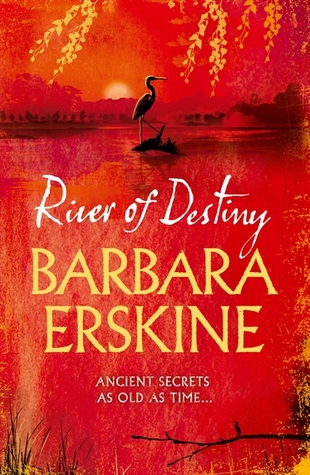
River of Destiny by Barbara Erskine

This is the first Barbara Erskine novel I’ve read. Knowing how popular she is and that I usually enjoy the type of books she writes – books that combine history and the supernatural – I’ve been meaning to try one for a long time but have never actually got around to it until now.

River of Destiny is set in three different time periods, one contemporary and two historical. The contemporary story follows Zoe and Ken Lloyd, who have moved away from London and bought a converted barn in Suffolk near the River Deben where Ken can indulge in his hobby, sailing. Zoe is not very happy with the move as she does not share Ken’s passion for boats and has had to leave behind a job she enjoyed. To make things worse, she is starting to sense ghostly presences in and around their new home. Gradually Zoe begins to learn that some of these paranormal occurrences could be echoes of The Old Barn’s eventful past.

In the novel’s two historical storylines we learn more about the events of the past which are haunting Zoe in the present day. The first of these is set in the Victorian period and tells the story of Dan, a blacksmith who finds himself a target of the scheming Lady Emily Crosby. Dan’s involvement with Emily will have tragic consequences. The third storyline is set in Anglo-Saxon England in the year 865 where we meet another smith, Eric, and his wife Edith. Amid the threat of a Viking invasion, Eric has been asked to forge a special sword for his lord, which he calls Destiny Maker – but it seems that the sword will not be given the chance to fulfil its destiny.

These three stories all take place in the same area of Suffolk, although in different periods, and are linked by sightings of a ghostly Viking ship sailing up the River Deben through a thick mist. Of the three storylines the one I found the most compelling was the contemporary one, which I thought had the most interesting group of characters: the mysterious Leo who lives alone in The Old Forge, Rosemary Formby who is on a mission to prove that walkers should have the right to cross a farmer’s field, and twelve year-old Jade whose family own one of the other barn conversions, The Summer Barn, and who is determined to cause trouble for Zoe and Leo. It surprised me that the present day story was my favourite, as with my love of historical fiction I usually prefer the historical parts of multiple time-frame novels!

I enjoyed the first few chapters of the book and was anticipating a great read, but as I got further into the story I started to lose interest. I think the problem was that I just didn’t like the way the novel was structured. The time shifts were a bit too frequent and abrupt for me and I also thought the story was told using too many different perspectives. Sometimes each section would only be two or three pages long – or even less – which meant I kept being pulled out of the flow of the story just as I was starting to get interested in it. I’m sure I would have enjoyed this book a lot more if I’d been able to get fully immersed in one storyline and one set of characters before moving on to the next.

So, I was left with mixed feelings about River of Destiny and I’m not sure if I really want to read any of Barbara Erskine’s other novels. If you’re a fan maybe you can convince me to give her another chance?