The Blank Wall by Elisabeth Sanxay Holding

Every time I pick up a Persephone book I’m amazed by the diversity of the books they publish. The Blank Wall, written by the American author Elisabeth Sanxay Holding and originally published in 1947, is completely different to the others I’ve read, in terms of both plot and overall feel.

The Blank Wall is a suspense novel set during World War II. Lucia Holley is living with her two teenage children and her father in their lakeside home, while her husband, Tom, is serving in the navy somewhere in the Pacific. Her daughter, Bee, has been having an affair with an older man who Lucia considers to be entirely unsuitable. Things quickly start to spiral out of control and Lucia finds herself involved in murder, blackmail and a series of other crimes, all of which she attempts to conceal from her family. But as she desperately tries to protect her loved ones and avoid a scandal, could Lucia actually be putting herself and others in danger?

With the story being told from Lucia’s perspective, we are given lots of insights into her thought processes as she tries to cope with the disruption to her previously peaceful life. I could really feel Lucia’s fear and panic as everything seemed to be closing in around her. I didn’t always understand her actions and there were times when I felt frustrated with her because some of her decisions were clearly silly and irrational, but it was an interesting study into the way a 1940s woman of Lucia’s class and background might have reacted. It was easy to see why Lucia felt under so much pressure. She was doing her best to take care of her family during wartime and provide meals for them despite rationing and shortages, as well as trying to solve their personal problems and keep them safe – while continuing to send letters to her husband assuring him that everything at home was fine.

The pages of The Blank Wall are filled with tension and suspense. The plot is exciting and fast-paced and I could never guess what might happen next. But apart from the thrilling plot, the other strength of this book is the skilful way Holding portrays the relationships between Lucia and the other characters, particularly with her daughter Bee, the housekeeper Sybil and one of the blackmailers, Martin Donnelly, with whom she starts to form a surprising friendship. And I haven’t read many stories of the American Home Front during the war, so this was another interesting aspect of the book for me. A great story and one of my favourite Persephones so far.

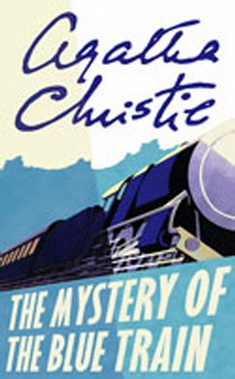
The Mystery of the Blue Train by Agatha Christie

Ruth Kettering is an American heiress who receives a set of valuable rubies as a gift from her father. Despite his warnings to keep them somewhere safe, Ruth takes the jewels with her on a trip to Nice. During her journey through France on the famous Blue Train, Ruth is found strangled to death in her compartment – and the case containing the rubies has disappeared. Hercule Poirot, who also happens to be travelling on the same train, promises to help Ruth’s father solve the crime and identify the killer. Suspicion falls first on Ruth’s husband, Derek Kettering, whom she had been about to divorce, and then on the mysterious Comte de la Roche. Is one of them the murderer?

I grabbed The Mystery of the Blue Train from the library shelf without really knowing anything about it. A bit of research now tells me it’s one of Agatha Christie’s less popular Poirot novels and now that I’ve read it I think I can see why. It was written quite early in her career and at a troubled time in her personal life, and apparently the author herself was unhappy with it. The book does have all the elements that should have added up to a classic Christie novel (a rich heiress, a journey on a luxury train, jewel thieves, the South of France – and Hercule Poirot himself, of course) but while I did enjoy it, I still felt there was something missing.

Compared to the other Agatha Christie books I’ve read, which admittedly isn’t all that many, this one was much longer and seemed to take a while to really get started (the actual crime doesn’t take place until about 100 pages into the book). There was a very long wait before Poirot made his first appearance and instead we spend a lot of time being introduced to other characters, which would have been okay had I liked these characters, but I found them a bit stereotypical, from the American millionaire to the French count to the old antiques dealer.

There were also a few sub-plots that I felt didn’t really add much to the story, although I did enjoy the dialogue between Poirot and Katherine Grey, a young woman he meets on the train who becomes involved in the murder investigation. The mystery itself kept me guessing, though I think there were probably enough clues to be able to work out at least part of the solution, if you were paying more attention than I was! The Mystery of the Blue Train was entertaining in places but is probably my least favourite Christie novel so far.

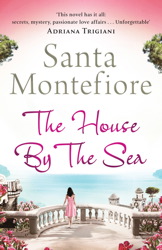
The House by the Sea by Santa Montefiore

The House by the Sea is the first book I’ve read by Santa Montefiore. The novel consists of two alternating stories, one set in present day England and the other in Italy several decades earlier. The Italian storyline begins in 1966 with Floriana, a ten-year-old girl who lives with her drunken father in a small village in Tuscany. Looking over the crumbling wall of a beautiful villa by the sea, Floriana comes face to face with seventeen-year-old Dante, whose parents own the house. Floriana dreams of one day marrying Dante and escaping from her lonely, miserable life but unfortunately things don’t go exactly as she planned.

In 2009 we meet Marina, a woman in her fifties who runs a hotel on the Devon coast. The hotel is in financial difficulties and in an attempt to save her struggling business, Marina advertises for an ‘artist-in-residence’ to spend the summer at the hotel teaching guests to paint. And so Rafa Santoro, an artist from Argentina, arrives in Devon and proves to be a big success – particularly with Marina’s stepdaughter, Clementine. But as Clementine begins to fall in love with Rafa, she starts to suspect that he may be hiding something.

What is Rafa’s secret? And what is the link between Floriana’s story and Marina’s? At first I had no idea; I couldn’t understand how the two could be connected. Eventually, though, the answers to these questions started to become clear – and there were a few other interesting sub-plots which also kept me guessing. I found myself completely engaged with both threads of the book. We spend quite a lot of time in each period before switching back to the other one, long enough to really get to know the characters and become absorbed in their lives. All of the characters were interesting to read about, even Clementine, who spent most of the book being completely annoying and irritating.

I thought Montefiore did a wonderful job of bringing two such different locations to life. The Devon chapters, with descriptions of cream teas, fishing trips and the office where Clementine works, have a very ‘English’ feel, while the Tuscan sections conjure up the sights and sounds of Italy. I loved both, though the Italian one felt particularly vivid and magical.

I really enjoyed this book and would be happy to read more books by Santa Montefiore, definitely. With mystery, romance, beautiful settings and well-developed characters, The House by the Sea proved to be a perfect summer read!

I received a copy of this book for review from Simon & Schuster

The Taste of Sorrow by Jude Morgan

The Taste of Sorrow is a fictional retelling of the lives of Charlotte, Emily and Anne Brontë, beginning with their childhoods and ending just after Charlotte’s wedding. Before I started reading this book if you’d asked me how much I already knew about the Brontës, I would have said I knew very little. And yet a lot of the story felt familiar to me – their early attempts at writing stories set in the fantasy worlds of Angria and Gondal, their experiences of working as governesses, their brother Branwell’s alcoholism – so I must have known more than I thought.

Although The Taste of Sorrow does seem to stick to the historical facts as far as I could tell, it’s important to remember that this is a novel and not a biography. Jude Morgan brings the Brontë sisters to life by giving us insights into their feelings and emotions, their hopes and dreams. His fictional Brontës are realistic, complex and three-dimensional, and would have been interesting characters to read about even if they had not been based on real people. We can obviously never know exactly what thoughts would have gone through the minds of the real Charlotte, Emily and Anne, but I had no problem believing that they may really have said and done the things that Morgan has imagined them to have said and done. And that’s the highest praise I can give to an author writing this type of historical fiction.

The Taste of Sorrow, as the title suggests, is not the happiest of books. The Brontës had a lot of sorrow in their lives, beginning with the death of their mother and two elder sisters, Maria and Elizabeth. They also had to deal with the usual challenges and obstacles that came with being a woman in the 19th century. When Charlotte suggested that she would like to be an author she was discouraged by her father simply because she was female. Instead, Mr Brontë pinned all his hopes on his son, Branwell.

I had read very little about Branwell before I started this book, though I knew he had caused his family a lot of pain because of his drinking. I thought Morgan portrayed him quite sympathetically, attempting to show the pressures and disappointments that contributed to his downfall, and how his sisters struggled to reconcile their love for him with their despair in him. Although I couldn’t like Branwell, his character felt as real to me as the characters of Charlotte, Emily and Anne.

The book itself is very well written, although the style is unusual and takes a while to get used to, but the strong point of the book is the characterisation and each sister is shown as having her own distinct personality. Morgan does focus more on Charlotte than the other two, though I can see that as the sister who outlived the others it probably made sense to tell most of the story from her perspective. But my favourite Brontë book is Wuthering Heights (I love it even more than Jane Eyre, which I know puts me in a minority within the book blogging world) and for that reason, the sister I was most interesting in reading about was Emily. Although we don’t get to spend as much time with Emily as we do with Charlotte, I thought Morgan’s portrayal of her was excellent and I could easily believe that his Emily was the person who wrote Wuthering Heights.

I was also pleased to see that Morgan does give Anne a lot of attention and she is not shown as being in any way inferior or less important than her sisters. Personally I loved both of Anne’s books, The Tenant of Wildfell Hall and Agnes Grey, and I think it’s sad to see how often she is overlooked or dismissed.

The Taste of Sorrow will obviously be of particular interest to Brontë fans, but I think it would also be enjoyed by a wider audience as an interesting and compelling historical fiction novel in its own right. Now I just need to read the remaining two Brontë novels I still haven’t read: The Professor and Shirley.

Thérèse Raquin by Émile Zola

Thérèse is a young woman trapped in an unhappy marriage to her sickly cousin, Camille Raquin. On the surface she appears quiet and passive, never voicing an opinion of her own. But underneath Thérèse is a passionate person who longs to break away from her boring, oppressive existence. When Camille introduces her to an old friend, Laurent, the two begin an affair. Desperate to find a way in which they can be together, Thérèse and Laurent are driven to commit a terrible crime – a crime that will haunt them for the rest of their lives.

If you think I’ve given too much away then I can tell you that this crime takes place quite early in the story and is not the climax of the book. The point of the story is what happens afterwards when Zola begins to explore the psychological effects this action has on the characters.

Thérèse Raquin, as you will have guessed, is a very dark book which becomes increasingly feverish and claustrophobic with scenes of violence and cruelty. I haven’t read much 19th century French literature, apart from a few books by Alexandre Dumas and Victor Hugo, and one thing that struck me about Zola’s writing was how much more daring and graphic this book is than British novels from the same period. The reader becomes locked inside the tormented minds of Thérèse and Laurent, sharing their fear and terror, their nightmares and sleepless nights, their inability to enjoy being together because the horror of what they have done stands between them. If you’ve read Dostoevsky’s Crime and Punishment or Edgar Allan Poe’s The Tell-Tale Heart, there are some similarities here.

This book could be enjoyed just for the dramatic plot (it’s as tense and gripping as any modern thriller) but I also thought the four main characters – Thérèse, Laurent, Camille and Madame Raquin – were fascinating and very vividly drawn. Zola apparently said that his aim was to create characters with different temperaments and see how each of them reacted to the situation they were in.

As the first book I’ve read by Zola, I wasn’t sure what I could expect from Thérèse Raquin but I thought it was excellent and I’ll certainly be reading more of his books.

The Invisible Bridge by Julie Orringer

The Invisible Bridge begins in 1937 and follows the fortunes of three Hungarian Jewish brothers – Andras, Tibor and Matyas Levi – as they try to survive in a Europe torn apart by World War II. At the beginning of the book, Andras is preparing to leave Budapest and go to Paris to study architecture. Soon after his arrival in France, Andras meets Klara Morgenstern, a woman nine years older than himself, a ballet teacher with a teenage daughter. Andras and Klara fall in love, but Klara has secrets in her past – secrets that she would prefer not to share with Andras.

Andras and Klara’s story is played out against a backdrop of wartime Paris, Budapest, Ukraine and parts of the Hungarian countryside. The complex relationship between Andras and Klara is always at the heart of the novel but to dismiss this book as just another romance is unfair because it’s so much more than that.

Despite reading a lot of novels set during World War II, this is the first one I’ve read that is told from a Hungarian perspective. Hungary was allied with Germany which meant this story approached things from a slightly different angle than most other books I’ve read about the war and as I knew almost nothing about the role Hungary played, I was able to learn a lot from this book. And of course, because Andras and his family are Jews the novel is very much from a Jewish viewpoint. We see how it grew increasingly dangerous to be a Jew living in wartime Europe and how the Levi family became desperate to escape to safety. And when eventually Hungary finds itself under German occupation, we see that the Hungarian Jews fared no better than Jews elsewhere in Europe.

I enjoyed this book but it wasn’t perfect. There were times when I thought the balance between the romance storyline and the war aspect wasn’t quite right. And some of the characters needed more depth. I really liked Andras at first as he was a character who was easy to like and sympathise with, but as the story went on I started to find him a little bit too perfect and after spending more than 600 pages with him I wished he’d had a few flaws just to make him more interesting. I also think it would have been a nice touch if part of the book had been written from another character’s point of view. Not really a criticism of the book – I just think it would have added another dimension to the story and with the book being so epic in scope, the opportunity was there to do this.

The biggest problem I had with the book was the length! I’m usually quite happy to immerse myself in a long book but unlike some stories which do take a long time to tell, I thought this one could easily have been a lot shorter. My attention started to wander somewhere in the middle of the book when a lot of time was spent describing Andras’s life in the forced labour service (Jews were no longer allowed to serve in the actual Hungarian army but instead were expected to do jobs such as felling trees and clearing minefields) but things did pick up again over the last hundred pages.

In fact, the final section of the book, with its descriptions of life in Budapest towards the end of the war is so compelling and filled with so much tension, it made it worth sticking with the book through the less interesting chapters in the middle. And of course, I was genuinely worried for some of the characters so I had to keep reading to make sure they survived to the end of the book! I thought Orringer did a good job of keeping us in suspense wondering who would live or die and despite the few minor negative points I’ve mentioned above, I loved The Invisible Bridge.

July Reading Summary

Another month over and another ‘Reading Summary’. I loved so many of the books I read in July that I’ve found it almost impossible to choose just two or three favourites like I usually do…so instead I’ve chosen six.

Before I Go to Sleep by S.J. Watson – I was worried this book might not live up to the hype, but I loved it and couldn’t put it down.
Jude the Obscure by Thomas Hardy – one of the Hardy books I was most looking forward to reading and it didn’t disappoint.
Therese Raquin by Emile Zola – my first experience of Zola. I was very impressed and will definitely be reading more of his work.

I also read three books set during World War II and all three were among my favourite books of the month too.

The Novel in the Viola by Natasha Solomons – a great story about an Austrian girl working as a maid in England during the war.
The Invisible Bridge by Julie Orringer – I started reading this in June and finally finished it this month. It’s a long book but I thought it was definitely worth the time and effort.
Hotel on the Corner of Bitter and Sweet by Jamie Ford – I’d been wanting to read this one for ages, so I was pleased to find I loved it as much as I’d hoped I would!

Other books read this month:

The Somnambulist by Essie Fox
The Road to Wanting by Wendy Law-Yone
Powder and Patch by Georgette Heyer
The Swimmer by Roma Tearne
Burned by Thomas Enger
The Observations by Jane Harris
The Mystery of the Blue Train by Agatha Christie
The Birth of Love by Joanna Kavenna
The Secret Lives of Baba Segi’s Wives by Lola Shoneyin
The Champion by Elizabeth Chadwick

All outstanding reviews have been written and will hopefully be posted in the next few weeks, so you shouldn’t have long to wait to find out what I thought about all of these books.

What have you been reading in July? Which books do you hope to read in August?