The Postmistress by Sarah Blake

It’s 1940. Frankie Bard is an American radio reporter working in London for CBS, broadcasting news on the Blitz into American homes. Frankie is right in the heart of the action, spending her nights sheltering from the bombs and her days reporting on homes that have been destroyed, families torn apart and children left orphaned.

Meanwhile on the other side of the Atlantic, we see the effects the war is having on the small town of Franklin, Massachusetts. In Franklin, we meet the postmistress (or actually, postmaster, as she prefers to be called): Iris James, a middle-aged single woman. And we also meet Emma Fitch, the doctor’s wife. When Emma’s husband travels to London to offer his medical skills to the war effort, it sets a chain of events in motion which will affect the lives of all three women.

I seem to have been reading a lot of books about World War II recently – books written during the war, set during the war and about the aftermath of the war. The Postmistress is a book I’ve had my eye on for a while and I was looking forward to reading it. Unfortunately, it turned out not to be one of the better WWII books I’ve read. In fact, it’s probably the most disappointing book I’ve read so far this year and I very nearly gave up on it after a few chapters. Although the writing was very elegant, it felt impersonal somehow and scenes that I’m sure should have made me cry left me unmoved.

The biggest problem I had was that I didn’t feel a real connection to any of the characters. The only one who came alive for me at all was Frankie Bard. I thought the book lacked focus and might have worked better if it had concentrated more on one central character. As it was, I’m not sure The Postmistress was the best title for this book. It implies that the postmistress (i.e. Iris) would be the main focal point of the book, which she wasn’t – this was really Frankie’s story in my opinion – and although Iris does play an important part in the plot, her character’s potential was never fully explored. As for the third main female character, Emma, she seemed very two-dimensional and I never felt that I got to know her at all.

It’s not all bad, though: there were some things that I did like about this book. I enjoyed the section where Frankie was sent to report on the refugee trains departing from Berlin and to attempt to interview some of the Jewish families who were leaving the city. I’m sure she wouldn’t really have found it quite so easy to travel by ferry from England to France in the middle of the war and then to catch a train to Berlin, though! Despite this and a few other inaccuracies (in the author’s note, for example, Sarah Blake admits that the recording equipment Frankie was carrying hadn’t been invented until 1944), I thought this was easily the most compelling part of the novel. This was around 150 pages into the book and was the first time I’d found myself becoming absorbed in the story, which made me glad I hadn’t abandoned it. Sadly though it didn’t continue to hold my attention and I quickly started to lose interest again when the focus returned to Iris and Emma.

I did find it interesting to read about the various ways in which the war was affecting the lives of people in Massachusetts, thousands of miles away from the fighting. We see people worrying about loved ones in Europe, people feeling frightened and expecting a German U-boat to land at any minute, people tuning into the radio every day to hear the latest news and wishing there was some way they could help. Most of the WWII books I’ve read have been from a European perspective so this was something different and I really liked that aspect of the book.

The Postmistress didn’t work for me personally, but I’ve seen a lot of reviews that are much more positive than mine, so clearly other readers have been able to connect with the characters and the story better than I have. I do however think it would make a good book group choice, as it raises some issues which would be perfect for a discussion, such as the importance of truth and whether the truth should always be told – and what happens to the people we hear about on the news after the reporter stops speaking and the radio is turned off.
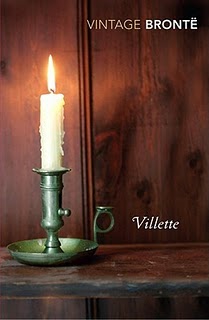
Villette by Charlotte Bronte

I wanted so much to love this book. Jane Eyre is one of my all-time favourite books and although it has taken me a long time to get round to reading another Charlotte Bronte novel, I had high hopes for this one. Unfortunately, for a long time Villette just wasn’t working for me and I’m not really sure why not.

I actually read this book at the end of January and discovered too late that there was a readalong taking place in February/March. I wonder whether reading it along with other people would have helped, as there were times when I really started to lose the motivation to continue with the book. There was a point where I didn’t think I was going to be able to keep reading, but eventually things improved and I finally became immersed in the story. I ended up enjoying it, but sadly it was too late for this book to become another favourite.

Villette is the story of Lucy Snowe who, after an unspecified family tragedy, finds herself completely alone in the world. She travels to Europe on her own and starts a new life teaching English to the girls at Madame Beck’s school in the city of Villette.

I think part of my problem with the first half of the book was that it took me a long time to warm to Lucy Snowe. I didn’t like her at all at the beginning of the novel, but eventually I did begin to feel a lot more sympathetic towards her and this coincided with the point where I started to enjoy the story more. My perceptions of Lucy changed as I learned more about her and saw how badly other people treated her. She was so lonely and isolated and my heart broke for her at times. Despite her cold exterior, underneath she was a person who desperately needed love and friendship. It’s quite sad that she doesn’t make this observation until two thirds of the way through the book:

“I liked her. It is not a declaration I have often made concerning my acquaintance, in the course of this book: the reader will bear with it for once.”

Lucy is also quite secretive and often withholds important information from the reader. And throughout the early chapters, although Lucy is our narrator, we learn more about the people around her than we do about Lucy herself. She’s an intensely private person and doesn’t open up to the reader very often. But as I got to know Lucy better, I found a lot of things to admire about her – her independence, for example, and her bravery in leaving England and travelling to another country with no idea of where she would go once she got there.

There is a romantic aspect to the book, but it’s not the most passionate of romances and not love at first sight. I already knew who Lucy’s love interest was going to be because it told me on the back cover, but things developed so slowly and so subtly it might not have been immediately obvious to me otherwise. Because of this though, the relationship feels believable and real.

Apart from the length of time it took me to get into the book, there are a couple of other negative points I should mention. Firstly, I thought the racism and religious prejudice was excessive, even by the standards of Victorian literature. Lucy considers the girls at Mme Beck’s school to be inferior to English girls in every way, and she doesn’t like Catholics or the Irish much either. Also, a lot of the book is written in French. I do have a basic understanding of French and am fine with books incorporating a few French phrases but this one has whole paragraphs where I kept wondering if I was missing something crucial.

Although I did end up enjoying this book and could eventually appreciate the complexity of Lucy Snowe’s character, it still doesn’t come close to Jane Eyre in my opinion. However, I know a lot of people think Villette is the better of the two. If you’ve read them both, what do you think?

February Reading Summary

I had another good reading month in February. I read thirteen books and enjoyed most of them, although a few were slightly disappointing.

February Stats:

Books read: 13
New-to-me authors: 10
Male to female author ratio: 2:11
Publication dates: 19th century – 1; 20th century – 3; 21st century – 9
Countries visited in my reading: England, USA, Guernsey, Scotland, Spain, Egypt, France

~

Favourite books read in February:

South Riding by Winifred Holtby
I loved this – and managed to finish it just in time for the start of the new BBC adaptation!
The Help by Kathryn Stockett
I realise I’m one of the last people in the world to read this but at least I’ve read it now and can see why so many people seem to love it so much!
Little Boy Lost by Marghanita Laski
One of the most emotional books I’ve read for a long time.

~

Other books read in February:

We Had It So Good by Linda Grant
Sacrifice by S.J. Bolton
By Fire, By Water by Mitchell James Kaplan
The Moorland Cottage by Elizabeth Gaskell
The Guernsey Literary and Potato Peel Pie Society by Mary Ann Shaffer
Mr Chartwell by Rebecca Hunt
The News Where You Are by Catherine O’Flynn
Moon Tiger by Penelope Lively
The Postmistress by Sarah Blake
The Anatomy of Ghosts by Andrew Taylor

As you can see, my reading rate has overtaken my blogging rate so I still have a lot of February books to review. I’d like to catch up with these over the next couple of weeks before I get much further behind.

~

Challenge progress:

Victorian Literature Challenge: 3/15
Gaskell Reading Challenge: 1/2
Historical Fiction Challenge: 5/20

~

Other reading/blogging activities in February:

This past weekend was Persephone Reading Weekend, as many of you will know. Little Boy Lost was the only Persephone I had time to read and review this weekend, but I enjoyed reading everyone else’s posts. I was even lucky enough to win a copy of Family Roundabout by Richmal Crompton in one of the giveaways!
I also took part in a group read of Elizabeth Gaskell’s The Moorland Cottage in February. This was the first of Gaskell’s works I’ve read (apart from a short story) and I’m looking forward to reading one of her other books soon.

In February I read a lot more contemporary/21st century books than I normally do. In March I’m hoping to have more of a balance between classics and newer books. Also in March I’m planning to take part in Irish Short Story Week, which will be hosted by Mel of The Reading Life from 14-20 March. If you’d like to participate too, there are plenty of classic short stories by Irish authors available online – so no need to buy any new books!

How was your February?

The Virgin Blue by Tracy Chevalier

The Virgin Blue was Tracy Chevalier’s debut novel, first published in 1997. The only other book I’ve read by Chevalier is her most recent one, Remarkable Creatures, but I found both the writing style and atmosphere of this one entirely different.

The Virgin Blue follows two separate storylines, one from the present and one from the past, which eventually become woven together. In the modern day story, we meet Ella Turner who leaves her home in California and moves to the small French village of Lisle-sur-Tarn when her husband is offered a new job in France. Ella has trouble fitting into her new community – the local people are hostile and unwelcoming, and only the librarian Jean-Paul makes any attempt at friendship. As she begins to dig deeper into her family history, Ella’s hair begins to turn gradually red and, haunted by dreams of a brilliant blue, she starts to become aware of the parallels between her own life and that of her 16th century ancestor, a girl called Isabelle.

Isabelle de Moulin was a young peasant girl, known as La Rousse in reference to her red hair, who married Etienne Tournier, a man from a Huguenot family. With her red hair, her skills as a midwife and her love of the Virgin Mary and the colour blue, Isabelle is an object of suspicion. When the Tourniers find themselves under threat from their neighbouring Catholics, they are forced to flee France for Geneva in Switzerland, where they can follow their religion in freedom. It’s Isabelle’s tragic story that forms the second thread in The Virgin Blue.

I thought the alternating time periods in this book were handled well and they were each written in a distinctive style so that there could be no confusion. The Isabelle chapters had a dreamlike feel, almost like reading a fairytale. These chapters were also very sad and dark. Poor Isabelle was surrounded by cruel, vindictive people and seemed to have very little happiness in her life. Her story unfolded very slowly, being interspersed with Ella’s, and from the beginning there was always a sense of foreboding, a feeling that something bad was going to happen to Isabelle or her children.

I loved the setting of rural France, with its beautiful countryside and picturesque villages. Chevalier gives just enough detail to bring the landscape to life, without weighing the story down with too much description. The one thing that let this novel down for me was the characters. With the possible exception of Jean-Paul none of them felt quite real to me. I thought Rick, Ella’s husband, was especially bland and wooden, to the point where I didn’t even care what happened to him. The characters in the 16th century storyline never really came to life for me either.

So The Virgin Blue, for me, was an enjoyable but forgettable book. Despite the weak characters, I was able to become absorbed in the story while I was reading it but by the next day it was already fading from my mind. Having read Chevalier’s oldest book and her newest I’m now looking forward to reading the ones in between!

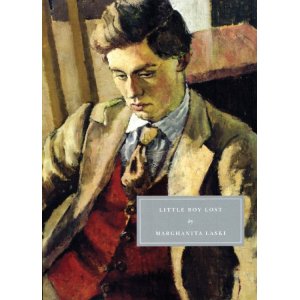
Persephone Reading Weekend: Little Boy Lost by Marghanita Laski

Persephone Reading Weekend is hosted by Claire and Verity. For those of you who are new to Persephone and wondering what this is all about, they’re a publisher dedicated to printing “mainly neglected fiction and non-fiction by women, for women and about women” and Claire and Verity have organised a weekend of reviews, giveaways and other Persephone-related fun. I’m glad I’m able to participate for the first time, as I hadn’t discovered Persephone Books in time for last year’s event. Since then I’ve read four Persephones – this one, Little Boy Lost, is my fifth. And I’m pleased to say that it has just become my favourite so far.

I was originally planning to read Alas, Poor Lady by Rachel Ferguson which I received from my Persephone Secret Santa at Christmas, but due to the length of the book I realised I wasn’t going to be able to read it in time to post about it this weekend. Although I’m still hoping to get to Alas, Poor Lady within the next few weeks (and looking forward to it as I’ve heard some good things about it), I decided that my book for the Reading Weekend would have to be the only other unread Persephone I own, Marghanita Laski’s Little Boy Lost.

And now I feel bad that Little Boy Lost was only my second choice. I can’t believe I’ve let this book sit on my shelf unopened for more than six months; if I’d realised I was going to love it this much I would have read it immediately.

Little Boy Lost is the second book I’ve read by Marghanita Laski – the first was The Victorian Chaise-Longue. However, I found the two books entirely different. Although I did enjoy The Victorian Chaise-Longue, this one was far more emotional and a more gripping, compelling read.

It’s Christmas Day, 1943, when Hilary Wainwright first learns that his son has been lost. He had seen baby John only once – a brief glimpse of a little red face with dark hair poking out of a bundle of blankets. Then, while Hilary was away, his wife, Lisa, was killed by the Gestapo in Paris and their little boy disappeared almost without trace. When the war is over, Hilary goes back to France and with the help of his friend, Pierre, he begins to follow a trail which he hopes will lead him to his lost son.

Laski does an excellent job of portraying the conflicting emotions Hilary experiences, torn between longing to be reunited with his son and worrying that if he does find him he might not want him. All through the book I was guessing what might happen – it wasn’t really obvious what the outcome would be and I could think of several different possibilities, some good and some bad.

The descriptions of post-war France are so vivid: the bomb-damaged buildings, the poverty, the food shortages – unless you were rich enough to take advantage of the black market, of course. And I was shocked by the descriptions of the conditions in the orphanages. As well as there not being enough to eat and drink, and a complete lack of any toys or games, it was chilling to think of children with tuberculosis living alongside the healthy ones.

Although I was trying to avoid hearing too much about this book before I read it, I knew it was supposed to become very nerve-wracking and suspenseful towards the end. Well, I can tell you that this is definitely true! There are so many great books that are let down by a weak ending, but this is certainly not one of them. The tension throughout the final few chapters was nearly unbearable, so much so that I was almost afraid to reach the end. And I imagine most readers, like I did, will have tears in their eyes when they reach the very last sentence.

Nicholas Lezard of The Guardian, who is quoted on the back cover, says it best: “If you like a novel that expertly puts you through the wringer, this is the one.”

Group Read: The Moorland Cottage by Elizabeth Gaskell

Having signed up for the Elizabeth Gaskell Reading Challenge I’m intending to read some of Gaskell’s full-length novels this year, but when I saw that Katherine of Gaskell Blog was hosting a group read of the novella, The Moorland Cottage, it seemed like a perfect way to start the challenge.

The Moorland Cottage is a short but very moving and emotional story. Mrs Browne and her children, Edward and Maggie, live with their elderly servant, Nancy, in a cottage near the town of Combehurst. It’s no secret that Edward is their mother’s favourite child but while she dotes on her son, she never has a kind word for her daughter. In a big house nearby live the wealthy Mr Buxton and his gentle, loving wife. There are also two children in the Buxton household: their son, Frank, and their niece, Erminia. The Buxtons attempt to befriend the Brownes, but while they can all see the goodness in Maggie, they find it difficult to like the spoilt, selfish Edward and the cold, snobbish Mrs Browne. As the years go by and the lives of the Brownes become more and more entwined with their neighbours’, Maggie is forced to make a decision which could potentially affect the future of both families.

The Moorland Cottage shows us the ways in which boys and girls were treated differently in Victorian society and I felt so sorry for Maggie. Throughout the first few chapters my heart was breaking for her as I saw how she was constantly pushed aside in favour of her brother. It was very, very sad to see the way, as a child, she meekly accepted her mother’s cruelty. For example, when Frank Buxton brings a pony for Maggie to ride, Mrs Browne decides “to spoil the enjoyment as far as possible, by looking and speaking in a cold manner, which often chilled Maggie’s little heart, and took all the zest out of the pleasure now”. How spiteful!

Maggie is also treated badly by Edward, and again, she allows him to do so, accepting that his needs are more important than her own. It’s not until she’s older and has spent more time in the company of the Buxtons and been exposed to other ideas that she starts to become aware of her brother’s faults. In the adult Edward, we see what happens to a child who is brought up always getting their own way and not being taught the difference between right and wrong.

I loved Gaskell’s descriptions of the Brownes’ home and the surrounding scenery throughout the changing seasons. Because the book was so short these descriptive passages had to be kept fairly brief which I thought made them even more effective.

The air on the heights was so still that nothing seemed to stir. Now and then a yellow leaf came floating down from the trees, detached from no outward violence, but only because its life had reached its full limit and then ceased. Looking down on the distant sheltered woods, they were gorgeous in orange and crimson, but their splendour was felt to be the sign of the decaying and dying year. Even without an inward sorrow, there was a grand solemnity in the season which impressed the mind, and hushed it into tranquil thought.

Finally, a few words on the group read itself: I thought this book was an excellent choice for a readalong. For such a short book it contains a wealth of interesting topics and issues. At only eleven chapters I could easily have read it in one day but I found that reading it slowly meant I had a better understanding of it and got more out of the story. And Katherine’s beautifully annotated chapter summaries were very useful and helped to bring the story to life. Visit Gaskell Blog to see them for yourself!

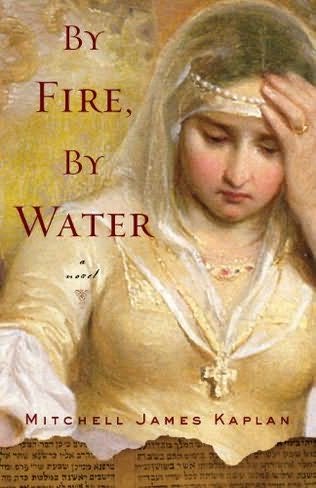
By Fire, By Water by Mitchell James Kaplan

By Fire, By Water tells the story of an important period in the history of Spain. A time of progress and discovery, as Christopher Columbus prepares to set out on his legendary voyage to the Indies and seeks funding from the Spanish court. But also a time of fear and suffering with Tomas de Torquemada’s New Inquisition designed to root out heresy.

Luis de Santángel, the King’s chancellor, is a converso – his family has recently converted from Judaism to Christianity – and his Jewish heritage means that even he, in his position of great wealth and power, is under suspicion. Santángel wants to understand the differences between the Jewish and Christian faiths but attempting to gain this knowledge could put his life in danger.

Intertwined with Santángel’s story is the story of Judith Migdal, who lives with her nephew and his grandfather in a Jewish community in Muslim-ruled Granada. Following the deaths of her brother and his wife, Judith decides to become a silversmith so that she can take over her brother’s silver workshop and support her family. Eventually Luis and Judith’s paths meet, but can there be any happiness for them?

By Fire, By Water was not a light or easy read and I found I had to really concentrate to follow everything that was going on. However, it was worth the effort because I felt that I really learned a lot from this book. I thought it was an excellent portrayal of what it must have felt like to live during the Inquisition, not being sure who could and couldn’t be trusted, knowing that even your own friends and family could betray you at any moment. This book really opened my eyes to the suffering and persecution the Jews faced in Spain. The images of thousands of Jews being driven from their homes and forced to leave the country are unforgettable.

I was also interested in the inclusion of Cristóbal Colón (Christopher Columbus) in the plot. Most people are aware of his quest to find the Indies and his subsequent arrival in America, but this book looks at the struggles he faced to obtain the funding he needed for the voyage and to get people to take his ideas seriously.

The author’s attention to detail is incredible, from the colours and fabrics of the clothes people wore, to the sights and sounds of the marketplace. You could never forget that you were in 15th century Spain and I was very impressed with the amount of research that must have gone into this book. Everything felt very realistic and believable.

I read most of this book in one day because I was so desperate to find out what would happen to Santángel, Judith and the other characters. The ending was not what I expected at all, but again, it was probably a realistic outcome. By Fire, By Water should be enjoyed by anyone who appreciates well-written historical fiction or is interested in learning more about 15th century Spain.

I received a review copy of this book from the author.