Drive-By Saviours by Chris Benjamin

Drive-By Saviours, the debut novel by Canadian author Chris Benjamin, tells the story of two men from very different backgrounds who meet one day on the subway in Toronto and form a friendship that changes both of their lives forever. One of these men is Bumi, an illegal immigrant from Indonesia, on the run from his troubled past. The other is Mark, a Canadian social worker who is growing increasingly disillusioned with his job. As they get to know each other, Mark learns that Bumi is suffering from OCD (obsessive compulsive disorder) and decides to try to help him get the treatment he needs – and at the same time discovers that this new friendship could have important consequences for his own future.

The novel moves back and forth between Indonesia and Canada, with alternating chapters being told from first Bumi’s perspective, then Mark’s. Bumi’s chapters are in chronological order, whereas Mark’s are in the form of flashbacks and anecdotes. This might sound like a confusing structure, but the author handles the transitions very well and the story flows nicely.

This wasn’t a bad book by any means, but overall it didn’t quite work for me. Although I enjoyed the first half of the book, there were a few occasions during the second half where I started to lose interest in the story. And while I thought Bumi was a fascinating and sympathetic character, I felt less engaged with the chapters narrated by Mark. Maybe I just wasn’t the right reader for this book as most other reviews seem to be very positive.

However, there were some things I really liked about this book. First of all, I enjoyed the chapters set in Indonesia which described Bumi’s childhood on a small fishing island and the difficulties he experienced when he was sent to school in the city of Makassar as part of a government experiment. I know very little about Indonesia so it was nice to have the opportunity to learn something about the history, politics and culture of the country. I also found the portrayal of Bumi’s OCD very interesting to read about. The author spent a lot of time describing how Bumi’s obsessions originated and spiralled out of control, what the symptoms were, and how people reacted to his behaviour in a community where most people were uneducated and had a limited understanding of mental illness.

A lot of other interesting issues are touched on, including families being separated by immigration, the effects of tourism and progress on an island community, and life in Indonesia under President Suharto’s regime. But at the centre of the novel is the idea that two people who have grown up thousands of miles apart can discover a number of parallels in their lives and form a bond that transcends their cultural and personal differences.

I received a review copy of this book through LibraryThing Early Reviewers

Historical Fiction Challenge 2011

I’ve been hoping someone would be hosting an historical fiction challenge next year, and here it is! This is the third 2011 reading challenge I’m signing up for and will probably be the last, unless I come across any others that I can’t resist.

The challenge is hosted by Historical Tapestry and will run from 1 January 2011 to 31 December 2011. There are five different levels to choose from.

1. Severe Bookaholism: 20 books
2. Undoubtedly Obsessed: 15 books
3. Struggling the Addiction: 10 books
4. Daring & Curious: 5 books
5. Out of My Comfort Zone: 2 books

I’m signing up at the Severe Bookaholism level. Although I don’t read as much historical fiction as I used to, it’s still one of my favourite genres and I’m sure I’ll easily be able to read at least 20 in 2011. If you want to participate in this challenge too you can sign up here.

Remarkable Creatures by Tracy Chevalier

First of all, this is probably my last post until after Christmas, so whether you celebrate it or not I hope you all have a great weekend! Now, back to my thoughts on Remarkable Creatures

Remarkable Creatures is set in the town of Lyme Regis on the south coast of England during the early part of the nineteenth century. It’s the story of two very different women who are brought together by a shared love of collecting fossils. Mary Anning is a young working-class girl who has lived in the town all her life and hunts for fossils for her family to sell to tourists. Elizabeth Philpot, twenty years older than Mary and from a middle-class background, moves to Lyme Regis with her two unmarried sisters. Her interest in fossils begins when she discovers an unusual stone on the windswept beach. Eager to have someone to share her new passion with, Elizabeth finds an unexpected friend in Mary.

Before I started this book I had no interest in fossils; I still don’t, unfortunately. I found the whole fossil aspect of the book pretty boring, but that’s not the fault of the author. I could still enjoy the story even though the subject bored me, and it did raise some interesting questions regarding the theory of evolution (the book was set several decades before Charles Darwin published his On the Origin of Species).

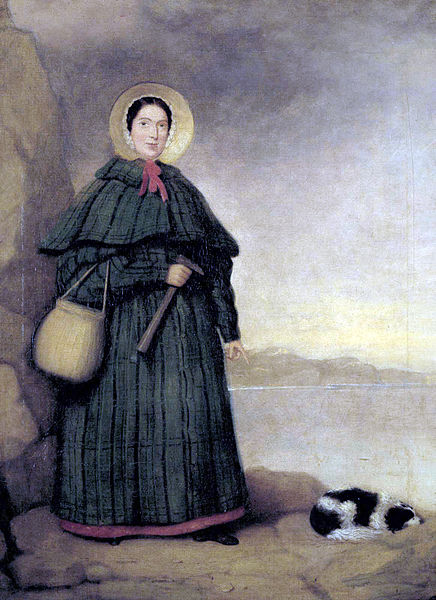
I do admire Tracy Chevalier for creating a story based around such an unusual topic and real-life characters who aren’t very well known. Mary Anning (pictured here with her dog, Tray) and Elizabeth Philpot are both real historical figures who contributed to the science of palaeontology, and as I knew nothing about either of them it was good to have the opportunity to learn about their lives. It was only after finishing the book and looking up the real-life Mary and Elizabeth that I realised how many details Chevalier had included that were based on fact.

I could sympathise with two women trying to gain recognition in a male-dominated field and the difficulties they faced in getting people to take notice of their work and give them the credit they deserved. They were unable to join the Geological Society of London, for example, because it was open only to men.

“That is all she will get, I thought: a scrap of thanks crowded out by far more talk of glory for beast and man. Her name will never be recorded in scientific journals or books, but will be forgotten. So be it. A woman’s life is always a compromise.”

Although I can’t say I loved Remarkable Creatures, it was enjoyable enough and a gentle, easy read. I do think it’s great though that this book has helped to bring two very important but little-known women back into the public eye.

Gaskell Reading Challenge

I know I said I would be signing up for as few challenges as possible in 2011, but when I came across this Elizabeth Gaskell challenge I knew I wouldn’t be able to resist it. I still haven’t read anything by Gaskell, apart from one of her short stories (The Manchester Marriage, which appeared in the book A House to Let), and I definitely want to read some of her novels next year.

The challenge is hosted by Gaskell Blog and you can sign up here. I need to read a minimum of two works between January and June 2011. Any recommendations? I’m thinking about North and South and Cranford.

After the Sunday Papers #9: Reading Challenge Wrap-Up & New Book Arrivals

It’s almost the end of 2010, which means most of the challenges I’ve been participating in this year are coming to an end (and some are already finished). I don’t want to bore you with twelve separate challenge wrap-up posts, so I’ve decided to incorporate them all into this week’s Sunday Papers post.

You can see the complete list of books I read for each challenge on my challenge page.

Women Unbound Reading Challenge: 8/8 books Completed
This challenge was a success. I had originally signed up for the Bluestocking level (5 books including 2 nonfiction) but easily reached Suffragette level (8 books including 3 nonfiction). I particularly loved all three of my nonfiction choices, Testament of Youth by Vera Brittain, Wild Swans by Jung Chang and Persepolis by Marjane Satrapi.

Year of the Historical: 12/12 books Completed
I had expected this to be an easy challenge to complete – and it was. For a total of 12 books, all I needed to do was read one historical fiction novel per month, but I actually met the requirements of this challenge halfway through the year.

New Authors: 50/50 books Completed
For the New Authors challenge I could choose to try either 15, 25 or 50 new-to-me authors in 2010. I chose 15, because in the past I’ve been slow to try new authors, preferring to stay with authors I know and love. Of course, book blogging has helped me to discover lots of new authors who I would never have even thought about trying, and I ended up reading 50!

All About the Brontes: 2/3 books Failed
Unfortunately I forgot that this challenge would be ending in the summer. I had been thinking I had until the end of the year to read my three Bronte books, so this one has been a failure. Not a complete failure though, because I enjoyed the two Anne Bronte books I read and am still intending to read Villette by Charlotte Bronte in 2011.

A-Z Challenge: 20/26 books Failed
For this challenge, I needed to read one book beginning with each letter of the alphabet. As I expected, some letters proved more difficult to find than others. I still haven’t read anything beginning with J, K, Q, X, Y or Z so I’ve obviously failed this one!

Flashback Reading Challenge: 2/6 books Failed
I’m disappointed to have failed this challenge because I used to love revisiting my favourite books. I fully expected this to be one of the easiest challenges to complete and it makes me feel sad that only two of the books I’ve read this year have been rereads. This is something I want to change in 2011, while still continuing to discover new books.

What’s in a Name? 3 Challenge: 4/6 books Failed
This challenge sounded fun, but was always going to be a difficult one for me. I managed to read a book with a plant in the title (The Black Tulip), a music term (The Cellist of Sarajevo), a title (The White Queen) and a food (The Sweetness at the Bottom of the Pie) but have failed on the place name and the body of water.

Historical Fiction Reading Challenge: 20/20 books Completed
Like Year of the Historical, this one was easy to complete as historical fiction is one of my favourite genres.

Our Mutual Read: 12/12 books Completed
As you’ve probably noticed, I love anything Victorian so this challenge was perfect for me! I read three neo-Victorian books and the rest were Victorian classics.

Gothic Novel Challenge: 5/5 books Completed
I signed up for the Easy level, for which I needed to read five gothic novels. I chose four gothic classics (The Castle of Otranto, The Monk, Vathek and Dracula) plus The Unburied by Charles Palliser.

Daphne du Maurier Challenge: 3/3 books Completed
I loved all three of the Daphne du Maurier books I read for this challenge (I’ll Never Be Young Again, My Cousin Rachel and The Scapegoat). The challenge doesn’t finish until next April, so I still have plenty of time to read one or two more.

RIP V Challenge: 4/4 books Completed
This was one of the challenges I enjoyed the most – and it helped me get in the mood for Halloween! I actually read more than required – eight books and one short story.

~

Newly acquired books

I haven’t shared my new book arrivals with you for a while, mainly because I haven’t acquired very many recently. My TBR pile is starting to get out of control, so instead of adding to it I’ve been trying to read some of my unread books. I have received a few this month, though.

The Return of the Soldier by Rebecca West: I found a second-hand copy of this and thought it would be perfect for the Virago Reading Week Rachel and Carolyn are planning.

Drive-by Saviours by Chris Benjamin: Won this through LibraryThing Early Reviewers.

Ghost Light by Joseph O’Connor: I received this a couple of weeks ago courtesy of Jessica at Park Benches & Bookends. It was the prize I won during the Readathon in October.

Darkside by Belinda Bauer: I received this one from Transworld Publishers. This is Belinda Bauer’s second book – I recently reviewed her first novel, Blacklands.

Have you read any of these?

Have a great week and enjoy whatever you’re reading!

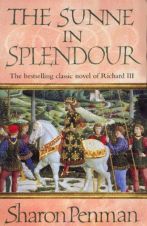
The Sunne in Splendour by Sharon Penman

“And what of those who didn’t know him? What happens, too, when all who knew him are dead, when people know only what they’ve been told?”

When I read The White Queen by Philippa Gregory earlier in the year, I became intrigued by Richard III, the Wars of the Roses and the mystery of the Princes in the Tower. The Sunne in Splendour was recommended to me as the best fictional account of Richard III, so I immediately bought a copy – and it has taken me until now to pick it up and read it. I think one of the things that was putting me off was the sheer size of the book; it’s one of those books that is physically difficult to hold because it’s so thick and heavy. But as soon as I started reading I knew I was going to love this book. Not only did it turn out to be the best historical fiction book I’ve read for a long time, it was also one of the best books of any type that I’ve read this year.

The Sunne in Splendour tells the complete life story of Richard III from childhood to death. Penman portrays Richard as a sympathetic figure who has been unfairly treated by history. Sadly, he is often thought of today as the villain of Shakespeare’s Richard III: the evil hunchback who murdered his nephews. It’s worth remembering though, that Shakespeare lived in Tudor England – and it was Henry Tudor who defeated Richard, the last of the Plantagenet kings.

The Wars of the Roses is the term used to describe a series of battles and rebellions that took place between two branches of the English royal family, the House of York and the House of Lancaster, during the late fifteenth century. I already had some basic knowledge of the period before I started reading this book, but even if you don’t I think Penman makes it easy enough to understand. Sometimes a story can suffer from the author’s attempts to include every little bit of interesting information they’ve uncovered in their research, but that’s not actually a problem here. Yes, there’s an enormous amount of detail, but everything feels necessary and helps to build up a vivid picture of Richard’s world.

The author really brought the characters to life and made them feel like real people who I could understand and care about rather than just names on the pages of a school history book. The number of characters with similar names could have caused confusion but I thought Penman handled the problem very well making them easy to identify by using nicknames (Ned, Dickon, Bess etc) or titles (Warwick, Clarence, Montagu) and Edward of Lancaster is given the French version of his name, Edouard, to distinguish him from Edward of York.

The story is told from multiple viewpoints, with surprisingly little of the story being from Richard’s perspective. Much of what we learn about Richard we learn through the eyes of his family, friends and enemies. A lot of time is devoted to the romance between Richard and Anne Neville, but what really fascinated me was the complex relationship between the York brothers, Richard, Edward and George.

As you might expect, there are a number of battle scenes – something that I don’t usually enjoy, but these were so well written that I was able to follow exactly what was happening and could even form mental pictures of the battlefields and the positions of the two opposing armies. The Battle of Barnet kept me up late on a work night and the Battle of Tewkesbury was even more compelling. I loved the way we got to see the human side of the battles, the emotions of the people on the battlefield, rather than just descriptions of the military tactics. While Richard and Edward are clearly supposed to be our ‘heroes’, it’s a testament to Penman’s writing that I could also cry at the deaths of their ‘enemies’.

Being almost 900 pages long, it took me a long time to read this book, but that was mainly because it was so emotionally intense in places that I couldn’t read too much at once. And also, I was dreading reaching the end. The problem with a book like this is that you know what’s ultimately going to happen (at least you do if you have some background knowledge of the period or have read about it before) so I knew what the eventual fate of the characters was going to be.

This is one of the best books I’ve read this year and I can’t believe I’ve never read anything by Sharon Penman before now. At least I know I’ll have hours of reading pleasure ahead of me as I work through the rest of her novels!

My Persephone Secret Santa Revealed!

Today is the day when Persephone Secret Santa participants reveal the identity of their Santa and the gift they received! Persephone Books have been a wonderful new discovery for me in 2010. I’ve read four so far and loved them all, so I couldn’t resist signing up for this year’s Secret Santa.

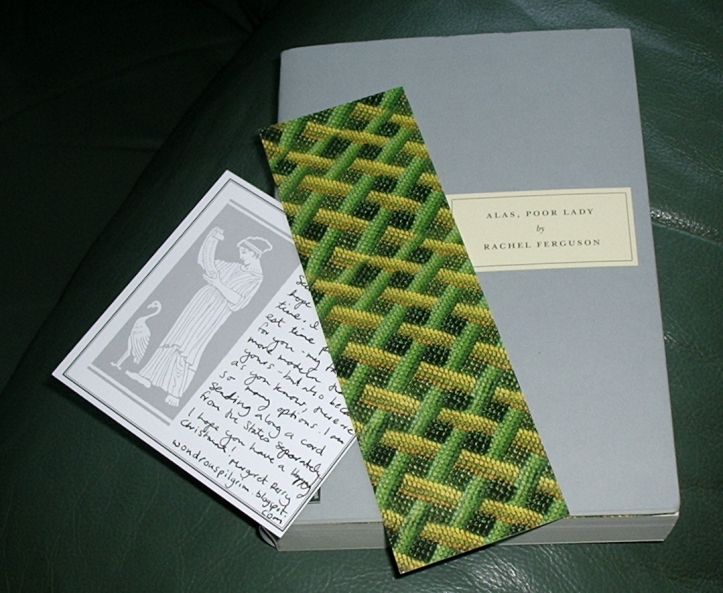
My Santa was Margaret of Ten Thousand Places. I was delighted to find that the book she sent me was Alas, Poor Lady by Rachel Ferguson. Margaret included a message with the book and mentioned that it had been a difficult decision – well, Margaret, I would have been happy with any of the Persephones I haven’t already read, but I think you’ve chosen one that will be perfect for me! I can’t wait to start reading it.

Thank you to Margaret for being my Santa and thanks also to Claire at Paperback Reader for hosting this! I’m looking forward to visiting everyone else’s blogs to find out what they received. For a list of all the Persephone Secret Santa participants see this post at Claire’s blog.