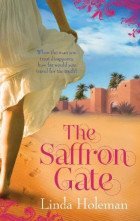
Review: The Saffron Gate by Linda Holeman

Linda Holeman’s books are perfect comfort reading for me. She writes the kind of historical fiction I love, with just the right combination of romance, history and adventure. One of the things I like about her books is the way she chooses such interesting settings (19th century Afghanistan in The Moonlit Cage, for example, or British-ruled India in In a Far Country). The Saffron Gate is set in 1930s Morocco, a time and place I know very little about, but Holeman really makes the setting come alive, from the noise and bustle of the souks in Marrakesh, the taste of hot couscous and mint tea, the vibrant colours of the trees and flowers.

But Morocco in the 1930s can be a dangerous place for a woman on her own, as our narrator soon discovers. Her name is Sidonie O’Shea and she’s travelling to North Africa from her home in Albany, New York in search of her fiancé Etienne Duverger, who disappeared without word, leaving behind a mysterious letter from his sister in Marrakesh. When Sidonie arrives in Morocco she realises the enormity of her task – she has no idea where to start looking for Etienne and it seems that certain people are determined to stop her from finding him at all costs. As Sidonie continues to search, she begins to fall in love with Morocco and at the same time uncovers some important truths about both Etienne and herself.

There were times when I wanted to throw this book across the room in disgust, not because it was badly written, but because one of the characters was just so horrible and so cruel to Sidonie I didn’t think I could bear to read any more. Not only that, but Sidonie is far too innocent and trusting, which started to frustrate me after a while. Somewhere in the middle of the book though, the story began to go in a different direction to what I was expecting and I started to feel more hopeful of a happy ending. Whether I got one or not I’ll leave you to find out for yourself.

I learned a lot from this book about the role of women in 1930s Morocco, how they lived, and how they were scorned and looked down upon if they didn’t have a husband. There was also a lot of information about their fashions, customs, superstitions – and some fascinating details, such as the rituals of the hammam (public baths).

I’ve enjoyed all of the Linda Holeman books that I’ve read, but I think this one has been my favourite so far. I would highly recommend The Saffron Gate to anyone who likes to read long historical fiction novels that allow you to immerse yourself in another culture for a while.

After the Sunday Papers #8: Persephones and Jane Austen

I had a nice surprise this week when I discovered part of my review of Good Evening, Mrs Craven: The Wartime Stories of Mollie Panter-Downes had been quoted in the Readers’ Comments section of the Persephone Biannually Autumn and Winter 2010 magazine.

I’ve enjoyed all four of the Persephones I’ve read so far, and would appreciate any recommendations for which ones I should read next.

The Persephones I’ve already read are:

The Victorian Chaise-longue by Marghanita Laski
Good Evening, Mrs Craven: The Wartime Stories of Mollie Panter-Downes
Miss Ranskill Comes Home by Barbara Euphan Todd
Miss Pettigrew Lives For a Day by Winifred Watson

Have you read any Persephone books? Which books or authors would you recommend?

Jane Austen

I came across this article yesterday about Jane Austen. Apparently Austen’s manuscripts show that she made spelling mistakes, had trouble with the ‘i before e’ rule and wrote in a regional accent. Although I’m not a big Jane Austen fan or an expert on her background, I think the article is a bit harsh considering the standard of education that was available to girls in those days and also the fact that written English didn’t necessarily follow the same rules then as it does today. What do you think?

Currently reading

I’m still working my way through the stories in The Haunted Hotel & Other Stories by Wilkie Collins which as you might expect, is proving to be a perfect Halloween read! This will be my seventh book for the RIP challenge, which means the only book on my original challenge list that I haven’t read yet is Frankenstein. I don’t think I’ll have time to fit that one in before the end of the month, so I’ll have to either read it after Halloween or leave it until next year.

I’m also reading a book that I requested from Netgalley, called The Dressmaker of Khair Khana by Gayle Tzemach Lemmon. It’s the true story of a woman living in Taliban-era Afghanistan who started her own business to support herself and her younger sisters, and is one of the most inspirational stories I’ve ever read.

What are you reading this week?

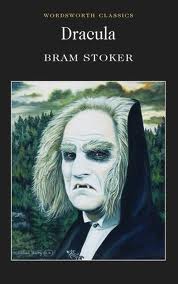
Review: Dracula by Bram Stoker

“My friend. – Welcome to the Carpathians. I am anxiously expecting you.”

When Jonathan Harker travels to Count Dracula’s castle in Transylvania to advise the Count on the subject of buying property in England, he quickly becomes aware that there’s something not quite normal about his host – and after making some terrifying discoveries, he finds himself imprisoned in the castle. Back in England, Harker’s fiancée Mina Murray is anxiously waiting in Whitby for news of Jonathan. But as if she didn’t already have enough to worry about, her friend Lucy Westenra becomes mysteriously ill, with inexplicable puncture wounds on her throat. Could Lucy’s illness have anything to do with the ship that was recently swept into the harbour during a storm?

Interspersed with the main storyline are Dr Seward’s medical notes on one of his patients, a man called Renfield who likes to eat flies and spiders – but what is the connection between Renfield, Lucy and Dracula? Dr Seward brings in his friend Van Helsing, an expert in unusual diseases, and with the help of Mina, Jonathan, Lucy’s fiance Arthur Holmwood and a friend, Quincey Morris, they attempt to solve the mystery and defeat Dracula.

Dracula was an obvious choice for me for the RIP challenge, particularly as it’s one of those books I feel as if I should have read years ago, yet never have (apart from a children’s version which doesn’t really count as it was so heavily abridged). Yet even though I had never read it, a lot of the story was familiar as it has become so firmly entrenched in popular culture. Dracula is not the first vampire story (a few weeks ago I wrote about John Polidori’s The Vampyre and Byron’s Fragment of a Novel) but it’s definitely the most famous.

The book is written in an epistolary style with the entire story being told through letters, journal entries, telegrams and newspaper reports. This structure kept the story moving forward and it was interesting to see so many different perspectives, but I did feel that some of the entries were too short and the story kept switching too abruptly from one person’s journal to another. I would have liked to have spent longer with one character before switching to the next. Some of the ‘voices’ were very similar, but I really liked the character of Mina, who was a strong, sensible, intelligent woman and although she was subjected to the usual Victorian attitudes of the time, she played an important role in the story. In comparison, Lucy is more of a typical Victorian heroine.

The opening section in Transylvania was my favourite part of the book. I loved the atmosphere Stoker created, with the snow falling and the wolves howling.

Though we were in shelter, we could hear the rising wind, for it moaned and whistled through the rocks, and the branches of the trees crashed together as we swept along. It grew colder and colder still, and fine, powdery snow began to fall, so that soon we and all around us were covered with a white blanket. The keen wind still carried the howling of the dogs, though this grew fainter as we went on our way. The baying of the wolves sounded nearer and nearer, as though they were closing round on us from every side. I grew dreadfully afraid, and the horses shared my fear.

When the story moved from Transylvania to Whitby, the pace slowed down and I started to get bored. I did enjoy all the descriptions of Whitby though, with its harbour and ruined abbey. Whitby is only a couple of hours’ drive from where I live, so we go there a lot, and it’s always nice to read about a place you know well.

I actually didn’t find the book very frightening, though maybe that’s just because I was already so familiar with the story. There were some very creepy scenes though, such as when Harker sees Dracula emerging through a window and crawling headfirst down the castle walls:

I was at first interested and somewhat amused, for it is wonderful how small a matter will interest and amuse a man when he is a prisoner. But my very feelings changed to repulsion and terror when I saw the whole man slowly emerge from the window and begin to crawl down the castle wall over the dreadful abyss, face down with his cloak spreading out around him like great wings…I saw the fingers and toes grasp the corners of the stones, worn clear of the mortar by the stress of years, and by thus using every projection and inequality move downwards with considerable speed, just as a lizard moves along a wall.

I’m glad I finally read Dracula, but it’s not going to become a favourite classic of mine. Although I didn’t love it, I thought it was surprisingly easy to read and the first few chapters were great, so if you have any interest at all in vampire stories or gothic horror novels, I think it’s worth reading at least once.

Review: The Canterville Ghost by Oscar Wilde

The Canterville Ghost is a ghost story with a difference. It takes place in an English country house, Canterville Chase, which for centuries has been said to be haunted. When a rich American called Mr Otis moves into the house with his wife and children, Lord Canterville feels he should warn them about Sir Simon, the resident ghost. However, the Otis family aren’t afraid of ghosts and no matter how hard Sir Simon tries, they simply refuse to be frightened!

For anyone reading this review and thinking this book is not for you because you’re scared of ghost stories, I can promise you that it’s really not scary at all – I would describe it as more of a comedy and a clever satire. Wilde juxtaposes an atmospheric gothic setting, the typical British ‘haunted house’, with a practical American family who have an amusing way of reacting to the appearance of Sir Simon.

Right in front of him he saw, in the wan moonlight, an old man of terrible aspect. His eyes were as red burning coals; long grey hair fell over his shoulders in matted coils; his garments, which were of antique cut, were soiled and ragged, and from his wrists and ankles hung heavy manacles and rusty gyves.

“My dear sir,” said Mr. Otis, “I really must insist on your oiling those chains, and have brought you for that purpose a small bottle of the Tammany Rising Sun Lubricator.”

Wilde is clearly having fun creating British and American stereotypes and using them to explore cultural differences, though he does it in a witty and inoffensive way. Another thing I liked is that some of the story is told from the ghost’s perspective, so that our sympathy is with him rather than the Otis family.

Although the ending is a bit too sweet and sentimental, I really enjoyed this unusual little book! It’s funny, imaginative, and so easy to read it’s suitable for younger readers as well as adults.

(As a side note, I read this book on Saturday 16th October, which happened to be Oscar Wilde’s 156th birthday. I had no idea of this until after I’d finished the book, turned on my laptop and saw that Google were honouring the occasion with a Google Doodle. Very appropriate!)

After the Sunday Papers #7: Reading From Lists

So far October has been a great reading month for me – I’ve finished eight books (including Bleak House, which I began in August). Last weekend’s Readathon obviously helped, as well as the fact that I’ve had a week off work. I’m back to work tomorrow, so my reading will probably slow down again now – that’s okay though, as it will give me a chance to catch up with all the reviews I still need to post.

I’ve become aware recently of the increasing number of bloggers who like to read from lists, whether it’s a list of must-read classics, the longlist or shortlist for a literary prize, a list of books from a specific publisher or a list for a personal challenge. Compared to a lot of people, my reading has no real structure at all. When I finish one book, I just choose another from my shelf almost at random – whatever I’m in the mood for next. I also try to only sign up for challenges that allow flexibility and where sticking to a list is not essential. I do wonder though whether it would be a good idea to try to plan my reading more than I currently do. There are so many books that I keep saying I want to read ‘sometime’, but ‘sometime’ is disappearing further and further into the future!

What do you think? Do you like to read from lists or do you just read whatever you feel like reading?

Before I go, I want to mention that yesterday was my first Blogoversary! It’s hard to believe it was a whole year ago when I decided to start a book blog. The time seems to have flown! I’d like to say thank you to everyone who reads my blog, and I’m looking forward to the next 12 months!

Review: The Night Watch by Sarah Waters

The Night Watch follows the lives of four very different people during and after World War II. There’s Kay, who drove an ambulance during the war, but now, in 1947, there’s something missing from her life and she wanders the streets of London on her own, a lost and lonely figure. There’s Helen, who is feeling insecure in her relationship with the sophisticated Julia. Then there’s Viv, having problems of her own with her boyfriend Reggie, an ex-soldier. And finally, we meet Viv’s brother Duncan, who was in prison during the war and is still haunted by events in his past.

The story quickly becomes so complex and involved that it would be difficult to tell you any more about the plot without spoiling it. What I can tell you about though, is the structure of the book, which was very unusual. The story begins by introducing us to the characters in 1947, after the war has ended, then moves back in time to 1944, and then in the final section goes back further still to 1941. I both liked this structure and disliked it.

I liked it because of the way it led to some surprising revelations about the characters and their histories. I disliked it because so many storylines were left unresolved. I wanted to know what happened; I wanted to know whether Kay, Helen, Viv and Duncan would find happiness. I think this is probably the first Sarah Waters book I’ve read where I really loved and cared about the characters – they all felt so real and believable. But while the book answered some of the questions about the characters’ pasts, I was left with a lot of unanswered questions about their futures.

In comparison to Sarah Waters’ other books, this one feels much more subdued and quiet, with an overall mood of sadness. Apart from relating some of the obvious horrors of war which affected society as a whole, there are some heartbreaking moments in the personal stories of all four main characters (the story that affected me the most was probably Viv’s). I also found it interesting to read about the various jobs that were available to women during the war. With so many of the men away fighting, this was a time when it was deemed acceptable for women to do jobs that would previously have been done by the men. Kay, as I mentioned, was an ambulance driver, and there were other women also doing the same work. Helen and Viv were employed in more conventional office jobs, but were still contributing to the war effort with Helen providing support for people who had lost their homes or were in financial difficulties, and Viv working as a typist for the Ministry of Food.

As I’ve come to expect from Sarah Waters’ books, The Night Watch is both well written and well researched. She manages to incorporate an incredible amount of detail into the book, but the detail never overwhelms the story. I would recommend this to anyone who enjoys reading about life during World War II and the effects of the war on the lives of ordinary people. But if you loved Fingersmith and are looking for more of the same, I should warn you that this book is about as different from Fingersmith as you could imagine!

Recommended.

Review: The Victorian Chaise-longue by Marghanita Laski

Of all the books in the Persephone catalogue this is the one I’ve been looking forward to reading the most. Maybe it was the word ‘Victorian’ that appealed to me (I’m slightly obsessed with the Victorian period) or maybe it’s just that it has sounded so fascinating in every review I’ve read. I’ve seen this book described as a horror story – ‘a little jewel of horror’. For me, though, it wasn’t so much frightening as unsettling and creepy.

Melanie Langdon is a young mother recovering from tuberculosis in bed at her home in 1950s London. When the doctor tells her she can move to another room for a change of scenery, Melanie decides to lie on the chaise-longue in the drawing room, an ugly item of Victorian furniture she had purchased in an antique shop.

Melanie lies on the chaise-longue and falls asleep – but when she awakens, something has changed. She’s still lying on the same chaise-longue, she still has TB, but it’s now the year 1864, she’s being cared for her by her hostile sister Adelaide, and her name is no longer Melanie – it’s Milly. Is Melanie dreaming? Remembering a previous life? Has she really travelled back in time and become somebody else?

Who is Milly Baines? came the gradual inquiry, and at last she looked, as she had not dared to before, at what was immediately around her, examined, tested, interpreted the feeling of this body of Milly Baines in which was imprisoned the brain of Melanie Langdon.

I have to admit I’m not sure that I fully understood what was supposed to be happening in this book. After thinking about it though, maybe that was the point – the reader isn’t supposed to understand because Melanie herself doesn’t understand. The book conveys a sense of confusion, panic and disorientation and I could really feel Melanie’s helplessness as she lay on the chaise-longue, trapped in Milly’s body, desperately trying to work out who she was and how she could escape.

What makes Melanie’s story so disturbing and nightmarish is that although she has apparently been transported back in time, she has kept all of her twentieth-century ideas and sensibilities. As Milly, she finds herself a victim of the repression of Victorian society and there’s nothing she can do to change her situation.

At only 99 pages, this book can easily be read in an hour, but there’s so much packed into those 99 pages that the story will stay in your mind for a lot longer than that.

Recommended