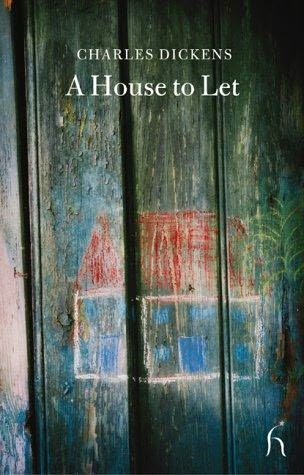
Review: A House to Let by Charles Dickens, Wilkie Collins, Elizabeth Gaskell and Adelaide Anne Procter

A House to Let, at less than 100 pages, is a collaboration between four 19th century authors which originally appeared as the Christmas edition of Charles Dickens’ weekly magazine, Household Words, in 1858.

The book is divided into six sections; the first, Over the Way, and the sixth, Let at Last, are joint efforts by Charles Dickens and Wilkie Collins, and provide the framework for the story. The other four sections are individual contributions from Elizabeth Gaskell, Charles Dickens, Adelaide Anne Procter and Wilkie Collins, in that order.

Over the Way introduces us to Sophonisba, an elderly woman who has never married but has two men vying for her attentions – one is her old admirer Jabez Jarber; the other is her servant, Trottle. When Sophonisba’s doctor advises a change of air and scene, she leaves her home in Tunbridge Wells and moves into new lodgings in London, where she immediately becomes obsessed with the house opposite – a house which has been vacant for many years and is permanently ‘to let’. Determined to discover why the house has remained empty for so long – and convinced she has seen an eye staring out from one of the windows – she asks Jarber and Trottle to investigate.

Over the Way and Let at Last are credited to both Dickens and Collins, but there’s no way to tell exactly which parts were contributed by which writer. The other four chapters, though, are each written in the distinctive style of their respective authors and each tell the story of a previous occupant of the house to let.

The chapter I liked the least was actually the one written solely by Dickens, Going Into Society. The story of a showman and a circus dwarf called Mr Chops, it was just too weird for me and was also quite difficult to read as it was written in dialect. It’s probably significant that I found the two Dickens/Collins collaborations much easier to read than this solo effort, as I’ve always thought Collins was a lot more readable than Dickens.

Three Evenings in the House, the contribution by Adelaide Anne Procter, whose work I was previously unfamiliar with, is in the form of a narrative poem. I’m not a big lover of poetry but luckily for me this was only thirteen pages long and quite easy to understand. Other than providing some variety though, I don’t think this chapter really added much to the story.

The Manchester Marriage
by Elizabeth Gaskell stands out as an excellent piece of writing: a tragic story of Alice Wilson, who is widowed when her husband is lost at sea. After marrying again, she and her new husband move into the house to let where further tragedy awaits them. This is good enough to work as a stand-alone short story (and according to the Biographical Notes, it was actually published separately in its own right). This and the Wilkie Collins contribution, Trottle’s Report, were my favourite chapters. Trottle’s Report is a typical Collins story, with unusual, quirky characters, a mysterious secret, and a slightly dark and gothic feel.

After exploring the histories of the various tenants of the house, the mystery is finally solved in the final chapter, Let at Last, which neatly ties up all the loose ends of the story.

If you like any of these four authors or Victorian fiction in general, then A House to Let is definitely worth reading. It also provides a good introduction to Dickens, Collins, Procter and Gaskell without having to commit yourself to one of their longer works.

Classics/Pages: 97/Publisher: Hesperus Press/Year: 2004 (originally published 1858)/Source: Library book
Book Drum: My profile of The Far Pavilions

Earlier in the year I mentioned that I was taking part in a tournament hosted by the Book Drum website. The idea of Book Drum is to bring books to life with pictures, music, videos and maps. To enter the tournament, members were required to choose a favourite title from a list of approved books and submit a profile of that book.

The book I decided to profile was The Far Pavilions by M.M. Kaye, which I read and reviewed on my blog in February. It was an interesting and fun experience, although I did occasionally regret my choice of book as it has over 950 pages and the profile took forever to complete!

Each profile consists of six sections: Review, Summary, Setting, Author, Glossary – and Bookmarks, which form the largest part of the profile and expand on individual quotes, phrases and references from the book.

Although I didn’t win the tournament, Book Drum have gradually been publishing all of the completed profiles. My profile of The Far Pavilions was published last night and is being featured on the front page of the Book Drum site until Sunday.

Review: Affinity by Sarah Waters

This is the story of two women, both prisoners in their own different ways and drawn together by a special bond – their ‘affinity’.

Margaret Prior is a single woman of twenty nine who, following the death of her father, begins visiting London’s Millbank Prison as a Lady Visitor. Lady Visitors were women who voluntarily visited prisoners with the aim of befriending them and giving them comfort during the time of their imprisonment. However, Margaret is in need of some friendship and comfort herself. From her very first visit, she finds herself strangely drawn to Selina Dawes, a young spiritualist imprisoned for assault after one of her spiritualism sessions goes badly wrong, leaving a woman dead and a girl traumatised.  Selina blames her ‘control spirit’, Peter Quick, for what happened, but is she telling the truth?

The book is told in the form of diary entries – Margaret’s longer sections being interspersed with Selina’s shorter ones. Margaret’s diary entries are very bleak and miserable, as she is trying to cope not only with the loss of her father, but also with her feelings for both Selina and her sister-in-law Helen, the expectations of her domineering mother, and the sense of being ‘left behind’ that she experiences when her younger sister gets married and leaves home. Although I found it difficult to like Margaret, I did have a lot of sympathy for her – she had been labelled a ‘spinster’ and was bound by the conventions of the time, preventing her from studying and leading the kind of life she wanted to lead.  I really wanted her to find happiness with Selina.

Selina’s sections of the story are very vague and confusing and I didn’t fully understand them until I went back and read them again after reaching the end of the book. Her entries chronicle the events leading up to the death of Mrs Brink at the seance, and allow us to watch the development of Selina’s spiritualist abilities and the first appearances of the spirit Peter Quick.  Throughout the story, the reader is made to wonder whether Selina really has the powers she claims to have or if Margaret is the victim of an elaborate hoax.

I enjoyed learning about life in a Victorian prison, as it’s not something I’ve read about in so much detail before. Waters does a wonderful job of conveying the oppressive atmosphere of Millbank, with its labyrinthine corridors and gloomy wards.

I haven’t read all of Sarah Waters’ books yet so I can’t really say where Affinity stands in comparison to her others, but I thought it was an excellent book – suspenseful, moving and with some passages that were genuinely spooky.

Recommended

Review: The Scapegoat by Daphne du Maurier

What would you do if you came face to face with yourself? That’s what happens to John, an Englishman on holiday in France, when he meets his exact double – a Frenchman called Jean de Gue.  John agrees to go for a drink with Jean but falls into a drunken stupor and wakes up in a hotel room to find that Jean has disappeared, taking John’s clothes and identity documents with him!

When Jean’s chauffeur arrives at the hotel, John is unable to convince him of what has happened – and ends up accompanying the chauffeur to Jean de Gue’s chateau, where the Frenchman’s unsuspecting family assume that he really is Jean de Gue.  Naturally, they expect him to continue running the family glass-making business and arranging shooting parties – things that John has absolutely no experience in.  Before long, it starts to become obvious that Jean is using John as a scapegoat; Jean’s family and business are both in a mess and he wants someone else to have to deal with them.

Throughout the book, I was forced to revise my opinions once or twice about what was really going on. If everything in the book is supposed to be taken literally, then we need to suspend belief at times: could two men really be so identical that even their mother, wife and daughter can’t tell the difference? There is also another way to interpret the story, one which goes deeper into the psychology of identity – I won’t say any more about that here, but if you have read the book this theory may have occurred to you too.

As usual, du Maurier’s writing is wonderfully atmospheric. She has a way of making you feel as though you’re actually there in the hotel room in Le Mans, the grounds of Jean de Gue’s estate in the French countryside and Bela’s antique shop in the town of Villars.

When John first arrives at the de Gue chateau, every member of the household is a stranger to him but we (and John) are given enough clues to gradually figure out who each person is and what their relationship is to Jean de Gue.  From the neglected pregnant wife and the hostile elder sister to the resentful younger brother and the religious ten-year-old daughter, every character is well-drawn and memorable.

Another thing I love about Daphne du Maurier’s writing is her ability to always keep the reader guessing right to the final page (and sometimes afterwards too).  This was a fascinating and unusual story, one of my favourite du Maurier books so far.

Highly recommended

Pages: 320/Publisher: Virago Press (Virago Modern Classics)/Year: 2004 (originally published 1957)/Source: Library book

After the Sunday Papers #4: Reading Challenge Update

I have now completed four reading challenges so, instead of posting individual wrap-ups for each challenge, I’ve decided to incorporate them all into this week’s After the Sunday Papers post.

Before I begin, I want to let you all know that I probably won’t have internet access this week as I’m going away tomorrow to spend five days in one of my favourite parts of England, the beautiful Lake District.

I won’t be able to comment or reply to comments, but I’ve scheduled one or two posts for while I’m away.  This is the first time I’ve tried the WordPress scheduling feature so I hope it works!

Now, on with the challenge updates.  For the full lists of books I’ve read for each of the challenges mentioned below, with links to my reviews, see my Completed Challenges page.

The first is the Typically British Challenge.  The idea was to read books written by British authors.  I signed up for the “Cream Crackered” level, which meant I needed to read 8 books.  The 8 British authors I chose were Anne Bronte, Horace Walpole, Richard Adams, Mary Elizabeth Braddon, Anthony Trollope, Daphne du Maurier, Thomas Hardy and Georgette Heyer.

The second challenge I’ve completed is the Chunkster Challenge.  I knew this one wouldn’t be a problem for me as I read so many long books.  To complete the challenge I needed to read 6 or more chunksters of 450+ pages or 3 books with 750+ pages.  I ended up reading 4 with 450+ pages and 2 with 750+ pages, so I think I’ve now satisfied the requirements of the challenge!

For the 2010 Classics Challenge, I had to read 6 classic novels.  Before the challenge started, I made a list of the classics I wanted to read but I’ve actually only read one from the list and five others that I hadn’t been intending to read.  This is why I don’t like making lists for challenges – I know that I won’t be able to stick to them.

The fourth challenge I’ve completed is the 18th & 19th Century Women Writers Challenge.  I only needed to read two books for this, and the two that I read were The Tenant of Wildfell Hall by Anne Bronte and The Doctor’s Wife by Mary Elizabeth Braddon.

I am still working on the rest of the challenges I signed up for and am making good progress with most of them.

Have a great week, and I’ll be back on Friday.

Thoughts on A Midsummer Night’s Dream by William Shakespeare

A few months ago I mentioned that I would like to revisit a few of Shakespeare’s plays, but for one reason or another I haven’t had time to do that until now. I thought this would be an appropriate time of year (unless you live in the southern hemisphere, of course) to look at A Midsummer Night’s Dream. As I’m not a Shakespearean scholar and haven’t actually tried to write about one of his plays since I was at school, this is not going to be an in-depth analysis. As the title of this post suggests, I am just going to give some of my thoughts on rereading the play.

A Midsummer Night’s Dream is widely performed on stage, making it one of Shakespeare’s most popular plays. The play is thought to have been written around 1594-1596 and is classed as a comedy.

There are three separate storylines woven into the plot. The first involves the upcoming wedding of Theseus, the Duke of Athens, and Hippolyta, Queen of the Amazons. A group of craftsmen (known as ‘mechanicals’) are rehearsing the story of Pyramus and Thisbe, a play they are planning to perform at the wedding. In the second thread we meet Oberon and Titania, King and Queen of the fairies. Titania has a new page boy and Oberon is jealous. He and his servant, the mischievous fairy Puck, come up with a plot to distract Titania while Oberon takes the boy away from her. The third storyline follows Hermia (who is in love with Lysander), Helena (who is in love with Demetrius), and Demetrius and Lysander (who are both in love with Hermia). Confusing? Yes – and it gets even more complicated when the four of them get mixed up in Puck and Oberon’s scheming!

In Act I Scene 1, Lysander tells us “the course of true love never did run smooth” – and the central theme of the play is love and its difficulties. Here is one of my favourite quotes on the subject of love:

Love looks not with the eyes, but with the mind;
And therefore is wing’d Cupid painted blind:
Nor hath Love’s mind of any judgement taste;
Wings and no eyes figure unheedy haste:
And therefore is Love said to be a child,
Because in choice he is so oft beguiled.

The play begins and ends in Athens but the majority of the play is set in the nearby woods, a place free from Athenian law. With some of Shakespeare’s plays I find it difficult to get a real sense of the time and place, but with this one I have no problem picturing the characters running through the moonlit woods on a warm midsummer’s night while the fairies dance around them weaving their magic. The dreamlike mood is enhanced by the way much of the action takes place while various characters are sleeping. Here Oberon describes the bank where Titania sleeps:

I know a bank where the wild thyme blows,
Where oxlips and the nodding violet grows,
Quite over-canopied with luscious woodbine,
With sweet musk-roses and with eglantine.
There sleeps Titania sometime of the night,
Lulled in these flowers with dances and delight;

As in several of Shakespeare’s plays there’s also a theme of doubling and symmetry with Theseus and Hippolyta mirroring Oberon and Titania, and the two men Lysander and Demetrius being balanced by the two women Hermia and Helena. The conflict is caused by the fact that although Hermia and Lysander are in love, Demetrius also loves Hermia, leaving Helena on her own. Only when the balance is restored by Demetrius falling in love with Helena can the story come to its conclusion.

If you’d like to read the play online you can do so here. In the meantime, I’ll leave you with a few words from Puck…

If we shadows have offended,
Think but this, and all is mended,
That you have but slumbered here
While these visions did appear.

*The picture at the top of this post shows “The Quarrel of Oberon and Titania” by Sir Joseph Noel Paton, c. 1849 (in the public domain)

Review: The Time of Terror by Seth Hunter

In The Time of Terror, Seth Hunter introduces us to a new naval hero in the style of C.S. Forester’s Horatio Hornblower.  Nathan Peake is a commander in the British Navy who spends his days chasing smugglers along the English coastline.  This is not really Nathan’s idea of fun and he longs to have some real adventures.  He gets his chance in the year 1793 when, with England and France at war, he is asked to run the blockade in the English Channel and deliver some important documents to the American minister in Paris.  Unknown to Nathan, however, his ship is carrying a cargo of counterfeit banknotes – putting his life in serious danger!

Although it’s not necessary to be an expert on French history to understand this story, you will get more out of it if you have some prior knowledge of the French Revolution and the Reign of Terror.  So if names such as Georges Danton and Robespierre mean nothing to you, it might be a good idea to do some research before beginning the book.

Readers who enjoy historical fiction novels that focus on real historical figures will be pleased to know that throughout the pages of The Time of Terror you’ll meet the author and feminist Mary Wollstonecraft, the American agent (and Mary’s lover) Gilbert Imlay, the revolutionary writer Thomas Paine and many more – so many, in fact, that I began to feel Hunter was just trying to drop as many famous names as possible into the story, regardless of whether they were necessary.  The sheer amount of historical detail in this novel was slightly overwhelming, though usually interesting.  There were dinner parties with Camille Desmoulins and Lucile Duplessis, visits to the waxworks (including a brief appearance by the young Madame Tussaud) and vivid descriptions of the guillotine.  However, other parts of the story that interested me were barely touched on.  The romantic storyline, for example, is very weak, and I would also have liked to have seen more of Nathan’s American feminist mother who had the potential to be a fascinating character.

If you’re concerned that there’ll be a lot of unfamiliar nautical terms and difficult-to-understand naval battles you’ll be right to some extent, but the story can still be followed even if you find yourself confused or bored by the seafaring aspects.  The sea battle scenes, although very well written, actually contribute very little to the plot and the book would have worked better as a more conventional historical fiction novel in my opinion.  However, there was probably too much land-based action to satisfy fans of nautical fiction so I think the book suffered from not really knowing what it wanted to be or what kind of reader it was aimed at.

This book is the first in a trilogy.  In the second Nathan Peake book, The Tide of War, the action moves to the Caribbean and in the third, The Price of Glory, Nathan will meet Napoleon Bonaparte.  Although I did find this book entertaining and interesting, I’m undecided as to whether I want to invest the time in following Nathan’s story to its conclusion.

Genre: Historical Fiction/Year: 2010/Publisher: McBooks Press/Pages: 391/Source: Won copy from LibraryThing