Review: Under a Blood Red Sky by Kate Furnivall

Unfortunately I was unable to finish this book – which is not something that happens to me very often. I hadn’t heard of Under a Blood Red Sky (also published under the title The Red Scarf) until I saw it in the library and I thought I’d give it a try as I love historical fiction set in Russia.   It sounded interesting:

Anna and Sofia are two women who meet whilst imprisoned in a Soviet labour camp in the 1930s and become best friends. When Anna becomes ill, Sofia comes up with a daring plan to run away from the camp and find help. Anna has told her about a childhood friend, Vasily, who is now living under an assumed name in the town of Tivil. After successfully escaping, Sofia heads for Tivil to look for Vasily and ask him to return to the camp with her to save Anna.

However, right from the beginning of the book I felt we were being asked to accept things that weren’t plausible.  The whole plot was just too far-fetched for me.  The other (bigger) problem I had with this book was that I couldn’t connect with any of the characters. Although they were constantly putting their lives at risk and facing unimaginable horrors under Stalin’s communist regime, I found I didn’t really care what happened to them. Sofia was one of those model heroines – beautiful, brave, intelligent and perfect. Everybody seemed to be captivated by her and I couldn’t really understand why. She just didn’t feel like a real person to me. Of course, there were some situations that even Sofia couldn’t deal with – that’s where the gypsy Rafik came in, using mesmerism and mind-control to overcome obstacles.  I thought the whole magical aspect of the book seemed a bit out of place.

I tried to keep reading, thinking the book might get better but when I found I was almost halfway through and still wasn’t enjoying it, I decided not to waste any more time on it and put it down with a sigh of relief. I’m glad I had borrowed this book from the library instead of spending money on it – at least I didn’t lose anything apart from a couple of days when I could have been reading something else.

Genre: Historical Fiction/Pages: 512/Publisher: Sphere/Year: 2008/Source: Library book

Review: I’ll Never Be Young Again by Daphne du Maurier

I’ll Never Be Young Again was Daphne du Maurier’s second novel, written when she was only twenty three years old. It’s different from the other books of hers that I’ve read so far. It doesn’t have the suspense or the gothic feel of some of her other works – this is more of a psychological, character-driven book. It’s the story of Richard, a young man who has grown up in the shadow of his famous father, and his struggle to find his own identity. I’m not really a fan of ‘coming-of-age’ novels, but I’m glad I chose to read this one. It certainly seems to be one of her least well known novels –  and I was concerned that this might mean it wasn’t very good. Well, I can tell you that it is good and I enjoyed it a lot more than I was expecting to.

The book opens with Richard – or Dick as he prefers to call himself – standing on a bridge, preparing to jump. Immediately the reader is intrigued, wondering what has happened to drive him to suicide.  At the last minute Dick feels a hand on his shoulder – this is Jake, a complete stranger who saves his life and becomes his closest friend. The first half of the book follows the adventures of Dick and Jake as they leave England and sail to Scandinavia together in search of a new life. The second half is the story of Dick’s relationship with Hesta, a girl he meets in Paris.

The whole book is written in the first person from Dick’s perspective, which is significant as it was apparently the first time Daphne du Maurier wrote from a man’s point of view – and I thought she captured the male voice perfectly. The only problem I had was that I just didn’t like Dick very much. I found his immaturity and whining very irritating – although I understood that the point of the book was to follow his development from an insecure, selfish youth into a sensible, mature adult. Eventually he does begin to grow up and want different things out of life, but this comes too late in the book for me to be able to warm to him. However, the book is so well-written I could still enjoy it even with such an unsympathetic narrator. Her writing is absolutely beautiful and quite dreamlike, as she lets us get right inside Dick’s head and share his thoughts and emotions. There are also some vivid descriptions of the mountains and fjords of Norway and the other places that the characters visit, particularly Paris with its cafés and boulevards.

This would probably not be the best Daphne du Maurier book for a newcomer to begin with, but it’s a good choice for someone who wants to venture away from Rebecca and read one of her less popular novels. A word of warning, though – if you’re going to read the Virago Modern Classics edition, leave the introduction until last as it gives away the entire plot, including the ending (this is good advice with any book – I’ve learned from experience never to read the introduction first).

This is my first book for the Daphne du Maurier Challenge hosted by Chris at Book-a-rama. I wasn’t planning to take part in this challenge until I discovered my local library had almost all of her books. I’m looking forward to reading some more of her work during the next year, as there are still a lot of her books I haven’t read yet. This book also counts towards the 1930s challenge as it was a contemporary novel published in 1932 and set in 1930s Europe – and also the Typically British challenge.

Pages: 304/Publisher: Virago Press (Virago Modern Classics 515)/Year: 2005 (originally published 1932)/Source: Library book

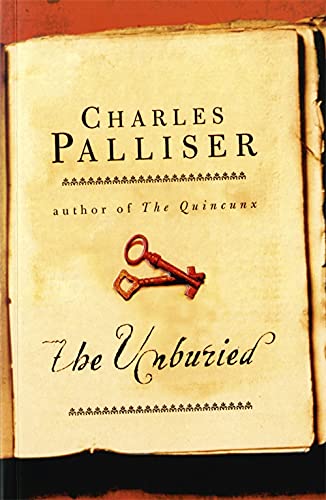
Review: The Unburied by Charles Palliser

The title of this book may suggest a horror story complete with zombies and vampires, but The Unburied is actually a scholarly murder mystery which reminded me of The Name of the Rose by Umberto Eco or An Instance of the Fingerpost by Iain Pears.  I wanted to read it because a few years ago I read another Charles Palliser book, The Quincunx, which I really enjoyed.  Like The Quincunx, this one is set (mostly) in Victorian England.  It begins with a mock ‘Editor’s Foreword’ in which we are told that we are about to read an account which will throw new light on the controversial Thurchester Mystery.  This account, known as The Courtine Account, forms the bulk of the book.

Dr Edward Courtine, a historian from Cambridge University, has been invited to spend the week before Christmas with Austin Fickling, an old friend from his student days who is now teaching at a school in the cathedral city of Thurchester.  He and Austin haven’t seen each other since they parted on bad terms twenty years ago, and Courtine is eager to renew their friendship.  He also has another reason for wanting to visit Thurchester – he has been studying King Alfred the Great and has learned that an ancient manuscript detailing the events of Alfred’s reign may be available in Thurchester Library.

On the night of Courtine’s arrival he hears the story of a murder that took place in the cathedral two centuries earlier.  Courtine is fascinated, but as he begins to investigate he becomes involved in another murder mystery – and discovers Austin’s true motive for inviting him to Thurchester.

As the main narrator of the book, I found Courtine very irritating, but at the same time I felt slightly sorry for him.  For such an obviously intelligent person he was completely lacking in perception, constantly saying the wrong things, missing important clues and failing to notice people behaving suspiciously.  Sometimes he would tell us that he was beginning to form a theory or that an idea had occurred to him, but he didn’t let us know what it was.  This was good in one way, as it encouraged me to work things out for myself, but it also annoyed me because I was already finding it difficult enough to keep all the threads of the story straight.

Although the town of Thurchester and its community are vividly depicted, I didn’t find any of the characters particularly memorable.  The fact that some of them had similar names (Slattery, Sheldrick, Sisterton for example) didn’t help.  There is actually a character list at the back of the book but I was trying not to look at it in case I came across any spoilers.  As for the plot, it’s so intricate you really need to read this book in as few sittings as possible so you don’t forget any important details.  There seemed to be a constant stream of unexplained deaths and forged documents, with at least three separate mysteries from different eras all running parallel to each other – and different characters giving different versions of what may or may not have happened.   I wished I had been taking notes from the beginning.

This is a very atmospheric book with lots of gothic elements, from the freezing fog that accompanies Courtine’s arrival in Thurchester to the obligatory ‘ghost’ supposedly haunting the cathedral.  It would have been a good book to read in front of the fire on a cold winter’s night.  In spite of the slow pace the book was relatively quick to read and although it was certainly confusing, I did enjoy it, especially when the various mysteries began to unravel towards the end.  Not as good as The Quincunx, though – if you’ve never read a Charles Palliser book before, try that one first.

Genre: Historical Fiction/Mystery/Publisher: Phoenix/Pages: 389/Year: 1999/Source: My own copy purchased used

Winners of Our Promised Land!

Throughout April Michael T. Darkow has been offering readers of this blog the chance to win one of 5 copies of his book Our Promised Land.

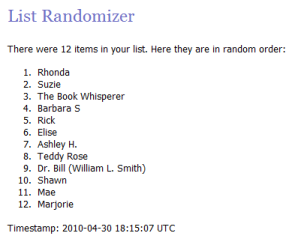
The contest ended yesterday (Thursday April 29th) and today I used the List Randomizer to find 5 random winners.  The winners are:

Rhonda, Suzie, The Book Whisperer, Barbara S and Rick!  I have contacted you by email to ask for your addresses so that the author can send you your books.  Congratulations to all of you!

Review: Wild Swans by Jung Chang

Wild Swans is the story of three generations of women in Jung Chang’s family.  The first is her grandmother Yu-fang, who grew up in pre-communist China, a time when women had their feet bound as children and could be given to warlords as concubines.  The second is Chang’s mother, De-hong, who became a senior official in the Communist party following their victory over the Kuomintang.  The third is Jung Chang herself and the longest and most compelling section of the book is devoted to her own experiences during Mao’s Cultural Revolution of the 1960s and 70s.

Before beginning this book I didn’t know very much at all about Chairman Mao, but I’m obviously not alone in that.  As Jung Chang says in her introduction to the 2003 edition, ‘the world knows astonishingly little about him’.  This book helped me understand why the Chinese people initally welcomed communism and how millions of children grew up viewing Mao as their hero and never dreaming of questioning his regime.   It also explained why many people eventually became disillusioned and why the system started to break down.

Reading Wild Swans made me realize how important books like this one are.  Wild Swans presents almost the entire 20th century history of China in a highly personal way that makes it so much more memorable than just reading the same information in a text book would have been.

One of the most horrible things in the book occurs within the first chapter when Chang describes her grandmother’s footbinding.  It’s so awful to think of a little girl being forced to undergo this torture just because tiny feet (or ‘three-inch golden lilies’) were thought to be the ideal.  Soon after her grandmother’s feet were bound the tradition began to disappear.  However, this is just one small part of the book and the first in a long series of shocking episodes the author relates to us.  For example, during the civil war between the Kuomintang and the Communists, inflation rose so quickly that currency became worthless and people began to take desperate measures to get food, with beggars trying to sell their children in exchange for a bag of rice.

Jung Chang’s parents both worked for the Communists during and after the civil war, rising to high positions within the party.  Chang’s father was completely devoted to the Communist Party, putting it before his wife’s welfare.  Every time she found herself in trouble with the party for some trivial reason, her husband would side against her.  However, this attitude extended to the rest of his family and friends too – he refused to do anything which could be construed as showing favouritism.

Some parts of the book made me feel so angry and frustrated, such as reading about the senseless waste of food when peasants were taken away from the fields to work on increasing steel output instead, as part of Mao’s ‘Great Leap Forward’.  There are some shocking accounts of starving people being driven to eat their own babies.  The famine shook a lot of people’s faith in the Party and afterwards even Jung’s father was less inclined to put the party’s needs before his family’s as he had done in the past – in fact during the Cultural Revolution of the 1960s, he found himself denounced and arrested, and eventually emerges as one of the most admirable people in the book, at least in my opinion.

“I thought of my father’s life, his wasted dedication and crushed dreams…There was no place for him in Mao’s China because he had tried to be an honest man.”

The descriptions of the Cultural Revolution are horrific; it went on for years and resulted in countless deaths.  One of the most frightening things about this period was that nobody was safe – people who had been high-ranking Communist officials before the revolution suddenly found themselves branded ‘capitalist-roaders’ or ‘counter-revolutionaries’ (sometimes by their own children) and some of them were driven to suicide.

Some of the parts I found most fascinating were Jung’s accounts of how the Chinese viewed the ‘capitalist countries’ in the west.

“As a child, my idea of the West was that it was a miasma of poverty and misery, like that of the homeless ‘Little Match Girl’ in the Hans Christian Andersen story.  When I was in the boarding nursery and did not want to finish my food, the teacher would say: ‘Think of all the starving children in the capitalist world!’

The book is complete with a family tree, chronology, photographs and map of China – all of which were very useful as I found myself constantly referring to them and without them I would have had a lot more difficulty keeping track of what was going on.

As you can probably imagine, it was a very depressing book, as Jung and her family experienced very few moments of true happiness.  She only really sounds enthusiastic when she’s describing the natural beauty of some of the places she visited – and the pleasure she got from reading books and composing poetry, both of which were condemned during the Cultural Revolution.  However, it was also the most riveting non-fiction book I’ve ever read – I kept thinking “I’ll just read a few more pages” then an hour later I was still sitting there unable to put the book down.

I don’t think I need to explain why this book counts towards the Women Unbound challenge.  All three of the women featured in Wild Swans – Jung Chang herself, her mother and her grandmother – were forced to endure hardships and ordeals that are unimaginable to most of us, but remained strong and courageous throughout it all.  However, Wild Swans is not just the story of three women – it’s much broader in scope than that and is the story of an entire nation.  So much is packed into the 650 pages of this book that I’ve barely scratched the surface in this review and if you haven’t yet read the book I hope you’ll read it for yourself – no review can really do it justice.

Highly Recommended

Genre: Non-Fiction/Memoir/Publisher: Harper Perennial/Pages: 650/Year: 2004 (originally published 1991)/Source: My own copy bought new

Not Quite The Sunday Salon

After I started typing this week’s Sunday Salon post it occurred to me that changing my blog address means I’m no longer officially a member of the Sunday Salon and as they’re not accepting new members at the moment I’m not able to rejoin.  However, I think I’ll still continue to do Sunday Salon posts on an informal basis – it just means they won’t show up on the official feed.

I’ve been here at WordPress for a week now and so far I’m very happy with it. Apart from a few initial problems, the move from Blogger has gone quite smoothly but if you notice anything not working properly please let me know!  One thing I love is being able to reply to comments individually as it’s still not possible to do that on Blogger (unless you install a separate commenting program such as Intense Debate).

This week I’ve been reading Wild Swans by Jung Chang. I’m slightly ashamed that it’s taken me so long to get round to reading it because I’ve been hearing about it for a long time and it has been on my Amazon wishlist literally for years. Well, better late than never. I won’t say too much about it here, except that I can’t remember ever being so gripped by a non-fiction book before.  I’m almost finished so should be posting my review soon.

I also signed up for Nymeth’s 1930s mini-challenge this week. The idea is to read books ‘from, set in, or about the 1930s’. I didn’t really want to be signing up for any more challenges because I think I’m doing enough already, but this one appealed to me as the first half of the 20th century appears to be a time period that I neglect in my reading. I usually seem to read either more recent books or pre-20th century books. At the moment I don’t know exactly what I would like to read, but as the challenge runs until July 18th I’m sure I’ll have time to read at least one 1930s book!

On Monday I found an interesting article in The Times about the portrayal of women with mental illnesses in 19th century literature – the article discusses Bertha Rochester, Anne Catherick and Emma Bovary as examples.

Finally, a reminder that my Michael T. Darkow giveaway in which you can win a copy of Our Promised Land is still open. You have until Thursday 29th April to enter – see the review and giveaway post for full details.  Winners will be announced on Friday.  Good luck!

Short Story Mini-Review: An Imaginative Woman by Thomas Hardy

An Imaginative Woman by Thomas Hardy (1894)

This is the first of Thomas Hardy’s short stories that I’ve read but I would now like to read more. As you might expect from Hardy, An Imaginative Woman is well-written and descriptive but with a slightly dark and melancholy feel.

Ella Marchmill, the ‘imaginative woman’ of the title is an aspiring poet, writing under the male pseudonym of John Ivy because ‘nobody might believe in her inspiration’ if they knew she was a woman. Her husband, a gunmaker, is her exact opposite in temperament and interests. When the couple and their three children go on holiday to Solentsea in Upper Wessex, Ella becomes obsessed with the previous occupier of their lodgings – a fellow poet by the name of Robert Trewe. During their stay in Solentsea she convinces herself she has fallen in love with a man she has never even met and desperately tries to arrange a meeting with Trewe. As I don’t want to spoil the story for you I won’t reveal any more of the plot and will leave it to you to find out whether or not Ella succeeds in meeting Robert Trewe.

No, he was not a stranger! She knew his thoughts and feelings as well as she knew her own; they were, in fact, the self-same thoughts and feelings as hers, which her husband distinctly lacked; perhaps luckily for himself, considering that he had to provide for family expenses.

“He’s nearer my real self, he’s more intimate with the real me than Will is, after all, even though I’ve never seen him,” she said.

The theme of this story was actually very similar to the Mary Elizabeth Braddon novel The Doctor’s Wife which I reviewed a few weeks ago, in which a woman becomes bored with her marriage and develops an obsession with another life that exists only in her fantasies. The outcome of the two stories, however, is very different. There’s a clever plot twist at the end of An Imaginative Woman but I found the final few paragraphs a bit too harsh and cruel.

If you’d like to read this story yourself, you can find it online here.

The illustration by Arthur J. Goodman shown at the top of this post originally appeared in The Pall Mall Magazine in April 1894 and depicts Robert Trewe and Ella Marchmill – Picture courtesy of Philip V. Allingham

Have you read any of Thomas Hardy’s short stories? Which one do you think I should read next?