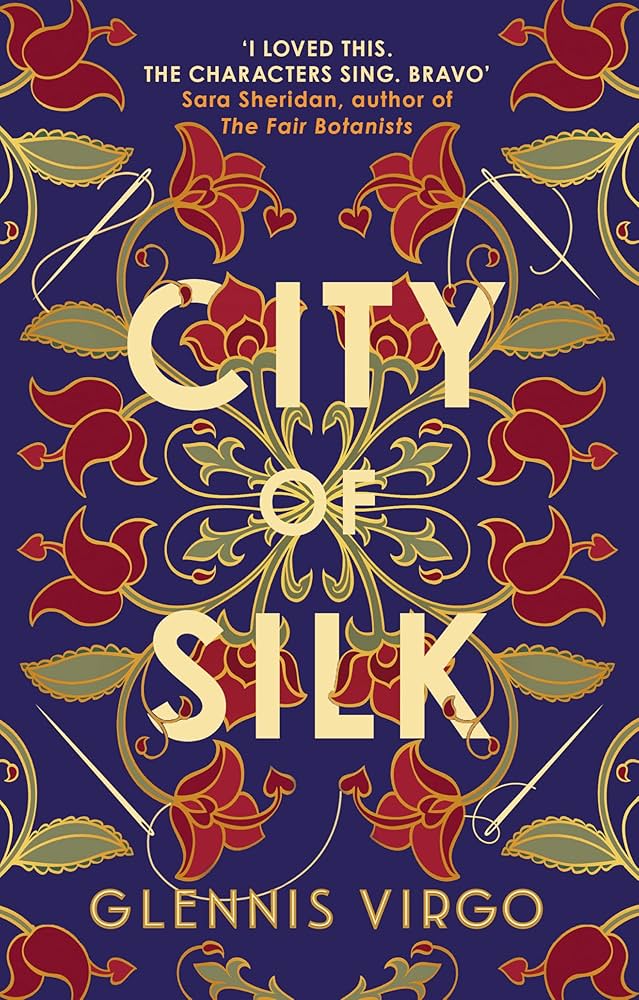
City of Silk by Glennis Virgo

I love reading about Renaissance Italy, but most novels focus on Rome, Florence or Venice, so this one, set in Bologna – famous for its silk industry in the 16th century – was something slightly different.

It’s 1575 and our narrator, Elena Morandi, is working as a seamstress in Signora Ruffo’s workshop. Although she was raised in an orphanage from the age of ten after the death of both parents, Elena remembers the skills she was taught by her father, a tailor, and has proved to have a real talent for needlework. However, she’s bored with sewing women’s gowns and capes and longs to work on men’s clothing and gain the title of tailor rather than seamstress. Sadly, this is not an option for a woman and Elena seems destined to stay with Signora Ruffo – until she flees to escape an arranged marriage.

In need of a new job, Elena decides to pursue her dreams and manages to obtain a lowly position in a tailor’s workshop, sweeping the floor and fetching fabrics and threads for the Maestro, Francesco Rondinelli, and his three tailors. Then, just as she’s settling into her new life, a figure from her past walks into Rondinelli’s workshop to ask for a fitting. This is Antonio della Fontana, benefactor of the orphanage Elena attended and one of the most powerful men in Bologna. He had abused his position of power at the orphanage and it seems that nothing has changed; when even Rondinelli and his friends begin to suffer at the hands of Fontana, Elena decides it’s time to take revenge.

City of Silk is one of several historical novels I’ve read recently that deal with women trying to forge a career for themselves in fields traditionally dominated by men. Tracy Chevalier’s The Glassmaker, Joanne Burn’s The Bone Hunters and Ambrose Parry’s The Spendthrift and the Swallow are three I’ve read just this year (featuring, respectively, a female glassmaker, a female would-be geologist and a woman desperate to become a doctor). This is obviously another and while I admired Elena’s determination and ambition, I would have liked more detail on why she felt it was so important to become a tailor instead of aspiring to be like Signora Ruffo, who was running her own successful business and was financially independent. I’m not sure I really understood why Elena seemed to look down on seamstresses so much or why she considered it so much more rewarding to make clothes for men rather than women.

As mentioned above, I did love the setting. I’ve never been to Bologna, but Virgo’s descriptions brought it to life for me. I also found it interesting to learn about the city’s role as a leading European centre of silk production and what it was like to work in a tailor’s or seamstress’s workshop during that period. Most of the characters are fictional, but Virgo explains in her author’s note at the end that a few of them really existed and another is inspired by a portrait in the National Gallery!

The scheme Elena and her friends come up with to take their revenge on Fontana seemed very unlikely to me – I couldn’t imagine anybody actually doing what they did, particularly not in the 16th century – but otherwise the plot was quite entertaining. This is Glennis Virgo’s first novel (for which she has won the Debut Writers Over 50 Award) and although I’m not sure if I’ll read her next one, I could be tempted depending on the subject.

Thanks to Allison & Busby for providing a copy of this book for review via NetGalley.

Book 50/50 for the Historical Fiction Reading Challenge 2024
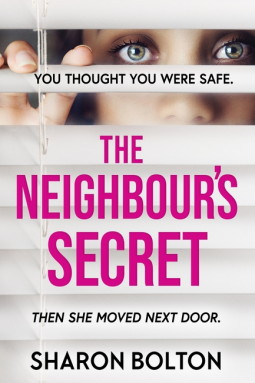
The Neighbour’s Secret by Sharon Bolton

The narrator of Sharon Bolton’s new novel is the very definition of a nosy neighbour. Living in the middle of three adjoining cottages with very thin walls makes it easy to hear the people on either side: the narrator knows what music they listen to and what they watch on television, who they speak to on the telephone and what time they get out of bed in the morning. In the evening, as it gets dark and people turn on their lights, it’s time to take a walk through the streets of the small Cumbrian village specifically to pry through illuminated windows to see the residents going about their daily lives. This is why the narrator becomes frustrated when Anna Brown moves in next door and stubbornly remains a woman of mystery, giving away very few clues to her past.

Yet the narrator is also a mystery, reluctant to share personal information with either the reader or the other characters. For a long time we don’t even know their name, which is why I’m being equally secretive in this review! Let’s focus on the plot instead. There are two separate storylines that alternate throughout the book, starting to come together towards the end. In the first, the narrator and Anna, who have formed a tense friendship, investigate the disappearances of several teenage girls at the InGathering, a yearly event held by the local church. The details of this event are – like everything else in this book – shrouded in mystery, but the church seems to resemble a cult with rituals and traditions that they prefer to keep hidden.

The other narrative is set a year earlier and describes the meetings between a psychiatrist and her patient, seventeen-year-old Jago Moore. Jago stabbed one of his teachers at school and the authorities want an assessment of his mental condition before deciding what action to take. This storyline seems quite unrelated to the other, until we start to suspect who the psychiatrist is. Again, though, not everything is as it seems and there are multiple twists and turns as we head towards the conclusion of the book!

I was able to guess some of the plot twists before they happened, but not all of them and not always very far in advance. It’s easy to make certain assumptions about some of the characters and situations in the book, but these assumptions aren’t necessarily correct and Bolton very cleverly creates confusion and misdirection from beginning to end.

The central mystery surrounding the disappearing girls at the InGathering was actually the part of the novel that interested me the least and I found the revelations about what was really going on at the church quite far-fetched. The Jago Moore sections, however, were chilling – Jago is clever and manipulative and I found his behaviour terrifyingly believable. The whole book has a dark, creepy atmosphere; the village of St Abel’s Chapel in the Lake District should have been an idyllic setting, but with so much secrecy and with most of the action taking place in the middle of the night, it feels like a sinister place rather than a picturesque one.

Although this isn’t one of my absolute favourite books by Sharon Bolton, I did enjoy it and liked it better than last year’s The Fake Wife. It seems that her next book, coming in 2025, will be another standalone; I’m looking forward to it but would also like a return to the Lacey Flint series, which I love!

Thanks to Orion for providing a copy of this book for review via NetGalley.

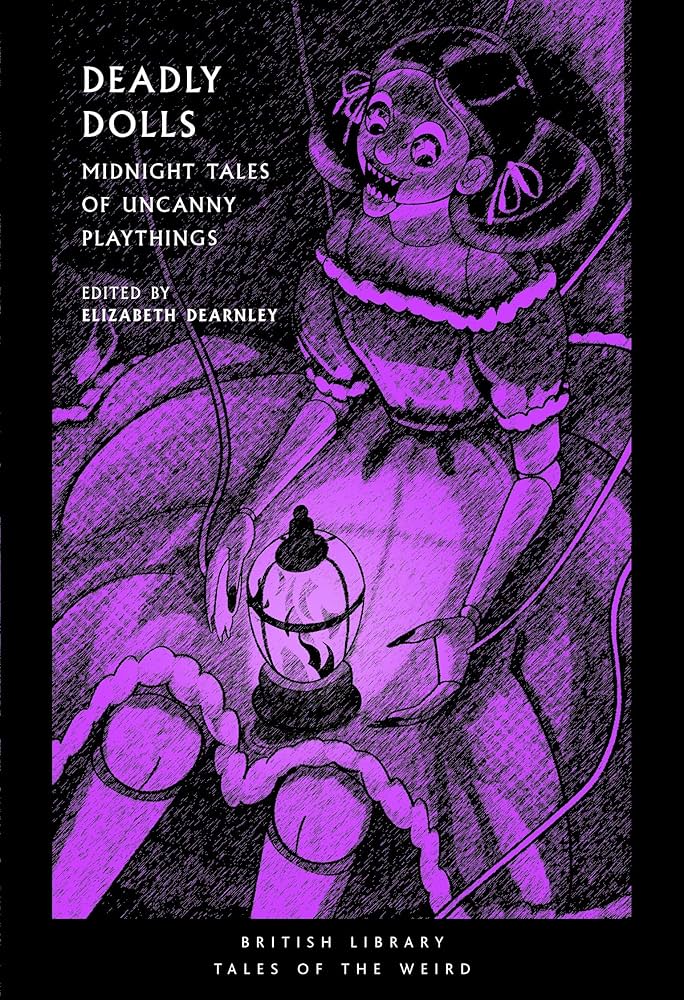
Deadly Dolls: Midnight Tales of Uncanny Playthings edited by Elizabeth Dearnley

Earlier this year I read Doomed Romances, a short story collection from the British Library’s Tales of the Weird series. I found it very mixed in quality – some great stories and some much weaker ones – but I was still interested in trying another one and I’m pleased to say that Deadly Dolls is much more consistent. As November is German Literature Month, I had initially planned to read the first story in the collection for now, which happens to be a German translation – ETA Hoffmann’s The Sandman – and leave the rest for later, but I then got tempted by the second story and read the whole book last weekend. The stories are all quite short, which made it a quick book to read!

This selection of fourteen stories is edited by Elizabeth Dearnley and as the title suggests, there’s a shared theme of dolls and toys. The Sandman, published in 1817 – and the story on which the ballet Coppélia was based – is the oldest story in the book, with the others spread throughout the 19th, 20th and 21st centuries. It’s a dark story – the Sandman of the title is a mythical character who steals the eyes of human children and takes them back to his nest on the moon to feed to his own children, an image which terrifies our young protagonist Nathanael so much that it haunts him for the rest of his life. I enjoyed it (my only other experience of Hoffmann is the entirely different The Life and Opinions of the Tomcat Murr) but I felt that others in the collection were even better.

A particular favourite was The Dollmaker by Adèle Geras, an author completely new to me. A dollmaker, known to the village children as Auntie Avril, opens a dolls’ hospital, repairing and restoring broken dolls. When three of the children notice that their dolls have been returned to them with alterations that seem unnecessary, they begin to question Auntie Avril’s motives. It seems Geras has been very prolific, writing many books for both children and adults, and I’m surprised I’ve never come across her before. I also enjoyed The Dancing Partner by Jerome K. Jerome (this time an author I know and love), in which a maker of mechanical toys decides to find a solution to the lack of male dance partners reported by his daughter and her friends. Although this is an entertaining story, it does have a moral: that we shouldn’t interfere with nature and try to play God.

At least two of the other stories have a similar message, despite having completely different plots. Brian Aldiss’ fascinating 1969 science fiction story, Supertoys Last All Summer Long, is set in a dystopian future where the rate of childbirth is controlled by the Ministry of Population. Meanwhile, in Ysabelle Cheung’s The Patchwork Dolls, a group of women literally sell their faces to pay the bills. Published in 2022, this is the most recent story in the book and I did find it interesting, if not quite as strong as most of the others. It’s one of only two contributions from the 21st century in this collection – the other is Camilla Grudova’s The Mouse Queen, an odd little tale that I don’t think I really understood and that I don’t feel belonged in this book anyway as it has almost nothing to do with dolls.

Joan Aiken is an author I’ve only relatively recently begun to explore, and as I’ve so far only read her novels it was good to have the opportunity to read one of her short stories. Crespian and Clairan is excellent and another highlight of the collection. The young narrator who, by his own admission, is ‘a very unpleasant boy’, goes to stay with an aunt and uncle for Christmas and becomes jealous when his cousin receives a pair of battery-operated dancing dolls. He comes up with a plan to steal the dolls for himself, but things don’t go quite as he expected! If I’d never read Aiken before, this story would definitely have tempted me to read more! The same can be said for Agatha Christie, whose The Dressmaker’s Doll is another one I loved. This story of a doll that appears to come to life when nobody is watching is maybe not what you would expect from Christie, as it’s not a mystery and there are no detectives in it, but it’s very enjoyable – as well as being very unsettling!

Unlike Doomed Romances, where the stories appeared in chronological order, adding to the unbalanced feel of the book, this one has the stories arranged by subject, which I thought worked much better. For example, two stories which deal with people in love with dolls are paired together – Vernon Lee’s The Doll and Daphne du Maurier’s The Doll. The latter is one I’ve read before (in du Maurier’s The Doll: Short Stories) but I was happy to read it again and be reminded of how good her work was, even so early in her career. There’s also a group of stories featuring dolls’ houses and of these I particularly enjoyed Robert Aickman’s The Inner Room, in which a girl is given a Gothic dolls’ house by her parents and develops an unhealthy fascination with it. In both this story and MR James’ The Haunted Dolls’ House, the houses and their inhabitants seem to take on a life of their own, but in different ways.

I think there are only two stories I haven’t talked about yet, so I’ll give them a quick mention here. They are The Loves of Lady Purple by Angela Carter and The Devil Doll by Frederick E. Smith. I’m not really a big Carter fan, but I’m sure those of you who are will enjoy this story about a puppeteer and his puppet, Lady Purple. I loved The Devil Doll, though. It’s a great story about a ventriloquist whose assistant suffers a terrible fate and is one of the creepier entries in the collection.

This is a wonderful anthology, with only one or two weaker stories, and if you’re interested in trying a book from the Tales of the Weird series I can definitely recommend starting with this one.

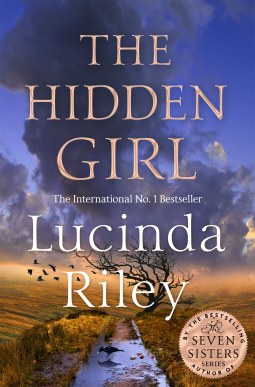
The Hidden Girl by Lucinda Riley

When Lucinda Riley died in 2021, it seemed that there would be no new books from her, but since then her son Harry Whittaker has completed her final, unfinished Seven Sisters novel, Atlas, and now has reworked one of her earliest novels which was originally published as Hidden Beauty in 1993 under the name of Lucinda Edmonds. Retitled The Hidden Girl, it’s not clear exactly how much input Harry has had, but he states in the foreword that he has ‘refreshed and updated the text’.

After a brief prologue, we meet our heroine Leah Thompson as a shy teenage girl living with her parents in 1970s Yorkshire. Leah has no big plans for the future – her time is filled with schoolwork and assisting her mother with her job as housekeeper at the big farmhouse owned by Rose Delancey – and she doesn’t consider herself to be anything special. She does have natural beauty, but is overshadowed by more confident girls, like Mrs Delancey’s adopted daughter, Miranda. Yet it’s Leah, not Miranda, who is spotted by a London modelling agency and within a few years has become one of the world’s top models.

In a second timeline, we join the young Rose – or Rosa as she was previously known – and her brother David, who are children in Poland during the Second World War. Rose and David are from a Jewish family and like many Polish Jews they experience some terrible things and are very lucky to survive the war. Some of the tension is lost because we already know that Rose and David are still alive in the late 1970s – we meet Rose in the very first chapter, a semi-retired artist living in Yorkshire with Miranda and her older son, Miles, and we learn that David is a wealthy businessman and a widower with a teenage son, Brett. However, it’s still harrowing to read about the things they had to go through before reaching a more settled status in life.

Although the wartime narrative does have relevance to the lives of the younger generation – in ways that they themselves don’t understand until much later – most of the novel is devoted to the ‘present day’ storyline (the 70s and 80s). At first I thought it was going to be a bit of a shallow story about celebrities leading glamorous lifestyles, but I soon discovered there was more depth to it than that. Riley explores the dark side of stardom and the fashion industry, including the temptations of drugs and alcohol, the pressure to succeed, the internal rivalries and competitiveness, and the men who just want to take advantage of beautiful young women. Some of the things that happen to Leah’s friend, Jenny, in particular, are horrible and I think anyone who picks up this book expecting a light read may be surprised by the topics it covers.

This is actually the third Lucinda Edmonds book to be reissued under a new title, after The Italian Girl and The Love Letter, but those two were rewritten by Lucinda herself and published during her lifetime. I wonder whether any of her other Edmonds novels will be reworked by Harry now as well – or whether he’ll decide to write a book of his own.

Thanks to Pan Macmillan for providing a copy of this book for review via NetGalley.

Top Ten Tuesday: Destination Titles

This week’s topic for Top Ten Tuesday (hosted by That Artsy Reader Girl) is: “Destination Titles (titles with name of places in them. These places can be real or fictional).”

Here are ten books with real cities, countries or islands in the title. These are all books that I’ve read and reviewed on my blog. I would have liked to have been able to represent all of the continents but I couldn’t quite manage it – I had plenty of titles with European destinations to choose from, but not as many for other parts of the world.

1. A Gentleman in Moscow by Amor Towles

2. The Lost Book of Salem by Katherine Howe

3. China by Edward Rutherfurd

4. To Calais, in Ordinary Time by James Meek

5. Death in Zanzibar by M.M. Kaye

6. The Enchantress of Florence by Salman Rushdie

7. The Mauritius Command by Patrick O’Brian

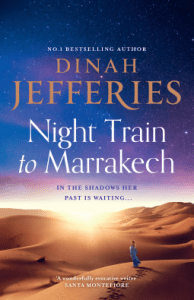
8. Night Train to Marrakech by Dinah Jefferies

9. The Glassblower of Murano by Marina Fiorato

10. Alone in Berlin by Hans Fallada

~

Have you read any of these? What other books with destination titles can you think of?

Nonfiction November: Week 3 – Book Pairings

Here’s this week’s topic for Nonfiction November:

Week 3 (11/11-11/15) Book Pairings: This week, pair up a nonfiction book with a fiction title. Maybe it’s a historical novel and the real history in a nonfiction version, or a memoir and a novel, or a fiction book you’ve read and you would like recommendations for background reading. Or two books on two different areas have chimed and have a link. You can be as creative as you like! (hosted by Liz at Adventures in Reading, Running and Working from Home).

The nonfiction title:

The Haunting of Alma Fielding by Kate Summerscale

Because I’m currently reading Kate Summerscale’s new book, The Peepshow, I decided to focus on her previous book, The Haunting of Alma Fielding, which was published in 2020. Here’s how I described the book in my review:

Like Summerscale’s others, this is a non-fiction book based on a true story, in this case the story of an ordinary thirty-four-year-old woman, Alma Fielding, who becomes the centre of paranormal activity in her London home. The book follows Nandor Fodor of the International Institute for Psychical Research as he investigates Alma’s claims, desperately hoping that this time – after being disappointed by a long line of frauds – he has finally come across a genuine haunting.

At first, having witnessed for himself the smashed glasses, spinning teacups, moving furniture and broken eggs, Fodor is convinced that a poltergeist is at work in the Fielding household. The more he learns about Alma’s abilities, which include producing live animals out of thin air and transporting herself from one area of London to another, the more intrigued he becomes…until, eventually, he begins to have doubts. Is this a real paranormal phenomenon he is investigating or is Alma haunted by something very different?

The fiction titles:

I couldn’t decide on just one book to pair with the Kate Summerscale, so I’ve picked three of them:

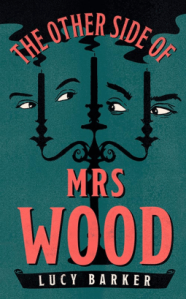
The Other Side of Mrs Wood by Lucy Barker is set in Victorian London and is the story of a fraudulent but successful medium who, like Alma Fielding, is able to ‘apport’ (transport by spiritual means) herself and other objects.

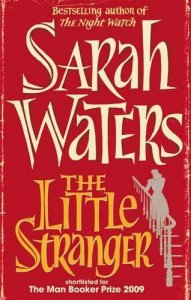
The Little Stranger by Sarah Waters also features a house – Hundreds Hall in Warwickshire – that appears to be haunted by a poltergeist. Is the ghost real or is there a more rational explanation?

In Spitting Gold by Carmella Lowkis, two sisters in 19th century Paris trick grieving victims out of their money by convincing them they are being haunted by departed family members – and then promising to lay the ghosts to rest.

~

Have you read any of these books? What else would you pair with The Haunting of Alma Fielding?

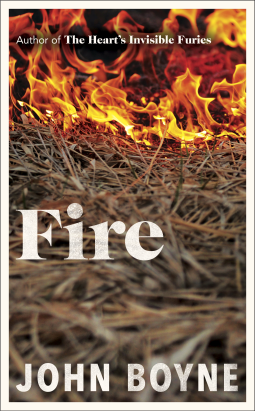
Fire by John Boyne – #NovNov24

This is the third book in John Boyne’s Elements quartet and it’s the darkest and most powerful so far. Each book can be read as a standalone story, but if you’ve read the previous two – Water and Earth – you’ll see some links between the characters and plots. I would still recommend reading them in order if possible, although it’s not essential.

Fire, like the other books, is novella-length – in this case 163 pages – but as usual, Boyne manages to pack a huge amount into those pages, more than you would often find in a much longer novel. Our narrator this time is Freya Petrus, a renowned surgeon who works with burns and skin grafts. She’s only in her thirties but has already established herself as one of the best in her field. What Freya gets up to in her private life, however, is much less admirable…in fact, it’s horrible. To understand what has made her the person she is – both the good side and the bad – we have to go back to Freya’s childhood and witness the traumatic experiences that shaped her future.

It’s difficult to really discuss the issues a book like this raises without spoiling things, so I’ll just say that what Freya experiences as a child leaves her badly damaged and, in her mind, justifies the harm she does to other people as an adult. I did have some sympathy for the young Freya, but that was surpassed by the loathing I felt for the older Freya. John Boyne is never afraid to tackle unpleasant and controversial subjects in his books, but the things Freya does are particularly shocking and I found it a very uncomfortable book to read. It’s also fascinating and completely gripping, so I do recommend it as long as you’re prepared!

As with the themes of water and earth in the previous two books, the element of fire plays a part in this one in several different ways: not only does Freya work with victims of fire, it could be said that she’s also playing with fire in her personal life. Other important themes running through the story include the question of nature versus nurture and which has the biggest role in forming our character, the level of responsibility each of us has to do what we know is right, and the different expectations society has of men and women. It’s a book that leaves you with a lot to think about after reaching the final page.

Although each book in this quartet does work on its own, a minor character from each one becomes the main protagonist of the next. It seems that Aaron, who works with Freya at the hospital, is going to be the star of the final book, Air. It will be published in May 2025 and I’m looking forward to seeing how Boyne brings the series to an end.

Thanks to Doubleday for providing a copy of this book for review via NetGalley.

I’m counting this book towards Novellas in November, hosted by Cathy of 746 Books and Rebecca of Bookish Beck